What this article answers
- The basics of heat control for Chinese stir-fries
- Heat a carbon-steel wok to about 250°C and stir-fry 150–200 g per batch
- Why stir-fries come out watery at home
- A home burner has under a quarter of a restaurant burner's power, so the cooking time stretches
- Oil temperature for passing through oil (velveting in oil)
- 130–150°C
- Tossing the wok on a home stove
- It does not raise the wok's temperature
- Keeping a clear stock from turning cloudy
- Don't let it boil. Keep the surface barely trembling
You make twice-cooked pork (hui guo rou) at home, and juice from the cabbage pools on the plate. The recipe said “high heat, cook fast.” You turned the burner all the way up, and it still isn’t what a restaurant serves.
This article gives the temperatures Chinese cooks aim for in stir-frying, passing through oil, and soup. It also gives the batch sizes that get a home stove closer.
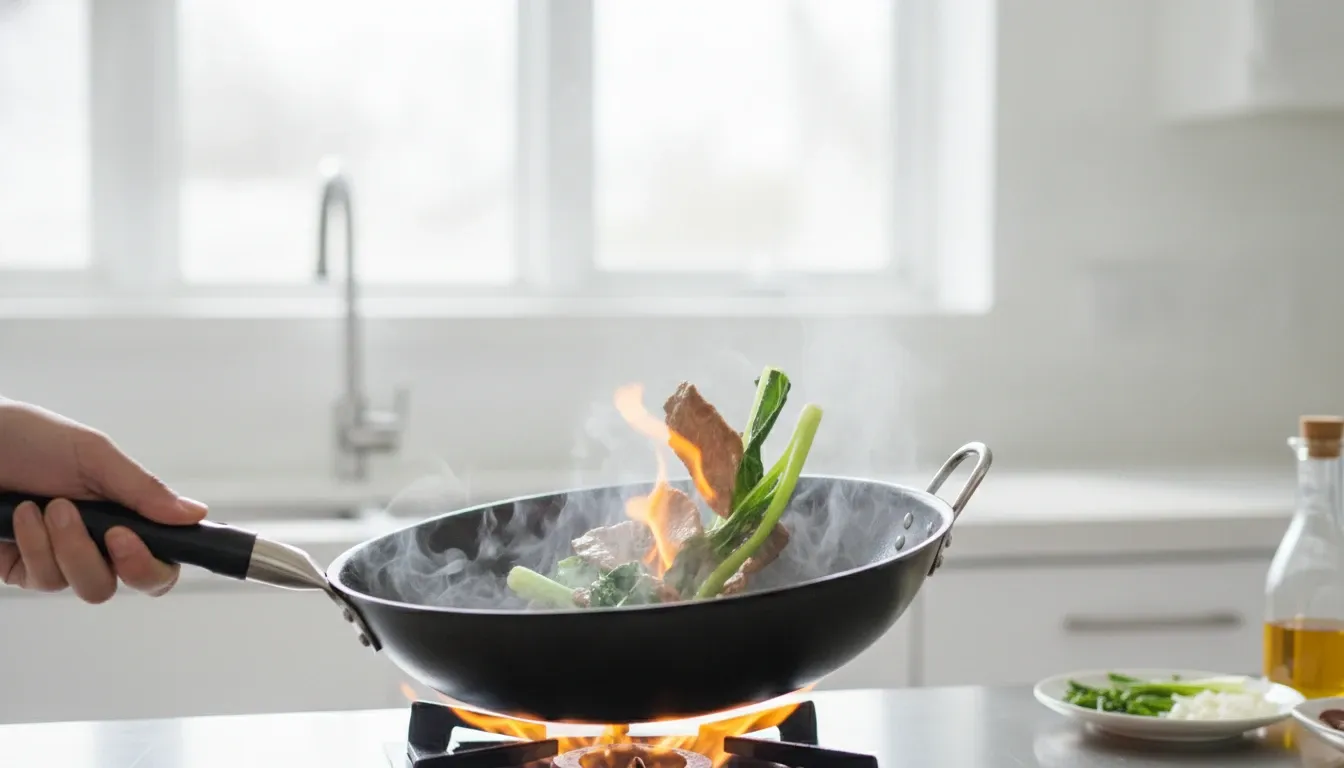
The short answer: in Chinese cooking, high heat means the temperature of the wok, not the size of the flame. Heat a carbon-steel wok to about 250°C (482°F) before the food goes in. Then win back, quickly, the heat the food takes away. A home burner lacks the power, so cut each stir-fry batch to 150–200 g.
Judge heat by pan, oil and soup temperature
The temperature to aim for in each job
| Job | What you measure | Target (°C) | The sign it’s there |
|---|---|---|---|
| Stir-frying | The empty carbon-steel wok, before food goes in | About 250 | A drop of water beads up and rolls across the wok (above about 200°C) |
| Passing through oil | The oil | 130–150 | Dense bubbles start around a dry chopstick |
| Clear stock (qing tang) | The stock | 94 | The surface barely trembles |
| White stock (bai tang) | The stock | About 100 | A steady boil |
Sources: the 250°C for stir-frying is from Mochinaga and Kawamura (2001), who heated an oiled iron pan to 250°C. The oil temperature is from the Japan Meat Information Service Center. The 94°C (201°F) for clear stock is from Kawamura and Inomata (1977), the condition they used to make a clear chicken-bone stock.
Passing through oil (guo you) means cooking cut ingredients, often meat, briefly in warm oil before the stir-fry. It is the oil version of velveting.
On a home stove, stir-fry 150–200 g per batch, enough for 1½ to 2 people. With 200 g of bean sprouts, that takes 60–90 seconds. The batch size is from the Japan Meat Information Service Center; the time is from the Mochinaga and Kawamura (2001) experiment.
Flame names only hint at strength
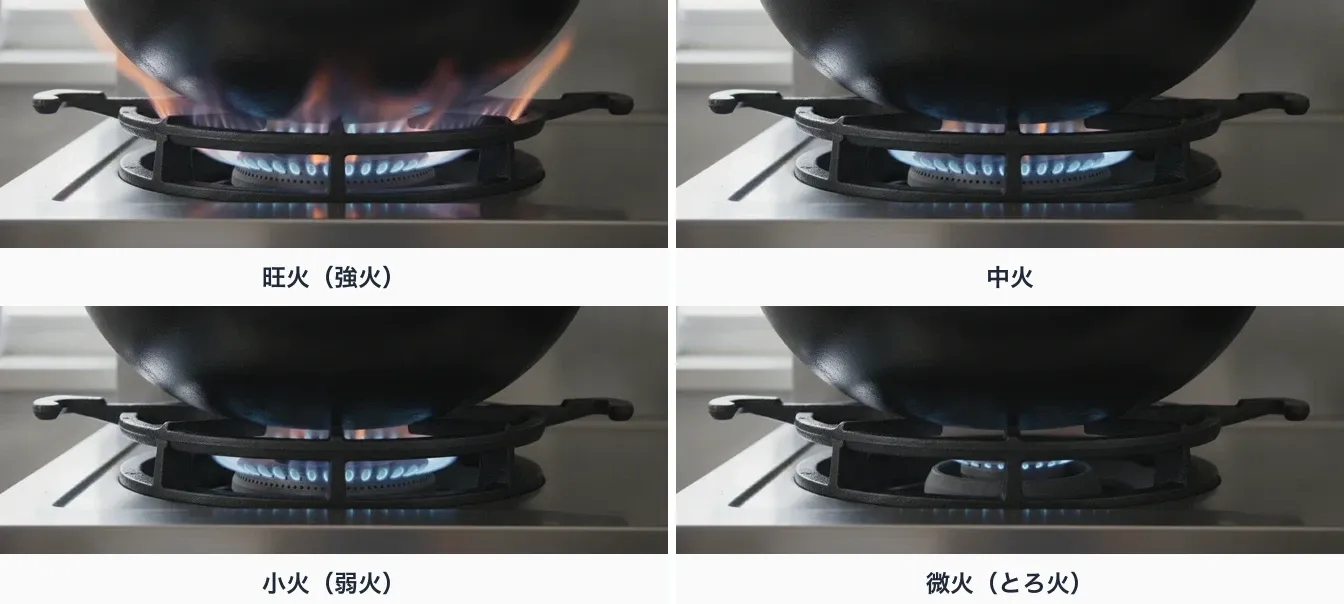
Chinese cooks name four strengths of fire: wang huo (high, called da huo in everyday speech), zhong huo (medium), xiao huo (low), and wei huo (the lowest). Recipes and books don’t all use the same names.
A Chinese cooking association explains that high heat is for stir-fries, medium heat for braising and for meat dishes, low heat for stewing, and the lowest heat for keeping food warm.
The size of a flame depends on the stove. On wang huo, a restaurant burner puts more than 4 times as much heat into the wok as a home burner. The same name does not give the same wok temperature. That is why this article works in temperatures.
Where the temperatures come from
The stir-fry numbers come from measurements in Japanese cooking-science studies. The oil numbers come from cheng, the scale Chinese cooks use for oil heat. The first were measured with instruments; the second is a rule of thumb in place of a thermometer. They are not equally precise.
During the stir-fry, about 140°C in a pro wok, 95°C at home
| What was measured | Professional (commercial Chinese range, 36 cm / 14 in iron wok) | Home (home stove, 26 cm / 10 in nonstick frying pan) |
|---|---|---|
| Wok temperature (as the cabbage goes in → at the finish) | 118.5°C → 140.5°C | 79°C → 95°C |
| Food temperature (going in → at the finish) | 53°C → 81.5°C | 52.5°C → 77°C |
| From adding the cabbage to the finish | 37.5 seconds | 50 seconds |
| Number of tosses (shaking the wok to turn the food) | 21 | 8 |
Source: Kawasaki et al. (2009). The head chef of a Sichuan restaurant and a home cook made twice-cooked pork from the same ingredients (including 300 g of cabbage). A thermal camera measured the surface temperatures of the pan and the food.
The commercial burner was rated at 22,000 kcal/h (about 25.6 kW), the home stove at 5,700 kcal/h (about 6.6 kW). The paper does not say whether the home figure is for the whole stove or a single burner.
Even the professional’s wok was at 118°C (244°F) as the cabbage went in. The paper does not give its temperature before that.
Put 200 g of bean sprouts into an iron pan at 250°C (482°F), and the pan bottom drops to 130°C (266°F). You preheat to 250°C because the pan loses more than 100°C the moment the food goes in.
Oil heat is counted in cheng, in three bands
| Oil heat name | Approximate oil temperature (°C) |
|---|---|
| San si cheng (“3–4 cheng”) | 85–120 |
| Wu liu cheng (“5–6 cheng”) | 120–180 |
| Qi ba cheng (“7–8 cheng”) | 180–240 |
Source: People’s Daily Online / Life Times (2016). Other Chinese sources put san si cheng at 90–130°C (194–266°F), and qi ba cheng at 170–230°C (338–446°F) or 210–240°C (410–464°F). The same name can be 20–30°C apart.
Cheng (成) counts oil heat in tenths, on a 10-step scale; a bigger number means hotter oil. Chinese cookbooks say things like “fry in wu liu cheng oil,” so you can read them through these three bands. The 130–150°C (266–302°F) for passing through oil sits at the low end of wu liu cheng.
Burner power, batch size, and whether soup boils
The heat going into a wok depends on the burner’s power. The heat taken out depends on how much food you add. Soup is different: its temperature tops out at the boiling point, so the only question is whether it boils.
A home burner has under a quarter of the power
| Burner | Power per burner (gas consumption, kW) |
|---|---|
| Japanese home gas hob, standard burner | 2.97 |
| Japanese home gas hob, high-power burner | 4.20 |
| Japan’s legal limit for home gas hobs | 5.8 |
| Commercial Chinese range, stir-fry burner | 23.3 |
| Commercial Chinese range, turbo burner | 46.5 |
Sources: home figures from Rinnai’s 2026 catalog (natural gas), commercial figures from Tanico’s catalog. In Japan, home gas hobs are limited to 5.8 kW per burner.
The commercial stir-fry burner has about 5.5 times the power of the home high-power burner, and the turbo burner about 11 times. Even at the 5.8 kW limit, a home burner has under a quarter of a commercial one.
US ranges rate burners in BTU per hour instead. 1 kW is about 3,412 BTU/h, so 5.8 kW is about 19,800 BTU/h and the stir-fry burner about 79,500 BTU/h.
Japanese home induction hobs top out at around 3.0 kW. But electric output and gas consumption deliver heat differently, so the two numbers cannot be compared directly.
Make up for low power with smaller batches
On a home stove, stir-fry no more than 150–200 g at a time, enough for 1½ to 2 people. For 4 servings, cook 2 batches. The more food you add, the deeper the wok’s temperature drops, and the longer it likely takes to recover.
In the experiment with 200 g of bean sprouts, 30 seconds brought the food only to about 60°C (140°F), and raw patches remained. At 120 seconds, some sprouts had scorched. The 60–90 seconds in between is the target. Move them to the plate before juice shows on the wok bottom.
Pros and home cooks finish at 80°C, at different speeds
In Kawasaki’s measurements, the finishing temperature of the food barely differed. What differed was the time to get there: 37.5 seconds for the professional, 50 seconds at home.
Those 12.5 seconds change how much the cabbage breaks down. In the professional’s cabbage, only the outer 2–4 layers of cells had broken. In the home cook’s, 4–6 layers or more had broken. Broken cells leak water, which is why home stir-fries leave juice on the plate.
For clear stock don’t boil, for white stock keep boiling
When stock boils, the bubbles and currents break the fat into tiny droplets. Proteins dissolved from the bones and meat coat those droplets and keep them spread through the water. The fine droplets scatter light, so the stock turns cloudy white.
White stock (bai tang) aims for that cloudiness and keeps boiling. A Chinese source says to bring it to a boil on high, then simmer it on medium for 2–3 hours.
For clear stock (qing tang), turn the heat down once it boils. Hold it just below boiling, with the surface barely trembling.
Why restaurant numbers don’t transfer home
Tossing the wok on a home stove doesn’t heat it
Each toss raised the wok’s temperature by 6.53°C for the professional and 1.45°C for the home cook. The 1.45°C is too small to count as a real difference between before and after.
The researchers suggest the professional’s strong burner puts more heat into the wok. The mechanism is not yet known.
Even the professional does not lift the wok off the fire. This wok toss is called da fan shao in Chinese cooking.
A study that filmed chefs tossing fried rice found that the wok stays against the edge of the stove. It slides back and forth on a cycle of about 0.3 seconds. On a home stove, leave the pan on the grate and turn the food with a spatula.
Iron-wok numbers don’t apply to induction or nonstick
Induction stops heating when the pan bottom leaves the glass. Every toss cuts the heat, so on induction, keep the pan on the glass and turn the food in place.
On any flat electric or induction hob, a flat-bottomed wok keeps the whole base in contact with the heat.
The 250°C (482°F) preheat was measured in an oiled iron pan. Makers of nonstick frying pans forbid heating them empty and warn to use medium heat or lower. In a nonstick pan, add the oil first, heat it over medium, and don’t take it to 250°C.
Cheng and wok hei can’t be pinned to numbers
The cheng temperatures differ by 20–30°C between sources, so they cannot replace a thermometer. The top of qi ba cheng, 240°C (464°F), reaches the point where refined vegetable oil starts to smoke.
The toasty aroma of a restaurant stir-fry is called wok hei. No study we found has measured wok temperature to confirm it. What a home stove can match is the preheating and the batch size.
Reading temperature without a thermometer
Read the wok with a drop of water
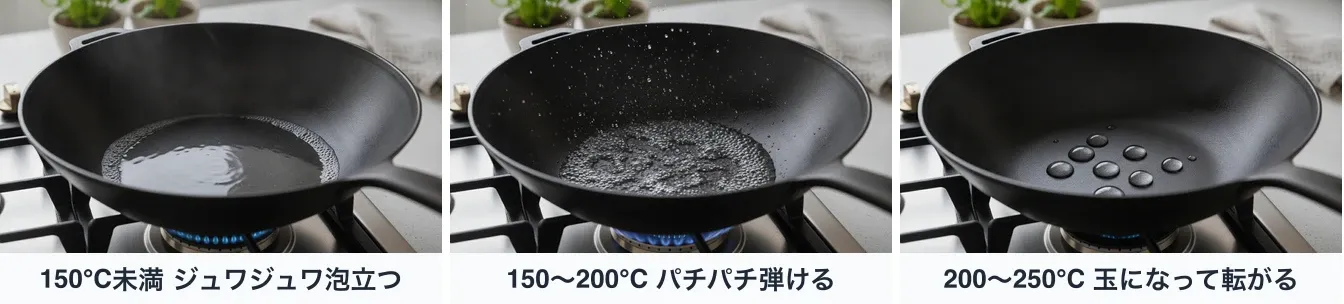
Drop a few drops of water into the hot wok. If the water spreads and sizzles into bubbles, the wok is still below 150°C (302°F). If the drops crackle and vanish at once, it is at 150–200°C (302–392°F).
Once the drops bead up and roll across the metal, the wok is above about 200°C (392°F). Add the stir-fry ingredients only after the drops roll. The 250°C figure is from an experiment with an oiled iron pan, and a water drop cannot tell you exactly 250°C.
If juice starts to show on the wok bottom mid-stir-fry, the batch is too big for the heat. Next time, cook less at once.
Read the oil with a dry chopstick and the surface
| Oil heat name | Oil surface | A dry chopstick dipped in |
|---|---|---|
| San si cheng | Still | A few fine bubbles around the chopstick |
| Wu liu cheng | Moves from the edge toward the center | Dense bubbles |
| Qi ba cheng | The movement settles | Lots of bubbles, crackling loudly |
Sources: People’s Daily Online / Life Times (2016), and other Chinese cooking guides.
Chinese sources say thin smoke rises at wu liu cheng, and plenty of smoke at qi ba cheng. But refined oils don’t smoke until much hotter: soybean oil at 226–242°C (439–468°F), rapeseed oil at 218–232°C (424–450°F). So smoke is no use as a signal. Old frying oil and less refined oil smoke at lower temperatures.
At 130–150°C (266–302°F), the range for passing through oil, there is no smoke yet. The bubbles around the chopstick are just turning dense.
Read the stock by its surface
Keep clear stock so the surface barely trembles, with a small bubble rising now and then. If bubbles rise steadily from the edge and the surface starts to roll, it is close to boiling, so turn the heat down.
Common failures and fixes
A watery stir-fry can be saved. A cloudy stock cannot be made clear again.
| Problem | Cause | Fix it now | Prevent it next time |
|---|---|---|---|
| The stir-fry is watery | There was too little heat for the amount of food, so the cooking time stretched. Meanwhile the vegetable cells broke down deep inside and released water | Take the food out onto a plate. Reheat the empty wok on high, then return the food in two halves and stir-fry again | On a home stove, cook no more than 150–200 g at a time, and add the food only once a drop of water beads up and rolls |
| The clear stock turned cloudy | Boiling bubbles and currents broke the fat into tiny droplets, and proteins in the stock coated them and spread them through it. The fine droplets scatter light and look white | The cloudiness won’t go away. Use it as white stock, or make fresh stock for the part you want clear | Once it boils, turn the heat down and keep the surface barely trembling |
Sources
- Kawasaki, H., Akagi, Y., Kasamatsu, C. & Aoki, Y. (2009). The effect of the chef's tossing of the wok on ingredient and wok temperatures in Chinese stir-frying. Journal of Cookery Science of Japan 42(5) 334-341. On wok and ingredient temperatures, time and number of tosses for a professional and a home cook (in Japanese)
- Mochinaga, H. & Kawamura, F. (2001). Effects of stir-frying methods on the quality of stir-fried bean sprouts. Journal of Cookery Science of Japan 34(4) 390-395. On the drop in pan temperature when bean sprouts go in, and stir-frying time (in Japanese)
- Ko, H. & Hu, D. L. (2020). The physics of tossing fried rice. Journal of the Royal Society Interface 17(163). On the tossing cycle, and keeping the wok on the stove
Show 10 more
- Rinnai. Built-in series (replacement models) general catalog 2026. On burner gas consumption of home gas hobs and Japan's 5.8 kW per-burner limit (in Japanese)
- Tanico general catalog. Chinese ranges. On burner gas consumption of commercial Chinese ranges (in Japanese)
- Japan Meat Information Service Center. Stir-frying meat: heat and method. On batch size and oil temperature for passing through oil (in Japanese)
- People's Daily Online / Life Times (2016). How to judge oil temperature in cheng. On the temperatures of san si cheng, wu liu cheng and qi ba cheng, and reading smoke and the oil surface (in Chinese)
- Kawamura, F. & Inomata, M. (1977). The effect of vegetables on the clarity and taste of soup. Journal of Home Economics of Japan 28(8). On heating conditions for a clear stock (in Japanese)
- World Association of Chinese Cuisine. The Importance of Cooking Temperature and Time (Google Arts & Culture). On how high, medium, low and slight heat look, and what each is used for
- Kepu China (2019). How is milky white soup made? On how boiling turns stock white, and the heat for a white stock (in Chinese)
- The Woks of Life. What is the best wok to buy? (flat-bottomed woks on electric ranges)
- Sohu / Tai'an Meishike (2020). Using heat in stir-frying: wang huo, zhong huo, xiao huo, wei huo. On wang huo being the everyday da huo (in Chinese)
- CaptiveAire. kW to BTU conversion (1 kW is about 3,412 BTU per hour)