What this article answers
- What shu you is
- Heating oil to 190–200°C (374–392°F) to drive off impurities and grassy smells before you cook with it
- How to tell the oil is ready without a thermometer
- The whole surface shimmers and a faint wisp of smoke appears. Hold it there 30 seconds to 1 minute
- Which oils gain the most
- Refined rapeseed (canola) and soybean oil. Skip it for toasted sesame oil, which loses its aroma
- The oil is smoking heavily
- At 220°C (428°F) or above it has gone too far. Turn the heat down or off
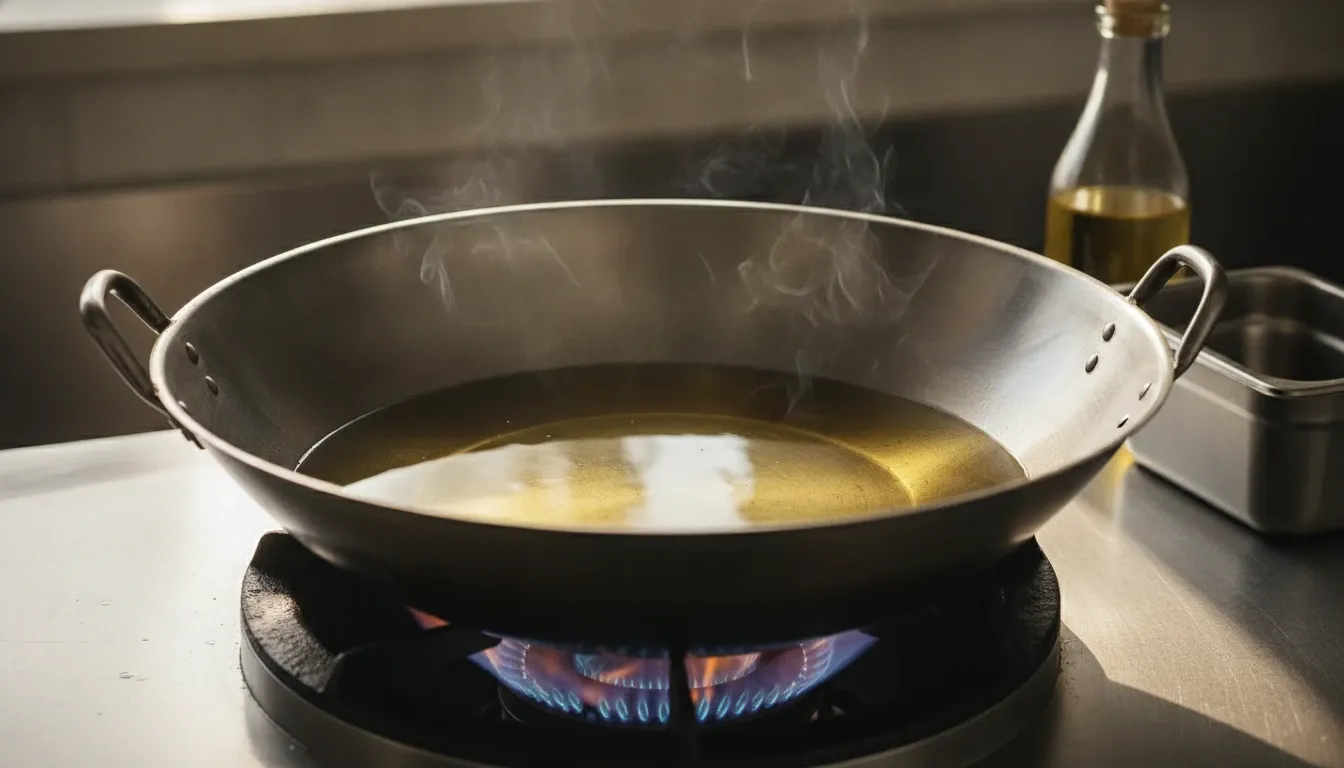
In Chinese cooking, oil almost never goes straight from the bottle into the dish. For a stir-fry, for deep-frying, or for a flavored oil, it is first heated hot to drive off impurities and grassy smells.
This step is called shu you (熟油, “cooked oil”). It turns raw oil into cooked oil. It is a plain step, but much of the clean taste of Chinese food rests on it.
Raw oil vs. cooked oil
Chinese cooks separate oil that has not been heat-treated, sheng you (“raw oil”), from oil cleaned up by high heat, shu you.
| Sheng you (unheated) | Shu you (heated) | |
|---|---|---|
| Aroma | Grassy notes from the raw material | Clean, with no off-flavors |
| Color | Slightly cloudy | Very clear |
| Viscosity | Somewhat heavy | Light and thin |
| Effect on flavor | Muddies the flavors of other ingredients | Brings out the aromas of ingredients and spices |
The difference sounds small, but it shows clearly in the finished dish. It is most obvious where the oil itself is the seasoning, as in chili oil or scallion oil.
Why oil needs shu you
Vegetable oils carry trace compounds that refining does not fully remove. They are what make oil smell raw.
The compounds shu you removes
| Compound | Effect | Temperature at which it leaves |
|---|---|---|
| Free fatty acids | Cause oxidized, stale-oil smells | Start to evaporate at 150–180°C (302–356°F) |
| Low-molecular-weight aldehydes | Grassy, green smells | Evaporate at 100–150°C (212–302°F) |
| Phospholipids | Cause cloudiness and foaming | Break down at 180–200°C (356–392°F) |
| Pigments (chlorophyll, etc.) | A greenish tint | Break down and fade at high heat |
Heat the oil to 190–200°C (374–392°F), and these impurities evaporate or break down. What remains is a clean oil with no off-flavors.
How to make shu you
The basic steps
- Put the amount of oil you need in the wok
- Heat over medium. Don’t rush; bring the temperature up slowly
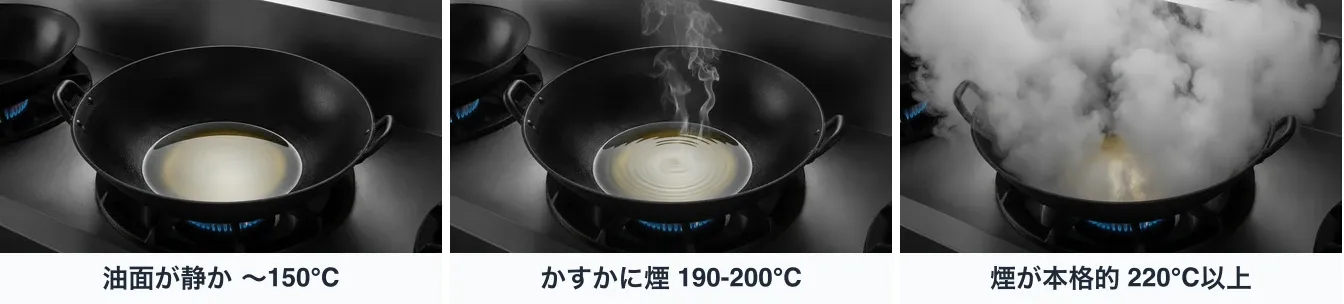
- Bring it to 190–200°C (374–392°F), when the surface shimmers and a faint wisp of smoke appears
- Hold it there for 30 seconds to 1 minute, so the impurities fully evaporate
- Turn off the heat, and let it cool on its own to the temperature the next step needs
On a flat electric or induction hob, use a flat-bottomed wok so the whole base sits on the heat.
Reading the heat from the surface and smoke
| What you see | Approximate temperature | What it means |
|---|---|---|
| The surface is still | Up to 150°C (302°F) | Not there yet |
| Fine ripples appear | 150–170°C (302–338°F) | Almost |
| The whole surface shimmers | 180–190°C (356–374°F) | Nearly there |
| A faint wisp of smoke | 190–200°C (374–392°F) | This is the target |
| Smoke pours off | 220°C (428°F) and above | Too far. Turn the heat down or off |
A thermometer makes it certain, but professional Chinese cooks go by the surface and the smoke.
You can also dip in the dry handle of a wooden spoon, or a wooden chopstick. Large bubbles streaming hard off the whole length mean about 180–190°C (356–374°F). While only small bubbles rise quietly, the oil is still in the 170s°C (338–354°F).
Heating with scallion and ginger
A common variation heats the oil with scallion and ginger instead of on its own.
- Put the oil in the wok and add the green parts of scallions and slices of ginger
- Heat slowly over low to medium heat
- When the scallion and ginger turn golden brown, take them out
- Keep heating up to the target temperature
Scallion and ginger absorb the oil’s raw smell. At the same time, they give it a faint sweetness and aroma, for a shu you with more depth.
In chili oil recipes, heating the aromatics before the spices doubles as this shu you step.
Which oils gain from shu you
How much an oil needs shu you, and how much it gains, depends on the oil.
| Oil | Smoke point | Character of the raw oil | Effect of shu you |
|---|---|---|---|
| Rapeseed oil | About 240°C (464°F) | Faintly grassy | Large. Becomes clean and clear |
| Peanut oil | About 230°C (446°F) | Nutty aroma | Moderate. The aroma turns milder |
| Soybean oil | About 230°C (446°F) | A beany smell | Large. The beany smell goes, and it becomes easy to use |
| Rice bran oil | About 230°C (446°F) | Nearly odorless | Small. Already clean |
| Untoasted sesame oil | About 210–230°C (410–446°F) | Nearly odorless, with body | Small, but it becomes more stable |
| Toasted sesame oil | About 177°C (351°F) | Strongly roasted | Skip it. The aroma is lost |
Rapeseed oil here means the refined kind, sold in North America as canola oil. Cold-pressed rapeseed oil is another product: dark golden, mustardy, and bought for its flavor.
Some oils are prized for their aroma, like toasted sesame oil. Put them through shu you, and they lose what makes them worth buying. Add them in small amounts at the end instead.
Where Chinese cooks use shu you
Shu you underlies almost every part of Chinese cooking.
1. The base for flavored oils
Chili oil, scallion oil, Sichuan pepper oil: every flavored oil starts with shu you. Add spices to raw oil, and its off-flavors muddy them.
Some chili oil recipes pour the hot oil in three stages. One step heats the oil to nearly 200°C (392°F) after the spices have flavored it, and that step doubles as shu you.
2. Conditioning the wok for stir-fries
For a Chinese stir-fry, the wok is heated until it smokes, then oil goes in and is swirled all over. This is qiang guo, conditioning the wok. The oil hits a high temperature for a moment, with the same effect as shu you.
Professional kitchens make a large batch of shu you ahead of time and take what they need from it.
3. Deep-frying
In Chinese deep-frying, the oil is sometimes brought to nearly 200°C (392°F) once, then lowered to the frying temperature. This uses the same principle. Oil that has been through high heat once foams less and fries crisper.
4. Ming you, the finishing oil
Ming you is a little oil poured over a dish as it is finished. If that oil smells raw, it spoils the whole dish. This is where you can taste shu you most clearly.
Common failures and fixes
A burnt smell cannot be fixed, a grassy smell and foaming can be fully fixed, and darkened oil can be only partly saved.
| Problem | Cause | Fix it now | Prevent it next time |
|---|---|---|---|
| The oil smells burnt | It went past its smoke point, the oil broke down, and acrid compounds such as acrolein formed | The smell will not go away. Throw it out and start again with fresh oil | Know the smoke point of each oil, and turn off the heat as soon as smoke really starts to pour off |
| The oil smells grassy | It never got hot enough, so the compounds behind the grassy smell, such as hexanal, did not evaporate | Raise it to 190°C (374°F) or above to drive them off, then let it cool | Check the shimmer and the smoke to confirm it has reached 190°C (374°F) or above |
| The oil foams | Water got into the oil and is boiling, so steam bubbles keep rising to the surface | Turn off the heat and let the water cook off. It will spatter, so shield yourself with a lid | Wipe the wok and tools completely dry before adding the oil |
| The oil has darkened | It was heated too long, so oxidation and polymerization formed colored compounds | The color will not come back. If the flavor has suffered, start again | Stop 30 seconds to 1 minute after reaching 200°C (392°F); do not hold it there for long |
Stop at a faint wisp of smoke
Shu you is the basic technique behind the clean taste of Chinese food.
Three things to remember
- Heat to 190–200°C (374–392°F), the range where impurities and grassy smells evaporate
- Stay under the smoke point. Don’t break down the oil itself; aim for a faint wisp of smoke
- Start every flavored oil here. Chili oil and scallion oil both begin with shu you
It is a plain step, but it decides how clean a dish tastes.
Sources
- Dunlop, Fuchsia. (2003). Land of Plenty: A Treasury of Authentic Sichuan Cooking (US edition of Sichuan Cookery, 2001). On handling oil in Chinese cooking and the tradition of shu you
- McGee, Harold. (2004). On Food and Cooking. On the chemical changes in fats and oils when heated
- Canola Council of Canada. Canola oil (canola as a low-erucic-acid rapeseed)