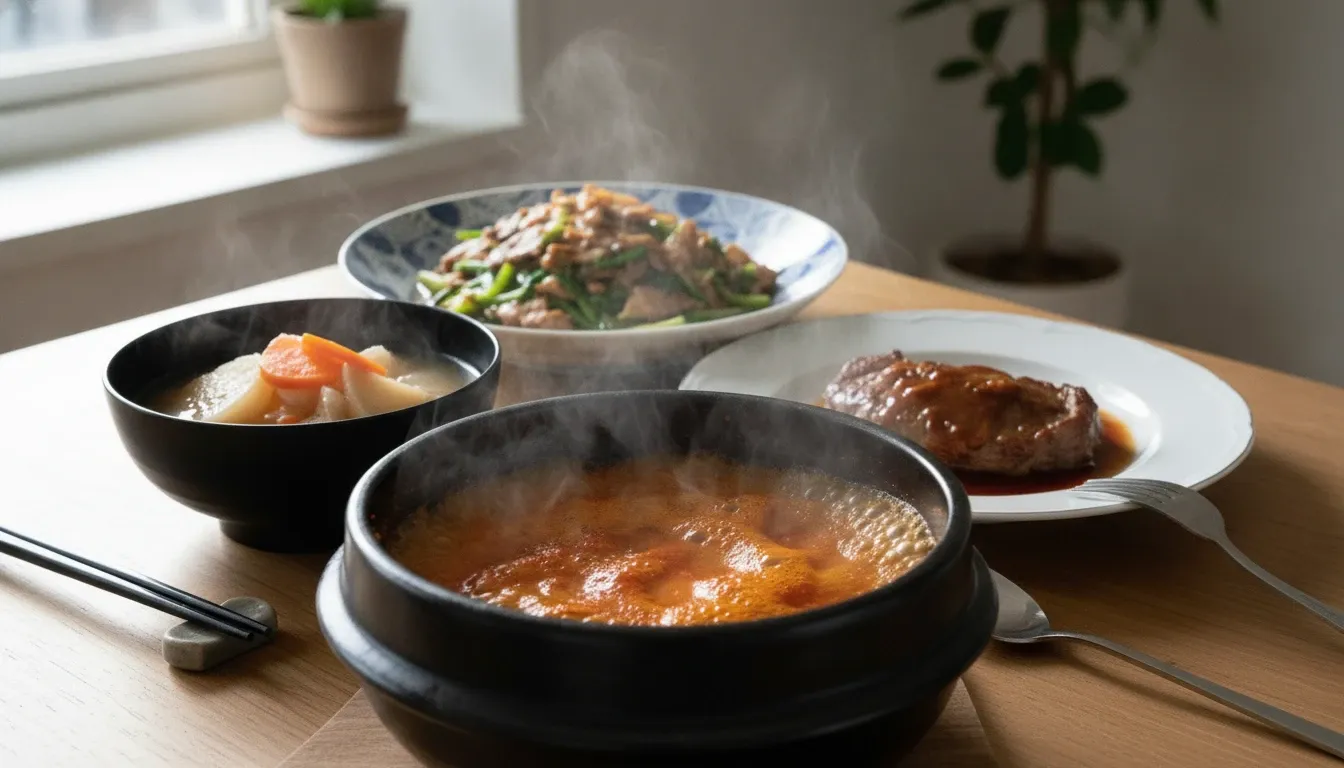
What this article answers
- How to judge the heat level
- Japanese cooks read the flame. With no flame (electric, induction), read the pot: a tremble, small bubbles, a full boil
- French simmering terms by temperature
- Frémissement 85°C (185°F), petits bouillons 90–95°C (194–203°F), gros bouillons 100°C (212°F)
- What the Chinese idea of huo hou means
- Heat level combined with timing: when to add ingredients and when to change the heat
- Frying temperatures across cuisines
- Tempura 160–180°C. Twice-fried: frites 140°C then 180°C, you lin ji 160°C then 200°C
Every cuisine in the world has to control heat. It is the most basic skill they share. Yet each food culture has built its own ideas, words, and techniques for it.
This article compares how five cuisines think about heat and control it, and the thinking behind each.
What heat control decides
Every cuisine cooks with fire, so every cuisine has to adjust it. How they approach it differs widely.
Heat control decides five things:
- The texture of the food (tenderness, bite)
- How much umami you draw out
- How well seasonings soak in
- How the food browns and picks up a toasty aroma
- How long it takes to cook
Each cuisine ranks these differently. That ranking is its philosophy of heat.
How each cuisine names its heat
Every cuisine has words for high, medium, and low. Some also name a level below low.
| Heat | Japanese | French | Chinese | Italian | Korean |
|---|---|---|---|---|---|
| High | Tsuyobi | Feu vif | Da huo | Fuoco alto | Senbul |
| Medium | Chubi | Feu moyen | Zhong huo | Fuoco medio | Jungbul |
| Low | Yowabi | Feu doux | Xiao huo | Fuoco basso | Yakbul |
| Lowest | Torobi | (none) | Wen huo | Fuoco lento (“slow fire”) | (none) |
The names line up. What each cuisine does with them does not.
Japanese cooking judges heat by the flame
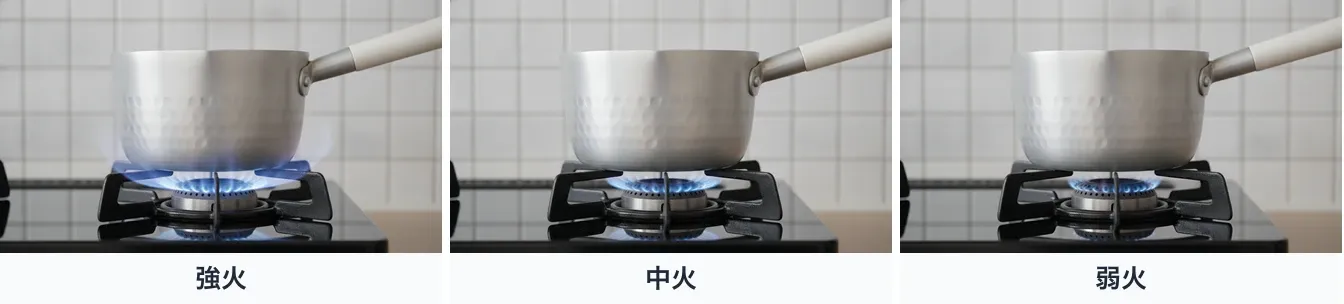
Japanese cooks read the heat level from the shape of the flame.
- Tsuyobi (high): the flame wraps the whole bottom of the pan
- Chubi (medium): the tips of the flame just touch the bottom of the pan
- Yowabi (low): a small blue flame flickers
- Torobi (lowest): the flame is barely alight
An electric or induction hob has no flame to read, so read the pot instead. A surface that barely trembles, small rising bubbles, and a full boil each mark a temperature. French cooks name all three (below). On a dial, torobi is simply the lowest setting.
Japanese cooking also has ideas of its own.
| Term | What it means |
|---|---|
| Nifukumeru | Letting flavor soak in slowly over low heat |
| Otoshibuta (drop lid) | A lid that rests on the food, keeping it from breaking apart and cooking it evenly. A circle of parchment paper cut to size does the same job |
| Stepwise adjustment | Changing the heat in steps: high, then medium, then low |
The thinking values delicacy and the natural flavor of ingredients. Slow cooking deepens flavor, and waiting is part of the craft.
French cooking names each state of the heat
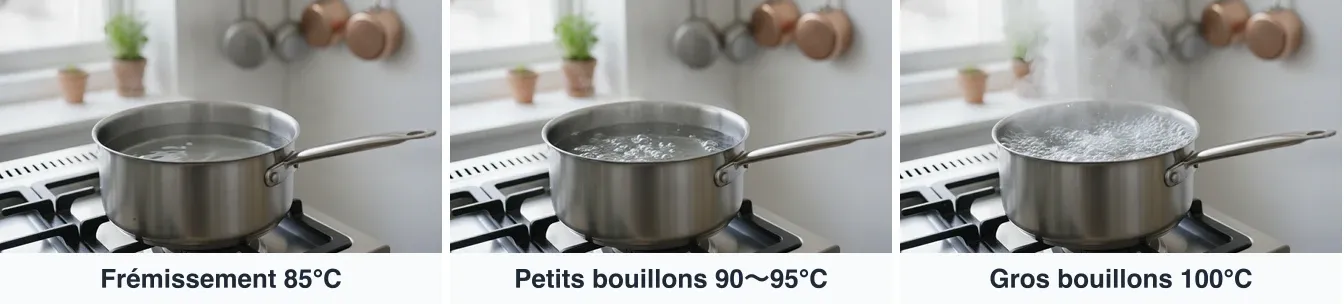
French cooking has a word for almost everything heat can do.
| Term | What it means | Temperature |
|---|---|---|
| Mijoter | Simmer slowly, below a boil | 85–95°C (185–203°F) |
| Pocher | Poach at a low temperature, without boiling | 80–85°C (176–185°F) |
| Saisir | Sear the surface over high heat | |
| Suer | Cook off moisture over low heat (literally “to make it sweat”) | |
| Blanchir | Boil briefly as preparation |
It also divides simmering by what the water looks like.
- Frémissement: the surface just trembles, 85°C (185°F)
- Petits bouillons: small bubbles rise, 90–95°C (194–203°F)
- Gros bouillons: a full boil with large bubbles, 100°C (212°F)
The French approach is scientific and precise. It shows most in sauce-making, where the cook adjusts the temperature while reading the state of the food.
Chinese cooking treats heat and timing as one
The central idea is huo hou (火候). It means heat and timing together, with the weight on timing.
| Term | What it means |
|---|---|
| Bao chao | Stir-frying everything at once over high heat |
| Hua chao | Briefly stir-frying, over high heat, ingredients already passed through oil |
| Kuai chao | Stir-frying quickly |
The cook also controls heat with the wok itself. Tossing it adjusts the heat. Lifting it off the flame or bringing it closer changes the temperature instantly.
Speed and timing come first. Quick work makes good flavor, and mastering high heat is where a cook shows skill.
Italian cooking names a “gentle fire”
Italian’s own heat words lean toward gentle, slow cooking.
| Term | What it means |
|---|---|
| A fuoco dolce | ”Over a gentle fire”: slowly, over low heat |
| Soffriggere | Frying gently over low heat to bring out aroma (as in soffritto) |
| Rosolare | Browning |
Italian cooking values simplicity and the flavor of the ingredients. Tomato sauce simmers slowly to bring out its sweetness. Heat that does not burn the olive oil matters.
Korean cooking has words for steaming in residual heat
Korean has words for residual heat and for the sounds of cooking.
| Term | What it means |
|---|---|
| Tteumdeurigi | Letting food steam in residual heat (the last step in cooking rice) |
| Bogeul-bogeul | The sound of something bubbling away as it simmers |
| Jigeul-jigeul | The sizzling sound of something grilling |
Stone-pot dishes use the heat the stone stores. Cooking through with residual heat is a defining feature.
Korean cooking simmers for a long time to draw out umami. It is skilled with residual heat, and heat control in braised and simmered dishes matters.
How each cuisine handles heat in practice
Japanese cooking adjusts in steps
Dashi shows how precisely Japanese cooking sets temperature.
| Dashi | Temperature | Why |
|---|---|---|
| Kombu dashi | 60–70°C (140–158°F) | Draws out umami. Boiling brings out off-odors |
| Katsuo dashi (bonito flakes) | 85–90°C (185–194°F), briefly | Too hot and it turns astringent |
| Awase dashi (combined) | Kombu first, then bonito flakes | The temperature rises in steps |
Nimono (simmered dishes) change the heat in four steps.
- Bring to a boil over high heat (5 minutes) to raise the scum
- Simmer over medium heat (10–15 minutes) to cook the ingredients through
- Simmer gently over low heat (15–30 minutes) to let the flavor soak in
- Turn off the heat and let it cool. Flavor soaks in most as it cools
Japanese cooking does not mind taking time. It protects the delicate flavor of ingredients. It favors doing less: no more heat than the food needs.
French cooking controls temperature precisely
Sauces need precise heat.
- Roux: cook butter and flour gently over low heat, without browning
- Déglacer: after searing meat, dissolve the browned bits in the pan with wine (medium heat)
- Réduction: boil down to concentrate (medium to high heat)
France also developed low-temperature cooking.
- Confit: cook slowly in oil at 60–80°C (140–176°F)
- Sous vide: vacuum-sealed cooking with precise temperature control
- Pocher: cook eggs or fish slowly at 80–85°C (176–185°F)
A braise (braiser) moves through three heats.
- Sear the surface over high heat (saisir)
- Add aromatic vegetables and sauté them (medium heat)
- Add liquid, cover, and braise slowly in the oven or over low heat (3–4 hours)
French cooks measure with a thermometer and have a word for each level of heat. The heat under the sauce decides the dish.
Chinese cooking wins on speed and timing
Bao chao, high-heat stir-frying, runs in five moves.
- Heat the empty wok over high heat until it smokes (200°C (392°F) or more)
- Add oil and swirl to coat the wok quickly
- Add the ingredients and stir-fry all at once (1–2 minutes)
- Add the seasonings, pulling the wok off the flame so they do not burn
- Return to high heat to finish
Huo hou is more than how strong the heat is. It includes when you add each ingredient and when you change the heat. “Good huo hou” means both the heat and the timing were right.
Moving the wok adjusts the heat.
- Lift it away from the flame to lower the temperature
- Bring it closer to raise the temperature
- Toss the food in the air to cook it evenly
On a flat electric or induction hob, cooks use a flat-bottomed wok so the whole base touches the heat. Lifting it still cools the food. On induction it does more: the heating stops the moment the pan leaves the surface.
Chinese cooking values speed, and mastering high heat is the foundation. The spirit is to finish in one go, without stopping partway.
Italian cooking keeps heat simple
Pasta follows three rules.
- Boil it in plenty of water, kept at a constant boil over high heat
- For al dente, boil 1–2 minutes less than the package says
- Finish it in the sauce over low to medium heat
Risotto changes the heat in four steps.
- Soffritto: bring out the aroma of onion and garlic over low heat
- Tostatura: toast the rice over medium heat until translucent
- Add the brodo (broth) a little at a time, keeping the heat at medium
- Mantecare: stir in butter and cheese over low heat
Tomato sauce starts hot and ends slow.
- Simmer over medium heat at first, crushing the tomatoes (10 minutes)
- Then simmer low and slow for 30 minutes to 2 hours to bring out sweetness
- Add olive oil and basil just before turning off the heat
The heat stays simple so the ingredients can speak. Cooks take care not to burn the olive oil. With pasta, finishing matters more than boiling.
Korean cooking leans on residual heat
Jjigae (stew) runs on high heat, then low.
- Bring the broth to a boil over high heat
- Once it boils, turn it down to low. Doenjang jjigae simmers 10 minutes, then 15 more after the other ingredients go in. Kimchi jjigae takes 20 minutes, then 10 more
- Keep it on low over a tabletop burner and adjust as you eat
Dolsot bibimbap (stone-pot bibimbap) is built on stored heat.
- Warm the stone pot over low heat for 5 minutes. A cold stone pot put straight over high heat cracks easily
- Coat it with sesame oil for a toasty aroma
- Add the rice and toppings. The residual heat forms a crust on the bottom
- Keep it on low heat to hold the temperature while you eat
Samgyetang (chicken and ginseng soup) is simple.
- Add the chicken and bring to a boil over high heat
- Turn it down to low, skim off the scum, and simmer for 40 minutes
Korean cooking simmers long for deep flavor. It uses the heat stored in stone and earthenware pots, and it is skilled at cooking with residual heat.
Four techniques across five cuisines
Stir-frying, from fastest to gentlest
| Food culture | Heat | Technique | Cooking time | Characteristics |
|---|---|---|---|---|
| Chinese | High | Bao chao, tossing the wok | 1–3 min | The strongest heat. Leaves no liquid behind |
| Japanese | Medium to high | Kinpira (sautéed and simmered root vegetables) and similar | 3–5 min | Weaker heat than Chinese. Turns to low when the seasonings go in |
| Italian | Medium | Soffritto | 5–10 min | Brings out aroma slowly |
| Korean | Medium to high | Stir-fry-simmer | 5–10 min | Uses more seasoning and reduces it |
| French | Medium | Sauté | 3–7 min | Sautés in butter, taking care not to burn it |
Chinese stir-frying uses the strongest heat. Western cooking puts the weight on not burning. Japanese cooking sits in between.
Simmering and braising, low and long
| Food culture | Typical dish | Heat | Time | Temperature range | Characteristics |
|---|---|---|---|---|---|
| Japanese | Nimono | High → medium → low | 30 min to 1 hr | 85–95°C (185–203°F) | Changes the heat in steps |
| French | Bœuf bourguignon | Low (mijoter) | 2–4 hr | 85–90°C (185–194°F) | Low temperature for a long time. Never boils |
| Italian | Ragù alla bolognese | Low | 2–4 hr | 80–90°C (176–194°F) | The lid is left ajar to cook off moisture |
| Korean | Samgyetang | Low | 40 min | 90–95°C (194–203°F) | Covered, slowly |
| Chinese | Hong shao rou (red-braised pork) | Low | 1–2 hr | 85–95°C (185–203°F) | Braised in a soy sauce base |
All five simmer slowly over low heat, avoid a hard boil, and use time to draw out umami.
The differences are in the details. Japanese cooking changes the heat in steps. French cooking controls temperature most strictly. Korean cooking simmers at a relatively high temperature.
Grilling and roasting, surface against inside
| Food culture | Typical dish | How the heat changes | Technique |
|---|---|---|---|
| Japanese | Salt-grilled fish | High → medium | Toobi no tsuyobi (“high heat from a distance”), grilling slowly |
| French | Poêlé fish | Medium → low | Slowly on one side, briefly on the other |
| Italian | Bistecca | High → medium → rest | Sear the surface, finish with residual heat |
| Korean | Samgyeopsal (grilled pork belly) | Medium | Grilled slowly on a tabletop burner |
| Chinese | Peking duck | Low → high | Crisps the skin |
Three of these are worth a closer look.
- Japanese toobi no tsuyobi: grill slowly at a distance from the charcoal. The surface does not burn before the inside cooks, and the fish has time to render its fat
- French poêlé: cook mostly on the skin side (80% of the time), only briefly on the other, and baste with butter as it cooks (arroser)
- Italian bistecca: sear the surface crisp over high heat (1–2 minutes per side), cook through over medium heat (3–5 minutes), then rest 5–10 minutes. The rest is essential
Deep-frying, where temperature is everything
| Food culture | Typical dish | Oil temperature | How the heat is adjusted | Characteristics |
|---|---|---|---|---|
| Japanese | Tempura | 160–180°C (320–356°F) | Adjusted while frying | Thin batter, delicate texture |
| French | Pommes frites | 140°C → 180°C (284°F → 356°F) | Fried twice | Finished crisp |
| Italian | Fritto misto | 170–180°C (338–356°F) | High temperature, short time | Fried in olive oil |
| Korean | Twigim (fritters) | 170–180°C (338–356°F) | Constant temperature | Thicker batter |
| Chinese | You lin ji (fried chicken with a scallion sauce poured over) | 160°C → 200°C (320°F → 392°F) | Fried twice | Crackling skin |
Every cuisine controls oil temperature closely, and many fry twice. Japanese tempura fries the coolest and most delicately. Chinese cooking finishes the hottest.
How each culture thinks about heat
Japanese cooking and the pause
Japanese cooking prizes ma (間), the pause, and a habit of doing less. It sees value in taking time. Waiting makes food taste better, and you add no more heat than you need.
- Dashi is never boiled (it is extracted at 60–85°C (140–185°F))
- Simmered dishes take on flavor as they cool, after the heat is off
- Toobi no tsuyobi grills slowly, from a distance
“Turning up the heat does not make things finish faster. Talk with the ingredients, and wait at the right temperature.”
French cooking as science and art
For French cooks, temperature control is science. Exact temperatures make a recipe reproducible, and experience and theory both count.
- A roux is cooked carefully over low heat, without browning
- Pocher holds 80–85°C (176–185°F), checked with a thermometer
- Confit cooks in oil at 60–80°C (140–176°F) for several hours
“Cooking is chemistry. Exact temperature control draws out everything an ingredient can be.”
Chinese cooking and the pursuit of fire
Huo hou means heat and timing are one. Mastering high heat is where a cook shows skill, and speed keeps food fresh and good.
- Bao chao is decided in 1–2 minutes
- Tossing the wok adjusts the heat instantly
- Preheating matters: heat the wok until it smokes
“Without enough heat, the food releases water. Do not fear high heat. Finishing in one go is the heart of Chinese cooking.”
Italian cooking and respect for ingredients
Italian heat is simple, so the ingredients can speak. Cooks take care not to burn the olive oil, and they value the wisdom of the nonna (grandmother).
- Soffritto draws out aroma slowly over low heat
- Tomato sauce simmers over low heat for 30 minutes or more
- Pasta is boiled al dente and finished in the sauce
“With good ingredients, the heat can be simple. Doing nothing unnecessary is the best way to cook.”
Korean cooking and the shared table
Korean cooking simmers long for deep flavor and uses the heat stored in stone and earthenware pots. At the table, diners adjust a tabletop burner as they eat.
- Samgyetang simmers on low heat for 40 minutes after it comes to a boil
- Dolsot bibimbap forms its crust with residual heat
- Jjigae has its heat adjusted while it is eaten
“Fire does not belong only to the cook. When the people eating take part in the heat, the dish is complete.”
The same chicken thigh, five ways
Chicken thighs cooked five ways
Here is how the same chicken thigh turns out under each cuisine’s heat.
Japanese teriyaki
Medium heat, then low.
- Cook the skin side over medium heat (5 minutes)
- Turn it over and cook through (3 minutes)
- Turn the heat to low and coat it in the sauce (2 minutes)
The skin is crisp, the inside juicy, and the sauce clings well.
French confit
Low temperature throughout, 60–80°C (140–176°F).
- Season with salt and herbs (overnight)
- Cook slowly in low-temperature oil for 2–3 hours
- Crisp the skin over high heat to finish
The meat turns remarkably tender, with concentrated umami.
Chinese you lin ji
Medium, then high: it is fried twice.
- Fry in oil at 160°C (320°F) for 5–6 minutes
- Take it out
- Finish crisp at 200°C (392°F) for 1 minute
The skin crackles and the inside stays juicy. The contrast is the point.
Italian roast chicken
High heat, then medium in a 180°C (356°F) oven.
- Sear the surface over high heat (2 minutes per side)
- Roast in the oven at 180°C (356°F) for 20 minutes
- Rest in its residual heat for 10 minutes
It comes out crisp outside and moist inside, with a good herb aroma.
Korean dakhanmari
Dakhanmari is a whole chicken simmered in broth. High heat, then a long simmer on low.
- Bring to a boil over high heat (10 minutes)
- Simmer over low heat for 1 hour
- Eat it at the table, kept on low over a tabletop burner
The chicken falls apart, and the broth is full of umami.
The five chicken dishes compared
| Dish | Cooking time | Texture | Characteristics |
|---|---|---|---|
| Teriyaki | 10 min | In between | Well balanced |
| Confit | 2–3 hr | Very tender | Takes the most work and time |
| You lin ji | 10 min | Crackling | A contrast of textures |
| Roast | 30 min + rest | Crisp outside, moist inside | Relies on the oven |
| Dakhanmari | 1 hr | Falls apart | The broth is part of the meal |
The same ingredient becomes an entirely different dish depending on the heat.
- Long cooking (confit, dakhanmari) makes the meat tender
- High heat for a short time (you lin ji, roast) creates a contrast of textures
- Heat in between (teriyaki) gives a good balance
The principles every cuisine shares
Across all these food cultures, three principles hold.
-
Choose the heat to suit the ingredient
- To make it tender → low heat for a long time
- To sear the surface → high heat for a short time
- To cook it evenly → medium heat, slowly
-
Understand how temperature changes
- Preheat
- Count on residual heat after the heat is off
- Adjust the heat in steps
-
Judge with all five senses
- Sight: the size of the bubbles, changes in color
- Hearing: the sound of simmering, the sound of sizzling
- Smell: a toasty aroma, the smell of burning
- Touch: the heat of the pan, the heat of the steam
A first skill and a lifelong one
Heat control is the first skill a beginner learns. It is also one cooks keep refining for a lifetime.
| Stage | What to work on |
|---|---|
| Beginner | Learn the basics of your own food culture. Follow the heat in the recipe. Do not fear failure; practice again and again |
| Intermediate | Try the heat control of other food cultures. Cook the same ingredient with different heat and compare. Find your own way with heat |
| Advanced | Understand the principles of heat and control it freely. Read the state of the ingredient and choose the best heat. Build a style of your own |