What this article answers
- The keys to boiling
- Change the starting water, the amount of water and salt, and the cooling, to suit the food
- Cold water or boiling water?
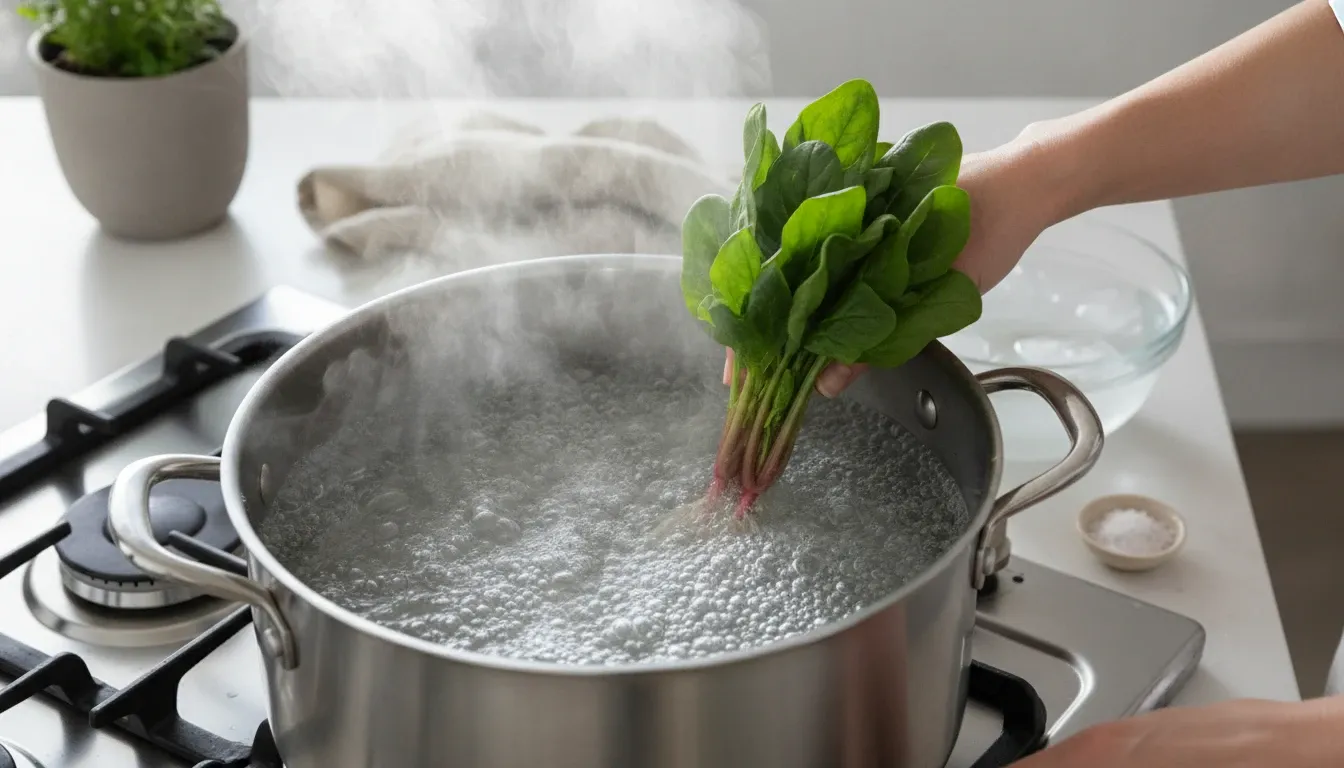
- Roots and potatoes, slow to heat through, start cold. Greens and noodles go into boiling water
- How much is plenty of water?
- 10 times the food's weight. Adding the food drops it only about 7°C
- How much salt in pasta water?
- 1%: 1 L of water and 10 g of salt for 100 g of pasta
- Should you cool it in water?
- Greens into water, broccoli onto a colander, somen washed under running water
You drop potatoes into boiling water, and the outsides fall apart while the centers stay hard. You cool broccoli in cold water, and the florets come out soggy and bland. Neither is a problem of boiling time. Both come from the water you started in and what you did after boiling.
This article covers three choices before and after boiling vegetables and noodles. Do you start in cold water or boiling water? How much water and salt? How do you cool the food afterward? For each food, you get the numbers and the reasons.
Three choices that change with the food
| Food | Start in | Water (by weight of food) | Salt (by weight of water) | After boiling |
|---|---|---|---|---|
| Leafy greens (spinach, komatsuna) | Boiling water | 10 times | Does not keep the color | Cool in water and squeeze |
| Broccoli | Boiling water | 10 times | Does not keep the color | Cool on a colander |
| Cauliflower | Boiling water | At least 4 times | None (vinegar keeps it white) | Cool on a colander |
| Green peas | Boiling water | 10 times | Does not keep the color | Cool in the pot |
| Potatoes, carrots | Cold water | Just enough to cover | None | Drain and let the surface steam dry |
| Pasta | Boiling water | 10 times (1 L for 100 g) | 1% | Straight into the sauce, unrinsed |
| Somen | Boiling water | 10 times (1 L for 100 g) | None | Rub and rinse under running water |
Sources: “10 times” is the same ratio as 1 L of water per 100 g, which both the traditional Italian ratio for pasta and the somen cooperative’s guideline give. How far the water temperature drops is worked out in the section on water below.
Cauliflower is from this site’s article on cauliflower (at least 1 L of water for 250 g of florets). Pasta follows the traditional ratio (1 L of water, 10 g of salt, 100 g of pasta). Somen follows the guideline of the Hyogo Prefecture hand-pulled somen cooperative.
Komatsuna, sometimes sold as Japanese mustard spinach, is a tender leafy green cooked much like spinach. Somen is a very thin Japanese wheat noodle.
Eggs and meat are not in this table. Both depend on the temperatures at which they set, so they get their own short section below.
How boiling differs from simmering and steaming
Boiling cooks food through in plenty of water, and then you throw the water away. Whatever comes out into the water, whether bitterness, salt, or sliminess, goes down the drain with it.
| Method | How water is used | What comes out into the water | Result |
|---|---|---|---|
| Boiling | Plenty of water cooks the food through | Thrown away with the water | Tastes of the ingredient; you season it later |
| Simmering | A little seasoned liquid flavors the food | Eaten with the liquid | The liquid’s flavor reaches the center |
| Steaming | Steam cooks the food | Little, since the food never sits in water | Does not turn watery |
| Blanching to clean | Only the surface goes through boiling water | Odors and sliminess are rinsed away | Only the surface turns white; the inside stays raw |
Throwing away the cooking water is common ground. Japanese ohitashi (boiled greens dressed with soy sauce and stock), French blanchir, and Chinese chao shui all do it.
Italian pasta is the one exception. Some of the cooking water goes into the sauce, because its salt and the starch from the pasta help bind the sauce.
Start cold when the center heats slowly
You do not need to memorize which foods start cold. Anything slow to heat through to the center starts in cold water. Anything that cooks through quickly goes into boiling water.
Roots and potatoes heat evenly from cold
Potatoes and carrots are thick, so heat takes time to reach the center. In boiling water, the outside quickly nears 100°C (212°F). By the time the center is cooked, the outside has overcooked and fallen apart.
Start them in cold water, and the outside and center warm up together, little by little. Vegetables firm up as they pass through 60–70°C (140–158°F), and the slower they pass through, the firmer they get. That firming is likely why potatoes started in cold water hold their shape.
Sources: the firming at 60–70°C (140–158°F) and how shape changes heating are from Kasai (2008). That a cold-water start softens more evenly is from Kasai (2012).
For the same volume, the thinner and flatter the piece, the faster it softens, and the closer to a ball, the slower. Cut pieces to the same size and shape, and they cook evenly.
Bones and meat for removing odors also start in cold water. Here the reason is not to keep them whole. As they warm slowly, blood and scum are drawn out.
Greens and noodles need hot water, briefly
Leafy greens, broccoli, green peas, and noodles are thin or small, so heat reaches the center quickly. Start them in cold water, and all the time it takes to come to a boil becomes cooking time, and they overcook.
The longer greens cook, the more their green pigment turns brown. Drop them into boiling water and lift them out quickly.
Judge water by how far it drops
Here is the calculated water temperature right after adding food at 20°C (68°F) to boiling water.
| Water (times the food’s weight) | Water right after adding | Drop |
|---|---|---|
| 10 times (1 L of water for 100 g of vegetables) | 93°C (199°F) | 7°C (13°F) |
| 5 times | 88°C (190°F) | 12°C (22°F) |
| 3 times | 82°C (180°F) | 18°C (32°F) |
Sources: calculated from the heat balance (taking the specific heat of vegetables as 0.9 times that of water, and leaving out heat from the pot and the burner). A real pot adds its own heat and the burner’s, so the actual drop is smaller.
With too little water, the food sits in lukewarm water until the temperature recovers. Greens lose color during that time, and noodles stick together. With 10 times the water, the drop stays at about 7°C (13°F).
Pasta takes 1 L of water for 100 g, and somen 1 L for 2 bundles (100 g). Both are 10 times. Stir as soon as the food goes in, and wait for the water to return to a boil.
Salt seasons noodles but cannot keep greens green
Pasta water is 1% salt
The ratio handed down in Italy is 1 L of water, 10 g of salt, and 100 g of pasta. That makes the water 1% salt.
Add the salt once the water boils, and add the pasta once the salt dissolves. The pasta itself takes on seasoning, and salt goes into the sauce along with any cooking water you add. Season the sauce after adding the cooking water and tasting.
If you measure salt by volume, the brand changes the amount. A teaspoon of Morton kosher salt weighs about 5 g and one of Diamond Crystal about 3 g, so 10 g is about 2 teaspoons of Morton or a little over 3 of Diamond Crystal.
Sources: 1 L of water, 10 g of salt, and 100 g of pasta, and salting once the water boils, are from Dissapore (2016). The weights of kosher salt are from America’s Test Kitchen.
Salt at 1% raises boiling point about 0.2°C
You may hear that salt lets you boil at a higher temperature. With 10 g of salt in 1 L of water, the boiling point rises only about 0.2°C (under ½°F). That makes no difference to the result. The reason to salt is flavor, not temperature.
Source: calculated from the boiling-point elevation constant of water (0.512°C·kg/mol).
Salt does not keep greens green
People often say greens are boiled in salted water to keep their color. At the amounts home cooks use, salt barely changes the color. What keeps it is the method: plenty of water, a short boil, and straight into cold water.
Whether to salt the water for greens or broccoli depends on whether you want them seasoned. Roots and potatoes are usually seasoned after boiling, so their water gets no salt.
Cool in water, colander, pot, or rinse
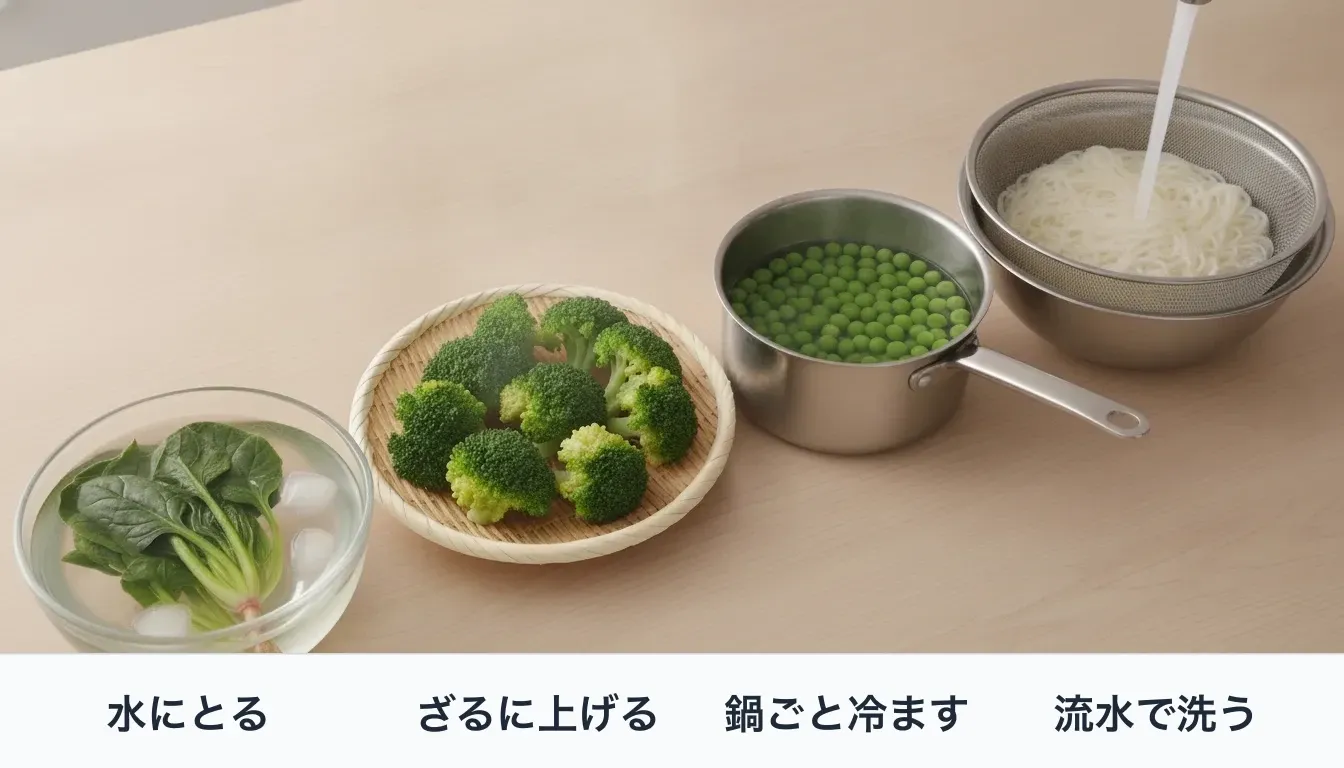
How you cool food after boiling depends on what you need to stop.
| Method | Suits | What it stops | When to take it out |
|---|---|---|---|
| Cool in water and squeeze | Spinach, komatsuna | Color turning in the leftover heat | As soon as it is cold to the core |
| Cool on a colander | Broccoli, cauliflower | Water getting between the florets | Spread out, until the steam stops rising |
| Cool in the pot | Green peas | Skins wrinkling | Until cool enough to touch |
| Rub and rinse under running water | Somen | Saltiness and oily sliminess | Until the sliminess is gone |
Sources: broccoli and green peas are from Kawasaki City’s guide, cauliflower from this site’s article on cauliflower, and somen from the Hyogo Prefecture hand-pulled somen cooperative.
Leave greens in water too long, and water gets in while water-soluble nutrients leach out. If you want broccoli as green as possible, as for ohitashi, dip it briefly in cold water and lift it straight out.
Somen is rinsed because the salt and oil used in making it have dissolved into the cooking water. Pasta is the opposite: do not rinse it. The starch on its surface helps the sauce cling.
What boils out, and what stays
When you boil food, anything water-soluble moves into the water. Here are values measured for spinach.
| Nutrient (per 100 g raw weight) | Raw | Boiled |
|---|---|---|
| Vitamin C (mg) | 35 | 13 |
| Folate (µg) | 210 | 77 |
| Potassium (mg) | 690 | 343 |
| Calcium (mg) | 49 | 48 |
Source: Standard Tables of Food Composition in Japan 2020 (8th revised edition), spinach leaves, year-round average. Boiled values are corrected for the change in weight (70% of raw).
Oxalic acid, the source of spinach’s harsh, mouth-coating bitterness, also moves into the water. Boiling 9 vegetables cut their soluble oxalate by 30–87%, and almost all of the lost amount turned up in the cooking water. Steaming cut it by 5–53%.
Source: the experiment by Chai and Liebman (2005, J Agric Food Chem).
Japanese cooks boil spinach for ohitashi and pour off the water so the bitterness goes with it. If you would rather keep vitamin C and the flavor that goes into the liquid, steam instead, or simmer it in a dish where you eat the liquid too.
Eggs and meat need their own temperatures
In an egg, the white and the yolk set at different temperatures inside the shell. The number of minutes after it goes into boiling water decides how it turns out.
Meat shrinks and toughens if it keeps boiling. For meat you eat boiled, such as poached chicken, cook it through below a boil. To clean off odors as a prep step, blanch it briefly.
How to tell when it is done
| Food | What to look for or feel | Time (conditions) |
|---|---|---|
| Spinach | Pinch one stem: the raw firmness is gone | In 10 times the water, stems first for about 30 seconds, then push the leaves under for about 10 seconds (under 1 minute in all) |
| Broccoli, cauliflower | A thin skewer into the stem meets a little resistance | 2–3 minutes for florets of 3–4 cm (1¼–1½ in) |
| Potatoes | A thin skewer slides straight in | Depends on size, so test with the skewer |
| Pasta | Cut one strand: a dot of white core remains at the center | Earlier than the package time, by however long it will cook in the sauce |
| Somen | Go by time | 1 minute 30 seconds to 2 minutes after the water returns to a boil |
Sources: spinach from DELISH KITCHEN, a Japanese recipe site; broccoli and cauliflower from this site’s article on cauliflower; somen from the Hyogo Prefecture hand-pulled somen cooperative’s guideline.
Pasta keeps cooking in the sauce. If it will toss in the sauce for 1–2 minutes, take it out that much earlier.
Common failures and fixes
Browned greens cannot be fixed, and potatoes that fell apart can only be partly saved. The other three can be fully fixed.
| Problem | Cause | Fix it now | Prevent it next time |
|---|---|---|---|
| The potatoes fell apart | They went into boiling water. Only the pectin on the outside (the substance that holds cells together) broke down, while the center was still hard | Turn the heat down so the water no longer boils and cook through to the center. Use the broken pieces in a mash or a dish where they are crushed | Cut them to the same size, start in cold water, bring to a boil over medium heat, then turn the heat down |
| The greens turned brown | Too little water made the cooking run long, and the green pigment chlorophyll turned into brownish pheophytin | The color will not come back. Use them in a dressed salad or a stir-fry rather than as plain blanched greens | Boil briefly in 10 times the water, and move them straight into cold water |
| It is watery | The broccoli went into water, and water stayed between the florets. Greens left in water too long soak it up | Spread it on a colander to drain and press with paper towels. Cut greens before squeezing | Cool broccoli on a colander instead of in water, and lift greens out once cold to the core |
| The noodles are gummy | With too little water, the boil stopped. Starch dissolved from the surface turned to paste and the strands stuck together | Loosen them gently in hot water and toss with sauce or oil right away | Use 1 L of water for 100 g, stir as soon as they go in, and wait for the water to return to a boil |
| The pasta tastes flat | No salt, or too little, went into the water, so the pasta itself has no seasoning | Season the sauce a little more firmly, and adjust it with the salted cooking water | Add 10 g of salt per 1 L of water once it boils |
Four things to remember when boiling
- Roots and potatoes, slow to heat through, start in cold water. Greens, flowering vegetables, and noodles go into boiling water
- Use 10 times the food’s weight in water. Adding the food drops it only about 7°C (13°F)
- Salt pasta water at 1%. Salt cannot keep greens green; plenty of water, a short boil, and fast cooling do
- After boiling, greens go into water, broccoli onto a colander, green peas stay in the pot, and somen gets rinsed
Sources
- Kasai, M. Changes in physicochemical properties by cooking and their prediction. Ochanomizu University research profile, 2008 (vegetables harden at 60–70°C, more so the slower the temperature rises) (in Japanese)
- Kasai, M. Basic study on setting optimum heating conditions for plant foods. Journal of Cookery Science of Japan 45(2), 71–80, 2012 (root vegetables started in cold water soften more evenly than in boiling water) (in Japanese)
- Japan's Ministry of Education, Culture, Sports, Science and Technology. Standard Tables of Food Composition in Japan 2020 (8th revised edition), spinach leaves, year-round average, raw and boiled (from Table 1 of ALIC's Vegetable Information, August 2021) (in Japanese)
Show 5 more
- Chai W, Liebman M. Effect of different cooking methods on vegetable oxalate content. J Agric Food Chem. 2005;53(8):3027-30
- Kawasaki City. Eat spring vegetables boiled! (drain broccoli on a colander without soaking it; cool green peas in the pot) (in Japanese)
- Kobe Shimbun. A time-saving method from the long-established somen brand Ibo no Ito, May 2021 (how the Hyogo Prefecture hand-pulled somen cooperative boils somen) (in Japanese)
- Mezzadri F. R. Come cucinare la pasta: una guida completa. Dissapore, 2016 (1 L of water, 10 g of salt, 100 g of pasta) (in Italian)
- America's Test Kitchen. The Wrong Kind of Salt Could Ruin Your Dinner (a teaspoon of Diamond Crystal kosher salt weighs 3 g, Morton kosher salt about 5 g)