What this article answers
- What aburi does
- Heats only the surface above 300°C (572°F) for seconds, leaving the inside raw or as it was already cooked
- How to use a kitchen torch
- Pat the surface dry, hold the flame 10–15 cm (4–6 in) away, and keep it moving so the heat never sits on one spot
- How long to sear
- A few seconds to ten-odd seconds. On sashimi, stop when the fat starts to sizzle up
- Searing beef for tataki
- Sear every side for 10–15 seconds over high heat, then plunge it straight into ice water
Aburi (炙り) means searing over a flame. It is a finishing technique: very high heat, on the surface only, for an instant.
Grilling cooks an ingredient through. Aburi adds browning and a toasty aroma to the surface and leaves the inside raw, or as it was already cooked.
That makes it essential wherever you want a toasty accent without losing the ingredient’s own flavor. Think tataki (seared outside, raw inside), aburi sushi, and crème brûlée.
This article covers the science behind aburi, how it differs from grilling, and how to do it well.
Why aburi cooks only the surface
Three reactions at the surface
Aburi uses very high heat, 300°C (572°F) or more, for a very short time. So the chemistry happens only at the surface.
The Maillard reaction
Above 140°C (284°F), amino acids and sugars react to make toasty flavors and a brown color. In aburi, only the surface gets that hot, so the inside stays raw while the outside picks up a toasty aroma.
A browned surface does not prove that bacteria have been killed, though. For beef served raw, Japan’s health ministry sets the line: 60°C (140°F) for 2 minutes, to a depth of 1 cm (⅜ in).
Fat melts and gives off aroma
Surface fat on fish or meat melts in the heat. Some of it oxidizes and breaks down, which creates a distinctive toasty aroma. This matters most with oily fish such as salmon and yellowtail.
Surface water flashes off
Water on the surface evaporates instantly, leaving a crisp texture. Sear too long, though, and the inside dries out too.
Radiant heat does the work
Aburi transfers heat mainly by radiation. Infrared from a flame or torch hits the surface directly and heats only the surface, fast.
A frying pan works by conduction, through contact. Aburi has no contact surface, so you can brown food without crushing its shape.
How aburi differs from grilling
Grilling and aburi look alike, but they have different goals and methods.
| Grilling | Aburi (searing) | |
|---|---|---|
| Goal | Cook it through | Cook only the surface |
| Temperature | 150–250°C (302–482°F), slowly | 300°C (572°F) or more, in an instant |
| Time | A few minutes to tens of minutes | A few seconds to tens of seconds |
| Inside | Cooked through | Raw, or already cooked beforehand |
| When it is used | As the main cooking method | As a finish |
| Typical dishes | Steak, grilled fish | Tataki, aburi sushi |
Why aburi is a finishing step
Aburi usually comes at the very end. It is used on three kinds of food.
- Food you can eat raw anyway, such as sashimi-grade fish. Aburi adds a toasty aroma
- Food already cooked through, by sous vide or boiling. Aburi browns the surface
- Food that needs no cooking at all, such as the sugar on crème brûlée. It only needs a browned finish
In other words, aburi does not cook food through. It adds a toasty aroma and good looks.
Torch, gas flame, or straw fire
Kitchen torch
The torch is the easiest and most common tool for aburi. A small kitchen torch runs on butane and has adjustable heat, which suits precise work. A high-output professional torch sears a wide area quickly.
Four habits keep the sear even.
- Hold the flame 10–15 cm (4–6 in) away (too close and it burns)
- Keep it moving at a steady speed (stop and it burns)
- Sear the whole surface evenly (to avoid patchy spots)
- Let the food come to room temperature first (if it is cold, the gap between surface and inside gets too large)
What you set the food on matters too.
| Material | Characteristics | Use |
|---|---|---|
| Heatproof dish or ceramic plate | Withstands heat and stays stable | Crème brûlée, aburi sushi |
| Stainless-steel tray | Conducts heat, so the underside warms too | Searing meat and fish |
| Cast-iron skillet | Holds a lot of heat | Finishing tataki |
Avoid wooden cutting boards (they scorch), plastic (it melts), and ordinary pottery (it may crack).
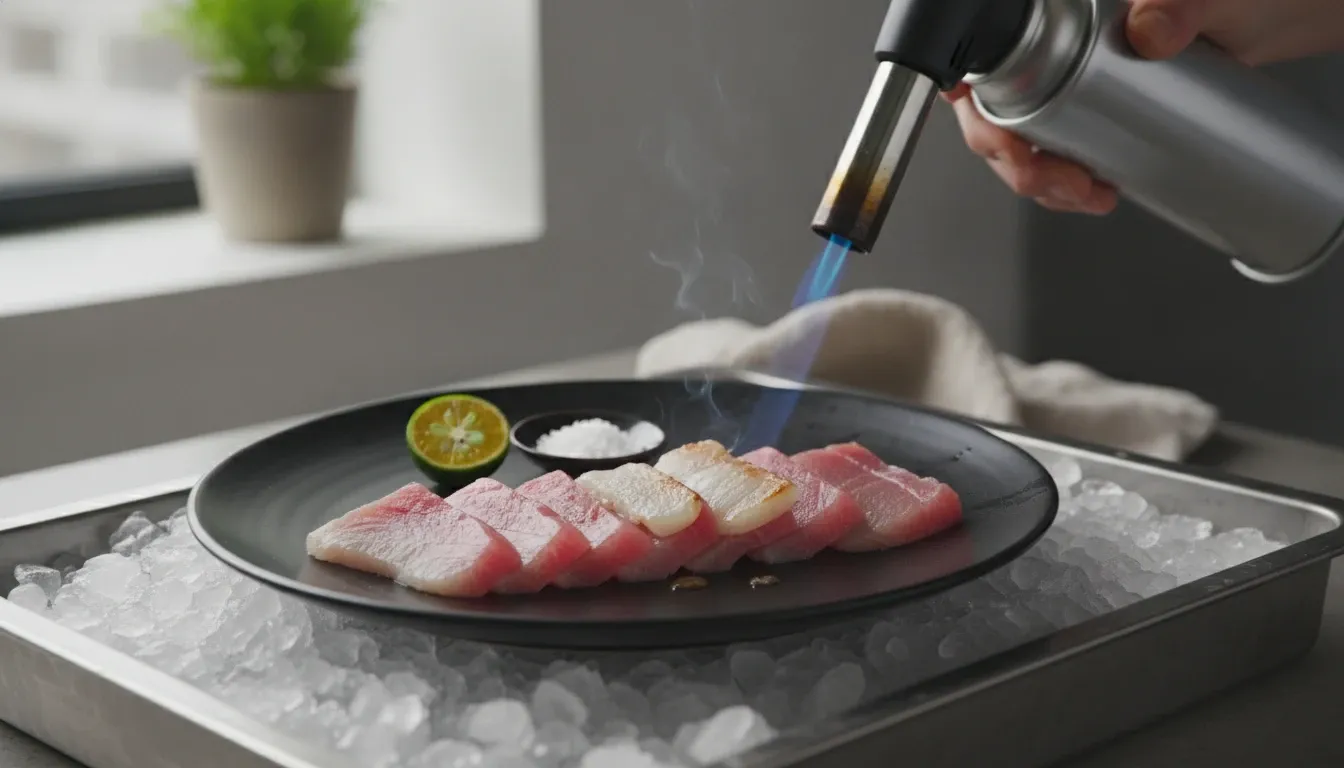
A professional trick for sashimi: set the plate on a tray lined with ice. The inside stays cold while you sear.
Gas flame
You can also sear on a wire rack over a gas burner. It suits tataki and finishing yaki-onigiri (grilled rice balls).
- Use high heat and work fast
- Preheat the rack
- Keep the food moving so it browns evenly
An electric or induction hob has no flame to sear over. Use a torch instead, or for beef, a frying pan over high heat as in the tataki steps below.
Wara-yaki, searing over burning straw
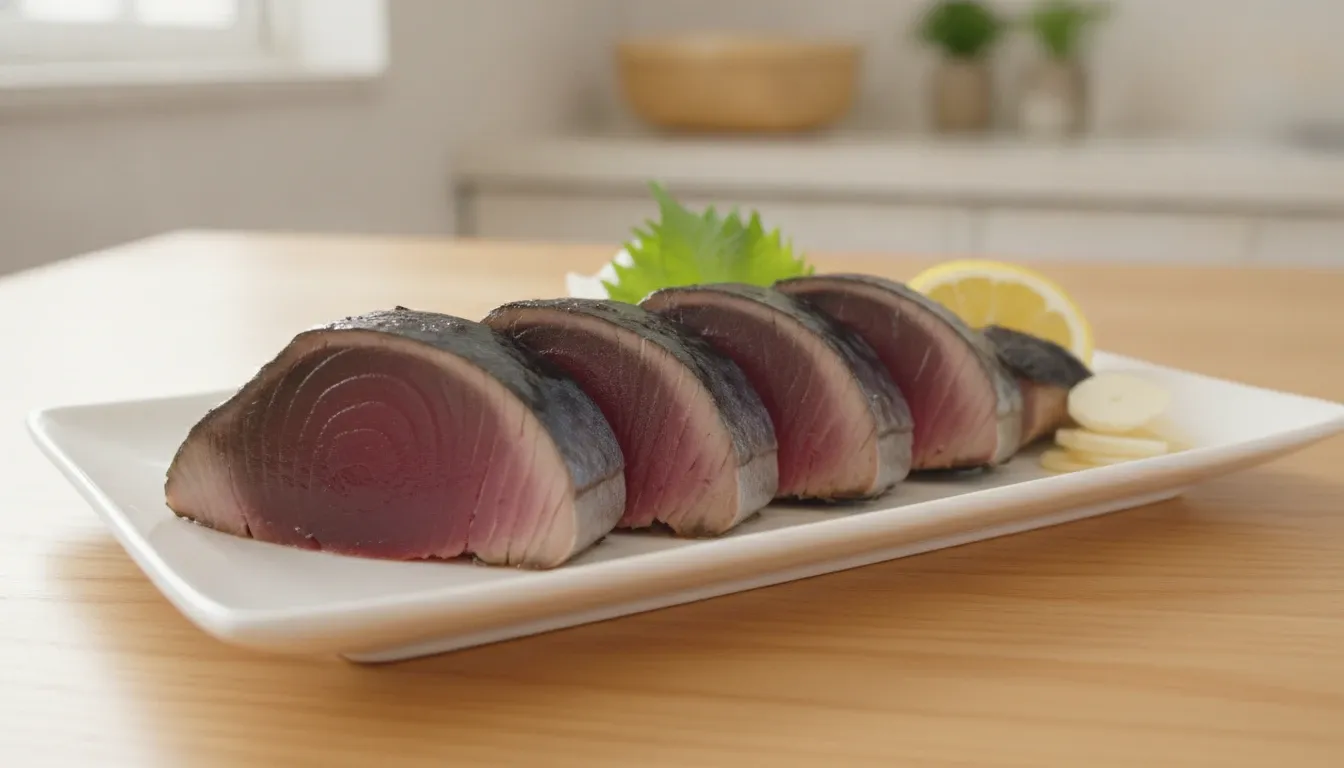
Wara-yaki is a traditional technique: you sear the food in one burst over the flames of burning straw.
- It sears at 800–1000°C (1,472–1,832°F) for a few seconds
- The aroma of the straw carries into the food
- Only the surface cooks; the inside stays completely raw
The classic dish is katsuo no tataki, seared skipjack tuna.
Aburi in Japanese and French cooking
Japanese tataki and aburi sushi
Japanese cooking uses aburi to add a toasty aroma while keeping the ingredient’s own flavor.
| Dish | Ingredient | How it is seared |
|---|---|---|
| Katsuo no tataki | Skipjack tuna | Seared all at once over burning straw, then chilled in ice water |
| Aburi sushi | Salmon, yellowtail, engawa (the fin muscle of flounder), etc. | The surface is seared lightly with a torch |
| Yakishimo-zukuri (skin-seared sashimi) | White fish | Boiling water is poured over the skin, or it is seared lightly, to cook the skin side |
Japanese aburi has three aims.
- Keep the raw texture
- Melt the fat to bring out umami
- Remove the fishy smell of the skin
French flambé and gratiné
French cooking uses searing at the finish, for presentation and flavor.
| Technique | What it is | Typical dish |
|---|---|---|
| Flambé | Setting alcohol alight to sear | Crêpes Suzette |
| Gratiné | Browning the surface (in the oven or with a torch) | Gratin, crème brûlée |
| Finishing with a torch | Browning with a torch | Sautéed foie gras |
Japanese and French aburi compared
| Japanese cooking | French cooking | |
|---|---|---|
| Main goal | Better aroma and texture | Looks, presentation, flavor |
| Typical tools | Straw, torch | Torch, salamander |
| Heat | Extremely high heat, extremely short time | High heat, short time |
| Result | Keeps the virtues of the raw food | Caramelized or gratinéed |
How to sear fish, meat, and sugar
Sashimi-grade fish
Salmon, yellowtail, amberjack (kanpachi), engawa, and shime-saba (vinegar-cured mackerel) all suit aburi.
- Slice the sashimi and arrange it on the plate
- Blot the surface lightly with paper towels
- Hold the torch about 15 cm (6 in) away and sear, moving it quickly
- Stop when the fat starts to sizzle up to the surface
- Add a squeeze of lemon or a pinch of salt if you like
The oilier the fish, the bigger the difference searing makes.
Beef for tataki
Use beef round or beef tenderloin.
- Rub salt over the whole surface of the block
- Sear every side for 10–15 seconds in a frying pan over high heat, or over an open flame
- As soon as the surface browns, plunge it into ice water
- Pat it dry and slice thinly
Keep the center completely raw and red.
Caramelized sugar
This is the finish for crème brûlée and tarts.
- Sprinkle granulated sugar in a thin, even layer
- Hold the torch at a 45-degree angle
- When the sugar melts and starts to bubble, move on to the next spot
- Stop when the whole surface is caramel-colored
Sugar burns easily, so never stay in one spot.
Common failures and fixes
A burnt surface can be only partly saved, overcooking cannot be undone, and missing or uneven browning can be fully fixed.
| Problem | Cause | Fix it now | Prevent it next time |
|---|---|---|---|
| The surface burned | The torch was too close and the heat focused on one spot, going past the Maillard reaction into charring | Shave off the burnt layer. Removing it is the only way to get rid of the bitterness | Hold it 15 cm (6 in) or more away and keep it moving to spread the heat |
| It overcooked | Searing went on too long, and heat meant only for the surface reached the center | Cooked parts cannot be undone. Use it in a dish that is meant to be cooked | Finish within a few seconds to ten-odd seconds, and chill thick pieces beforehand |
| It will not brown | The surface was wet, so evaporation took the heat and it never reached Maillard temperatures | Wipe off the moisture, turn up the heat, and sear again | Wipe the surface dry, and check the gas level and the strength of the flame |
| It browned unevenly | The torch’s distance and speed were not steady, so different spots got different amounts of heat | Aim at the paler areas and sear them again | Keep a steady distance and speed, and sear from one end to the other |
Dry it, keep moving, stop in seconds
Aburi is a finish: high heat, on the surface only, for an instant.
- The goal is not to cook food through but to add a toasty aroma and good looks
- The Maillard reaction makes the toasty aroma; melting fat adds flavor
- Hold the torch 15 cm (6 in) away and keep it moving
- Wipe the surface dry before searing
- Stop within a few seconds to ten-odd seconds
It takes seconds, but it changes how a dish comes across. Use it wherever you want both the virtues of raw food and a toasty aroma, as in tataki and aburi sushi.