What this article answers
- What separates the dairy products
- Whether the milk's fat was collected, its water removed, or it was set with acid or enzymes
- Adding richness to a dish
- Cream, where the fat is collected. For a small amount, condensed milk, with the water removed
- How yogurt and cheese differ
- Set with acid and eaten with the whey, or set with enzymes and the whey drained off
- Why milk splits in a braise
- Acid sets its protein. Cream, high in fat, splits far less
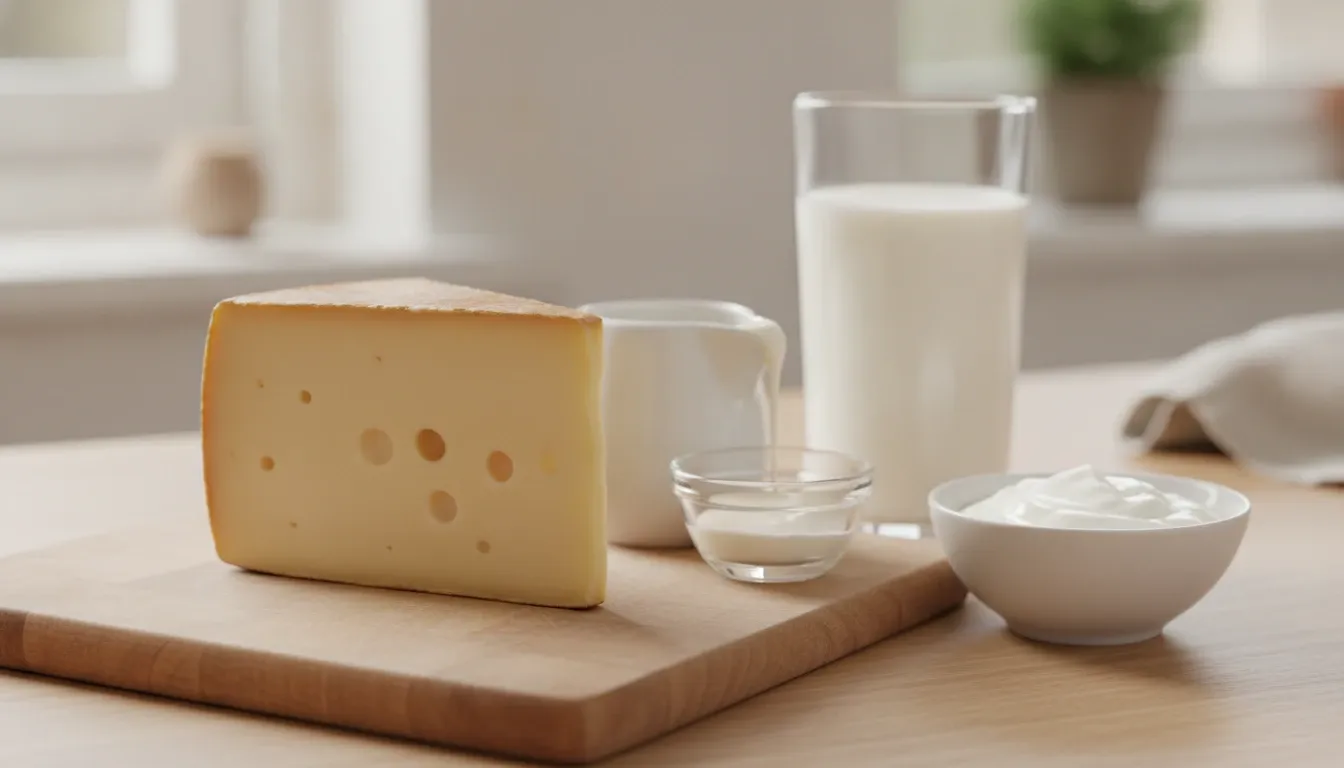
Milk, cream, condensed milk, milk powder, yogurt, cheese. They sit on different shelves in the store, but all of them come from cow’s milk. What sets them apart is what was done to the milk: collecting the fat, removing water, or setting the protein with acid or with enzymes.
This article sorts the whole range of dairy products by these four methods. The figures come from Japan’s Standard Tables of Food Composition (“the food tables” from here on).
Once you know which method made a dairy product, you also know what it does in cooking. It brings richness, shelf life, sourness, or umami and salt.
What was done to milk decides the product
Milk is nearly 90% water; the rest is fat, protein, and lactose
Of 100 g of whole milk, 87.4 g is water. The remaining 13 g or so is 3.8 g of fat, 3.3 g of protein, 4.8 g of carbohydrate (almost all of it lactose, the sugar in milk), and small amounts of minerals.
Dairy products differ by which of these four was increased and which was thrown away. When the protein sets, a yellowish liquid separates out. That liquid is whey.
Collect fat, remove water, set with acid, set with enzymes
What was done shows up directly in what 100 g contains. Compare each with milk, and see which numbers went up and which went down.
| Dairy product (per 100 g) | Water (g) | Fat (g) | Protein (g) | Carbohydrate (g) | What was done to the milk |
|---|---|---|---|---|---|
| Whole milk | 87.4 | 3.8 | 3.3 | 4.8 | (the starting milk) |
| Cream (dairy fat) | 48.2 | 43.0 | 1.9 | 6.5 | Fat collected |
| Evaporated milk | 72.5 | 7.9 | 6.8 | 11.2 | Water removed |
| Sweetened condensed milk | 26.1 | 8.5 | 7.7 | 56.0 | Sugar added, water removed |
| Nonfat dry milk | 3.8 | 1.0 | 34.0 | 53.3 | Fat removed, then water removed |
| Yogurt (whole milk, plain) | 87.7 | 3.0 | 3.6 | 4.9 | Set by acid from lactic acid bacteria |
| Gouda | 40.0 | 29.0 | 25.8 | 1.4 | Set, whey drained, aged |
Source: Standard Tables of Food Composition in Japan (8th revised edition), 2023 supplement
Yogurt’s numbers are almost the same as milk’s. Cheese has almost no carbohydrate left.
Casein sets with acid and enzymes, not heat
About 80% of milk protein is casein, which heat won’t set
About 80% of the protein in milk is a kind called casein. Casein stands up to heat very well and won’t set even when boiled at 100°C (212°F). The skin that forms on warm milk comes from the remaining 20% or so, the whey proteins, set by heat.
Eggs and meat set with heat; milk doesn’t. That is the starting point both for making dairy products and for cooking with milk.
Acid makes yogurt; enzymes plus draining make cheese
Two things set casein: acid, and an enzyme called rennet.
In yogurt, lactic acid bacteria turn lactose into lactic acid. As the milk sours, the casein gathers, and the whole thing sets loosely.
No water is drained from the set milk, so you eat it with the whey. The liquid on top when you open the tub is whey.
Cheese is milk set with rennet or similar, with the whey drained off. Most of the lactose runs out with the whey, so almost no sugar is left in cheese. That is why Gouda has less than a third of milk’s carbohydrate.
Collected fat makes cream, for richness and whipping
Cream is milk fat concentrated to 18% or more
Leave fresh milk to stand and the light fat globules rise to the top. Dairies use that lightness to collect the fat with a centrifuge. Take away everything but the milk fat, and what remains is cream.
Japanese rules allow the name cream only at 18.0% milk fat or more. US light cream starts at the same 18%, light whipping cream at 30%, and heavy cream at 36%. In the UK, single cream has at least 18%, whipping cream 35%, and double cream 48%.
Whipped toppings made with vegetable fat don’t count as cream and are sold under other names.
More fat whips better and gives a sauce body
Whether to use milk or cream comes down to the amount of fat. Milk is a low-fat liquid that thins a white sauce or a soup and keeps it light. Cream has more than 10 times the fat of milk, adds richness in a small amount, and also whips.
What cream does in cooking is richness and foam. It whips to peaks that hold their shape only at 30% milk fat or more, and milk won’t foam that way at all. Added to finish a sauce, it rounds the texture, with fat globules kept spread through the liquid (an emulsion).
Beat cream harder, and the fat globules stick together and set into butter. Butter is mostly fat, so it gets its own article.
Removing water gives condensed and powdered milk
Condensed milk is concentrated; powdered milk is dried
Condensed milk is concentrated milk. Concentrate it without sugar, seal it in cans, and heat-sterilize it, and you get evaporated milk. Concentrate it with sugar, and you get sweetened condensed milk.
Sweetened condensed milk has less than a third of milk’s water. Its dense sugar keeps microbes from growing, so it keeps. Refrigerate it once opened.
Milk powder is milk with almost all its water removed, dried to a powder. Dry it as it is for whole milk powder; remove the fat first for nonfat dry milk (skim milk powder). Nonfat dry milk has almost no fat, so it adds milk protein and lactose as a powder.
A little adds richness without adding water
With the water already gone, a little goes a long way for richness and adds no water to the dish.
| Condensed or powdered milk | Uses in cooking |
|---|---|
| Sweetened condensed milk | Poured over strawberries, Vietnamese coffee, milk jam. Adds sweetness and richness at once |
| Evaporated milk | Richness in chowder or curry. Thicker than milk, not sweet |
| Nonfat dry milk | Mixed into bread dough. Adds milk flavor and browning without adding fat |
Dissolve 10 g of nonfat dry milk in 90 ml of water, and it is about as concentrated as 100 ml of skim milk. Use that as your guide when it stands in for milk.
Lactic fermentation makes yogurt, which adds sourness
Almost the same as milk, with some lactose turned to lactic acid
Plain whole-milk yogurt is almost the same as milk in composition. The differences are that some of the lactose has turned into lactic acid, so it is sour, and that it has set.
Sourness, and a marinade for meat
What yogurt does in cooking is sourness. Marinate meat in it before cooking, as in tandoori chicken. Make lassi, use it in dips and dressings, or stir it into a curry at the end for a sour edge.
Drain it and it firms up, so you can use it much like cream cheese.
Yogurt already contains acid, so it breaks into curds if it boils. If it goes into a braise, add it after the heat is off.
Drained curd becomes cheese, for umami and salt
How much water is drained runs from soft to grating cheese
Natural cheese is milk set with enzymes or similar, with part of the whey drained, sometimes then aged. How much water is drained changes how hard and how salty it is.
| Natural cheese (per 100 g) | Water (g) | Salt equivalent (g) | Use in cooking |
|---|---|---|---|
| Cream cheese | 55.5 | 0.7 | Spreading, cheesecake |
| Camembert | 51.8 | 2.0 | Eaten as it is, or baked whole until runny inside |
| Gouda | 40.0 | 2.0 | Sliced thin, melted on toast or in a gratin |
| Parmesan | 15.4 | 3.8 | Grated over pasta or salad |
Source: Standard Tables of Food Composition in Japan (8th revised edition), 2023 supplement (water, salt equivalent)
The less water, the more concentrated the protein and salt.
Cheeses with more water are mild in salt; eat them as they are or use them in desserts. Those with less water are strong in salt and umami; grate a little to season a dish. Aging breaks the protein down and adds umami.
Process cheese is natural cheese melted and reset
Process cheese is natural cheese that has been broken up, melted with heat, emulsified, and set again. The heat stops the aging, so its flavor and shape hardly change and it keeps well.
Sour cream and ice cream, from close relatives
| Dairy product | What it is closest to | How to use it |
|---|---|---|
| Sour cream | Cream fermented with lactic acid bacteria. Between cream and yogurt | Adds tangy richness. Dips, a finish for borscht |
| Ice cream | A sweet of milk and sugar, frozen while stirred | For richness, choose full ice cream over lower-fat versions |
| Lactic acid drinks (such as Yakult) | Close to yogurt, but a sweetened drink | Hardly used as a cooking ingredient |
| Goat’s milk | A liquid milk from goats, like cow’s milk | Use it as you would cow’s milk. As cheese, it has a distinctive aroma |
Source: Ministerial Ordinance on Milk and Milk Products Concerning Compositional Standards (Japan)
Soy milk is called milk, but it is made from soybeans and isn’t a dairy product.
Pick by what each product kept
- For richness, use cream, where the fat was collected. For richness in a small amount, use condensed milk, with the water removed.
- For sourness, use yogurt, fermented with lactic acid bacteria.
- For umami and salt, use cheese, set and drained of whey. The less water it has, the less you need.
Sources
- Japan's Ministry of Education, Culture, Sports, Science and Technology. Standard Tables of Food Composition in Japan (8th revised edition), 2023 supplement, Food Composition Database. Whole milk (13003): water, fat, protein, carbohydrate
- Same database. Cream, dairy fat (13014): water and fat
- Same database. Sweetened condensed milk (13013): water and carbohydrate
Show 9 more
- Same database. Nonfat dry milk (13010): water, fat, protein
- Same database. Yogurt, whole milk, plain (13025): water, fat, protein
- Same database. Natural cheese, Parmesan (13038): water, protein, salt equivalent
- Ministerial Ordinance on Milk and Milk Products Concerning Compositional Standards, etc. (Japan, 1951) (in Japanese). Definitions and standards for cream, butter, natural and processed cheese, condensed milk, milk powder, and fermented milk
- Standard Tables of Food Composition in Japan (8th revised edition), Chapter 3, 13) Milk and milk products (in Japanese). How dairy foods are classified and described
- Japan Dairy Industry Association. "Yogurt basics, explained from scratch" (2024) (in Japanese). Milk solids-not-fat and lactic acid bacteria counts for fermented milk and lactic drinks
- Japan's Ministry of Agriculture, Forestry and Fisheries. aff, June 2018. "Make dairy products by hand" (in Japanese). How dairy products are made from raw milk; reconstituting nonfat dry milk
- US Code of Federal Regulations, 21 CFR 131.155 (light cream), 131.157 (light whipping cream), 131.150 (heavy cream). Milk fat ranges for each cream
- UK Food Labelling Regulations 1996, Schedule 8, Part III. Minimum milk fat for single, whipping, and double cream