What this article answers
- What good pork leg looks like
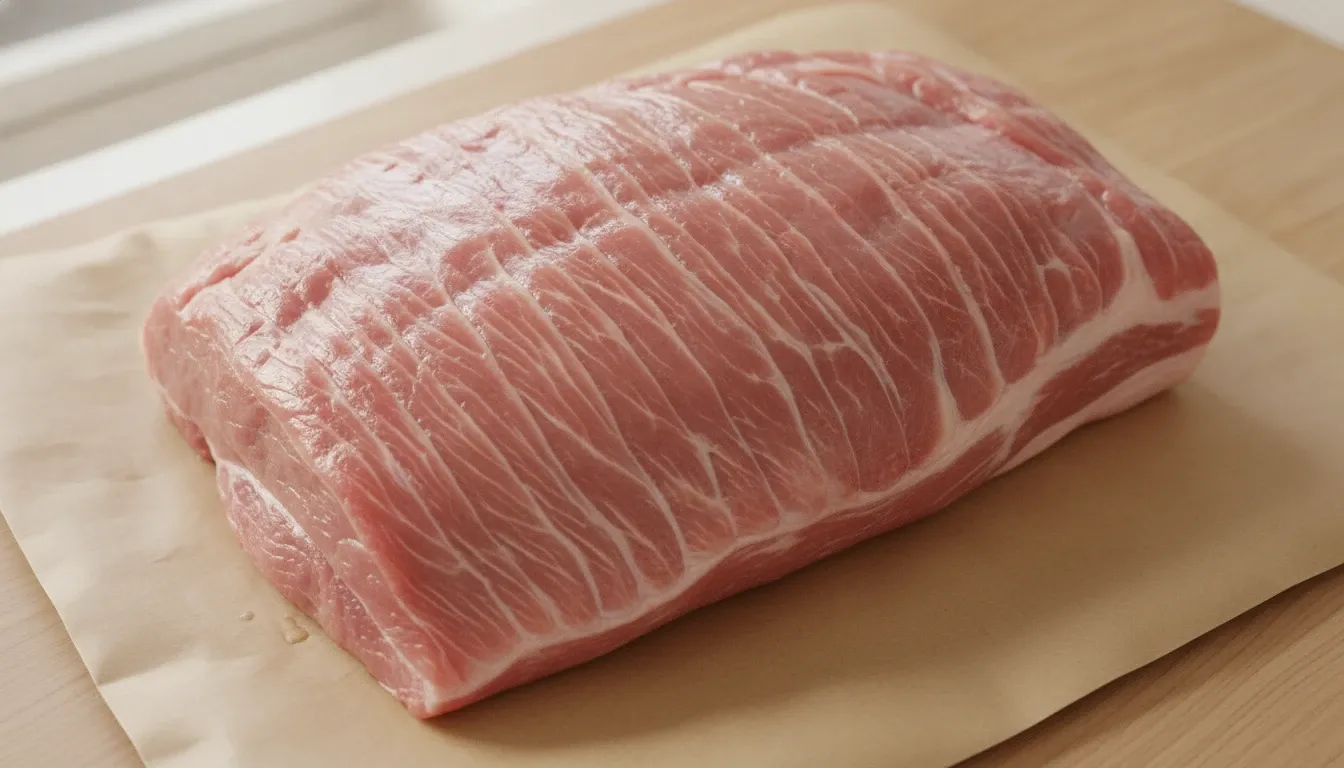
- A slightly deeper pink than loin, with a sheen. Grain running one way, white fat, little drip
- Why the grain direction matters
- Cut across the grain and the fibers break short, so the meat is easy to bite through
- When to check for thick sinew
- When buying a block. Slices hide it. Thick sinew through the center means trim it or braise
- What to buy for each dish
- Roast: a 500 g–1 kg block. Hot pot: 2–3 mm slices. Pan-fry: 1–1.5 cm slices. Stew: 2–3 cm cubes
Pork leg is the pig’s hind leg. Uncured, it is sold as pork leg or, in the US, as fresh ham. On a US label, “ham” on its own can only mean this cut.
Choosing pork leg starts with the checks you’d use for any meat and for pork in general. On top of those, look at three things: the quality of the lean, whether the grain runs one way, and whether thick sinew runs through it.
The leg has little fat, so the state of the lean itself decides its quality.
What good pork leg looks like
| Point | Good | Watch out |
|---|---|---|
| Color | Slightly deep pink, with a sheen | Grayish, dull |
| Grain | Runs one way | Runs every which way; ragged cut face |
| Fat | Little; white to milky white | Yellowish |
| Thick sinew | Little, or already trimmed | Thick sinew running through the center |
| Drip | Little | A lot, running in the package |
| Springiness | Springs back firmly | Doesn’t spring back; finger marks stay |
A little deeper pink than loin
Pork leg is normally a little deeper pink than loin. The hind legs work harder than the loin, so they hold a bit more myoglobin, the red pigment of muscle, and the color is deeper.
| Color | What it means |
|---|---|
| Slightly deep pink, with a sheen | Ideal |
| Solid pink | Typical |
| Grayish | Possibly losing freshness |
| Brown | Metmyoglobin has formed; old |
Grain that runs one way
What sets judging the leg apart from other cuts is checking the direction of the grain.
| Grain | What it means |
|---|---|
| Runs one way | Ideal: easy to cut, good texture |
| Varies slightly | Typical |
| Runs every which way; ragged cut face | Rough cutting during processing, or a boundary between muscles |
Cut across the grain, at a right angle to it, and the meat is easier to bite through and smoother to eat. Check which way the grain runs before you cut.
Check the block for thick sinew
The leg is a group of several muscles. US butchers divide it into three main ones: the inside, the outside, and the knuckle. Depending on the piece, thick sinew (connective tissue) may run through it.
- No sinew: good for thin slices, pan-frying, and ham
- Small bits of sinew: fine for stews and stir-fries
- Thick sinew through the center: trim it out, or keep the piece for braising
Pre-sliced meat hides sinew, so check for it when you buy a block.
What to buy for each dish
For roast pork or homemade ham
- A large block (500 g–1 kg)
- Even in shape and thickness
- A thin, even layer of fat
- No thick sinew
For hot pot and quick stir-fries
Hot pot here means dishes like Japanese shabu-shabu, where thin slices are swished through simmering broth.
- Slices 2–3 mm (1/16–⅛ in) thick
- Every slice the same color
- Grain running one way
- No discoloring where slices overlap
For pan-frying and steaks
- Slices 1–1.5 cm (⅜–⅝ in) thick
- 100–150 g per slice
- No thick sinew
For stews and curries
- Cubes 2–3 cm (¾–1¼ in)
- Sinew is fine; it softens as it braises
- Keep the fat on the low side
For ground pork
- If it is sold as lean ground pork, judge it by how fine the grind is
- No gray mixed in
Reading the label on ham products
When choosing ham made from pork leg, check the ingredient list.
- Pork leg named as the meat: a single cut, so quality is steady
- Only “pork” listed: may be a mix of several cuts
- Dry-cured ham: check the origin (Parma, Serrano) and how long it was aged
What to check in the package
- Chilled: how much drip is in the package, the grain direction, uneven color
- Vacuum-packed: after opening, check that it blooms (turns redder in the air) within 5–30 minutes
- Frozen and thawed before sale: expect the lean to cook up drier
Three things to check
- Color: slightly deep pink, with a sheen
- Grain: running one way
- Sinew: an amount that suits the dish (for a block, no thick sinew)
Sources
- Japan Meat Information Service Center (JMTC). "Pork cuts" (in Japanese). Division, location, and features of each cut
- Japan Pork Producers Association. "More about pigs and pork" (in Japanese). Breeds, meat quality, and uses of each cut
- U.S. Code of Federal Regulations, 9 CFR 317.8(b)(13). The word "ham" without a species prefix is used only for the hind legs of swine