What this article answers
- Real Pixian doubanjiang
- Look for 郫县豆瓣 on the front and choose 3-year aged. Juan Cheng or Dandan
- Tianmianjiang, not hoisin
- Wheat flour should be the first ingredient. Hoisin is a different, sweeter sauce
- Additives to avoid
- Caramel color, MSG, preservatives, and artificial sweeteners. Beans, salt, and koji are enough
- Yellow soybean paste for zhajiangmian
- Huangjiang from northern China. Liubiju or Wangzhihe
Doubanjiang, tianmianjiang, and huangjiang vary enormously in quality from jar to jar. A paste from a long-established maker and a mass-produced one taste like different seasonings. This article covers how to tell them apart on the shelf, and where to find the good ones.
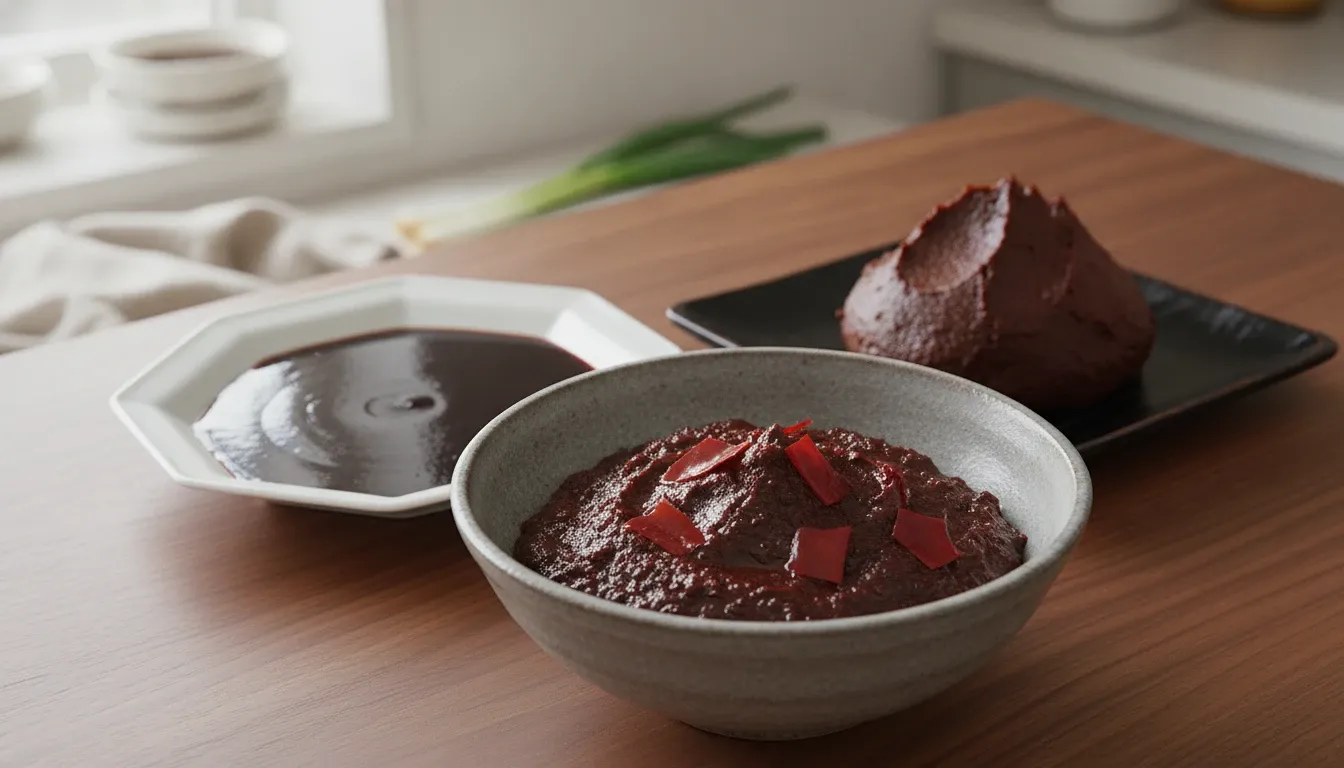
All three are Chinese jiang, fermented pastes in the same family as Japanese miso. Doubanjiang is the red, spicy broad bean paste of Sichuan. Tianmianjiang is a sweet, dark paste made mostly from wheat flour. Huangjiang is a salty soybean paste from northern China.
The three pastes at a glance
| Paste | Must check | Top brand | Easy to find |
|---|---|---|---|
| Tianmianjiang (sweet bean sauce) | Made in China, no additives | Liubiju (Beijing) | Lee Kum Kee |
| Doubanjiang (chili bean paste) | “Pixian” (郫县) on the label, aged 3 years or more | Juan Cheng | Lee Kum Kee (not Pixian) |
| Huangjiang (yellow soybean paste) | Made in northern China, naturally brewed | Liubiju | Wangzhihe |
The English names on the jar are not reliable. Tianmianjiang is sold as sweet bean sauce, sweet flour sauce, or sweet wheat paste, and is often mislabeled as hoisin. Hoisin is a different sauce: sugar is its main ingredient, and it carries garlic and other seasonings.
Doubanjiang is sold as broad bean chili sauce, chili bean paste, or toban djan. Huangjiang usually appears as yellow soybean paste.
Read the ingredient list first
When choosing a jiang, the ingredient list matters most.
What a good ingredient list looks like
- Tianmianjiang: wheat flour, soybeans, salt, sugar, koji
- Doubanjiang: broad beans, chilies, salt, wheat flour
- Huangjiang: soybeans, wheat flour, salt, koji
Koji is grain or beans cultured with a mold that starts the fermentation. For tianmianjiang, wheat flour should come first. If soybeans lead the list, it is likely the soybean-based southern style, such as Lee Kum Kee’s.
Additives to avoid
| Additive | Why to avoid it |
|---|---|
| Caramel color | Darkens the paste quickly. That color should come from aging |
| MSG | Adds umami from outside. It is not the umami of fermentation |
| Preservatives (such as sorbic acid) | Make up for short fermentation. The salt is not doing the preserving |
| Artificial sweeteners | Used in place of sugar, they blur the flavor’s outline |
Established brands to look for
Tianmianjiang
| Brand | Notes |
|---|---|
| Liubiju (六必居) | The oldest name in Beijing, tracing its history to 1530. Once supplied the imperial court |
| Wangzhihe (王致和) | A traditional Beijing brand dating to 1669 |
| Tianyuan (天源) | Beijing, founded in 1869. A household staple |
Doubanjiang from Pixian
| Brand | Notes |
|---|---|
| Juan Cheng (鹃城) | The top Pixian doubanjiang brand, and the most widely distributed Pixian brand in the US |
| Dandan (丹丹) | An established Sichuan maker with a traditional style |
| Shaofenghe (绍丰和) | A long-established maker loved locally |
Huangjiang
| Brand | Notes |
|---|---|
| Liubiju | Its huangjiang is also top grade |
| Wangzhihe | The standard huangjiang |
Huangjiang also comes in a dry form (干黄酱, gan huangjiang) sold in plastic packs. Thin it with water before use.
Where to find the good jars
- Mainstream supermarkets. These mostly carry Lee Kum Kee. It is easy to get, but it is a southern Chinese maker, and the flavor differs from the Sichuan and Beijing originals. Its chili bean sauce (toban djan) is not Pixian and contains soybeans as well as broad beans.
- Chinese and Asian grocery stores. These carry Liubiju, Wangzhihe, and Juan Cheng, the same products sold in China.
- Online shops. Every major brand is available, including rarer ones. Specialty shops such as The Mala Market sell 3-year aged Pixian doubanjiang.
- Restaurant suppliers. Wholesalers sell large restaurant packs of the original products.
How aging shows up in quality and price
Doubanjiang: aging time
| Grade | Typical aging |
|---|---|
| Mass-produced, not from Pixian | A few months to 1 year |
| Standard Pixian | 1 year |
| Premium Pixian | 3 years |
| Top-grade Pixian | 5 years or more |
Longer aging generally costs more. Think of 3-year Pixian doubanjiang as an investment that takes mapo tofu up a level.
Tianmianjiang and huangjiang: the maker
These differ less with aging time than doubanjiang does. Whether the maker is an established brand decides the quality.
| Price | What to expect |
|---|---|
| Cheapest | Mass-produced. Falls short for serious Chinese cooking |
| Mid-range | Where the established brands sit |
| Most expensive | Premium and rare pastes |
Three rules for buying well
Rule 1: always read the ingredients
Choose jars with no caramel color, MSG, preservatives, or artificial sweeteners. The ideal list is just the main ingredient, salt, and koji.
Rule 2: check where it was made
- Tianmianjiang and huangjiang: northern China (Beijing, the Northeast, Hebei)
- Doubanjiang: Pixian, Sichuan province (郫县, often spelled PIXIAN)
Be wary of a jar with no region, or one that says only “Made in China.”
Rule 3: for serious dishes, name the brand
| Dish | Brand to use |
|---|---|
| Mapo tofu | Juan Cheng or Dandan Pixian doubanjiang |
| Peking duck | Liubiju or Wangzhihe tianmianjiang |
| Zhajiangmian (noodles with fried bean sauce) | Liubiju or Wangzhihe huangjiang |
“Chinese seasonings are all the same” is a misconception. The brand decides how good the dish turns out.
Your first three jars
To stock Chinese jiang with the original flavor, start here:
- Always one Pixian doubanjiang: Juan Cheng or Dandan, aged 3 years
- A tianmianjiang from an established maker: Liubiju or Wangzhihe
- Huangjiang if you can find it: zhajiangmian needs it
You can taste the gap between a generic supermarket paste and an established brand in the first bite. If you want to cook Chinese food seriously, start with the established brands.
Sources
- China National Food Safety Standard GB 2718-2014, Fermented Sauces (in Chinese). Definitions of bean paste and flour paste, and rules for ingredients and fermentation
- China Condiment Association. Technical specification for producing Sichuan-style doubanjiang (in Chinese). Broad beans and erjingtiao chilies; sun-drying and night-dew fermentation
- The Woks of Life. "Spicy Bean Sauce (Doubanjiang)". Chinese label characters to look for, Pixian versus Lee Kum Kee, and why longer-aged paste costs more
Show 4 more
- Nguyen, A. "Doubanjiang chile bean paste buying tips" Viet World Kitchen (2020). 郫县豆瓣 on Pixian labels, Juan Cheng as the most widely distributed Pixian brand in the US, Lee Kum Kee toban djan made with soybeans and broad beans
- The Woks of Life. "Sweet Bean Sauce (Tian Mian Jiang)". English names on the jar, wheat as the main ingredient, and how it differs from hoisin
- Omnivore's Cookbook. "Sweet Bean Sauce (Tian Mian Jiang)". Mislabeling as hoisin, Liu Bi Ju as a northern brand, Lee Kum Kee as a southern soybean-based version
- Wikipedia. "Yellow soybean paste". Huang jiang in Beijing cooking and zhajiangmian, and the dry form (gan huangjiang) diluted with water