What this article answers
- Keep the aroma of soy sauce
- Add it at the end, just before or just after you turn off the heat
- Take the harsh edge off soy sauce
- Heat it to 80–85°C (176–185°F) to drive off the alcohol and volatile organic acids (nikiri)
- A roasted, nutty aroma
- Scorch it at 150–160°C (302–320°F). Above 160°C (320°F) it turns bitter
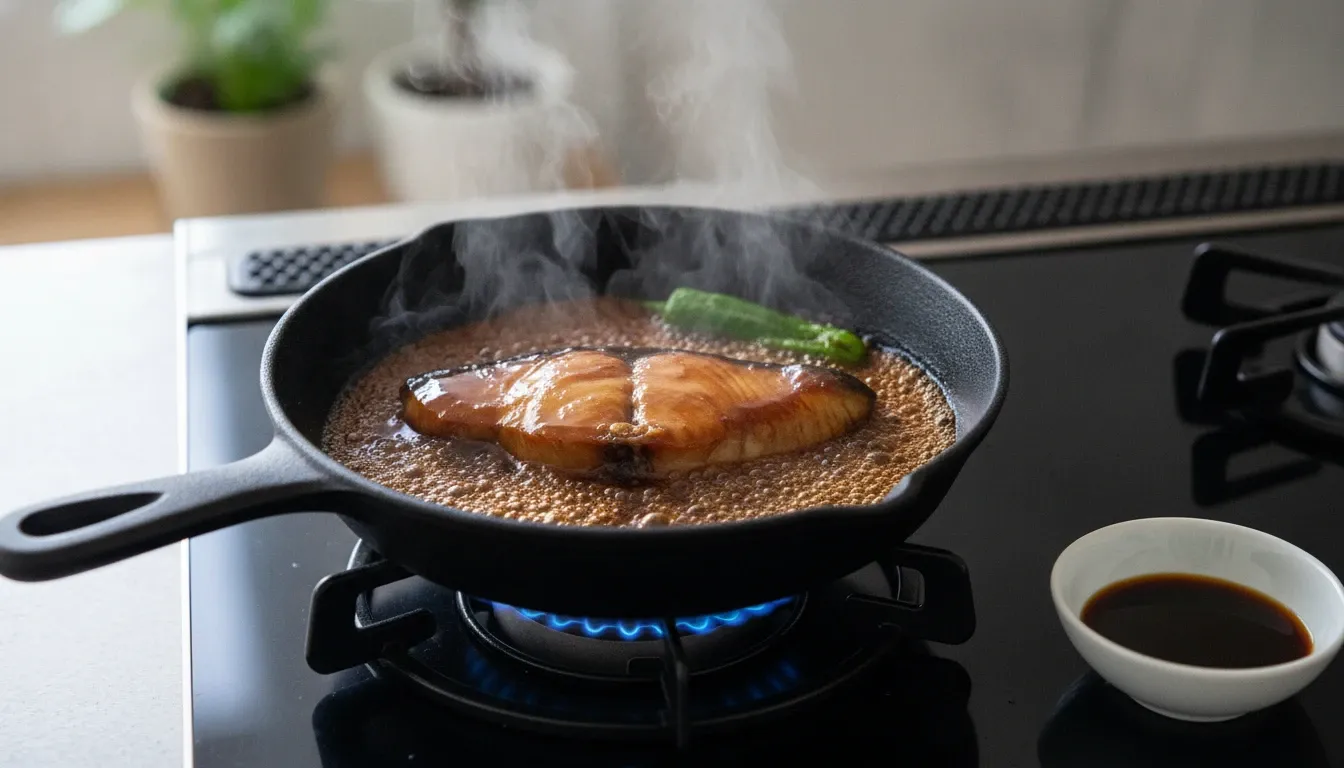
- A glossy teriyaki
- Use tamari. It has more amino acids, so it browns faster and deeper than regular Japanese soy sauce
Soy sauce holds more than 300 aroma compounds, along with amino acids, sugars, organic acids, and alcohol. Each of them evaporates, reacts, or breaks down at its own temperature.
So the same soy sauce turns into something different depending on how hot the pot is when it goes in, and when.
This article maps those changes across the temperature range and shows how to choose among them.
Soy sauce’s flavor at every temperature
| Temperature | Technique | Main chemical change | Flavor | Typical uses |
|---|---|---|---|---|
| Room temperature (raw) | Used as is | None; all volatile compounds remain | Vivid aroma; a sharp edge from the alcohol | Sashimi, hiyayakko (chilled tofu), shoyu-arai (a soy sauce wash) |
| 50–60°C (122–140°F) | Warming | Small loss of low-boiling compounds | The edge softens a little; turns mellow | A little added to hot dashi (Japanese stock of kombu and bonito flakes) |
| 80–85°C (176–185°F) | Nikiri (heating off the alcohol) | Ethanol and volatile organic acids are driven off | The sharpness goes; umami and sweetness come forward | Nikiri shoyu, kaeshi (a soy sauce base for noodle sauces) |
| 85–100°C (185–212°F) | Simmering | Slow Maillard reaction | Color deepens; richer and more complex | Added early to simmered dishes |
| Above 100°C (212°F), for a long time | Long simmering | Maillard products build up; aroma compounds escape | Darkens toward black; aroma turns heavy and flat | Kakuni (braised pork belly), tsukudani (foods simmered down in soy sauce) |
| 150–160°C (302–320°F) | Kogashi shoyu (scorched soy sauce) | Rapid Maillard reaction | Strong roasted aroma; nutty notes | Scorched soy sauce with butter, fried rice |
| Above 160°C (320°F) | Burning | Charring begins | Bitter, burnt smell | Avoid |
Many of the compounds behind soy sauce’s aroma have low boiling points. The hotter it gets, the more aroma you lose, and color and richness form in its place.
That trade-off between aroma and browning is the core of cooking with soy sauce.
Why soy sauce goes in twice
For simmered dishes, cooks add soy sauce in two rounds. This is oi-joyu (追い醤油, “chasing soy sauce”), and it is not just a rule of thumb. The chemistry backs it up.
The early addition builds flavor
- Purpose: flavor that soaks in, and richness
- Long heating drives the Maillard reaction, giving the liquid color and body
- It gives the amino acids time to work their way into the food
- Most of the aroma is lost, but this stage is about building the backbone of the flavor
The late addition brings aroma
- Purpose: aroma
- Add it just before or just after you turn off the heat
- The volatile aroma compounds survive, giving the bright smell that makes soy sauce smell like soy sauce
- It is heated only briefly, or by residual heat alone, so the color barely changes
The first soy sauce carries the flavor, and the second carries the aroma. Add it all at once, and the flavor gets in but the aroma is gone.
Which soy sauce stands up to heat
Soy sauces differ in amino acids, sugar, and pigments. So they also behave differently under heat.
| Type of soy sauce | Amino acids | Color change when heated | Maillard speed | Best use with heat |
|---|---|---|---|---|
| Koikuchi (濃口醤油, regular Japanese soy sauce) | Standard | Moderate | Standard | All-purpose, from simmering to finishing |
| Usukuchi (淡口醤油, light-colored soy sauce) | Somewhat low | Small | Slow | Dishes that show off the ingredients’ color. Avoid long, high heat |
| Tamari (たまり醤油, a thick, soybean-rich soy sauce) | Very high | Large | Fast | Teriyaki, glazes for grilled dishes |
Koikuchi is the everyday Japanese soy sauce, the kind in a standard Kikkoman bottle. In a Chinese recipe it can stand in for light soy, not dark soy. Dark soy is thicker, sweeter, and added mainly for color.
Usukuchi is not Chinese light soy either. It is paler than koikuchi but carries about 10% more salt, so use less of it.
Tamari suits teriyaki for a simple reason. Its nitrogen content, a measure of umami, is 1.5–2.0%, against 1.2–1.7% for koikuchi.
At high heat, that extra nitrogen drives the Maillard reaction all at once, for a fine gloss and a roasted aroma. In a simmered dish, though, tamari turns everything too dark, so match it to the dish.
Usukuchi stays off high heat because it exists to let the ingredients’ color show. Once heat forms melanoidins, you lose the reason you chose a pale soy sauce. Use it for finishing or brief heating.
Choosing temperature, soy sauce, and timing
Every way of using soy sauce comes down to three questions.
-
What do you want: aroma, or color and richness?
- Aroma → low heat, from room temperature to after the heat is off
- Color and richness → high heat, from simmering to scorching
-
Which soy sauce? Choose by how well it takes heat
- High heat → tamari or koikuchi
- Low heat, finishing → usukuchi or koikuchi
-
When does it go in? The timing changes its job
- Early in cooking → flavor soaks in
- At the end, or after the heat is off → aroma
Keep those three variables in mind, temperature, type, and timing, and your soy sauce cooking gets far more precise.