What this article answers
- Why soba dough breaks so easily
- Buckwheat cannot form gluten, so a binder or gelatinized starch has to hold the noodles together
- How much water to add
- 40–45% for 100% buckwheat, 45–50% for 80/20. Less on hot, humid days, more on dry ones
- The step that matters most
- Mizumawashi: add 2/3 of the water at once, then work in the rest until every grain is evenly moist
- How long to boil
- 90 seconds to 2 minutes, then chill in cold water at once. Boil right after cutting
Soba is hard to make because buckwheat flour does not hold together. It has none of the proteins that form gluten (gliadin and glutenin), so no amount of kneading builds an elastic network.
With udon, pasta, and Chinese wheat noodles, the question is how to tighten the gluten. Soba turns that question around: how do you hold a noodle together without any gluten at all?
Every technique and ratio in soba-making answers it in two ways. One is what you bind the dough with. The other is mizumawashi, working the water evenly into the flour.
That is where the gap between 100% and 80/20 soba comes from. It explains yu-gone, kneading with boiling water. And it is why soba-makers say mizumawashi is everything.
This article follows soba through every step, from choosing a ratio to mizumawashi and cutting.
How to make soba without gluten
In wheat noodles, gliadin and glutenin bond with water and kneading into a gluten network. That network gives the noodle both its bite and its ability to hold together.
Buckwheat is not related to wheat; it belongs to the knotweed family. It does contain protein, just not the kind that forms gluten.
| Wheat noodles (udon, pasta) | Soba | |
|---|---|---|
| What holds it together | A gluten network | Nothing (depends on a binder) |
| Why you knead | To develop the gluten | To bring the particles together and even out the water |
| How the dough behaves | Elastic and stretchy | Brittle; cracks as it dries |
So you do not knead soba to make it stronger. You bring it together and finish before it starts to break. That is a completely different way of thinking from wheat noodles.
Six steps, finished before the dough breaks
Seen this way, soba-making is a sequence for spreading the water evenly and finishing fast, before the dough can break. There are six steps, and they take about 30–40 minutes.
| Step | What you do | Key point |
|---|---|---|
| 1. Choose the ratio | Set the ratio of buckwheat to binder, and the amount of water | Water: about 40–45% for 100% buckwheat, 45–50% for 80/20 |
| 2. Mizumawashi | Scatter the water over the flour in several additions and moisten every grain evenly | The most important step. Add 2/3 of the water at once at the start |
| 3. Kukuri (gathering) and kneading | Gather everything into one mass and knead it | Press down and flatten it 100–150 times |
| 4. Rolling out | Dust with flour and roll into a thin sheet | Work fast so it does not dry out |
| 5. Cutting | Cut to an even width | About 2 mm is the standard width |
| 6. Boiling | Boil briefly in plenty of water | 90 seconds to 2 minutes, then chill in cold water at once |
Adjust the water for the weather. Flour takes up moisture from humid air, so use less water on a hot, humid day and more on a dry one. The sections below take each step in turn, with the reason behind it.
Why soba is unlike other noodles
Set soba beside other noodles and its oddness stands out. Udon, pasta, and Chinese wheat noodles go about it differently, but all of them are working out how to handle gluten. Soba is not in that contest at all.
| Noodle | The question | The means | Where it stands |
|---|---|---|---|
| Soba | How to hold it together without gluten | Binders, and gelatinizing starch (yu-gone) | Does not depend on gluten |
| Udon | How to tighten the gluten | Salt water tightens it | Tightened with salt |
| Chinese wheat noodles | How to tighten the gluten | Kansui (an alkaline salt solution) tightens it | Tightened with alkali |
| Pasta | How to make the most of the gluten | High-protein, coarsely milled durum | Relies on the strength of the flour |
| Rice noodles | Does not even need a binder | The rice starch gelatinizes and retrogrades on its own | Outside the gluten contest altogether |
Udon is a gluten noodle. Its dough is traditionally trodden underfoot to develop the gluten, then rested to mature. Soba has no gluten to develop, so kneading to strengthen the dough means nothing here.
Instead, you borrow a structure from a binder. You even out the water with mizumawashi. Then you finish cutting before the dough dries. The workflow has almost nothing in common with the three wheat noodles.
Rice noodles have no gluten either, but they sit one step further out. Soba still leans on a binder, whether wheat flour or yu-gone. Rice noodles need none, because the rice starch itself becomes the structure.
Soba is half a step outside gluten; rice noodles are a full step.
100%, 80/20, and soto-ichi compared
Japanese soba menus and flour bags use the terms juwari (十割, “ten tenths”) and nihachi (二八, “two-eight”). Both describe the ratio of buckwheat flour to binder, which is wheat flour.
| Name | Buckwheat flour : wheat flour | How easily it holds together | Flavor and texture |
|---|---|---|---|
| Juwari, 100% buckwheat (also called kiko-uchi) | 10:0 | Hard (needs techniques such as yu-gone) | The strongest buckwheat aroma. Breaks cleanly in the mouth |
| Soto-ichi | 10:1 (1 part binder added on top of 10 parts buckwheat) | Somewhat hard | Close to 100% in flavor, but easier to handle |
| Nihachi, 80/20 | 8:2 | Standard. The classic for handmade soba | A balance of aroma, holding together, and smoothness going down |
| Dowari (“equal parts”) | 5:5 | Easy | Leans toward wheat. Slippery, with a strong bite |
Easier dough means less aroma
The more wheat flour you add, the more gluten the dough has. It gets easier to make and less likely to break. But the buckwheat aroma fades by the same amount.
Nihachi is the classic because it sits at the balance point. You get the help of gluten without giving up much aroma.
Watch the counting, though. Soto-ichi and soto-ni (10:2) add the binder on top of 10 parts buckwheat. Nihachi counts the whole batch as 10. The bases are different.
How each binder holds the dough
Wheat flour is not the only binder, and each one works on a different principle.
| Binder | How it binds | Characteristics |
|---|---|---|
| Wheat flour | A gluten network forms the structure | The most common. Its strength can be adjusted through the ratio |
| Yamaimo (Japanese mountain yam) | Its sticky polysaccharides and protein glue the dough | Moist and smooth. Little effect on flavor |
| Egg | Its proteins set in the boiling water and fix the noodles in place | Less likely to break; a firm, springy bite |
| Yu-gone (boiling water) | Gelatinizes the buckwheat’s own starch into a paste | Adds no other ingredient. The standard technique for 100% buckwheat |
| Funori (a red seaweed) | The seaweed’s sticky polysaccharides glue the dough | Used in hegi soba, a regional style from Niigata, Japan. A distinctive, slippery texture |
Mizumawashi is the most important step
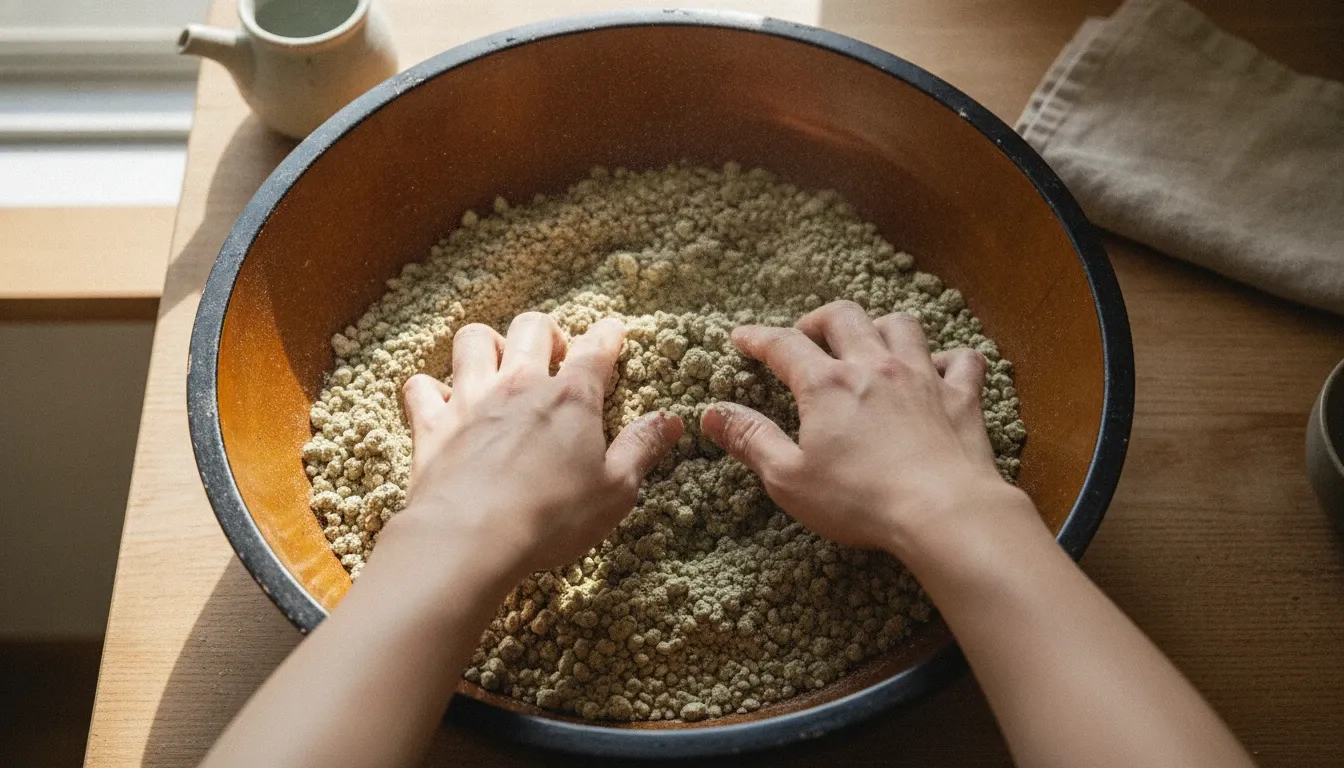
The most important step in soba-making is not kneading or rolling. It is the first one, mizumawashi: scattering water over the flour and stirring with both hands until every grain is evenly moist.
| How well the water is spread | What happens to the dough |
|---|---|
| Evenly | Every particle holds the same amount of water, so the dough comes together well and does not break easily |
| Unevenly | Only the damp parts set first, and every boundary with the dry parts becomes a weak point (a break) |
Gathering, kneading, rolling, and cutting
If mizumawashi goes well, all that is left is to bring the dough together and finish it. You do not develop it as you would a wheat dough. Even out the water, make the dough denser, and finish cutting before it dries.
| Step | What you do | Guide and tips |
|---|---|---|
| Kukuri | Pull the damp grains together into one mass | Think “gather,” not “knead” |
| Kneading (kiku-neri, “chrysanthemum kneading”) | Press it flat with the palm and push out the air | 100–150 times, until the surface is smooth |
| Rolling out | Dust with flour and roll it thin, to about 30 cm square | Uneven thickness causes breaks |
| Cutting | Cut to an even width against a koma-ita, a board that guides the knife | About 2 mm wide. Loosen the cut noodles with dusting flour |
Juwari cracks all at once when it loses moisture, so finish it faster than the other ratios.
Wheat doughs benefit from resting, but soba gains almost nothing from a long rest. There is no gluten tension to relax. The longer it sits, the drier and more crack-prone it gets, and the aroma fades. So boil it as soon as it is made.
Boil for 90 seconds to 2 minutes and chill it in cold water as soon as it comes out. That brings out its smoothness and aroma.
How the flour is milled changes the dough
The same buckwheat seed gives very different flours depending on which part you mill and how.
| Flour | What is milled | Color and flavor | How the dough behaves |
|---|---|---|---|
| Sarashina-ko (更科粉), the first flour | The center of the seed (mostly starch) | White and refined; restrained aroma | Low in protein and hard to hold together (often combined with yu-gone) |
| Second and third flours | The outer endosperm, toward the inner husk | Darker, with a rich aroma | More protein, so it comes together more easily |
| Hikigurumi (挽きぐるみ, whole-milled) | Everything, including the inner husk | Dark, with a rustic aroma (inaka soba, “country soba”) | Flavor comes first. If the grind is coarse, it breaks easily |
White sarashina soba looks refined but is hard to make. Dark inaka soba has a strong aroma. Color does not tell you how hard a soba is to make.
Most buckwheat flour bags say only light or dark. Light buckwheat flour is milled from hulled seeds, so it is closest to hikigurumi. Dark buckwheat flour also contains ground hull, seen as black flecks, and leans further toward inaka soba. Neither is sarashina-ko, which uses only the center of the seed.
Why soba breaks, stage by stage
Almost every soba failure comes down to one thing: the noodles break. Sort out the cause by the stage where it happens.
| When it breaks | Main cause | What to do |
|---|---|---|
| It will not come together in kukuri or kneading | Not enough water, or water spread unevenly in mizumawashi | Add water a little at a time. Do mizumawashi carefully and evenly |
| It cracks as you roll it out | The dough has dried out, or the thickness is uneven | Work quickly, and do not let waiting dough dry out |
| It breaks into short pieces in the pot | Not enough binder, the water boils too hard, or the dough sat too long | Review the ratio. Boil as soon as it is made |
The standard advice is to learn the steps with nihachi before you try juwari. If your nihachi still breaks, the ratio is not the problem. Look at mizumawashi or drying.
Bind it, wet it evenly, boil it fast
- Buckwheat flour has no gliadin or glutenin and cannot form gluten. Soba-making is the craft of deciding what holds it together
- Juwari is bound by yu-gone (gelatinized starch), nihachi by the gluten in wheat flour. The more wheat, the easier the dough and the fainter the aroma
- Besides wheat flour, binders include yamaimo (stickiness), egg (heat-setting), and funori. Each binds on a different principle
- The most important step is mizumawashi. Buckwheat flour absorbs water fast, and early unevenness cannot be fixed later
- Do not rest soba. Boil it as soon as it is made. Drying is its worst enemy
Udon is tightened with salt, Chinese wheat noodles with alkali, and pasta relies on the strength of its flour. All three are gluten noodles. Only soba, with no gluten at all, is built on a different idea.
Sources
- Yamada, Masaharu. (2019). The Science of Noodles: the texture, aroma, and umami that flour creates (Kodansha Blue Backs) (in Japanese). On soba binders and how starch holds dough together
- McGee, Harold. (2004). On Food and Cooking. On the properties of buckwheat proteins and starch
- Caputo. All about hydration (humid days need less water, dry days more)