What this article answers
- The whole process
- Knead flour, water, and salt; rest 30 minutes; roll thin
- Flour-to-water ratio
- 200 g medium-protein flour to 90–110 ml water (depends on water temperature)
- A softer, chewier wrapper
- Knead with boiling water (gelatinizes the starch)
- A springier bite
- Knead with cold water (builds gluten)
- The base tears, or the pleats are thick
- Roll the center thick and the edge thin
A gyoza wrapper has to roll out thin and hold a filling without tearing. The water you knead it with decides which texture leads.
Boiling water gelatinizes the starch for mochi-mochi, a soft, clinging chew. Cold water builds gluten for koshi, a springy bite that pushes back.
There are only three ingredients: flour, water, and salt. Every step, from the ratio to kneading, resting, and rolling, serves one goal. You want a thin wrapper that wraps without tearing, with the texture you are after. Make your own, and you control the thickness, the water content, and the texture.
This article walks through the whole process: choosing flour, mixing, kneading, resting, rolling, adjusting for pan-fried and boiled dumplings, and fixing failures.
What sets gyoza wrappers apart
Every wrapper dough has the same job: roll thin and wrap without tearing. Gyoza wrappers are medium in thickness. What sets them apart is that the water temperature can push their texture one of two ways.
Ultra-thin wonton and shumai wrappers are all about thinness. Gyoza wrappers have the range to lean toward either mochi-mochi or koshi.
| Wrapper | Thickness | Main way the texture is built | Target texture |
|---|---|---|---|
| Gyoza | Medium | A choice: cold water (gluten) or boiling water (gelatinization) | Designed anywhere between mochi-mochi and koshi |
| Wonton and shumai | Ultra-thin | Kansui (alkaline salts) and thinness | Slippery and light |
| Spring roll | Ultra-thin, cooked to form | Cooked on a hot griddle | Crisp |
So for gyoza wrappers, the decision comes down to one thing: cold water or boiling water. Flour, water temperature, resting, and rolling are all ways to carry out that choice.
Ingredients, and which flour to use
You need only flour, water, and salt. Start with the basic quantities.
| Ingredient | Amount (about 20 wrappers) | Role |
|---|---|---|
| Wheat flour | 200 g | The structure of the wrapper. The type of flour changes the texture |
| Water | About 100 ml (50% hydration) | Drives gluten formation and gelatinization as you knead |
| Salt | 2 g (about 1% of the flour) | Tightens the gluten and makes the dough easier to handle |
50% hydration is the midpoint. The right amount depends on the water temperature: 105–110 ml (52–55%) with boiling water, 90–100 ml (45–50%) with cold water.
Boiling water gelatinizes the starch, which then absorbs more water. So you need more of it to reach the same firmness.
The biggest choice is the flour. The more protein a flour has, the stronger its gluten and the more koshi the wrapper has.
| Flour | Protein | Gluten strength | Wrapper texture | Closest flour to buy |
|---|---|---|---|---|
| Low-protein flour | About 8% | Weak | Soft; leans mochi-mochi through gelatinization | US cake flour (7–9%) |
| Medium-protein flour | About 9% | Medium | A good balance of mochi-mochi and koshi | UK plain flour (9.5–11%) |
| High-protein flour | About 12% | Strong | Strong koshi; resists tearing even when boiled | US bread flour (12% and up), UK strong flour (12–14%) |
If in doubt, use a medium-protein flour alone. It is the hardest to get wrong. US all-purpose flour runs 9–12% protein, from medium to high, so a lower-protein brand comes closest.
Otherwise, a 2:1 blend of cake and bread flour comes close. The more bread flour you add, the stronger the koshi, and the better the wrapper suits boiled dumplings.
Mixing and kneading the dough
These are the basic steps, from adding water to a finished knead. The water temperature you choose here is your biggest lever on texture.
| Step | What to do | Key point |
|---|---|---|
| 1. Dissolve the salt | Dissolve the salt in the measured water | The salt spreads evenly through the dough |
| 2. Hydrate | Pour the water over the flour and stir with chopsticks into crumbly clumps | Add it all at once and mix quickly |
| 3. Bring together | Press the crumbs firmly into one mass | Until no dry flour remains |
| 4. Knead | Knead until the surface is smooth | 5–10 minutes. Done when it turns glossy |
Koshi and mochi-mochi are different textures
Every decision from here on comes down to koshi or mochi-mochi. Everyday Japanese tends to blur the two, so it helps to separate them first.
| Texture | What happens in your mouth | What it is | How to get it |
|---|---|---|---|
| Koshi | It pushes back against your teeth when you bite. It stretches without breaking and springs back (elasticity + extensibility = viscoelasticity) | The gluten network | Higher-protein flour, cold water, kneading |
| Mochi-mochi | It clings softly to your teeth. Little push-back | Gelatinized starch | Boiling water, leaning toward low-protein flour |
Koshi is the force that springs back; mochi-mochi is a soft stickiness. Boiled dumplings must not tear in the pot, so they lean toward koshi. Pan-fried dumplings, where a soft first bite matters most, lean toward mochi-mochi.
The koshi of udon noodles comes from the same gluten network.
Water temperature decides the texture
With the same ingredients, boiling water gives a mochi-mochi wrapper and cold water gives one with koshi. Use boiling water for mochi-mochi pan-fried or steamed dumplings. Use cold water for boiled dumplings, which need koshi to survive the pot.
Resting makes the dough easy to roll
Wrap the kneaded dough in plastic wrap and rest it for at least 30 minutes. This goes for pan-fried and boiled dumpling dough alike.
While it rests, water spreads through the whole dough, and the gluten tensed by kneading relaxes. The dough then rolls out far more easily. In short, resting is hydration plus stress relaxation.
Skip the rest, and the dough shrinks back and won’t go thin, so the wrapper ends up thick and tough. If you have time, rest it in the refrigerator for 1 hour to overnight. It gets even easier to handle.
Roll the center thick, the edge thin
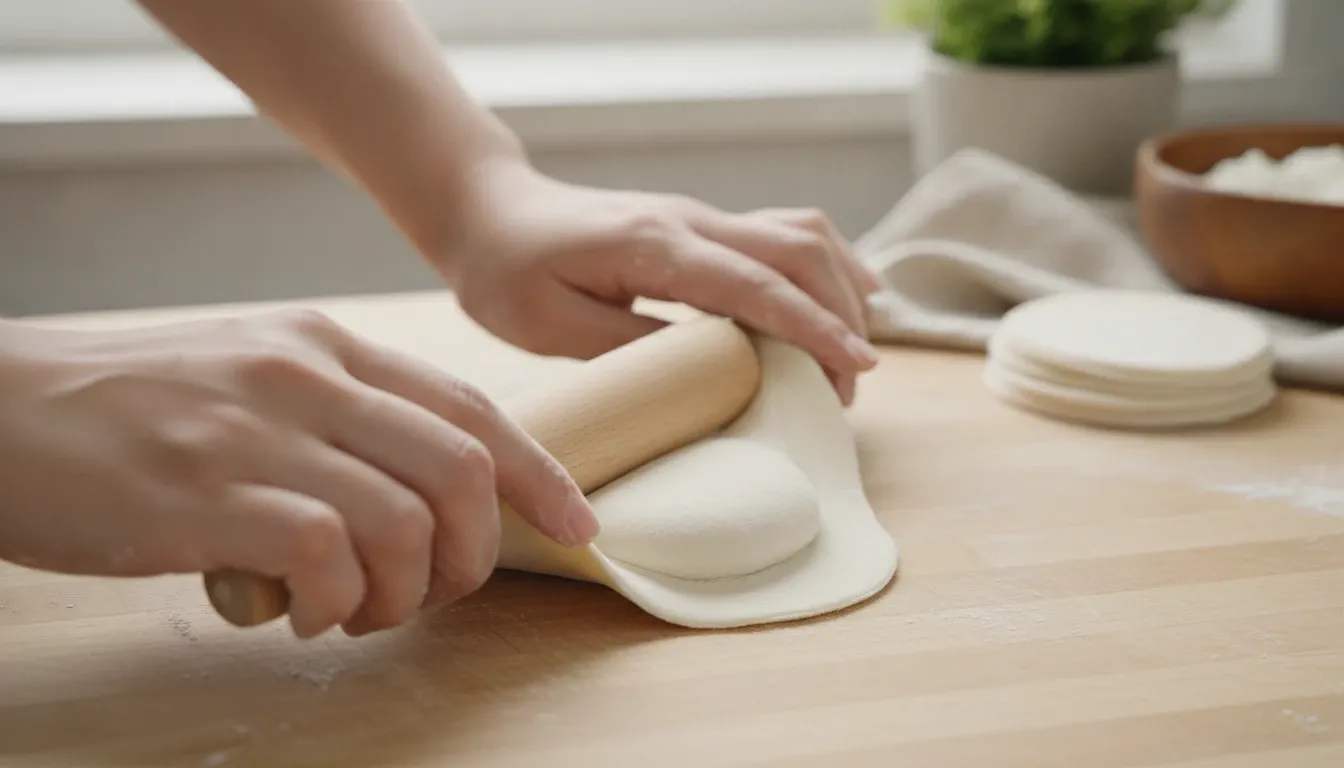
Shape the rested dough into a log and cut it into equal pieces, about 10 g each. Press each piece flat, cut side up, and roll it into a circle 8–10 cm (3–4 in) across.
The rule every professional follows here: thick in the center, thin at the edge.
| Part | Thickness | Why |
|---|---|---|
| Center | Thicker | It becomes the base, where the moisture and weight of the filling concentrate. Prevents tearing |
| Edge | Thinner | When you pleat, the dough overlaps at the edge and becomes more than twice as thick |
Wrappers for pan-fried, boiled, and steamed dumplings
Even among gyoza wrappers, the best formula changes with how you cook them: pan-fried, boiled, or steamed. The deciding factor is water temperature.
Chinese cooking has names for the two doughs: leng shui mian, kneaded with cold water, and tang mian, kneaded with boiling water. Boiled dumplings start from leng shui mian, steamed dumplings from tang mian.
| Pan-fried dumplings | Boiled dumplings | Steamed dumplings | |
|---|---|---|---|
| Water temperature | Warm to boiling (a partly scalded dough) | Cold (cold-water dough) | Boiling (hot-water dough) |
| Flour blend | More low-protein (e.g., low 7 : high 3, up to half and half) | More high-protein (e.g., high 7 : low 3) | More low-protein |
| Hydration | 52–55% with boiling water / about 50% with warm water | 45–50% | About 55% |
| Thickness and size | Thinner, about 10 cm (4 in) across | Thicker, about 8 cm (3 in) across | Ultra-thin, about 8 cm (3 in) across |
| Leading texture | Mochi-mochi | Koshi | Mochi-mochi + translucency |
| Goal | Mochi-mochi with a crisp base | Does not tear when boiled; keeps a bite that pushes back | Rolls thin enough for the filling to show through |
Why not use hot-water dough for boiled dumplings? In a hot-water dough, gelatinized starch leads, and boiling softens it further until no koshi is left. What survives boiling, the harshest test for a wrapper, is the gluten network of a cold-water dough.
Boiled dumplings gain the most from homemade wrappers. Japanese store-bought wrappers are mostly thin ones made for pan-frying. Boiled, they lack koshi and tear easily, so a thicker homemade wrapper with more high-protein flour really shines.
| Homemade wrappers | Store-bought wrappers | |
|---|---|---|
| Thickness | Can be designed for the dish | Uniform (mostly thin, made for pan-frying) |
| Water content | Hydration can be adjusted | Somewhat low, for machine production and shelf life |
| Mochi-mochi texture | Can be maximized with a hot-water dough | Few are made as hot-water dough |
| Suitability for boiled dumplings | Handled with more high-protein flour and a thicker wrapper | Thin ones tear easily when boiled |
Most tearing and toughness comes down to how the thickness is spread and how long the dough rested.
Common failures and fixes
All four of these can be recovered.
| Problem | Cause | Fix it now | Prevent it next time |
|---|---|---|---|
| The wrapper tears | The edge or base was too thin and the hydration too low, so the gluten could not hold up to the tension of wrapping | Rewrap the torn wrapper with less filling | Roll the center thicker, raise the hydration, and rest the dough |
| Wrappers stick together | Not enough dusting flour, so the starch on their surfaces touched and bonded | Peel them apart one at a time, dust with potato starch, and stack them again | Dust each wrapper with potato starch before stacking |
| The wrapper is tough and will not stretch | Not rested long enough, so the gluten stayed tense, and the hydration was too low | Rest it at least 30 minutes to relax the gluten | Rest at least 30 minutes, and longer if it shrinks back |
| The pleats will not hold | The edge is thick or has dried out, and has lost the plasticity to take a fold | Brush a thin film of water on the dry edge to soften it, then fold | Roll the edge thin, and cover the wrappers with a damp cloth so they do not dry out |
Water temperature is the switch
| Step | What it changes | Guideline |
|---|---|---|
| Flour | How strong the koshi is | Medium-protein flour (UK plain, or a lower-protein US all-purpose). Without it, cake : bread flour = 2:1 |
| Water temperature | Which way the texture goes | Boiling = mochi-mochi, cold = koshi |
| Resting | How easily it rolls | At least 30 minutes (1 hour to overnight in the refrigerator) |
| Rolling | How the thickness is distributed | Thick center, thin edge |
| Use | Which flour and water to combine | Pan-fried = more cake flour + warm to boiling water / boiled = more bread flour + cold water |
Only the hot-water dough lives or dies by technique. Add freshly boiled water all at once and mix quickly.
If sorting by dish is too much trouble, make a 1:1 blend of bread and cake flour your standard for both. It works like medium-protein flour, and you change only the water temperature.
Ultra-thin wonton and shumai wrappers follow a different design, built on kansui and thinness.
Sources
- McGee, Harold. (2004). On Food and Cooking. On starch gelatinization and gluten formation in wheat doughs
- Yamada, Masaharu. (2019). Men no Kagaku [The Science of Noodles: Texture, Aroma, and Umami Created by Flour] (Kodansha Blue Backs) (in Japanese). On hydration and the texture of wheat doughs
- America's Test Kitchen. What is the difference between bread flour, all-purpose flour, pastry flour, and cake flour?