What this article answers
- What arroser is
- Tilting the pan to pool butter, then spooning it over the food again and again as it cooks
- When to start basting
- Once the butter foams with fine, fizzing bubbles, at 130-150°C
- I basted, but it only tastes greasy
- You started while the bubbles were still large, at 100-120°C
- Basted fish smells fishy
- Wipe away the juices the fish releases and baste with butter only
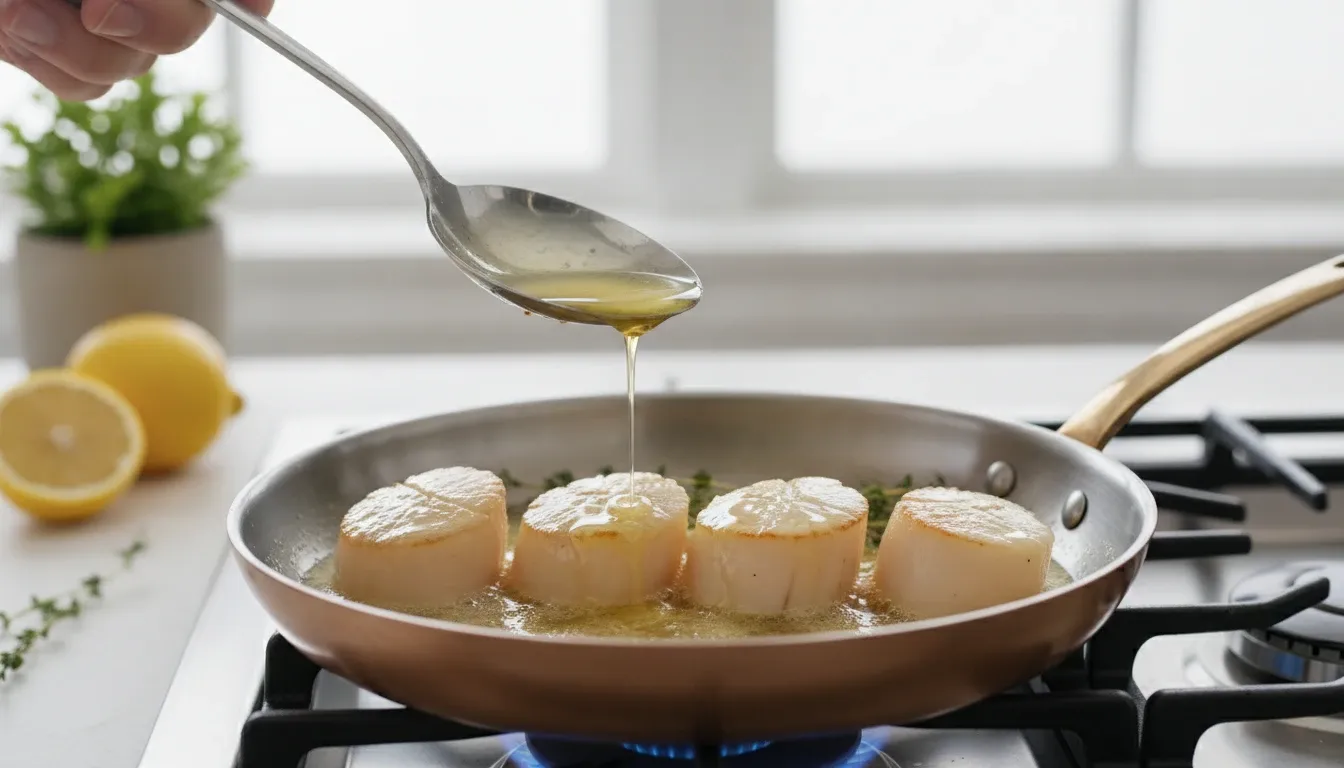
Arroser is the French technique of spooning melted butter or pan juices over food as it cooks. Done well, it gives a browned, toasty surface and a juicy inside.
This article covers what basting does and why, how to do it, and how to read the butter’s temperature. It also covers meat versus fish, and similar techniques in Japanese and Chinese cooking.
Pool the butter, then spoon it over
Arroser is French for “to water” or “to pour.” In the kitchen, you tilt the pan so melted butter and juices pool at one side. Then you spoon them over the food, again and again.
French cooks use it to finish a poêlé (meat or fish pan-roasted in fat) or a sauté. It cooks the food evenly and gives it a buttery flavor and a good brown color.
Why basting makes food taste better
Basting works on both the surface and the inside. Comparing it with a sauté shows what it adds.
How it differs from a sauté
If both cook in butter, are they the same? The results are quite different.
| Arroser (basting) | Sauté | |
|---|---|---|
| Butter flavor | Builds up in layers with each spoonful, so it is rich | Only where the food touches the pan, so it is simple |
| Toasty flavor | The top browns too | Only the side touching the pan |
| Juiciness | Gentle heat keeps the juices in | High heat pushes juices out |
| Texture | Crisp outside, juicy inside | Even all the way through |
The top gets flavor and color too
Each spoonful of butter adds another layer of flavor to the surface. Foaming at 130–150°C (266–302°F), the butter adds a nutty, toasty aroma. At that point the solids on the bottom run from gold to the hazelnut brown of beurre noisette.
In a sauté, the butter only works where the food touches the pan, so the flavor tends to be flat.
The Maillard reaction starts once the surface water has boiled off and the surface passes 100°C (212°F). The hotter it gets, the faster it goes. Hot butter spooned on top heats the top as well. So food cooked on one side browns all over without being turned.
Because the food cooks under a film of fat, its surface dries out less than in a hot sauté.
Heat from above cooks the inside evenly
Cooked on one side, food gets heat only from the face touching the pan. Basting adds heat from above. Even a thick piece cooks evenly, and you avoid an overcooked outside with a raw middle.
A sauté cooks both sides over high heat, so the gap between surface and center tends to be large.
Basting cooks gently at a lower temperature. The proteins contract slowly, so less juice runs out.
A sauté on high heat makes the meat contract fast, and juice runs out more easily. Searing the surface does not seal the juices in.
Read the butter’s temperature by its foam

The butter’s temperature matters more than anything else in basting. You can read it from the foam.
| Temperature | What the foam looks like | What it means |
|---|---|---|
| 100–120°C (212–248°F) | Large bubbles boiling up | Water is still boiling off. Not hot enough yet |
| 130–150°C (266–302°F) | Fine foam, fizzing steadily | Ideal. Baste now |
| 150°C (302°F) and above | The foam disappears and the milk solids darken | The top of the noisette range. Above 160°C (320°F) it burns, so take it off the heat |
Butter is about 80% fat, about 16% water, and around 1% milk solids, with lactose and the like making up the rest. As it heats, the water boils off. The milk solids turn gold at 120–140°C (248–284°F) and hazelnut brown (beurre noisette) at 140–150°C (284–302°F).
These temperatures come from a thermometer in the melted butter. They match the range used for browning butter in French sauces. This stage smells best and suits basting best.
How to baste, step by step
What to prepare
| What | Guide | Why |
|---|---|---|
| Food | Meat or fish at least 2 cm (¾ in) thick | Thinner pieces cook faster if you just turn them |
| Food | Out of the fridge for about 30 minutes, to room temperature | So the surface doesn’t finish before the center warms up |
| Food | Pat the surface dry with paper towels | Water makes the butter spit and emulsify |
| Butter | Plenty: 30–50 g for two servings. Salted or unsalted | You need enough to pool and spoon. Salted butter burns more easily |
| Pan | Stainless steel or carbon steel with sloping sides | Butter pools easily, and heat spreads well |
| Tool | A large metal spoon | It scoops more at once |
The basic steps
- Heat the pan with a little oil and brown one side of the food over medium-high heat. Once it is browned, don’t turn it. Lower the heat to medium-low
- Add the butter beside the food and wait for it to melt and start foaming
- Lift the handle and tilt the pan toward you so the melted butter pools on the far side
- Spoon up the butter and pour it over the top and over thick parts that cook slowly
- Keep going, once every 1–2 seconds, almost without pause. Add butter when it runs low
| Food | Thickness | Basting time | Rough number of spoonfuls |
|---|---|---|---|
| Steak | 2 cm (¾ in) | 2–4 minutes | 60–120 |
| Chicken thigh | Bone-in | 3–5 minutes | 90–150 |
| White fish | 2 cm (¾ in) | 1–2 minutes | 30–60 |
Adjust for doneness and thickness.
Keep the heat under the butter pool
With the pan tilted, keep the heat source under the side where the butter pools.
Over the heat, the pooled butter doesn’t cool, so basting keeps working. And with no heat right under the food, its underside is less likely to burn. You can also adjust the heat while watching the foam.
On an electric or induction hob, the same rule means keeping the low side of the pan on the element. On induction, keep that edge touching the glass: induction heats the pan itself and stops once the pan is lifted off.
| What the butter is doing | What to do |
|---|---|
| Fizzing with fine foam | Stay at medium-low and keep the pan tilted |
| About to burn | On high heat it burns quickly. Take the pan right off the heat and keep basting on the stored heat |
| Cooling down | Put it back on the heat |
How to tell it is done
| What to check | Sign that it is done |
|---|---|
| Color | Even browning across the whole surface |
| Butter | It has turned beurre noisette (hazelnut brown) and smells nutty |
| Firmness | Pressed with a finger, it feels like the doneness you want |
Rest the meat, turn the butter into sauce
Move the food to a plate or board with tongs or a spatula, and leave the butter in the pan. For meat, set it skin side up, cover loosely with foil, and rest it for 2–3 minutes.
The juices redistribute inside, so less runs out when you cut it. Carryover heat keeps cooking it while it rests, so take it off a little early.
The beurre noisette left in the pan is already a sauce.
| How to use it | What to add |
|---|---|
| As it is | Pour it over the food and serve |
| Beurre noisette citron | A little lemon juice for acidity |
| With herbs | Parsley or capers |
| Deglazed | White wine, to dissolve the browned bits on the bottom of the pan |
Basting meat, fish, and vegetables
Meat: brown it, then baste on low heat
Meat is where basting is most common and works best.
| Food | Before basting | While basting | When to stop |
|---|---|---|---|
| Steak | Brown both sides over high heat (1 minute each) | Turn the heat down, add butter, and baste with the juices and butter together | 3–4 minutes for medium-rare |
| Chicken (bone-in thighs, etc.) | Cook skin side down over medium heat until the skin crisps | Don’t turn it. Add butter and baste the thick parts | 75°C (167°F) at the center |
You can also turn the chicken once the skin is browned and baste it skin side up. The skin picks up butter flavor, and the film of fat keeps it crisp.
Baste too much, though, and the skin goes soft. Keep the amount and the number of spoonfuls modest.
| Method | Best for |
|---|---|
| Baste without turning | Cooking the flesh side through, moist and juicy |
| Turn, then baste | Butter flavor on the skin, and crisp skin |
Fish: baste with butter only, not its juices
Baste fish with its own juices, and the fishy smell goes into the butter. This gets worse the less fresh the fish is.
| What to do | How |
|---|---|
| Baste with butter only | Wipe away the fish’s juices with paper towels |
| Use fresh butter | Old butter picks up fishy smells easily |
| Flavor with herbs or garlic | Add thyme, rosemary, or crushed garlic to the butter |
| Finish quickly | Fish cooks fast, so baste only about 5–10 times |
Thick white fish (sea bream, sea bass, flounder), salmon, and yellowtail suit basting. For how far to cook each fish, see fish heat control.
Vegetables: drive off water first, then baste
Basting gives vegetables color and aroma. Thick slices of potato, mushrooms, asparagus, and zucchini suit it.
Vegetables hold a lot of water, so brown the surface first to drive it off. After adding the butter, baste slowly over low heat. Thyme or rosemary in the butter lifts the aroma.
Why it ends up just greasy
The most common failure is food that only ends up greasy, not better. Basting is a finish after browning. Miss either the temperature or the first browning, and no toasty flavor builds up.
| Cause | What happens | Fix |
|---|---|---|
| The butter is too cool (large bubbles, 100–120°C) | Water is still in it, so you are just pouring lukewarm butter | Wait for the fine, fizzing foam (130–150°C) |
| The first browning was too light | The food more or less simmers in fat | Before basting, brown one side well over high heat |
| The surface was wet | Water repels the butter, and the two emulsify into a sticky film | Pat the food dry with paper towels before cooking |
| The heat is too low | The butter cools and only soaks into the food | Keep it at medium-low so the butter stays hot |
Do other cuisines baste with hot fat?
Do other cooking traditions pour hot fat over food the way arroser does?
Japanese cooking has no equivalent
Japanese cooking has no technique of pouring hot fat over food again and again. It has traditionally used little fat, and what it pours over food is mostly dashi (stock) or sauce. A cooking philosophy that favors the ingredient’s own flavor lies behind this too.
The closest pouring technique is shimofuri: pouring boiling water over fish or meat. But that is prep to remove odor, so its aim differs from basting, which adds flavor.
Chinese lin you (淋油)
Chinese cooking has a technique close to basting. Hot oil is poured over steamed fish or poached chicken with a sizzle. It adds a toasty aroma, crisps the surface, and wakes up the scallion and ginger on top.
It differs from basting in three ways. The oil goes on once at the end, not again and again. It is vegetable oil, such as sesame oil, not butter. And it comes after cooking, not during.
The three compared
| Technique | Cuisine | Fat | When | Main aim |
|---|---|---|---|---|
| Arroser | French | Butter | Repeatedly, during cooking | Flavor, even cooking |
| Lin you | Chinese | Vegetable oil | Once, at the end | Aroma, a finished surface |
| (none) | Japanese | – | – | No technique of pouring fat developed |
French and Chinese cooking developed ways to pour hot fat over food. Japanese cooking pursued methods that don’t rely on fat. The difference reflects each cuisine’s approach to food.
Common failures and fixes
A fishy smell and dried-out meat can be only partly saved. Every other problem here can be fully fixed.
| Problem | Cause | Fix it now | Prevent it next time |
|---|---|---|---|
| The butter burned | The heat was too high, and the milk solids went past browning to burnt, giving bitterness and black specks | Pour off the burnt butter and baste again with fresh butter | Keep the heat at medium-low, and take the pan off the heat once the butter colors |
| It cooked unevenly | Too few spoonfuls, so not enough hot butter reached the thick parts | Focus the butter on the thick parts to even out the cooking | Baste 10–20 times, focusing on the thick parts |
| The oil spatters | Water on the food boils suddenly in the butter, and the steam throws the fat | Lower the heat and wait for the water to boil off before going on | Pat the surface dry with paper towels before cooking |
| It smells fishy | Basting put the fish’s juices, with the trimethylamine dissolved in them, back on the surface | Pour off the juices, switch to fresh butter, and lift the aroma with lemon | Don’t use the juices. Baste with butter only and flavor it with herbs |
| The center is undercooked | The food went in cold, and the center didn’t heat up in the time the surface took to finish | Keep basting, or move it to a low oven to cook through | Take it out of the fridge 30 minutes before cooking |
| It is just greasy | The butter was too cool to give off aroma, and the browning was too light to add a toasty flavor | Re-brown the surface on high heat, bring the butter up to fine foam, and baste again | Brown on high heat before basting, and bring the butter up to fine foam |
| The aroma is weak | The temperature was too low, so the milk solids never browned to noisette | Raise it to 140–150°C and baste once the specks on the bottom turn hazelnut brown | Hold 130–150°C and baste while the specks are between gold and hazelnut brown (beurre noisette) |
| The meat is dry | The surface dried between spoonfuls, and high heat made the fibers contract and lose water | Coat it in the butter or pan juices to add moisture back, and slice it thin | Baste steadily and hold medium-low heat |
| The surface is soggy | The butter still held water when you basted, so the surface steamed and went limp | Turn up the heat to drive the water off the surface again | Start basting only once the large bubbles are gone and the water has boiled off |
Keep the butter in range
Arroser is one of the signature ways French cooks control heat.
- What it is: spooning melted butter over food as it cooks
- What it does: even cooking, good color, butter flavor, and juices kept in
- Butter temperature: 130–150°C (266–302°F), when the foam is fine and fizzing
- The steps: brown one side, add butter, tilt the pan, spoon it over (10–20 times)
- Meat versus fish: meat juices can go in the butter. For fish, use butter only, to keep the fishy smell out
Practice on a thick chicken thigh
To practice basting, use a thick chicken thigh. It is forgiving, and you can see the change: crisp skin and a juicy inside.
Sources
- McGee, Harold. (2004). On Food and Cooking: The Science and Lore of the Kitchen. Scribner. Butter temperature ranges and the chemical changes in them
- López-Alt, J. Kenji. The Food Lab: Better Home Cooking Through Science. How to cook a steak and what basting does
- Beranbaum, R. L. "Clarifying Clarified Butter and Brown Butter/Beurre Noisette" Real Baking with Rose (2019). Thermometer readings in melted butter: 137–140°C when the solids on the bottom are pale gold, 140–143°C when they are dark brown (beurre noisette)