What this article answers
- Why French cooks finish with butter and cream
- For gloss, body, and dairy aroma. Boiling changes the aroma, so they go in last
- How much butter to finish a sauce
- 80–140 g per liter of sauce in the source text. 16–28 g for 200 ml at home
- What temperature to add butter at
- Melt cold butter into sauce at 45–55°C. Above 60°C, the sauce splits
- When to stop browning butter
- At 140–150°C, when the solids on the bottom turn golden brown and smell of nuts
A chicken sauté recipe ends: “Turn off the heat, add 20 g of cold butter, and swirl the pan until it melts.” Isn’t 20 g a lot? Why turn off the heat? Can’t you just boil it in?
French cooks add butter and cream last, and once they are in, the sauce doesn’t boil. The source text gives the amount as 80–140 g per 1 L of sauce, and temperature tells you when to stop.
This article covers why French cooking finishes with butter and cream, how much goes in at each step, and where to stop.
Butter and cream go in last
Here are the steps where French cooks add dairy fat, with when it goes in and where it stops. “Stop” means taking the pan off the heat or ending the reduction.
| Step | When it goes in | How much | Where to stop |
|---|---|---|---|
| Monter au beurre (finishing butter) | Once the sauce is made, off the heat | 80–140 g per 1 L of sauce | Melt at 45–55°C (113–131°F). No boiling after |
| Beurre noisette (browned butter) | After the fish or meat is cooked, in a separate pan | 20 g for 1–2 fish fillets | 140–150°C (284–302°F), solids golden brown |
| Reducing with cream | While the sauce liquid reduces | 200–250 ml per 1 L of sauce | Reduced by a third, coating the back of a spoon |
| Finishing cream | Last, after reducing and straining | 100–150 ml per 1 L of sauce | Stirred in raw. No more reducing |
Sources: amounts from the soup and sauce recipes in Le Guide Culinaire, 2nd edition. Temperatures from this site’s articles on emulsion sauces and meunière. The noisette amount is the sauce amount for meunière.
At every step, the dairy fat goes in near the end. That sets it apart from the bases made ahead (fond, glace, and roux).
Escoffier said never boil once butter is in
The reason for adding it last comes from Le Guide Culinaire, the cookbook by the chef Auguste Escoffier (1846–1935). First published in 1903, it gives the timing and amount of dairy fat for each soup and sauce.
Off the heat, in the last minute
In the section on thickened soups, Escoffier wrote that the finishing is done off the heat in the last minute. The ratio is 80–100 g of butter per 1 L of soup.
Sauces follow the same pattern. For sauce Bercy, a fish sauce, the pan comes off the heat before 100 g of butter and parsley go in.
Boiling changes the butter’s aroma
In the same section, Escoffier wrote that a soup with butter in it must never boil again, and called this an absolute rule. Boiling changes the butter’s flavor, he said, and that flavor must come through clearly in the soup.
Diacetyl, the aroma compound in cultured butter, boils at about 88°C (190°F). Boiling carries it off with the steam. So butter kept for its aroma goes in off the heat.
Cream soups get no butter
Escoffier separated soups finished with cream (crèmes) from soups bound with egg yolk (veloutés).
| Soup | Binder | Added last (per 1 L) |
|---|---|---|
| Crème | Thin béchamel | 200 ml of very fresh cream. No butter, no egg yolk |
| Velouté | 3 egg yolks and 100 ml of cream | 80–100 g of butter |
Sources: the rules for crèmes and veloutés in Le Guide Culinaire, 2nd edition.
A crème is finished with cream alone, with no butter on top. Some sauces, like the chicken suprême, take both cream and butter. The source text spells out which goes in, dish by dish.
80–140 g of butter per liter of sauce
These are the source recipes, converted to 1 L of sauce and to 200 ml, a home sauce for 2.
| Dish | Source amount | Butter per 1 L (g) | Butter per 200 ml (g) |
|---|---|---|---|
| Thickened soup | 80–100 g of butter per 1 L | About 90 | About 18 |
| Sauce suprême for chicken | 80 g of butter and 100 ml of cream per 1 L | About 80 | About 16 |
| Sauce Bercy for fish | 100 g of butter per about 1.1 L | About 90 | About 18 |
| Sauce normande for sole | 125 g of butter per about 900 ml, cream included | About 140 | About 28 |
Sources: Le Guide Culinaire, 2nd edition. The 1 L and 200 ml columns are the writer’s conversion, divided by the sauce volume before the butter goes in.
The white chicken sauce takes about 80 g, and the fish sauces take 90–140 g. Fish sauces take more.
Richer than any sauce is glace de viande beurrée. Melt 125 g of butter (250 g per 1 L) and a few drops of lemon juice into 500 ml of reduced fond.
Escoffier served this with small meat dishes garnished with vegetables. A thickened sauce would break down in the water from the vegetables.
For a 200 ml pan sauce at home, start with 16–20 g of butter. Cut the cold butter into 5 g pieces, and you can add more while watching how fast it melts.
When to stop, by temperature and look
Every step that adds dairy fat has a stopping temperature, and a look that goes with it.
Mount at 45–55°C, once the edges go still
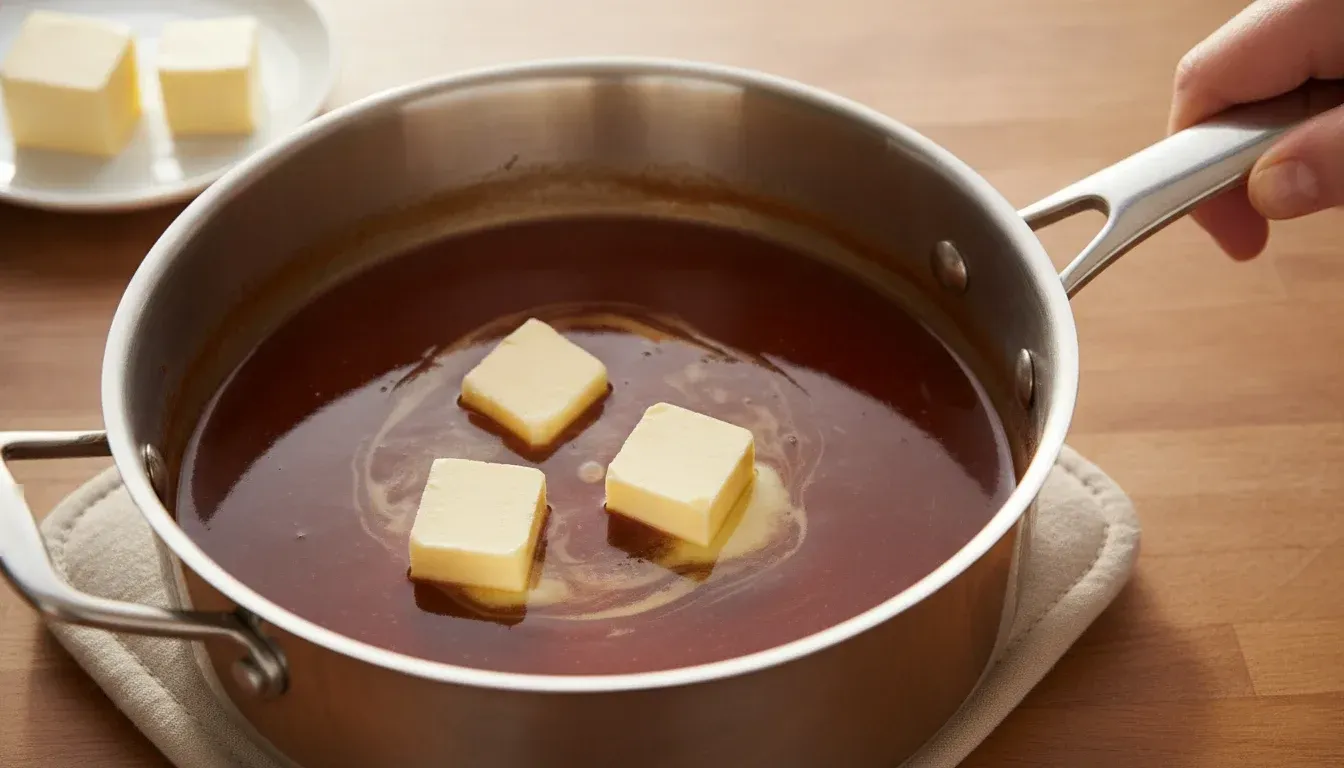
Take the sauce off the heat. Check with a thermometer that it has dropped to about 50°C (122°F), then add butter straight from the fridge. Swirl the pan to melt it, and add the next piece before the last one is fully melted.
With no thermometer, touch a little sauce on a spoon to your lips. Wait until it is hot but sippable (the writer’s own rule of thumb). Cold butter takes heat from the sauce as it melts, so the sauce cools as you go.
Cold butter, at about 5°C (41°F), melts slowly in sauce at 45–55°C (113–131°F). Milk proteins wrap the fat, and the sauce turns glossy with body. Above 60°C (140°F), the fat separates and floats. Below 40°C (104°F), the butter won’t fully melt.
Once it is all melted, no oil beads float on the surface, and a thin film stays on the back of a spoon. Don’t put it back over direct heat. To rewarm, set it over a pan of hot water.
Brown butter at 140–150°C, then move it
Noisette is French for hazelnut. Butter heated to that color is beurre noisette. Melt it over medium-low heat. The large bubbles turn to fine ones, and when the foam settles, the solids on the bottom turn golden brown.
At 140–150°C (284–302°F), when it smells of nuts, take it off the heat and pour it over the food or into a cold dish. Left in the pan, it keeps darkening. Above 160°C (320°F), it turns black and bitter.
For fish meunière, Escoffier said to squeeze lemon over the fish, scatter blanched parsley, pour on the browned butter, and serve at once. The hot butter foams on the wet parsley, and he wanted that foam still there in front of the guest.
Reduce cream by a third, then refresh it
Cream goes in twice. The first addition is reduced to build body. The second goes in raw at the end.
For sauce suprême, 250 ml of cream goes little by little into 1 L of chicken velouté, which boils hard until it is reduced by a third. After straining, 100 ml of cream and 80 g of butter go in.
Sauce à la crème works the same way. Béchamel and 1.2 L of cream reduce to 750 ml, and 150 ml of fresh cream brings it back to the right thickness.
Stop reducing when the sauce thinly coats the back of a spoon, and a line drawn through it with a finger doesn’t close at once. The rest of the thickness comes from the raw cream and butter added last.
Reduce only high-fat cream
French cream names follow milk fat
The French decree names cream by its milk fat.
| Name | Condition in the decree |
|---|---|
| Crème | At least 30% milk fat |
| Crème légère | 12% to under 30% milk fat |
| Crème fraîche | Pasteurized only, and packed within 24 hours of being made |
Source: French cream decree (Décret n° 80-313).
The fraîche in crème fraîche is a condition of freshness, not a fat level. At 30% milk fat or more, it is crème fraîche. Below that, crème légère fraîche.
The thick crème fraîche on French shelves is cultured with lactic acid bacteria. The decree doesn’t separate that thickness by name.
For reducing, choose at least 30% milk fat
The more milk fat in the cream, the less it curdles when boiled. The membrane around each fat globule holds on to milk proteins and keeps them from clumping together.
Many of the source recipes use crème for reducing and crème double (thick cream) for the final addition. At home, choose cream with at least 30% milk fat.
In US shops, heavy cream has at least 36% milk fat, which clears that line. In the UK, whipping cream (at least 35%) and double cream (at least 48%) do. Single cream and US light cream start at 18%, in the crème légère range.
If the pan holds wine or lemon acid, reduce the wine all the way first, then add the cream. Lower-fat cream has fewer fat globules to hold the proteins, and splits easily when boiled with acid.
How much fat Japanese and Chinese cooks add
Every cuisine adds something at the end to balance the dish. The difference is how much fat goes in.
| Cuisine | Fat added to finish | Fat added to one dish for 2 (g) |
|---|---|---|
| Japanese (simmered dishes, soups) | None. Body comes from the umami of dashi and soy sauce | 0 |
| French | Butter or cream | 16–28 |
| Chinese | Ming you (finishing oil), swirled down the side of the wok | 4–10 |
Sources: this site’s article on umami in Japanese cooking, Ming You, and Le Guide Culinaire, 2nd edition. The Chinese figure doubles ½–1 tsp (2–5 ml) per serving of stir-fry, at 1 ml of oil ≈ 1 g. The French figure is per 200 ml of sauce.
Ming you is a few grams for gloss and aroma, and the stir-fried food carries the dish. French butter goes into a 200 ml sauce at 16–28 g, and becomes part of its flavor.
France also eats a lot of dairy fat. The French eat the most in Europe: 8.2 kg per person in 2022.
Japanese simmered dishes cook in dashi with no added fat. Nikujaga, a Japanese beef-and-potato simmer, has 1.3 g of fat per 100 g. Beef stew made with butter and roux has 12.6 g, so nikujaga has about a tenth.
Conditions that make it work
| When | What to do | Why |
|---|---|---|
| You want to keep the sauce warm | Hold it over hot water, below 60°C (140°F) | Back over direct heat, it passes 60°C and splits |
| You have AOP (EU protected origin) or cultured butter | Use it only for mounting. Use ordinary butter for browning and sautéing | The aroma escapes at about 88°C (190°F) |
| Fatty meat, such as duck or marbled beef | Keep butter to 10 g or less per 200 ml, and serve an acidic sauce | The butter’s fat piles onto the meat’s fat |
| You have only 3–4 tbsp (45–60 ml) of sauce | Add butter 5 g at a time. When it stops melting, set the pan bottom over hot water | A small amount drops below 45°C from the cold butter |
| You only have salted butter | Melt it all in, then taste before adding salt | 20 g of salted butter holds about 0.4 g of salt |
The salt figure uses 1.9 g of salt per 100 g of salted butter, from Japan’s food composition tables. Salt levels vary by brand, so check your label.
Common failures and fixes
Burnt butter cannot be fixed. A split sauce and a greasy sauce can be partly saved. An over-reduced cream sauce can be fully fixed.
| Problem | Cause | Fix it now | Prevent it next time |
|---|---|---|---|
| The sauce splits | The sauce went back on the heat after the butter and passed 60°C. The milk proteins set and could no longer hold the fat, so oil beads rose | Take it off the heat, add 1 tbsp (15 ml) of cold cream or cold water, and whisk from the center out. If it has browned, it won’t come back | Melt butter off the heat at 45–55°C, and don’t boil after. To rewarm, use a pan of hot water |
| The butter burns | It stayed on the heat after the foam settled and passed 160°C. The milk proteins and lactose on the bottom went past browning, burned, and turned bitter | Butter with black specks can’t be saved. Wipe the pan and brown fresh butter | At 140–150°C, when the solids are golden brown and smell of nuts, move it to a cold dish or onto the food |
| The cream sauce is too thick | It was reduced past the point of losing a third. Too much water boiled off, and the sauce got heavy enough to hold a spoon mark | Take it off the heat and add cream or fond 1 tbsp (15 ml) at a time, until it thinly coats the back of a spoon | Stop reducing once it coats the back of a spoon. Build the rest of the thickness with the raw cream and butter added last |
| The sauce is greasy | A sauce for fatty duck breast got as much butter as a sauce for white fish. The butter’s fat piled onto the meat’s fat and coated the mouth | Add no more butter. Sharpen it with 1 tsp (5 ml) of wine vinegar or lemon juice | For fatty meat, choose an acidic sauce over a butter sauce. If you use butter, keep it to 10 g or less per 200 ml |
Four things to remember
French butter and cream are dairy fat added last, once the sauce is made, and never boiled after.
- Add finishing butter off the heat in the last minute. Boiling changes the butter’s flavor, so the sauce never boils again.
- The amount is 80–140 g per 1 L of sauce in the source text, or 16–28 g for 200 ml at home.
- Stop at 45–55°C for mounting, at 140–150°C for beurre noisette, and when the cream has reduced by a third.
- Don’t add butter to cream soups, and reduce only cream with at least 30% milk fat.
Back to the chicken sauté: take the deglazed, reduced sauce off the heat and melt in 20 g of cold butter, 5 g at a time. With 200 ml of sauce, 20 g falls inside the source ratio (16–28 g).
Sources
- Escoffier, A. Le Guide Culinaire, aide-mémoire de cuisine pratique (first edition 1903; quoted from the 2nd edition, Émile Colin) (in French). Thickened soups (potages liés), sauce suprême, sauce à la crème, sauce normande, sauce Bercy, sauce vin blanc, the note on sauces for meat with vegetables, beurre à la meunière, and finishing fish meunière
- Décret n° 80-313 du 23 avril 1980 relatif aux crèmes de lait (in French). French cream decree: crème at least 30% milk fat, crème légère 12% to under 30%, and the conditions for crème fraîche
- FranceAgriMer. "Fiche filière lait de vache 2025" (January 2025) (in French). The French eat the most dairy fat in Europe: 8.2 kg per person in 2022
Show 4 more
- McGee, H. On Food and Cooking (2004). Why high-fat cream resists curdling when boiled
- Beranbaum, R. L. "Clarifying Clarified Butter and Brown Butter/Beurre Noisette" Real Baking with Rose (2019). Thermometer readings in melted butter: 140–143°C when the solids are dark brown (beurre noisette)
- US Code of Federal Regulations, 21 CFR 131.150 (heavy cream) and 131.155 (light cream). Milk fat ranges for each cream
- UK Food Labelling Regulations 1996, Schedule 8, Part III. Minimum milk fat for single, whipping, and double cream