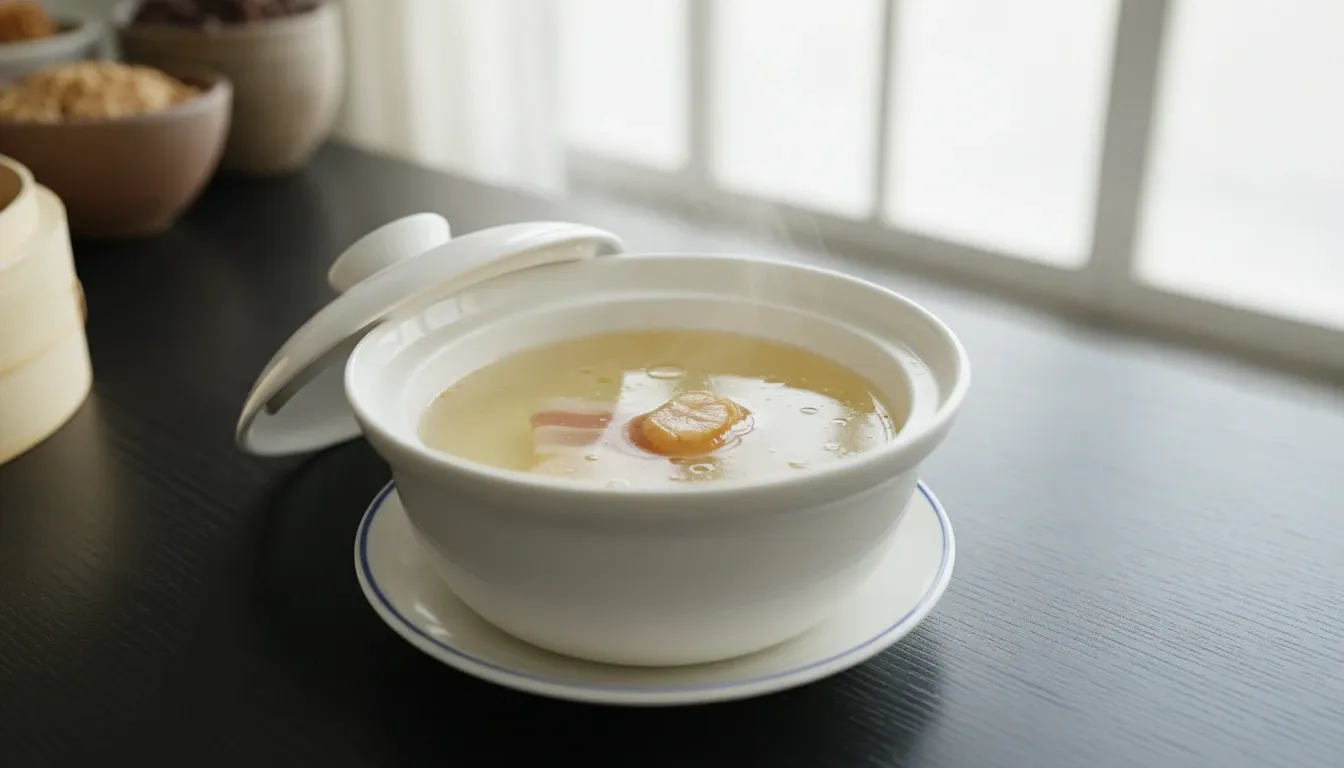
What this article answers
- How the Chinese stocks relate
- Clear mao tang with ground meat for qing tang, add dried goods for shang tang. Bai tang is a separate branch
- Why qing tang takes 3 hours in one recipe and 30 minutes in another
- Started from water, the ground meat makes the stock and clears it at the same time
- How to get a milky white bai tang
- Choose collagen-rich parts such as trotters and chicken feet. Bones and skin at about 60% of the water's weight
- Whether shang tang is worth making at home
- Rarely. Making mao tang with care does more for your cooking
Chinese cooking has several named stocks, called tang (汤). First, here is what each name means.
- Mao tang (毛汤): stock from chicken carcasses and pork bones. The base of all Chinese cooking.
- Qing tang (清汤): stock cleared with ground meat, which pulls the cloudiness out.
- Shang tang (上汤): qing tang with the umami of dried goods layered on. The highest grade, often called superior stock.
- Bai tang (白汤): a rich stock made cloudy white on purpose.
- Er tang (二汤): a second stock, made from ingredients already used once.
Most explanations set these five side by side in a list. That is what makes them confusing. They are not parallel.
Clear stocks form a ladder, bai tang branches
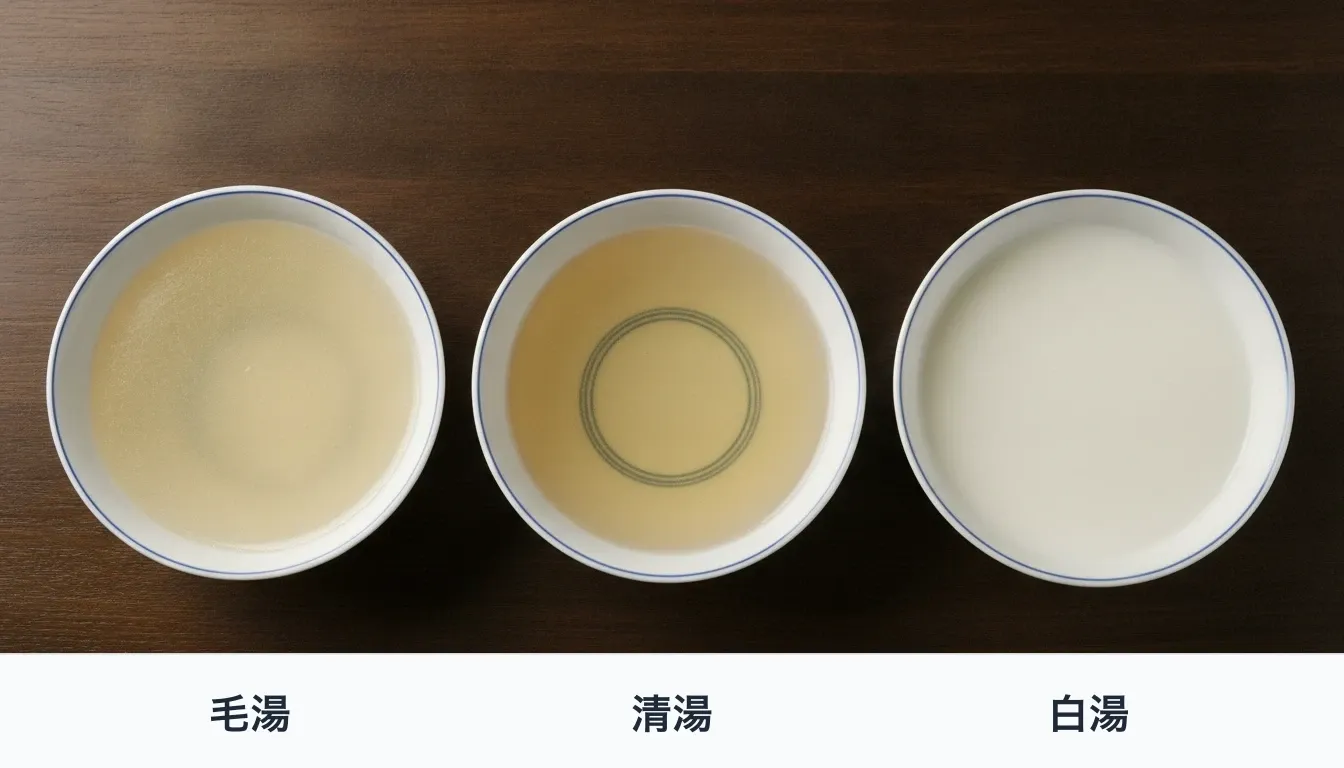
The real structure is one ladder, climbing in grade as the stock is cleared and enriched, and bai tang off to the side.
| Stock | Clarity | Heat and time | Use |
|---|---|---|---|
| Mao tang | Slightly cloudy | Low heat, about 3 hours | The base of every kind of dish |
| Qing tang | Clear | Low heat | Soups served as they are, dishes that show off the ingredients |
| Shang tang | Clear | Low heat | Banquet dishes |
| Bai tang | Cloudy white on purpose | High heat, or a long time | Dishes meant to be rich |
| Er tang | Slightly cloudy | Low heat | Second stock, for everyday uses where you can pour it freely |
Low heat here means never boiling: the surface just trembles. Each step up the ladder costs more work and more ingredients. Which step to use is up to the dish.
Mao tang is the base for everything
Mao tang is made by simmering chicken carcasses, a stewing hen (an old laying hen), and pork backbone with ginger peel and the green tops of long green onions. It cooks on low heat for about 3 hours.
Cooks use it as the base for almost everything. It goes into the finish of stir-fries, the base of braises, and dishes such as chili shrimp.
As a technique, it sits in the same place as French fond (the base stock of French cooking) or bouillon. Simmering bones and aromatics on low heat is almost the same.
| Aromatics | Where the flavor goes | |
|---|---|---|
| Fond, bouillon (France) | Onion, carrot, celery | Sweetness and body |
| Mao tang (China) | Ginger, green onion | Aroma that masks meaty smells |
Only the aromatics differ. That choice sets the direction of the whole dish.
The reason to keep the heat low is also the same as for fond: a boil emulsifies the fat and clouds the stock. But mao tang isn’t meant to be clear, so some cloudiness is fine.
Qing tang clears with ground meat, like consommé
Qing tang is stock cleared by the protein in ground meat.
It clears because meat protein sets as it heats. As the protein sets, it traps the particles that cloud the stock and carries them out with it.
Why qing tang takes 3 hours or 30 minutes
Some sources say qing tang takes 3 hours; others say 30 minutes. Both are right. The difference is whether making the stock and clearing it are two steps or one.
| 1. Clear a finished mao tang | 2. Start from water | |
|---|---|---|
| Starting point | Finished mao tang | Water |
| Making the stock | Simmer mao tang (about 3 hours) | The ground meat does it |
| Clearing it | Add ground pork leg and chicken breast | The same ground meat does it at once |
| Job of the ground meat | Filter only | Stock base and filter |
| Time | 3 hours of mao tang, plus clearing | 30 minutes |
The second way is shorter not because it cuts corners, but because the ground meat does two jobs. That is also why it needs more ground meat: 350 g of ground chicken plus lean ground pork for 2 L of water.
Your stock on hand decides which to use. If you always keep mao tang, use the first. If you only want qing tang this once, use the second.
Only two differences from consommé
The mechanism is the same as French consommé. France and China reached the same physics on their own. They even share the rule to use lean meat, because fat gets in the way of clearing.
What differs is how the set protein is handled.
| Consommé (France) | Qing tang (China) | |
|---|---|---|
| What clears it | Egg white and lean ground meat | Lean ground meat only |
| The set protein | Forms a raft on the surface, left alone and used as the filter | Stirred gently, then strained out at the end |
| In common | Setting protein traps the cloudiness; lean meat | The same |
Qing tang goes into soups and dishes meant to bring out the flavor of the ingredients. As a clear stock you can drink as it is, it also holds the same place as consommé.
Shang tang stacks umami at the top
Shang tang starts from a stewing hen, pork leg, and beef shank. Jinhua ham (a dry-cured Chinese ham), white peppercorns, and chenpi (dried tangerine peel) go in with them.
It has two features:
- Three animal sources stacked together: chicken, pork, and beef. Together they give a depth no single one can.
- Aged, dried goods added on top. Jinhua ham is rich in concentrated glutamate. Adding it aims at umami synergy, where different umami compounds boost each other.
Chenpi adds a layer of aroma. Shang tang is designed for aroma as well as umami.
Seen as a structure, shang tang is qing tang’s technique with the umami of dried goods stacked on top. The clearing is the same; the ingredients are a grade higher.
So there is little point in aiming for shang tang at home. Jinhua ham is hard to find and the cost isn’t worth it. Making mao tang with care will improve your cooking more.
Bai tang is set by its ingredients
Bai tang uses pork leg bones, pig’s trotters, chicken feet, pork back fat, and caul fat. These are fundamentally different from the other stocks.
What they share is a very high load of collagen and fat. In other words, bai tang is decided by its ingredients before the heat.
It turns white through emulsification. Gelatin from the bones acts as an emulsifier and spreads the fat through the water in tiny droplets.
Both “high heat” and “low heat for 6 hours” are right
Here, too, the sources disagree.
| Source | Heat |
|---|---|
| A culinary-school explanation | ”Cook it at a rolling boil over high heat” |
| A professional recipe | ”Once it boils, turn to low. Cover and cook for 6 hours” |
Neither says why. Think about what emulsification needs, and the conflict resolves.
Emulsification needs both an emulsifier (gelatin) and stirring (convection). High heat is a way to get the stirring, not a goal in itself.
Get enough gelatin and fat from the ingredients, and you can lower the heat. That is the method that uses lots of trotters, chicken feet, and back fat over 6 hours. With light ingredients, only high heat gives enough stirring. Both meet the same condition by different means.
Remember the amounts as ratios
One professional record uses 4 kg of pork leg bones, 1 kg of trotters, 1 kg of chicken feet, and 300 g of back fat for 10 L of water. Cooked for 6 hours, it gives 5 L of finished stock. It reduces by half.
These amounts don’t fit a home kitchen, but the ratio does. Use bones and skin at about 60% of the water’s weight. That is the guide for bai tang.
Chinese and Japanese ladders run opposite ways
Er tang is a second stock: water added to ingredients already used once, then extracted again. It is the same idea as niban dashi, the second dashi in Japanese cooking. Dashi is the Japanese stock made from kombu (dried kelp) and katsuobushi (dried, smoked bonito).
But the ladder runs the other way.
| First stock | Second extraction | Direction of the ladder | |
|---|---|---|---|
| Japanese dashi | Ichiban dashi (the best) | Niban dashi | Down (it gets weaker) |
| Chinese tang | Mao tang (the base) | Er tang | Up (mao tang → qing tang → shang tang) |
In Japanese cooking, the first dashi is the top, and the steps run down from it. In Chinese cooking, mao tang is the ground floor, and the steps are built up from it.
Common failures and fixes
Most failures look like a heat problem but are really an ingredient or process problem. What they share: first work out which step of the ladder the problem belongs to. Bai tang that won’t turn white is an ingredient problem, not a bai tang process problem. Weak shang tang is a mao tang problem, not a shang tang one.
Stock that won’t turn white can be fully fixed. Cloudy stock and stock without umami can be only partly saved.
| Problem | Cause | Fix it now | Prevent it next time |
|---|---|---|---|
| The stock turned cloudy | Boiling currents broke the fat into fine droplets that emulsified into the water and scatter light | Making it again without boiling is faster and surer than clearing it again | Never boil; keep it at a temperature where the surface just trembles |
| The stock won’t turn white | There wasn’t enough gelatin, the emulsifier, to spread the fat in fine droplets | Add trotters or chicken feet and simmer to add gelatin | Get gelatin from the ingredients; more heat won’t supply it |
| The umami doesn’t build | The qing tang underneath was thin, with no base for the umami drawn from dried goods | Adding more dried goods leaves it thin. Make the qing tang again | Work from the bottom of the ladder: get the qing tang strong first |
Pick the step your dish needs
- Tang are not four parallel types. Mao tang → (clear with ground meat) → qing tang → (add dried-goods umami) → shang tang is a ladder of grades, and bai tang is a separate line.
- Mao tang cooks on low heat for about 3 hours. It holds the same place as fond or bouillon; only the aromatics (ginger and green onion) differ.
- Qing tang clears the same way as consommé. It differs in using no egg white and in straining the set protein out rather than building a raft. The strainer shapes the finish.
- Qing tang takes 3 hours or 30 minutes depending on the method. Let the ground meat both make the stock and filter it, and the time gets shorter.
- Shang tang is qing tang’s technique plus dried goods on top. There is little point in it at home; careful mao tang does more.
- Bai tang is set by its ingredients: cuts very high in collagen and fat. High heat is a way to get stirring; with heavy enough ingredients, long, low cooking works too.
- Er tang is the same idea as Japanese niban dashi, but the ladder runs the other way. Japanese dashi gets weaker; Chinese tang gets richer and more refined.
Sources
- Tsuji Culinary Institute blog. "About tang, the stocks of Chinese cuisine" (in Japanese). Ingredients, heat, and time for mao tang, qing tang, shang tang, and bai tang; how qing tang clears as protein sets
- chefpartners. "How to make qing tang" (Ryosuke Tamura) (in Japanese). Qing tang made from water with ground meat, without egg white, and strained to finish
- Cookpit. "How to make Chinese bai tang" (in Japanese). Ingredient ratios and cooking time for bai tang