What this article answers
- How long to simmer fond
- A few hours at 85–95°C. Recipes that take 1–2 days hold it at a lower temperature
- Why fond must never boil
- A boil breaks the fat into droplets that gelatin holds in the liquid, and the stock turns cloudy
- Whether to roast the bones
- Roasting adds aroma and color, not umami. Roast for a brown sauce, skip it for a pale one
- Whether store-bought fond will do
- For flavor alone, yes. For a sauce with body, make your own: store-bought gives less body
- How long to simmer fish fumet
- 20–30 minutes. Fish bones turn bitter if cooked long
Look up how to make fond de veau, the French veal stock, and the simmering times don’t agree. One recipe says 8 hours, another 12 hours or more, another 2 days. Each calls itself the authentic, professional way.
None of them is wrong. Only the temperature differs.
Before you pick a time, there is something more basic to settle. Fond draws out two different things.
Fond is for building on, not drinking
Stocks made with water fall into 4 families.
| Family | What it is made from | Where the time goes | Attitude to cloudiness |
|---|---|---|---|
| Japanese dashi | Kombu (dried kelp) and katsuobushi (dried bonito) | Into making the dried ingredients | Never heated enough to turn cloudy |
| Fond (France) | Bones, meat, aromatic vegetables | Into the extraction | Kept clear |
| Bouillon and consommé (France) | Bones, meat, aromatic vegetables | Into the extraction | Cloudy stock is cleared afterward |
| Chinese tang | Bones, meat, dried goods | Into the extraction | Cleared, or made cloudy on purpose |
What sets fond apart is that nobody drinks it on its own. Dashi goes straight into a clear soup. Bouillon and consommé are served as soup, and Chinese tang becomes soup too. Fond alone is a half-made product, a base for sauces and braises, and its flavor is not finished.
That changes the design. A stock for drinking aims to be clear, fragrant, and good as it is. Fond aims to survive reduction and to stay clear when layered with other things. That is why you draw out so much gelatin: fond supplies body as well as flavor. These are the two things this article is about.
It tastes different, too. Sip fond on its own and it has none of the sharp outline of dashi. It tastes thin and vague. That is fine, because it is the base you reduce and build other flavors on.
So reach for it when you make a sauce or need liquid for a braise. If you want a soup to drink, make bouillon or consommé. If you want aroma to lead, make dashi.
Fond draws out two different things
| What comes out | What it becomes | How it comes out |
|---|---|---|
| Gelatin | Body. It thickens a sauce without flour or butter | Slowly, depending on temperature and time |
| Umami | Depth of flavor: amino acids and nucleotides from bones, meat, and aromatic vegetables | Fairly quickly |
The two come out at different speeds.
The time depends on which one you want
So how long to simmer depends on which one comes first for you. Recipes say 8 hours, 12 hours, or 2 days because they never say which.
If you only want depth of flavor, you don’t need to simmer that long. If you want to reduce it into a sauce with body, you have to wait for the gelatin.
Why simmering times differ between sources
Gelatin forms as collagen breaks down, and the hotter the liquid, the faster that goes. Several routes lead to the same result.
| Route | Temperature | Rough time |
|---|---|---|
| Hold it low | 60–65°C (140–149°F) | 24–72 hours |
| Gentle simmer | 85–95°C (185–203°F) | A few hours |
| Pressure cooker | 100–121°C (212–250°F) | 45–75 minutes |
Sources: the same values as the three routes in this site’s article on collagen and gelatin.
Fond is normally made in the middle band, 85–95°C, so it takes a few hours to half a day. A recipe that takes 2 days makes sense if it holds the stock at a lower temperature, or simmers it in several sessions.
So copying the time alone won’t reproduce the result. A recipe that gives a time without a temperature is missing information.
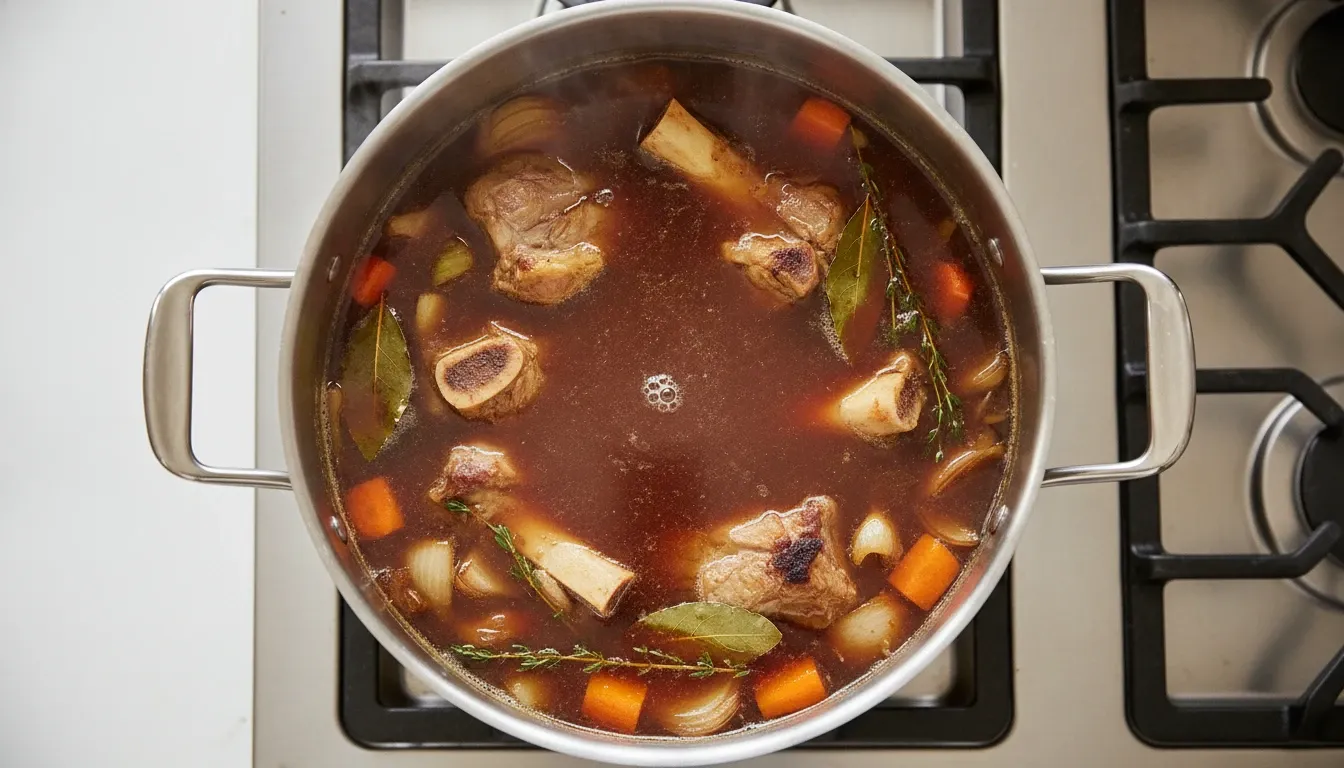
At home, the practical choice is 85–95°C for a few hours. Don’t let it boil; keep the surface just trembling.
Why fond must never boil
Boil fond and it turns cloudy.
The cause is emulsification. Over high heat, strong currents break the fat into tiny droplets. Gelatin coats them and holds them in the liquid. That is the cloudiness.
Skimming works on the same logic. The scum on the surface is clumped protein. Boil it before you skim, and it breaks up and returns to the liquid as cloudiness. Skim it while it floats.
“Keep it gentle and skim it” isn’t about looks. It is the physical condition for not creating cloudiness.
Roasting the bones adds aroma and color
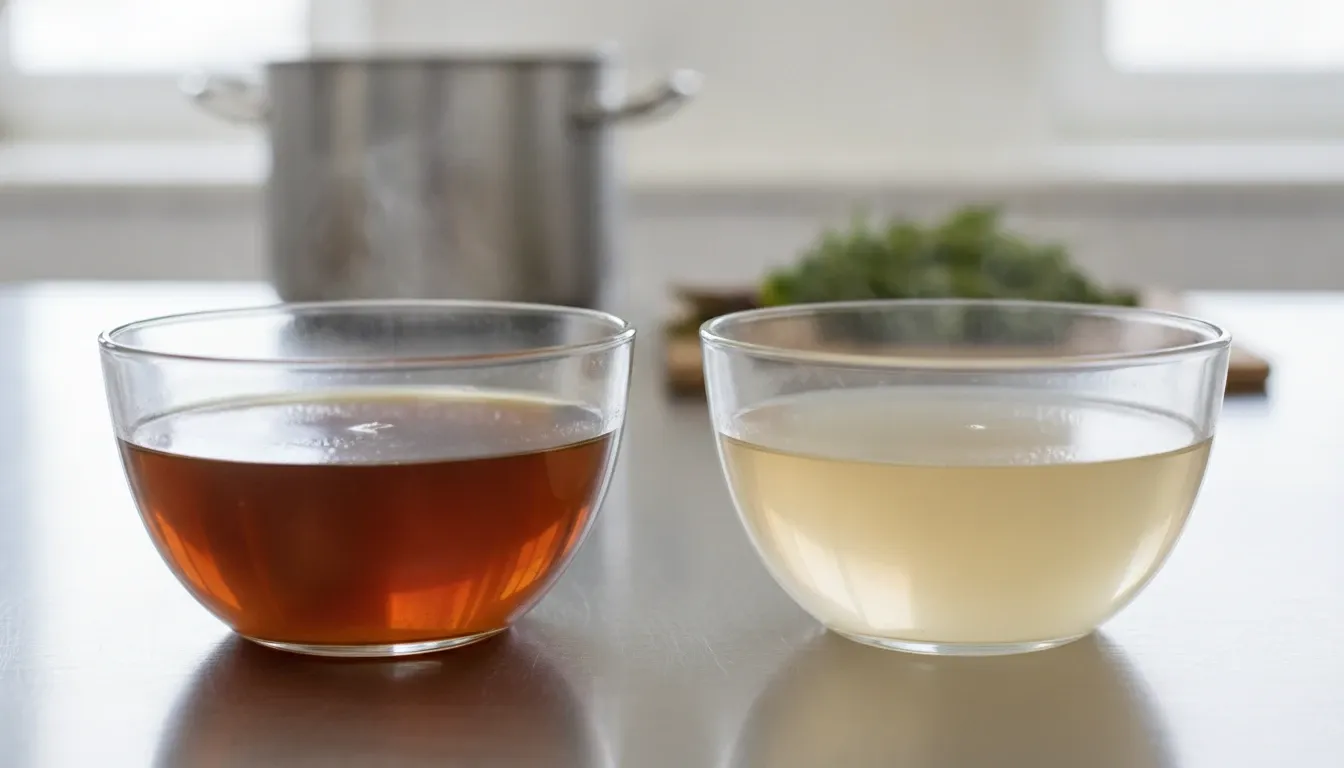
Left, brown fond (roasted bones). Right, white fond (unroasted bones). White fond is not a cloudy white liquid; it is clear and pale gold.
For fond de veau, the bones are roasted in the oven for about 30 minutes until browned.
What happens is the Maillard reaction. Once the surface of the bones dries and passes 100°C (212°F), it gets going, and the hotter it is, the faster it makes brown pigments and roasted aromas.
The point to keep in mind: you roast for aroma and color. The umami itself comes out during simmering, so fond works without roasting.
That is why there is fond made with unroasted bones: white fond, or fond blanc.
| Roast the bones? | Best for | |
|---|---|---|
| Brown fond | Yes | Sauces for meat. The espagnole family |
| White fond | No | The velouté family. Dishes that should stay pale |
So whether to roast depends on the color of the sauce you want. French cooking sorts its mother sauces by the color of the fond because this choice comes first.
Can store-bought stock replace it?
Many cooks look for a store-bought substitute, because homemade fond seems like a lot of work. It does take half a day.
Decide by whether you need body.
| What you want | What to use |
|---|---|
| Depth of flavor only | Store-bought is enough |
| A sauce with body | Homemade is worth it |
Store-bought concentrated fond can match the flavor, but it tends not to give as much body as homemade. Gelatin comes from long cooking, and its properties change easily in concentrating and processing.
When store-bought fond lacks body, reduce it to concentrate it, or add gelatin.
If you make your own, make a large batch and freeze it. Fond rich in gelatin sets when cold, so you can portion it into cubes.
The bones set the character
| Ingredient | Name | Gelatin | Best for |
|---|---|---|---|
| Veal bones | Fond de veau | Very high | Sauces for any meat dish |
| Chicken carcasses | Fond de volaille | Medium | Pale sauces and soups |
| Fish bones | Fumet de poisson | Low | Sauces for fish |
| Vegetables only | Bouillon de légumes | None | Vegetarian dishes, light soups |
Veal bones are rich in gelatin because the collagen of young animals breaks down easily: it has fewer cross-links.
At home, chicken carcasses are the most practical. They are cheap and take less time than veal bones.
Chinese tang also uses chicken carcasses, but the goal and the heat differ: bai tang, the milky Chinese stock, is emulsified on purpose. Japanese dashi is quicker still. The kombu comes out at 60°C (140°F) and the katsuobushi at around 85°C (185°F). Even among stocks made with water, the temperature and time change completely with the ingredient.
Choose the temperature, then the time
- Fond draws out two things, gelatin and umami. Which comes first for you sets the time.
- Simmering times differ between sources because the temperatures differ. At 85–95°C it takes a few hours; lower, it takes 1–2 days.
- You keep it from boiling not for looks, but to stop the fat from emulsifying and clouding it. Skim while the scum floats.
- You roast the bones for aroma and color. Umami comes from simmering, so unroasted white fond works too. Choose by the color of the sauce you want.
- What store-bought lacks is body. For flavor alone it is enough; when you need body, homemade is worth it.
- The ingredient sets the character. Fish alone takes only 20–30 minutes; cook it longer and it turns bitter.
Sources
- L'au-delà (French restaurant). "How to make fond de veau, with the theory, for professionals" (in Japanese). Simmering time and skimming
- Mr.Cook. "Authentic fond de veau made from beef bones" (in Japanese). Roasting the bones and the aromatic vegetables
- Seiyo Ryori Kenkyu. "Fond and bouillon in Western cooking" (in Japanese). The difference between fond and bouillon