What this article answers
- The temperature for a springy bite
- A narrow band of 50–65°C. Past 70°C, shellfish turns hard and rubbery
- How long to boil shrimp
- 1–2 minutes in boiling water. Take it out as soon as it turns opaque
- Clams and mussels that stay plump
- Lid on, high heat. Turn off the heat when half the shells have opened
- Squid and octopus that aren't tough
- Either 30 seconds to 1 minute, or 1 hour or more. 5–30 minutes is the toughest
Shellfish is delicate. Cook it a little too long and it suddenly turns hard and rubbery. A springy, juicy bite takes close control of temperature and time.
This article covers clams, mussels, shrimp, crab, squid, and octopus. It explains how each changes with heat, and how to stop before it goes too far.
Why shellfish turns rubbery with heat
Little collagen, so no softening stage
Clams, shrimp, and crab carry less collagen than fish or meat.
- Meat: lots of collagen. Long cooking turns it into gelatin, and the meat softens.
- Shellfish and crustaceans: little collagen. Long cooking never softens them.
So shellfish has almost no stage where heat makes it tender. It goes straight from raw to hard.
What happens at each temperature
| Temperature | State | Texture |
|---|---|---|
| Below 40°C (104°F) | Raw | Soft |
| 40–50°C (104–122°F) | Proteins start to set | Slightly springy |
| 50–60°C (122–140°F) | Half-cooked | Springy and juicy (the target) |
| 60–70°C (140–158°F) | Cooked through | Firm |
| 70°C (158°F) and above | Overcooked | Hard and rubbery |
The springy texture lives only in a narrow band, 50–65°C (122–149°F). At 70°C (158°F) and above, it is gone.
Squid and octopus are the exception
Squid and octopus, unlike clams and shrimp, are rich in collagen. That gives you two ways to cook them.
- Short cooking, 30 seconds to 1 minute: finish before the collagen shrinks, and the flesh stays springy.
- Long cooking, 1 hour or more: turn the collagen into gelatin, and the flesh turns meltingly soft.
Anything in between, 5–30 minutes, gives the toughest result.
Times and temperatures for each kind
Clams and mussels
Clams and mussels tell you they are done: the shells open.
| Method | Heat and time | Texture | Use |
|---|---|---|---|
| Steamed in sake (Japanese rice wine) | High heat, 3–5 minutes | Springy | Sake-steamed clams, pasta |
| In miso soup | Add just before the water boils | Tender | Soups |
| Sautéed | Medium heat, 2–3 minutes | Plump | Sautés |
Turn off the heat as soon as the shells open. Every moment of heat after that makes the meat harder.
Shrimp
Shrimp turns from translucent to opaque when it is done.
| Method | Heat and time | Texture | Use |
|---|---|---|---|
| Boiled | 1–2 minutes in boiling water | Springy | Salads, sushi |
| Stir-fried | High heat, 2–3 minutes | A springy bite | Stir-fries |
| Deep-fried | 170–180°C (338–356°F), 2–3 minutes | Crisp outside, springy inside | Tempura, breaded fried shrimp |
| Sous vide | 10 minutes after the center reaches 60°C (140°F) | Moist and springy | Starters |
Pull out the dark vein along the back so the shrimp cooks evenly. Once it curls, it is cooked.
Crab
The shell turns red when crab is done.
| Method | Heat and time | Texture | Use |
|---|---|---|---|
| Boiled | 15–20 minutes in boiling salted water | Moist | Boiled crab |
| Steamed | High heat, 20–25 minutes | Concentrated flavor | Steamed crab |
| Grilled | Medium heat, 10–15 minutes | Toasty | Grilled crab |
Boil crab with the top shell facing down, and the savory juices stay in the meat.
Squid
Squid wants either a short time or a long one. Never in between.
| Method | Heat and time | Texture | Use |
|---|---|---|---|
| Stir-fried | High heat, 30 seconds to 1 minute | Springy | Stir-fries |
| Grilled | High heat, 30 seconds per side | Toasty and springy | Grilled squid |
| Braised | Low heat, 1 hour or more | Meltingly soft | Braises |
Score the surface. The squid cooks evenly and doesn’t curl up.
Octopus
Octopus works like squid: a short time or a long one.
| Method | Heat and time | Texture | Use |
|---|---|---|---|
| Boiled | 30 seconds to 1 minute in boiling water | Springy | Sashimi, salads |
| Braised | Low heat, 1–2 hours | Meltingly soft | Braises, ragù |
| Sous vide | 77°C (171°F) for 5 hours | Tender yet springy | Confit |
Japanese cooks often boil octopus with daikon, a large white radish. They credit enzymes in the radish with softening the meat.
How four cuisines cook shellfish
Japanese cooking keeps it fresh and brief
Japanese cooking puts freshness first and cooks seafood for as short a time as it can.
- Sashimi and sushi: raw, or lightly seared.
- Sakamushi: steamed briefly in the vapor of sake.
- Shabu-shabu: swished through boiling broth for a moment.
Typical dishes: sake-steamed clams, shrimp tempura, and ika somen (raw squid cut into thin, noodle-like strips).
French cooking pairs it with a sauce
French cooking cooks seafood with the sauce in mind.
- Poêlé: sautéed in butter, then coated in a sauce.
- Meunière: dusted with flour and cooked in butter.
- Bouillabaisse: seafood simmered until its flavor goes into the broth.
Typical dishes: mussels steamed in white wine (moules marinières) and lobster Thermidor.
Italian cooking keeps it simple
Italian cooking draws out the flavor of seafood with olive oil and garlic.
- Pescatora: seafood simmered in tomato sauce.
- Acqua pazza: seafood simmered in white wine and water.
- Fritto: fried in a light coating.
Typical dishes: spaghetti alle vongole in bianco and fried calamari.
Chinese cooking uses high heat, fast
Chinese cooking finishes seafood over high heat in a short time.
- Bao chao: a fast stir-fry over fierce heat.
- Oil blanching: a brief dip in hot oil before the main cooking.
- Steaming: in a bamboo steamer, to keep the seafood’s own taste.
Typical dishes: shrimp in chili sauce, squid with black bean sauce, and steamed shrimp dumplings (har gow).
The four side by side
| Cuisine | Approach | Signature techniques |
|---|---|---|
| Japanese | Freshness first, short cooking | Sake steaming, sashimi |
| French | Built around the sauce | Butter sautés, bouillabaisse |
| Italian | Olive oil | Acqua pazza, fritto |
| Chinese | High heat, short time | Bao chao, oil blanching |
How to cook shellfish tender and springy
Preheat, then let carryover heat finish
- Preheat the pan or pot well.
- Cook fast, in one go.
- Let carryover heat finish the job. Cooking goes on after the heat is off.
Sake-steamed clams
- Soak the clams in salted water so they spit out their sand, then wash them.
- Put the clams, sake, and garlic in a skillet.
- Cover and cook on high heat.
- Turn off the heat when half the shells have opened.
- Let carryover heat open the rest.
Keep heating after the shells open, and the meat shrinks and toughens.
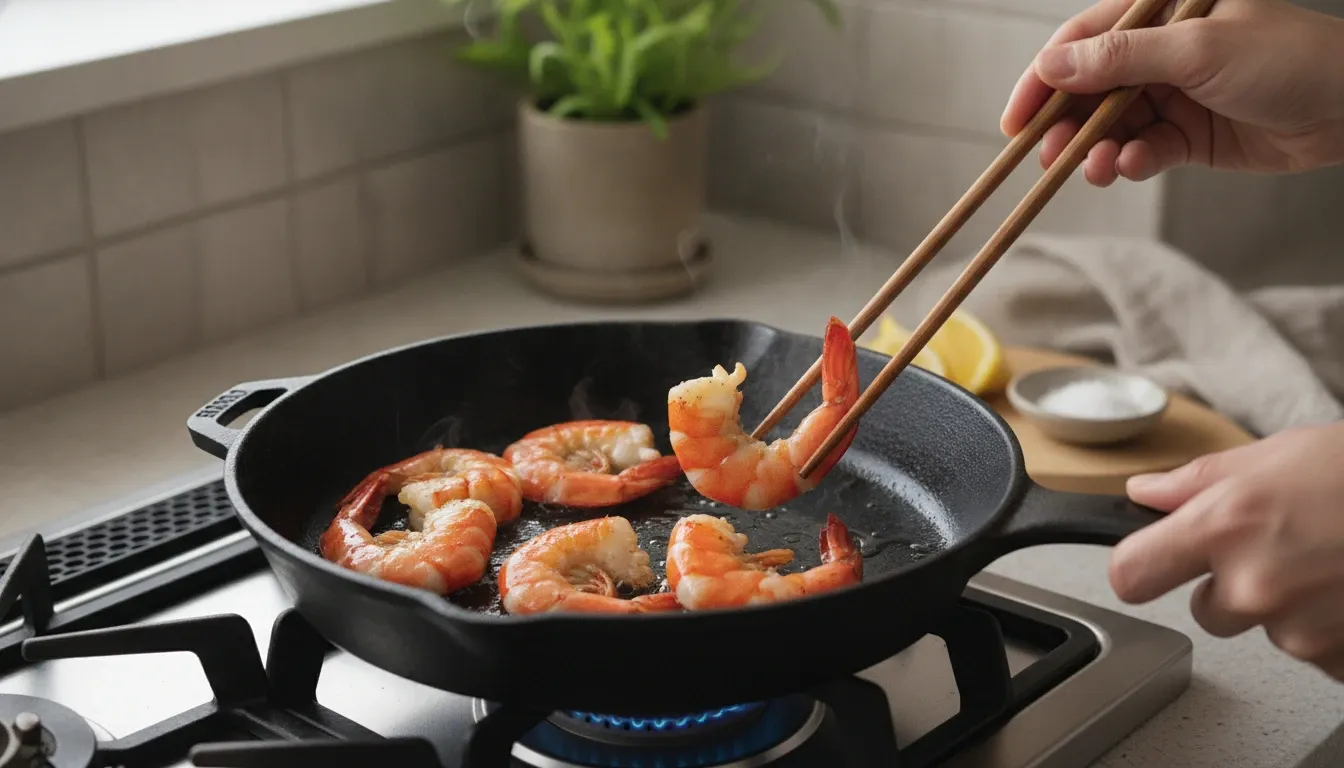
Stir-fried shrimp
- Devein the shrimp, rub them with salt and potato starch, and rinse.
- Heat the skillet on high.
- Add oil, then the shrimp.
- Leave them untouched for 30 seconds, turn them, and give them 30 seconds more.
- Take them out as soon as the color changes.
Stirring too much drops the pan’s temperature and cooks the shrimp unevenly.
Stir-fried squid
- Peel the squid and score it in a crosshatch.
- Cut it into bite-size pieces.
- Heat the skillet on high until it smokes.
- Add oil, then all the squid at once.
- Take it out after 30 seconds to 1 minute.
The scoring cooks the squid evenly and keeps it from curling.
Meltingly soft braised octopus
- Rub the octopus with salt to remove the slime.
- Add daikon to the pot (Japanese cooks credit it with softening the meat).
- Braise on low heat for 1–2 hours.
- Stop when a skewer slides in easily.
The in-between times, such as 30 minutes, give the toughest octopus. Choose short or long.
Common failures and fixes
Overcooked shrimp can’t be fixed. Shells that won’t open can only be discarded. Shrunken or tough squid and octopus can be fully fixed by braising longer.
| Problem | Cause | Fix it now | Prevent it next time |
|---|---|---|---|
| The shrimp is overcooked and rubbery | Too much heat set the proteins hard and made them rubbery | The texture won’t come back. Chop it for a sauce or fried rice | Turn off the heat once the color changes, and count on carryover heat |
| Clams or mussels won’t open | The shellfish wasn’t alive, or the heat was too low, so the muscle holding the shell shut never set | Discard any that stay closed after 3–5 minutes of cooking | Throw out any that are open before cooking, and cook on high heat in one go |
| The squid shrank | The heat stopped while the collagen was shrinking, and the fibers stayed tight | Switch to a long braise and turn the collagen into gelatin | Cook either 30 seconds to 1 minute or 1 hour or more, and score the flesh |
| The meat is tough | The cooking time fell in between, stopping before the collagen turned to gelatin | Braise 1 hour or more until it gels and turns meltingly soft | Commit to 30 seconds to 1 minute for springy, or 1 hour or more for soft |
The numbers to remember
The main thing with shellfish is not to overcook it.
| Food | Sign it’s done | Cooking time |
|---|---|---|
| Clams and mussels | The shells open | 3–5 minutes |
| Shrimp | Translucent turns opaque | 1–2 minutes |
| Crab | The shell turns red | 15–20 minutes |
| Squid | It turns white | 30 seconds to 1 minute, or 1 hour or more |
| Octopus | The color changes | 30 seconds to 1 minute, or 1–2 hours |
Three principles:
- Shellfish has little collagen, so long cooking won’t soften it. That is where it differs from meat.
- The springy band is 50–65°C. It is narrow.
- Cook squid and octopus short or long. In between is the worst.
For fish, see fish temperatures. For how proteins change with heat, see what temperature does to food.
Control the temperature, and your shellfish comes out like a professional’s. When you wonder whether it’s done yet, that is the moment to take it out.