What this article answers
- What happens at which temperature
- Meat sets from 50°C. Browning starts once the surface passes 100°C
- What low and slow is good for
- Tenderness and sweetness. It does nothing for browning
- Making shank tender
- 85–95°C for 3–8 hours, or 60–65°C for 24–72 hours
- Keeping potatoes from falling apart
- Hold them at 55–60°C for 20–30 minutes before simmering
- Making roasted sweet potatoes sweet
- Let the inside pass slowly through 58–80°C
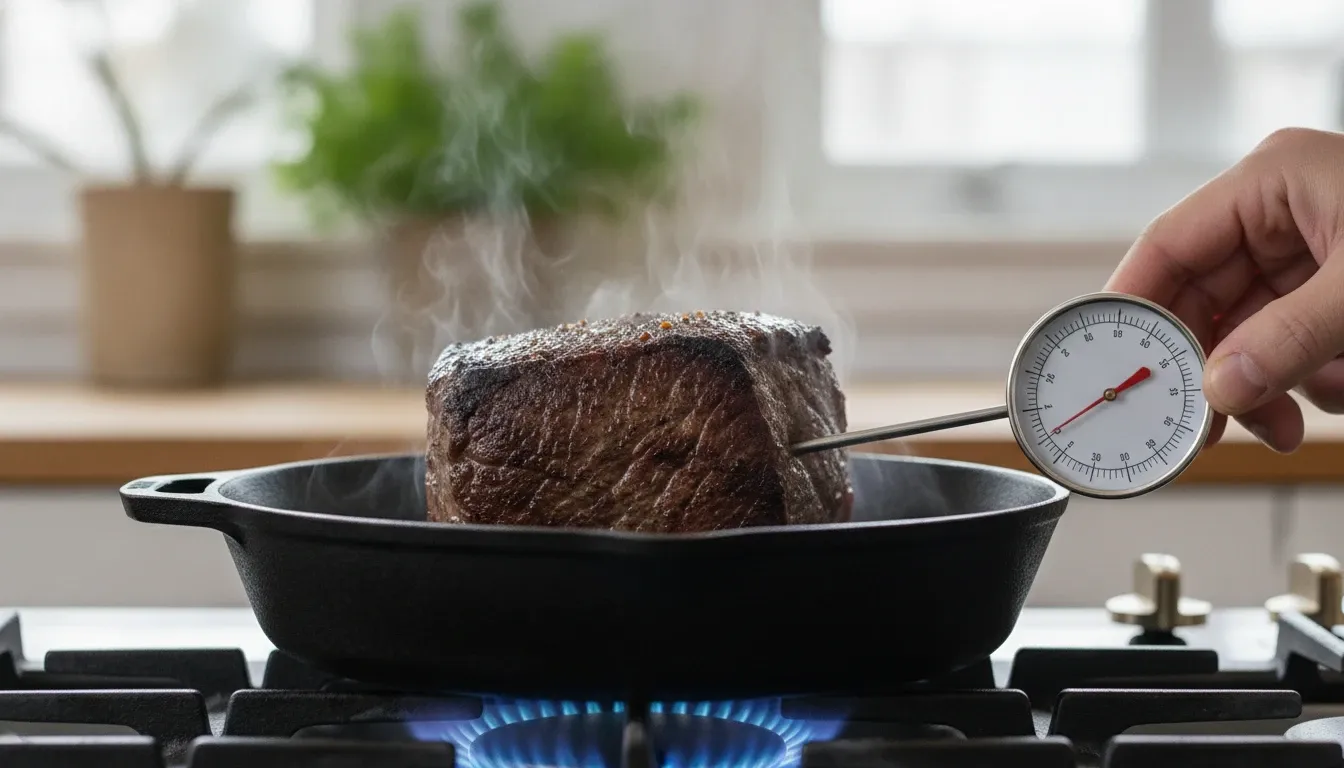
The thermometer in the pot reads 62°C (144°F). The meat has already started to set. The starch in the potatoes is starting to loosen, while root vegetables are actually getting firmer. Only browning won’t happen, however long you wait.
This article puts on one chart what happens at a given temperature, for any food, and what hasn’t happened yet.
What happens at each temperature
The inside of a food that holds water never goes above 100°C (212°F). Only a surface dried out by roasting, searing, or frying gets hotter, so there are two charts.
Inside the food, up to 100°C
Read across a row to see what happens together at that temperature. Read down a column to see where each change takes place. The temperature in parentheses is where the change in that cell happens. “Not yet” means it hasn’t started.
| Food temperature | Meat, fish, eggs | Starch gelatinization | Collagen (sinew, skin) | Vegetable firmness | Browning | Fat |
|---|---|---|---|---|---|---|
| Below 40°C (104°F) | Not yet | Not yet | Not yet | Not yet | Not yet | Chicken fat starts to melt (30°C) |
| 40–50°C (104–122°F) | Fish starts to set (44°C) | Not yet | Not yet | Not yet | Not yet | Beef fat starts to melt (40°C) |
| 50–60°C (122–140°F) | Meat starts to set (50°C) | Wheat starts (52°C) | Not yet | Starts to firm (50°C) | Not yet | Melted |
| 60–70°C (140–158°F) | Meat shrinks and juices start to run (66°C) | Rice starts (60°C) | Shrinks and toughens (65°C) | Firms | Not yet | Melted |
| 70–80°C (158–176°F) | Meat shrinks sharply (70°C) | Rice finishes (77°C) | Dissolves little by little (70°C) | The firming enzyme stops (70°C) | Not yet | Melted |
| 80–100°C (176–212°F) | Egg white fully set (80°C) | Even sweet potato finishes (83°C) | Dissolves over hours (85°C) | Softens (84°C) | Barely happens | Melted |
Sources: meat, fish, and eggs from this site’s article on protein denaturation; starch from its article on gelatinization; collagen from its article on collagen turning to gelatin; vegetables from its article on cooking vegetables and from Anthon & Barrett (2006); browning from its article on the Maillard reaction; fat from its article on fat melting points.
The 62°C (144°F) from the opening falls in the 60–70°C row. The meat shrinks and its juices start to run, root vegetables firm up, and there is no browning yet. Food in a sous vide bag doesn’t brown, and that isn’t a failure. Browning simply doesn’t happen at this temperature.
On a dry surface, above 100°C
| Dry surface temperature | Browning (Maillard reaction) | Sugar caramelizing |
|---|---|---|
| 100–140°C (212–284°F) | Starts, but slowly | Not yet |
| 140–170°C (284–338°F) | Clearly browns | Starts to color (150°C) |
| 170–190°C (338–374°F) | Browns fast and deep (170°C) | Turns bitter (180°C) |
| 190°C (374°F) and above | Scorches and turns bitter (190°C) | Burns black (190°C) |
Sources: browning from this site’s article on the Maillard reaction; caramel from its article on caramelization.
Why the ranges vary by food
The same change starts at different temperatures in different foods. The temperatures in parentheses are typical values. Your food may be a few degrees either way.
Fish starts to set 5–6°C (9–11°F) lower than meat from land animals. The colder the water a fish lives in, the lower the temperature at which its muscle proteins unfold. Cook fish the way you cook meat, and the fish dries out first.
Each starch starts to gelatinize at its own temperature. Wheat starts at 52°C (126°F), potato starch at 55°C (131°F), tapioca at 56°C (133°F), sweet potato at 58°C (136°F), and rice at 60°C (140°F). Potato starch thickens a sauce before it boils because it starts to gelatinize at 55°C.
Which changes more time can push further
The changes in the chart fall into three groups by how they relate to time. Long, gentle cooking improves only the changes whose amount depends on time spent in a temperature range.
Meat and eggs stop setting once they reach temperature
Once the center of a piece of meat reaches the target temperature, its proteins more or less stop setting. Put meat in water just slightly hotter than the target core temperature, and it won’t overcook however long it sits.
So judge when meat, fish, and eggs are done by core temperature, not time. Even over low heat, once the center passes 66°C (151°F), the juices run out.
Tenderness and sweetness grow with time in a range
Cuts with a lot of sinew, like shank, turn meltingly tender in 3–8 hours at 85–95°C (185–203°F), or 24–72 hours at 60–65°C (140–149°F). At the lower temperature, given time, you get to the same place.
A roasted sweet potato gets sweeter the longer its inside stays at 58–80°C (136–176°F). In that range, an enzyme (β-amylase) cuts gelatinized starch into maltose, a sugar.
A sweet potato blasted in the microwave isn’t sweet because it rushes through that range in a few minutes.
Potatoes and root vegetables firm up only while they sit at 50–70°C (122–158°F). An enzyme active in that range links the pectin in their cell walls together with calcium. Hold them at 55–60°C (131–140°F) for 20–30 minutes before simmering, and they won’t fall apart.
Above 70°C (158°F) this enzyme stops, and from around 84°C (183°F) the vegetables start to soften.
Browning never happens at 100°C or below
While a surface is wet, its temperature stops at 100°C (212°F), because evaporating water carries the heat away. The Maillard reaction, which browns food, only visibly gets going once the surface water is gone and the temperature passes 100°C. The hotter it gets, the faster it goes. As long as there is water on the surface, turning up the heat won’t brown it.
That is why a stew doesn’t turn dark brown and a boiled egg never browns. When you want browning, don’t add time. Dry the surface.
Surface and center sit at different temperatures
While a steak cooks, the surface can easily be at 180°C (356°F) and the center at 55°C (131°F). Which chart to read depends on where in the food you measure.
| Where you measure | Typical temperature | Which chart to read |
|---|---|---|
| The center of the food | 50–95°C (122–203°F) | Inside the food |
| A wet surface (simmering, steaming, boiling) | Up to 100°C (212°F) | Inside the food. No browning yet |
| A dry surface (roasting, searing, frying) | 140–200°C (284–392°F) | Dry surface |
Sources: surface temperatures from this site’s articles on browning and moisture and on the Maillard reaction.
Frying works the same way. Even in 170°C (338°F) oil, the food inside the coating stays at or below 100°C as long as it holds water. Only the coating dries and browns, and the inside cooks as if steamed.
After you take it off the heat, the center of a thick piece keeps rising by a few degrees.
When the changes you want collide
In one dish, a change you want and a change you don’t can share the same temperature range. Then you adjust which range you pass through, and for how long.
| Goal | Temperature range and time | What you give up |
|---|---|---|
| Lean beef cooked pink | Sear the surface of a whole piece; stop the center at 55–60°C (131–140°F) | The sinew won’t dissolve |
| Onsen tamago, a Japanese egg cooked slowly in hot water | 65°C (149°F) for 30–40 minutes | The white won’t fully set |
| A browned steak with a pink center | Dry the surface and sear at 170°C (338°F) or more; stop the center at 55–60°C | Just under the surface overcooks |
| Deeply caramelized onions | Drive off the water first, then brown once the surface passes 100°C | Time to finish |
Sources: this site’s articles on meat cooking temperatures, cooking eggs, the Maillard reaction, and caramelized onions.
Stopping the center at 55–60°C (131–140°F) is only for a whole piece of beef with a seared surface. For pork, chicken, ground meat, or beef served to children or older people, use the Japanese health ministry figure instead: a core of 75°C (167°F) held for 1 minute.
Dissolving sinew, sweetening sweet potatoes, and keeping potatoes whole are three changes you control by time in a range, not by temperature.
Each cuisine also works mostly in its own range. Chinese stir-frying heats a wok to about 250°C (482°F) and brings the inside of the ingredients up to about 80°C (176°F) in a short time. That gives both a seared aroma on the surface and crunch in the vegetables (heat control in Chinese cooking).
Japanese simmered dishes hold 85–95°C (185–203°F) so the food doesn’t fall apart. A French braise keeps the liquid at 82–88°C (180–190°F) for a long time to dissolve the sinew.
When the chart doesn’t apply
The chart gives values for food heated with only water. Under the conditions below, things don’t follow the chart.
| Condition | How it differs from the chart |
|---|---|
| Egg mixture with a lot of sugar (custard, crème caramel) | Eggs set at a higher temperature |
| Firming with vinegar or salt (vinegar-cured mackerel) | The flesh turns white and firm without heat |
| Starch without enough water (rice not soaked first) | A hard core remains even at temperature |
| Wanting to reduce bacteria | Look at holding time, not temperature alone |
Reading the range without a thermometer
You can see many of the changes in the chart. Watch how the food itself changes, and you can tell which range it has passed.
| What you see in the food | Range it has passed |
|---|---|
| Fish flesh turns from translucent to opaque white | 40–50°C (104–122°F): fish has started to set |
| Egg white turns from clear to cloudy white | 57–62°C (135–144°F): egg white has started to set |
| Juices seep out of meat | 66–73°C (151–163°F): meat has started to shrink |
| A skewer slides easily through sinew | 3–8 hours at 85–95°C (185–203°F): sinew has dissolved |
| The surface browns and smells toasty | Above 100°C (212°F): the surface has dried. Fast above 140°C (284°F) |
Sources: fish, egg, and meat temperatures from this site’s articles on protein denaturation and on cooking eggs; sinew from its article on collagen turning to gelatin.
Common failures and fixes
Falling apart and a lack of sweetness cannot be undone. No browning and tough meat can be fully fixed.
| Problem | Cause | Fix it now | Prevent it next time |
|---|---|---|---|
| Potatoes or root vegetables fell apart | They went straight into boiling water and rushed through 50–70°C, where the enzyme that firms pectin works, so only the cell walls broke down | It can’t be undone. Mash what fell apart into a soup or use it to thicken the cooking liquid | Hold them at 55–60°C (131–140°F) for 20–30 minutes before simmering |
| The sweet potato isn’t sweet | It was baked hot and fast, so it rushed through 58–80°C, where the enzyme (β-amylase) turns starch into maltose | A baked sweet potato won’t get sweeter. Use it in a dish with sugar or syrup | Bake at 150–160°C (302–320°F) so the inside spends longer at 58–80°C |
| It won’t brown | Water stayed on the surface, and evaporation held the surface at 100°C | Take it out, wipe the surface dry, and return it to a well-heated pan | Wipe the surface dry before cooking, and don’t crowd the pan |
| Meat with a lot of sinew is tough | It was simmered too briefly, so the collagen shrank around 65°C and never turned to gelatin | Keep it at 80–95°C (176–203°F) and simmer 1–2 hours more | For shank, plan on 3–8 hours at 85–95°C |
Low and slow helps tenderness and sweetness
- One temperature moves meat, starch, sinew, vegetables, browning, and fat all at once. At 62°C (144°F), meat starts to shrink, root vegetables firm up, and there is no browning yet
- Time decides how much sinew softens, how sweet a sweet potato gets, how well potatoes hold their shape, and how many bacteria die. Stop meat by core temperature, and get browning by drying the surface past 100°C
Sources
- Douglas Baldwin. A Practical Guide to Sous Vide Cooking. Water slightly above the target does not overcook; longer holding keeps tenderizing; tough beef at 55–60°C for 24 hours
- Anthon, G. E., & Barrett, D. M. (2006). Characterization of the Temperature Activation of Pectin Methylesterase in Green Beans and Tomatoes. J. Agric. Food Chem., 54(1), 204-211.
- Pectin methylesterase catalyzed firming effects on low temperature blanched vegetables (Journal of Food Engineering, 2005)
Show 2 more
- Nakamura, Y., Kuranouchi, T., Ohara-Takada, A., & Katayama, K. (2014). The Effects of β-Amylase Activity and Starch Pasting Temperature on Maltose Generation in Steamed Storage Roots of Sweet Potato (in Japanese). Nippon Shokuhin Kagaku Kogaku Kaishi, 61(12), 577-585.
- McGee, Harold. (2004). On Food and Cooking: The Science and Lore of the Kitchen.