What this article answers
- Why greens turn olive-brown
- Long cooking breaks down chlorophyll. Boil in plenty of water for under 2 minutes, then chill in ice water
- Potatoes and roots that hold their shape
- Pass slowly through 50–70°C, where an enzyme firms the cell walls
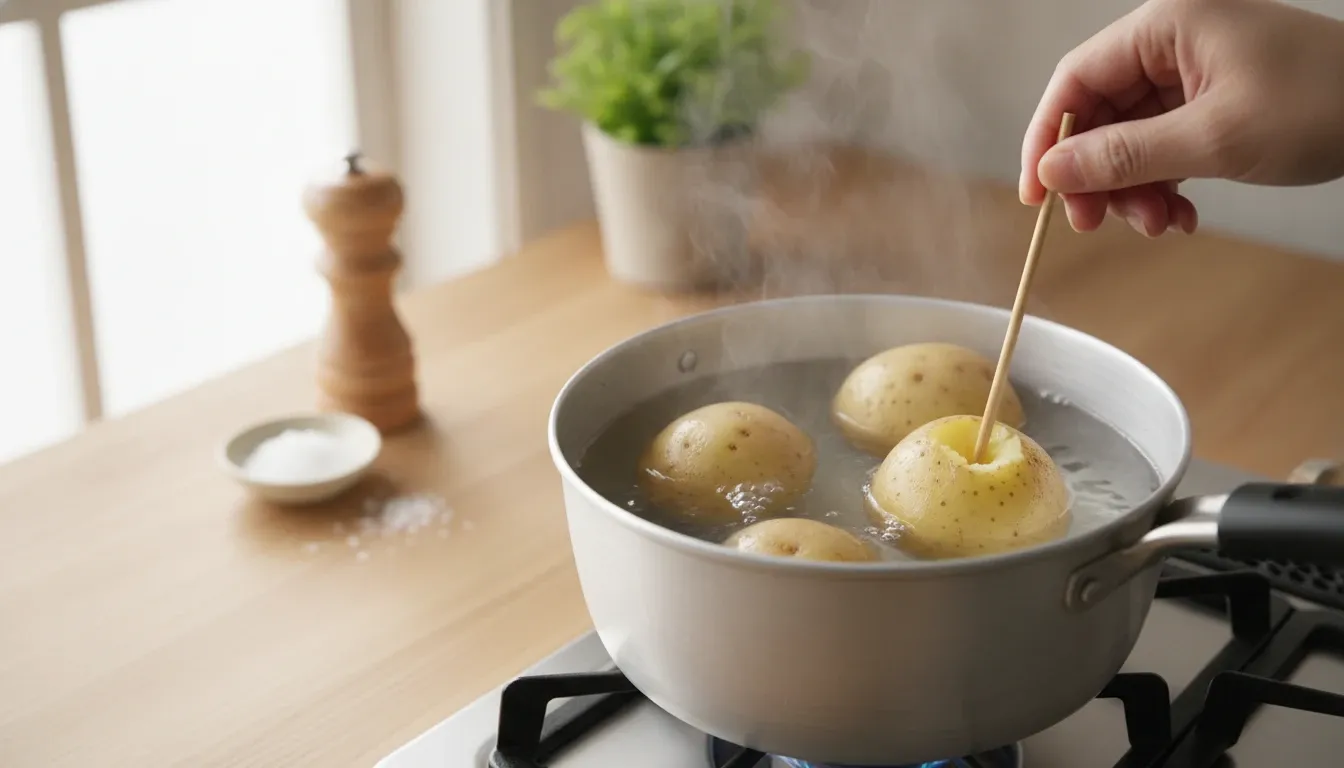
- Why root vegetables start in cold water
- The heat rises evenly, and the starch spends longer in the range where it gelatinizes
- Crisp blanched greens
- 30 seconds to 1 minute in boiling salted water, then straight into ice water
With vegetables, cooking is about controlling texture and color. The same vegetable can come out crisp, fluffy, or meltingly soft, depending on the temperature and the time.
This article explains how vegetables change with heat and how to get the texture you want. It answers two common questions: why overcooked greens lose their color, and why root vegetables start in cold water.
Three changes that decide texture and color
Three chemical changes set the texture and color of a vegetable.
Cell walls soften as pectin breaks down
A vegetable’s crunch comes from its cell walls. Pectin is the main material that holds them together, and heat breaks it down.
| Temperature | What pectin does | Texture |
|---|---|---|
| Raw (room temperature) | Firm | Crisp and crunchy |
| 50–70°C (122–158°F) | Firms up instead (the enzyme pectin methylesterase binds the cell walls together) | Holds its shape better |
| 70–80°C (158–176°F) | The enzyme stops working, and softening begins | Slightly soft |
| 80–100°C (176–212°F) | Breakdown speeds up | Fluffy to meltingly soft |
| Long cooking | Fully broken down | Falls apart |
Above 70°C (158°F), the longer you cook, the softer the vegetable gets. But between 50–70°C (122–158°F), it firms up instead. So low and slow does not always mean soft.
For potatoes and roots that must not fall apart, pass slowly through this band. To soften them fast, get through it quickly and up above 80°C (176°F). The temperature guide shows how time fits in.
Starch gelatinizes into a fluffy texture
Potatoes, sweet potatoes, and squash are rich in starch. Potato starch gelatinizes at 55–80°C (131–176°F) and sweet potato starch at 58–83°C (136–181°F). That gives the fluffy texture.
| How it’s cooked | What the starch does | Texture |
|---|---|---|
| Raw or undercooked | Not gelatinized | Chalky, hard to digest |
| Cooked right | Fully gelatinized | Fluffy, with sweetness |
| Overcooked | Gelatinized, then dried out | Dry and crumbly |
Why cook starchy vegetables slowly? To keep the starch in its gelatinizing range long enough. The same rule holds for boiling and frying.
| Method | Avoid | Do instead | Why |
|---|---|---|---|
| Boiling | Dropping them into boiling water | Start in cold water and heat slowly | They stay longer in the gelatinizing range |
| Frying | Frying once at high heat | Fry twice, low then high | The first fry gelatinizes the center |
The temperature guide goes into this in more detail.
Pigments change color with heat
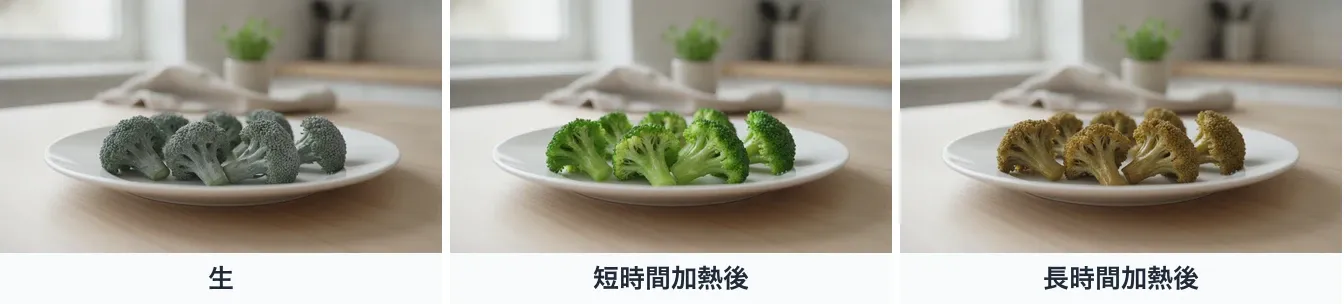
Heat changes the bright colors of vegetables too.
| Pigment | Vegetables | What heat does | How to keep the color |
|---|---|---|---|
| Chlorophyll (green) | Spinach, broccoli | Turns brown with acid and long cooking | Cook briefly in plenty of water, then chill in ice water |
| Carotenoids (orange, yellow) | Carrots, squash, tomatoes | Fairly stable; fat-soluble | Cooking with oil helps the body absorb them; stir-frying and frying work best |
| Anthocyanins (purple, red) | Red cabbage, eggplant | Change color with pH and temperature | Vinegar brightens them; cook briefly |
| Betalains (red) | Beets | Water-soluble; leach out when boiled | Boil with the skin on; vinegar steadies the color |
Why does boiling make green vegetables brighter? A brief boil makes greens more vivid than they were raw.
| State | Air in the cells | How the color looks |
|---|---|---|
| Raw | Air sits between the cells | Light scatters, and the color looks dull |
| Briefly cooked | The air is driven out | The chlorophyll shows clearly |
| Cooked a long time | Already gone | The chlorophyll turns brown |
In raw vegetables, air between the cells scatters light and blurs the color. Boiling pushes the air out, and the pigment shows through. Cook too long, though, and the chlorophyll breaks down and browns. Cook briefly and chill fast.
The best heat for each kind of vegetable
Vegetables cook differently by structure.
Leafy greens such as spinach and bok choy
Leafy greens have thin cell walls and cook through fast.
| Method | Time | Texture | Use |
|---|---|---|---|
| Boiled | 30 seconds to 1 minute | Crisp | Dressed greens, salads |
| Stir-fried | 1–2 minutes | Slightly wilted | Stir-fries |
| Steamed | 2–3 minutes | Moist | Steamed vegetables |
Boil them briefly in plenty of water, then plunge them into cold water at once.
Root vegetables such as potatoes and carrots
Potatoes, carrots, and daikon (a large white radish) have thick cell walls and contain starch.
| Method | Time | Texture | Use |
|---|---|---|---|
| Boiled from cold water | 15–30 minutes | Fluffy | Mash, simmered dishes |
| Steamed | 20–40 minutes | Moist and fluffy | Steamed vegetables |
| Deep-fried | 5–10 minutes | Crisp outside, fluffy inside | French fries |
Start them in cold water, and they cook evenly to the center. A sudden jump in temperature is what you avoid.
Baked sweet potatoes show this at work. Sweet potatoes are among the most starch-rich roots. Cook them low and slow, and the enzyme beta-amylase gets time to work, so the sweetness peaks. Hold the inside at 58–80°C (136–176°F) for a long time. The starch turns to maltose, and the potato comes out dense, sticky, and sweet.
Fruiting vegetables such as eggplant and tomatoes
Eggplant, tomatoes, and bell peppers hold a lot of water, and their pectin breaks down fast. They turn soft easily, and the skin and flesh cook at different rates.
| Method | Time | Texture | Use |
|---|---|---|---|
| Stir-fried | 2–5 minutes | Silky | Stir-fries |
| Grilled | 5–10 minutes | Toasty and soft | Grilled eggplant |
| Simmered | 10–20 minutes | Meltingly soft | Stews |
Let them soak up oil, or score the skin, and they cook through more easily.
Brassicas such as broccoli and cabbage
Broccoli, cauliflower, and cabbage change character the most with high heat. Boiled, they lose sulfur compounds to the water and turn watery. Roasted above 200°C (392°F), as with roast cauliflower, the Maillard reaction gives them a nutty, toasty flavor. The same vegetable becomes a different dish with a different method.
Their cell walls are fairly thin, so they soften quickly. They also carry their own aroma compounds, isothiocyanates.
| Method | Time | Texture | Use |
|---|---|---|---|
| Boiled | 2–4 minutes | A pleasant bite | Salads, side dishes |
| Steamed | 5–8 minutes | Moist | Steamed vegetables |
| Stir-fried | 3–5 minutes | Crisp | Stir-fries |
Boil them too long and they smell of sulfur. Cook them briefly.
How four cuisines cook vegetables
Japanese cooking keeps the vegetable’s own character
Japanese cooking aims to keep each vegetable’s own color, texture, and taste.
- Boiling: briefly, in plenty of water, then into cold water to stop the cooking.
- Simmering: gently, in dashi (Japanese stock), until the flavor soaks in.
- Steaming: in a bamboo steamer, to bring out the vegetable’s taste.
Typical dishes: ohitashi (blanched greens in a light soy and dashi dressing), simmered vegetables, and steamed vegetables.
French cooking switches between crisp and fondant
French cooking moves between two textures: crisp-tender, the bite Italians call al dente, and fondant.
- Crisp-tender: blanched so the vegetable keeps some bite.
- Fondant: cooked until meltingly soft, by braising or confit.
- Glacé: simmered with butter and sugar until glossy.
Typical dishes: ratatouille, gratin, and pot-au-feu.
Chinese cooking uses high heat, fast
Chinese cooking starts from high heat and a short time.
- Bao chao: a fast stir-fry over fierce heat.
- Bai zhuo: blanched, then dressed with a sauce poured over.
- Guo you: oil blanching, a quick pass through hot oil as a first step.
Typical dishes: shredded meat with green peppers (qing jiao rou si), stir-fried seasonal greens, and mapo eggplant.
Italian cooking works with olive oil
Italian cooking draws out the flavor of vegetables with olive oil.
- Sautéing: cooked slowly in olive oil.
- Grilling: marked over direct heat.
- Contorno: served simply as a side dish.
Typical dishes: caponata, grilled vegetables, and soffritto.
The four side by side
| Cuisine | Approach | Signature techniques |
|---|---|---|
| Japanese | Keep the vegetable’s character | Boiling and chilling, gentle simmering in stock |
| French | Switching between textures | Crisp-tender, fondant |
| Chinese | High heat, short time | Bao chao, oil blanching |
| Italian | Olive oil draws out flavor | Sautéing in olive oil |
How to cook for each texture
For crisp vegetables
Best for leafy greens, bean sprouts, and snap peas.
- Bring plenty of water to a full boil.
- Add salt: 1 teaspoon (5 ml) for 1 L of water.
- Add the vegetables and drain them after 30 seconds to 1 minute.
- Chill them in cold or ice water right away.
- Drain them well.
Carryover heat keeps cooking them, so the cold water is what stops it.
For fluffy vegetables
Best for potatoes, sweet potatoes, and taro.
- Cut the vegetables to an even size.
- Put them in the pot with cold water.
- Heat slowly over low to medium heat.
- After it boils, cook until a skewer slides in easily.
- Drain, then let the steam rise off them. For potatoes, shake the dry pot over the heat until the surface turns floury.
A sudden change in temperature cooks the surface and center unevenly.
For meltingly soft vegetables
Best for eggplant, onions, and tomatoes.
- Cut the vegetables into large pieces.
- Cook them in olive oil over low heat.
- Cover and let them steam in their own juices.
- Cook for 20–30 minutes, stirring now and then.
- They are done when soft enough to lose their shape.
Gentle, slow heat draws out the vegetables’ water and turns them silky.
Common failures and fixes
Browned greens can’t be fixed. Vegetables that fell apart can be partly saved. A soggy stir-fry and a chalky center can be fully fixed.
| Problem | Cause | Fix it now | Prevent it next time |
|---|---|---|---|
| The greens turned brown | Heat replaced the magnesium in chlorophyll with hydrogen, turning it into brown pheophytin | The color won’t come back. If the taste is fine, use them as they are | Boil in plenty of water for under 2 minutes and chill in cold water to stop the reaction |
| It fell apart | The pectin that glues the cell walls together broke down completely, and nothing held the cells in place | Mash the broken pieces into a soup or purée | Cut large pieces, heat slowly on low, and check with a skewer |
| The stir-fry went soggy | The heat didn’t match the amount in the pan; the pan cooled, water couldn’t evaporate fast enough, and the vegetables steamed | Turn up the heat to drive off the water, then stir-fry briefly to finish | Keep the heat high and cook in small batches. Add watery vegetables last |
| The center is hard and chalky | The starch in the center never reached the temperature and time it needs to gelatinize, and stayed raw | Boil again from cold water until cooked through to the center | Start in cold water so the whole thing heats evenly, and check the center with a skewer |
The rules to remember
Understand three changes, in pectin, starch, and pigment, and you control how vegetables cook.
| Vegetable | Key to cooking it |
|---|---|
| Leafy greens | Short cooking, then cold water |
| Roots | Start in cold water, heat slowly |
| Fruiting vegetables | Use oil, medium heat |
| Green vegetables | Plenty of water, lid off |
Three principles:
- Time sets the texture: short means crisp, long means meltingly soft.
- Temperature and acid change the color: cook briefly in plenty of water to keep it.
- Roots start in cold water, leafy greens go into boiling water. Both are for even cooking.
Understand the science, and cooking vegetables moves from guesswork to technique.