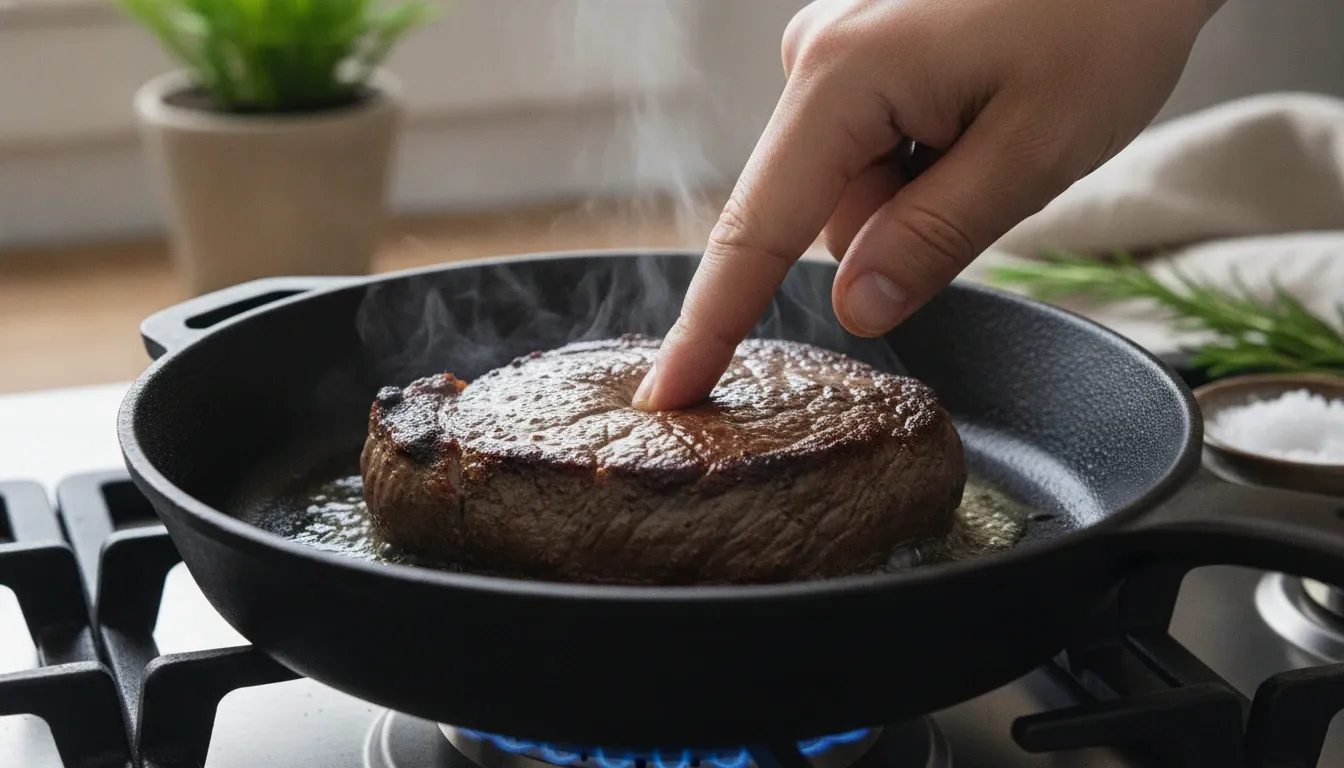
What this article answers
- How to tell temperature without a thermometer
- A full boil, bubbles on a chopstick, beading water drops, smoking oil. Each changes at a set temperature
- Is the frying oil at 170°C (338°F)?
- Fine bubbles stream from a chopstick that was wetted and wiped dry
- Is the pan hot enough?
- A water drop that beads up and rolls means about 200°C or more. If it vanishes at once, the pan is cooler
- Water at 70°C (158°F) with no thermometer
- 2 parts boiling water to 1 part tap water gives about 72°C. The bowl takes some heat, so it runs a little lower
- Can bubbles or sound tell you the water temperature?
- No. On high heat, even lukewarm water bubbles and hisses
Dip a chopstick in the frying oil and watch for bubbles. Flick a drop of water into the pan. Cooks have used both in place of a thermometer for a long time. Yet bubbles in a pot of water heating up tell you nothing about its temperature. What separates the signs that work from the ones that don’t?
This article lines up the signs you can use without a thermometer, across water, oil, and pans. It covers which temperature each one tells you, and how far you can trust it.
How the pan’s temperature follows the burner setting is covered in pan temperature and heat.
Reliable signs and their temperatures
| Sign | Temperature it tells you (°C) | What shifts it |
|---|---|---|
| Water boils from the whole surface and keeps boiling | 100 | Drops at altitude (about 88 on the summit of Mount Fuji in summer) |
| Fine bubbles stream from a chopstick, wetted and wiped dry, held in the frying oil | 170–180 | Plastic chopsticks, or chopsticks dried out completely, give fewer bubbles |
| A water drop beads up and rolls on the pan | About 200 or more | The pan’s metal and the state of its surface |
| Thin smoke rises from the oil | About 230 (refined vegetable oil) | Type of oil (roasted sesame oil: 165–178°C) |
| Sugar syrup dropped in cold water forms a soft ball | 112–116 | The ball firms at each stage of cooking down |
Sources: boiling points calculated from NIST’s saturation properties of water and the Japan Meteorological Agency’s mean pressure on Mount Fuji (July–August). The chopstick, smoke point, and sugar syrup figures come from this site’s articles on deep frying, cooking oils, and sugar syrup stages.
In Fahrenheit, those temperatures are 212°F for boiling, 338–356°F for chopstick bubbles, 392°F for beading drops, about 446°F for smoke, and 234–241°F for the soft ball.
On the other hand, the size of bubbles before a boil, how loud the water sounds, and how hot your hand feels are not signs of temperature. Each one changes with the heat and the pot.
When you have neither a thermometer nor a sign, mix boiling water with cold water. That gives you water at a known temperature.
How to read each sign
The signs in the table have one thing in common. Each is a point where water or oil switches state at a set temperature. That switch point does not move with the burner or the pot, so you can see the temperature with your eyes.
Water at a full, steady boil is 100°C
While water is boiling, turning up the heat does not raise it past 100°C (212°F). The extra heat goes into turning water into steam. Water boiling hard across its whole surface is at 100°C, in any pot, on any burner. It is the most certain temperature you can get without a thermometer.
Only altitude shifts it. Lower air pressure lowers the boiling point. On the summit of Mount Fuji in summer, the pressure is about two-thirds of that at sea level, and water boils at about 88°C (190°F). At 1,500 m (5,000 ft), water boils at about 95°C (203°F).
Frying oil at 170–180°C bubbles around a chopstick
The bubbles around a chopstick in frying oil are not the oil boiling. They are water from the chopstick turning to steam in the hot oil. Researchers at Utah State University confirmed that hotter oil vaporizes the water faster, so the bubbles come more often and more vigorously.
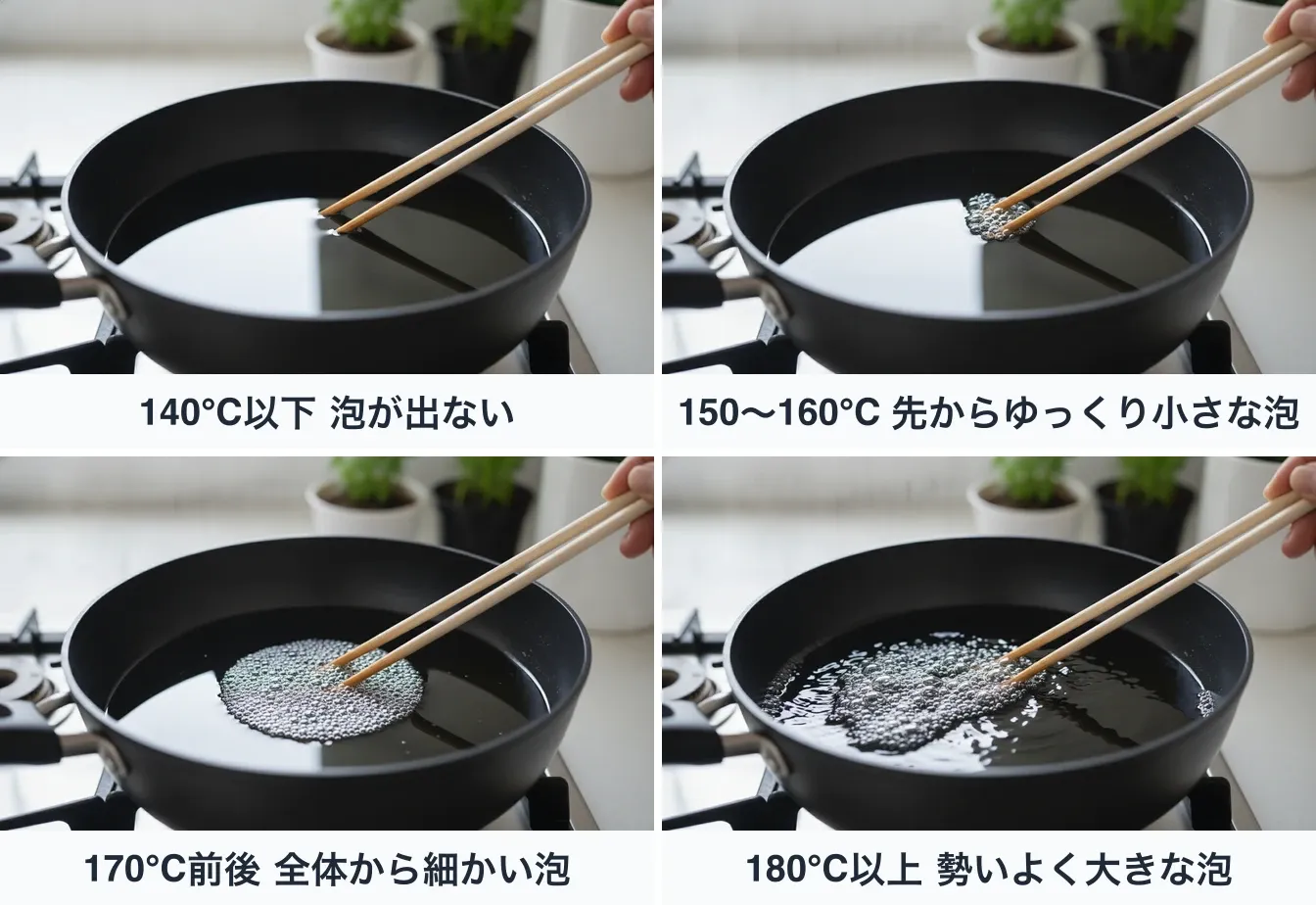
Because the bubbles come from water in the stick, the stick changes how they look. Wet a wooden or bamboo chopstick once, wipe it with a cloth, then put it in. That gives you the same conditions every time. The handle of a dry wooden spoon bubbles the same way.
A chopstick dripping wet makes the oil spatter. Plastic chopsticks absorb no water, so they bubble less and can make you read the oil as cooler than it is.
At 170–180°C (338–356°F), the oil is in the range for most deep frying.
A pan is about 200°C when drops bead and roll
Flick water onto a hot pan, and the drops behave differently depending on the temperature.
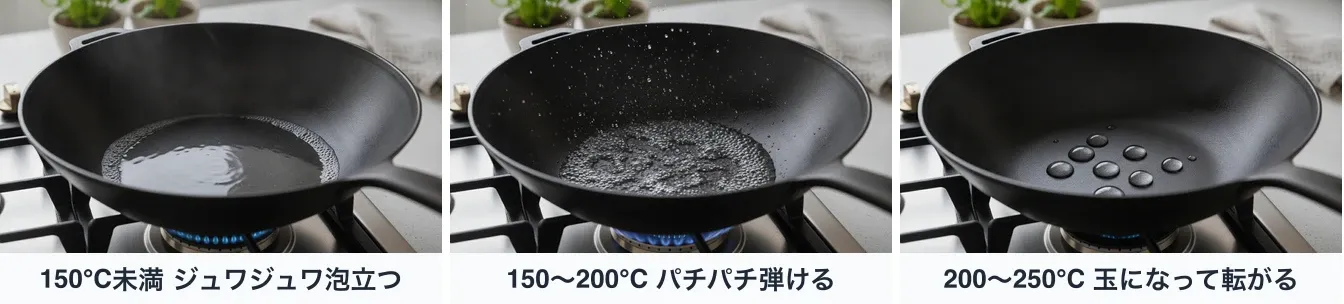
Once the pan passes about 200°C (392°F), the bottom of each drop flashes into a cushion of steam. The drop rides on that cushion and rolls as a bead. It is not touching the pan, so it lasts. This is the Leidenfrost effect.
Just after beading starts, a drop vanishes as soon as it touches a cooler spot on the pan. On a carbon steel or iron pan above about 240°C (464°F), drops roll on and on wherever they land.
This temperature moves with the pan. Polished aluminum is lower, at 171–235°C (340–455°F). Stainless steel is higher, at 240–325°C (464–617°F). A rougher surface, or one with mineral spots from tap water or marks from earlier drops, raises it. A seasoned surface that repels water lowers it.
The easy mistake is to think that a drop vanishing fast means a hot pan. A drop that hisses and disappears in a few seconds is touching the pan directly, below 200°C. The pan is hotter when drops bead, roll, and last.
This works the same on gas, electric, and induction, because it reads the pan, not the burner. How hot the pan gets at each heat setting is in pan temperature and heat.
Refined vegetable oil smokes at about 230°C
Keep heating oil, and at some point thin smoke rises. It means the oil has started to break down from the heat. That temperature is the smoke point. For a refined neutral oil such as canola or soybean, it is about 230°C (446°F).
The smoke point depends on the oil. Roasted sesame oil smokes at 165–178°C (329–352°F), and extra virgin olive oil across a range of 189–207°C (372–405°F). To use smoke as a sign, you need to know the smoke point of the oil in your pan.
Deep frying runs at 170–180°C, well below the smoke point of refined vegetable oil. If the oil smokes while you fry, it has climbed past frying temperature.
Signs that don’t tell temperature
Bubbles and sound before a boil depend on heat
As a pot of water heats, bubbles cling to the bottom and the pot starts to sing before it boils. Those bubbles and that sound reflect the heat of the pot bottom over the burner, not the temperature of the water as a whole.
In a study that measured the sound of heating water, the heater surface was near boiling point while the water was still at 20°C (68°F). The loudness changed with the heat input. On low power, the water sometimes reached a boil without making any sound.
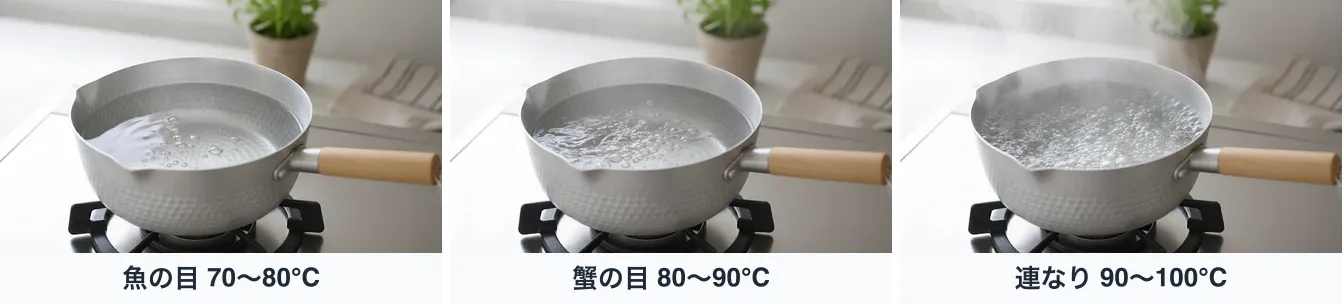
The photo labels follow a Japanese rule of thumb that names the stages by their bubbles: “fish eyes” at 70–80°C, “crab eyes” at 80–90°C, and “strings of beads” at 90–100°C. We could not confirm these figures in a primary source.
The same bubble stage shows up at a lower temperature on high heat, and not until a higher one on low heat. Treat bubbles in water below a boil as a rough guide with a wide margin. To know the temperature, mix boiling and cold water, or use a thermometer.
Fingers can’t read differences above 43°C
The sensors in your skin that register heat as pain start working at 43°C (109°F). Dip a finger in water and you can tell “warm” from “too hot to keep my finger in.” Above 43°C, the differences get hard to read.
Testing hot water with a finger is also a good way to get burned.
Holding a hand over a pan or a charcoal fire to judge its heat is no better. The result changes with the distance, the heat, and how your hand feels that day. It cannot stand in for a number.
No thermometer? Mix boiling and cold water
Ratios and the temperatures they give
If you can’t measure the water, make it by mixing water of known temperatures. Freshly boiled water is 100°C, so if you know the amounts and the cold water’s temperature, you can calculate the result.
Mixed temperature = (amount of boiling water × 100 + amount of cold water × its temperature) ÷ total amount
| Boiling : cold | Cold water at 15°C (59°F) | Cold water at 5°C (41°F) |
|---|---|---|
| 1:3 | About 36°C (97°F) | About 29°C (84°F) |
| 1:2 | About 43°C (109°F) | About 37°C (99°F) |
| 1:1 | About 58°C (136°F) | About 53°C (127°F) |
| 2:1 | About 72°C (162°F) | About 68°C (154°F) |
| 3:1 | About 79°C (174°F) | About 76°C (169°F) |
| 4:1 | About 83°C (181°F) | About 81°C (178°F) |
Tap water is warmer in summer than in winter. In winter, use the 5°C column.
Mixed water suits jobs where you use it up within a few minutes. Examples are a quick hot-water rinse for fish or meat, or warm water for soaking dried foods.
When it comes out lower than calculated
The mix falls short of the calculation because the bowl or pot takes some of its heat. Pour it into a cold bowl, and it comes out lower than the table. Warm the bowl with boiling water first, and you get closer to the calculated value.
Water that boiled a while ago, or water kept in an electric kettle or hot-water dispenser, is below 100°C. Use water just off the boil.
For a held temperature, use a thermometer
Mixed water cools as it sits. That is fine if you use it within a few minutes. It won’t work for anything that needs the same temperature for tens of minutes, such as onsen tamago or sous vide.
Onsen tamago (eggs with a soft, custardy white and yolk) are held at 65°C (149°F) for 30–40 minutes. If the water cools, the yolks don’t set.
Without a thermometer, cook pork and chicken until the meat has turned an opaque, whitish color all the way through. Sous vide can’t be checked by color, so use a thermometer.
Common failures and fixes
Greasy food and smoking oil can both be fully recovered. Food stuck to the pan can only be partly saved.
| Problem | Cause | Fix it now | Prevent it next time |
|---|---|---|---|
| Fried food is greasy | The oil was too cool, so it soaked into the coating before the coating’s water could boil off | Lift onto a rack to drain, bring the oil up to temperature, and refry briefly | Wait until fine bubbles stream from a chopstick that was wetted and wiped dry |
| Food sticks to the pan | The pan was not preheated enough, so the food’s proteins set while touching the metal and bonded to it | Don’t force it. Wait until it browns and releases on its own | Preheat until a water drop beads up and rolls, then add the oil |
| Too much smoke | The oil passed its smoke point and began to break down from the heat | Turn off the heat, let the oil cool, and start cooking once the smoke settles | Add the food before smoke appears. Roasted sesame oil smokes at 165–178°C, so drizzle it on at the end |
For how cuisines around the world have taught heat control, see heat control in five cuisines.
Sources
- Japan Meteorological Agency. Mount Fuji (Shizuoka) climate normals, 1991–2020 (in Japanese). Mean summit pressure 646.8 hPa in July and 648.7 hPa in August
- NIST Chemistry WebBook. Saturation Properties for Water (boiling point of water at each pressure)
- Utah State University. "USU Researchers Explore the 'Why' Behind a Widely Used Cooking Trick" (2021, presented at the American Physical Society Division of Fluid Dynamics meeting). Water in a wet chopstick vaporizes in hot oil, and hotter oil makes more bubbles
Show 7 more
- Walker, J. "Boiling and the Leidenfrost Effect." Supplement to Halliday et al., Fundamentals of Physics, 6th ed. The temperature at which water drops bead up and last on a hot metal plate (Fig. 3)
- Kita, Y., et al. (2024). Thermal hysteresis in wettability and the Leidenfrost phenomenon. Phys. Rev. Research 6: 033287. When drops start to float on stainless steel and when they keep rolling (Fig. 3)
- KAKEN grant 14017043 (Tominaga, M.) (in Japanese). The heat-pain receptor TRPV1 activates at 43°C and above
- "Analysis of the liquids composition by the sound produced by their heating" (2021). The sound of heating water changes with heat input, and on low power water reaches a boil without making sound
- Shizuoka Prefecture. The environment of Mount Fuji (in Japanese). Summit pressure is about two-thirds of that at sea level, so water boils below 100°C
- ThermoWorks. High Altitude and Its Effect on Cooking. Boiling point of water by elevation
- Food Republic. The Wooden Spoon Hack To Check Hot Oil Without A Thermometer. The handle of a dry wooden spoon bubbles in hot oil the same way a chopstick does