What this article answers
- Why dry-roasting makes food toasty
- The Maillard reaction speeds up above 140°C, fats oxidize into new aromas, and water boils off for crunch
- How hot to roast
- The toasty aroma peaks at 170-200°C. Above 200°C it starts to burn and turn bitter
- How long to toast sesame seeds
- 2-4 minutes over low to medium heat, shaking constantly, until they crackle and smell toasty
- How to roast dried soybeans
- 15-20 minutes over low heat, or 30-40 minutes in a 150°C oven, until brown right through
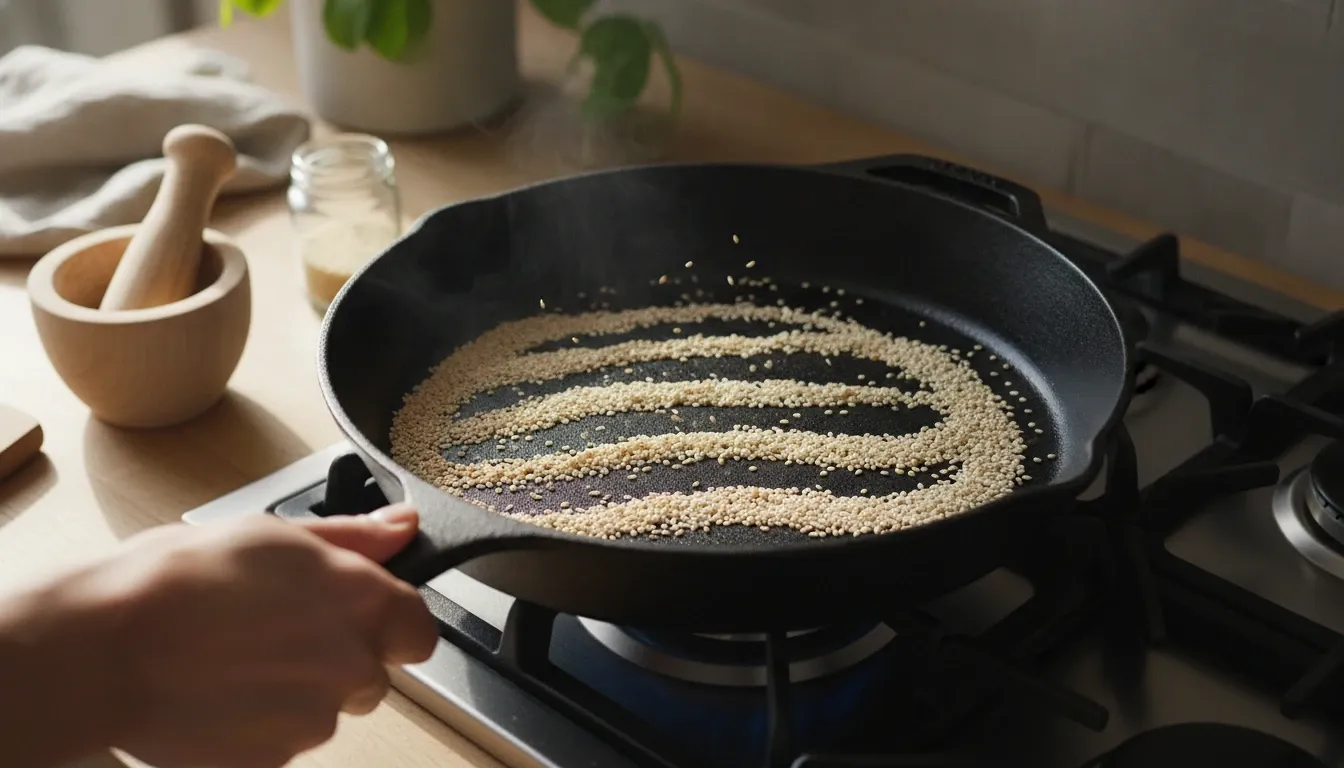
Dry-roasting means heating food with dry heat, without oil. Roast sesame seeds, soybeans, nuts, or spices, and their aroma changes dramatically, adding depth to a dish.
This article explains the science of dry-roasting and the techniques that get the most aroma out of it. You will learn to roast evenly and toastily without burning.
Why dry-roasting makes food toasty
Three reactions at work
Roasted food turns toasty because of three chemical reactions.
1. The Maillard reaction makes the toasty aroma
Amino acids and sugars react above 140°C (284°F). They form hundreds of aroma compounds and brown pigments.
- Raw sesame seeds: pale, with little aroma
- Roasted sesame seeds: brown, with a toasty aroma
That change is the Maillard reaction. For more, see what happens to food at each temperature.
2. Fats oxidize into new aromas
Sesame seeds and nuts are rich in fat. Heat oxidizes the fat and creates distinctive aromas.
| Ingredient | Fat content | Aroma from roasting |
|---|---|---|
| Sesame seeds | About 50% | Nutty, toasty |
| Almonds | About 50% | Sweet and toasty |
| Walnuts | About 65% | Deep and rich |
| Soybeans | About 20% | Toasty and sweet |
Push the heat too far, though, and over-oxidized fat smells unpleasant. Roast moderately.
3. Water boils off and the food crisps
Roasting drives water out of the food and gives it a crisp texture.
- Raw soybeans: dense and hard
- Roasted soybeans: crunchy and toasty
What happens at each temperature
| Temperature | What happens | Result |
|---|---|---|
| Below 100°C (212°F) | Water evaporates | The food dries |
| 100–140°C (212–284°F) | Drying continues; faint color starts | It starts to crisp |
| 140–170°C (284–338°F) | The Maillard reaction speeds up | It colors and gives off aroma |
| 170–200°C (338–392°F) | The Maillard reaction is in full swing | The toasty aroma peaks |
| Above 200°C (392°F) | It starts to burn | Bitter, burnt smell |
The toasty aroma peaks at 170–200°C (338–392°F). Beyond that, it burns.
How to roast each ingredient
Sesame seeds (white and black)
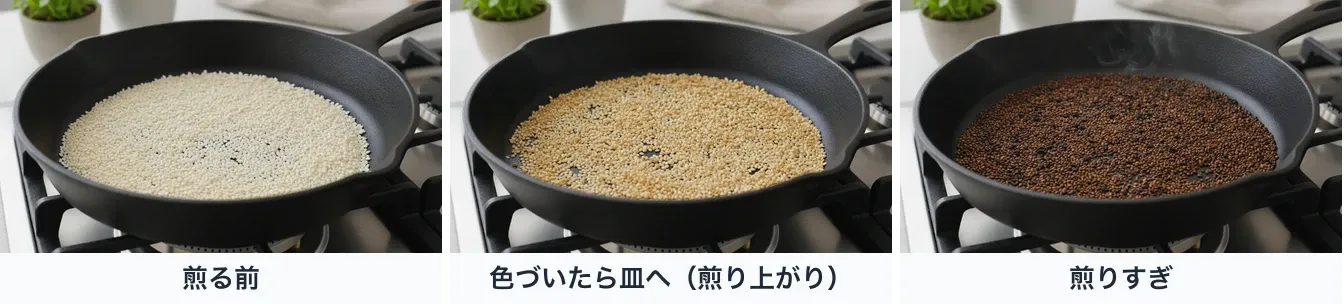
Sesame seeds are oily, so their aroma comes out easily. Over-roast them and the oil oxidizes and turns bitter.
| What | Guide |
|---|---|
| Heat | Low to medium |
| Time | 2–4 minutes |
| When they are done | They crackle and smell toasty |
| Watch out | They burn easily. Keep shaking the pan |
How to roast:
- Preheat the pan over low heat (no oil)
- Add the sesame seeds and keep shaking the pan
- When they start to crackle and pop, pay close attention
- Once they smell toasty and have colored, move them to a plate right away
Soybeans
Soybeans hold a lot of water and need to dry thoroughly. Roasting brings out sweetness and a toasty flavor.
| What | Guide |
|---|---|
| Heat | Low |
| Time | 15–20 minutes (dried soybeans) |
| When they are done | Crunchy, and brown right through when split |
| Watch out | They burn easily. Cook them through to the center |
How to roast:
- Use dried soybeans (canned or cooked beans won’t work)
- Heat the pan over low heat
- Add the soybeans and shake the pan from time to time
- Roast slowly for 15–20 minutes
- Split one; if it is brown all the way through, they are done
In the oven: 150°C (302°F) for 30–40 minutes. They come out evenly.
Nuts (almonds, walnuts, cashews)
Nuts are oily and burn easily. Roasting transforms their aroma and texture.
| Nut | Heat | Time | When they are done |
|---|---|---|---|
| Almonds | Low to medium | 5–8 minutes | Lightly colored, aromatic |
| Walnuts | Low | 3–5 minutes | Aromatic (they burn easily) |
| Cashews | Low to medium | 5–7 minutes | Golden and crisp |
How to roast:
- Preheat the pan over low heat
- Add the nuts in a single layer
- Heat them, shaking the pan from time to time
- Take them out once they smell toasty and have colored lightly
- They keep cooking in their own heat, so take them out early
Spices (cumin, coriander, Sichuan pepper)
Spice aromas are volatile. Roast them too long and the aroma is gone.
| Spice | Heat | Time | When they are done |
|---|---|---|---|
| Cumin seeds | Low | 1–2 minutes | Aromatic, color changes |
| Coriander seeds | Low | 2–3 minutes | Aromatic |
| Sichuan pepper | Low | 1–2 minutes | Aromatic, crackling |
How to roast:
- Use a small pan
- Heat slowly over low heat
- Take them out as soon as they smell fragrant
- Crushing them in a mortar releases more aroma
Aroma is the whole point of a spice. Over-roast it and the aroma escapes, and the spice is wasted.
Rice and brown rice
Roasted rice is the base of genmaicha, Japanese green tea blended with roasted brown rice. Its starch browns and turns toasty.
| What | Guide |
|---|---|
| Heat | Medium |
| Time | 10–15 minutes |
| When it is done | Golden, and some grains pop like popcorn |
| Watch out | It colors unevenly. Keep shaking the pan |
Dry-roasting in four cuisines
Japan: sesame seeds and soybeans
In Japanese cooking, roasted sesame seeds and roasted soybeans are the classics.
- Roasted sesame seeds: in dressed vegetable dishes, rice seasonings, and sesame salt
- Roasted soybeans: eaten whole, or ground into kinako (roasted soybean flour)
- Roasted rice: in genmaicha and arare (small rice crackers)
The aim is to bring out the ingredient’s own aroma and use it simply.
China: Sichuan pepper and five-spice
Chinese cooking roasts spices to bring out their aroma.
- Sichuan pepper: for mapo tofu and other Sichuan dishes
- Dried chilies, dry-roasted: for la zi ji, Chongqing chicken buried in chilies
- Star anise and cassia: ground into five-spice powder
Spices are roasted and then crushed, or their aroma is moved into oil.
India: tempering spices
Indian cooking roasts spices in a technique called tempering (tadka).
- Cumin seeds: the base of the aroma in curries
- Mustard seeds: in South Indian cooking
- Curry leaves: for aroma
Tempering is often done in oil, which takes on the spices’ aroma.
The Middle East: nuts and seeds
Middle Eastern cooking roasts nuts and seeds to use as toppings.
- Pine nuts: on hummus and tabbouleh
- Almonds: on couscous and pilaf
- Sesame seeds: for tahini (sesame paste)
They go on at the end, adding texture and aroma.
The four compared
| Cuisine | Main roasted ingredients | How they are used |
|---|---|---|
| Japanese | Sesame seeds, soybeans, rice | Whole, or ground into powder |
| Chinese | Sichuan pepper, chilies | Roasted and crushed, or infused into oil |
| Indian | Cumin, mustard seeds | Tempering (roasted in oil) |
| Middle Eastern | Nuts, seeds | Toppings, pastes |
Getting the most aroma out of roasting
Three rules
1. Low to medium heat, slowly
On high heat the surface burns before the inside cooks. Low heat and patience are the basics.
2. Keep it moving
Food that sits in one spot burns. Shake the pan or stir constantly.
3. Count on carryover heat
Food keeps cooking after the heat is off. Take it out early and move it to a plate.
Tips for the frying pan
- No oil: roast in a dry pan
- No lid: trapped steam keeps the water in, so the food never crisps
- Preheat lightly: an overheated pan burns the food the moment it goes in
- Small batches: food piled up won’t roast evenly
- Use all your senses: don’t miss changes in aroma, sound, and color
Why no lid? Roasting is about driving off water. With a lid, the steam can’t escape, and you are steaming instead of roasting. The exception is food that pops, like popcorn, which needs a lid.
Tips for the oven
The oven has the edge in roasting evenly.
- Preheat to 150–170°C (302–338°F)
- Spread the food thinly on a baking sheet
- Stir every 10–15 minutes
- Take it out once it smells toasty and has colored
Best for: large batches of nuts, and soybeans.
Storing roasted food
- Keep it in an airtight container
- Store it somewhere cool and dark
- Use it within 1–2 weeks (the aroma fades)
- Freeze it for longer storage
Freshly roasted is most fragrant. Ideally, roast only what you will use.
Common failures and fixes
A burnt surface can be only partly saved, and bitterness cannot be fixed. Uneven color, weak aroma, and an underdone center can be fully fixed.
| Problem | Cause | Fix it now | Prevent it next time |
|---|---|---|---|
| The surface burned | The heat was too high, so only the side touching the pan got hot and went past the Maillard reaction into charring | Pick out the burnt pieces and roast the rest again over low heat | Shake constantly over low to medium heat, and turn the heat down if it smokes |
| It colored unevenly | Pieces piled up and never touched the pan, so the heat reached them unevenly | Spread it out thinly again and roast it, stirring the whole batch evenly | Spread it thinly and keep stirring, or heat it all at once in the oven |
| The aroma is weak | The temperature was too low and the time too short, so the Maillard reaction that makes the toasty aroma never got going | Raise it above 140°C (284°F) and keep roasting until the color and aroma come up | Hold it above 140°C, and judge by the crackling sound |
| The center is underdone | The heat was too high, so the surface colored first and hit its limit before heat reached the center | Turn down to low, take 15–20 minutes, and split one to check the center | Roast slowly over low heat, or give it 30–40 minutes in a 150°C (302°F) oven |
| It tastes bitter | It went past the Maillard reaction and caramelization into charring, which makes bitter breakdown products | The bitterness won’t go away, and you can’t roast it again. Use it where bitterness matters less | Take it out early, allowing for carryover heat, and spread it on a plate to cool |
The numbers to remember
Dry-roasting is a simple technique with real depth: dry heat draws out aroma.
Roasting changes color, aroma, and crunch at once
- Maillard reaction: once the surface dries and passes 100°C (212°F), it starts to color. Above 140°C (284°F), the toasty aroma comes on fast
- Fat oxidation: the distinctive aroma of nuts and sesame
- Water loss: a crisp texture
Quick reference
| Ingredient | Heat | Time | Sign |
|---|---|---|---|
| Sesame seeds | Low to medium | 2–4 minutes | Crackling, aroma |
| Soybeans | Low | 15–20 minutes | Brown right through |
| Nuts | Low to medium | 3–8 minutes | Lightly colored |
| Spices | Low | 1–3 minutes | Fragrant |
Three rules
- Low heat, slowly: no burning, and cooked through
- Keep it moving: even color
- Count on carryover heat: take it out early
Roasting draws out what an ingredient has in it. Enjoy the aroma of food roasted fresh.