What this article answers
- Why shio koji makes meat tender
- Mostly the salt holding in water. The enzymes are weak, about 1/8 as strong as kiwi's
- Shio koji did not make my meat tender
- Its enzymes are about 1/8 as strong as kiwi's. The tests where it worked used ground meat and chicken tenderloin
- Why shio koji adds umami
- Koji enzymes cut the meat's proteins and make amino acids
- I only want tenderness
- Fruit enzymes are stronger. For moistness alone, salt is enough
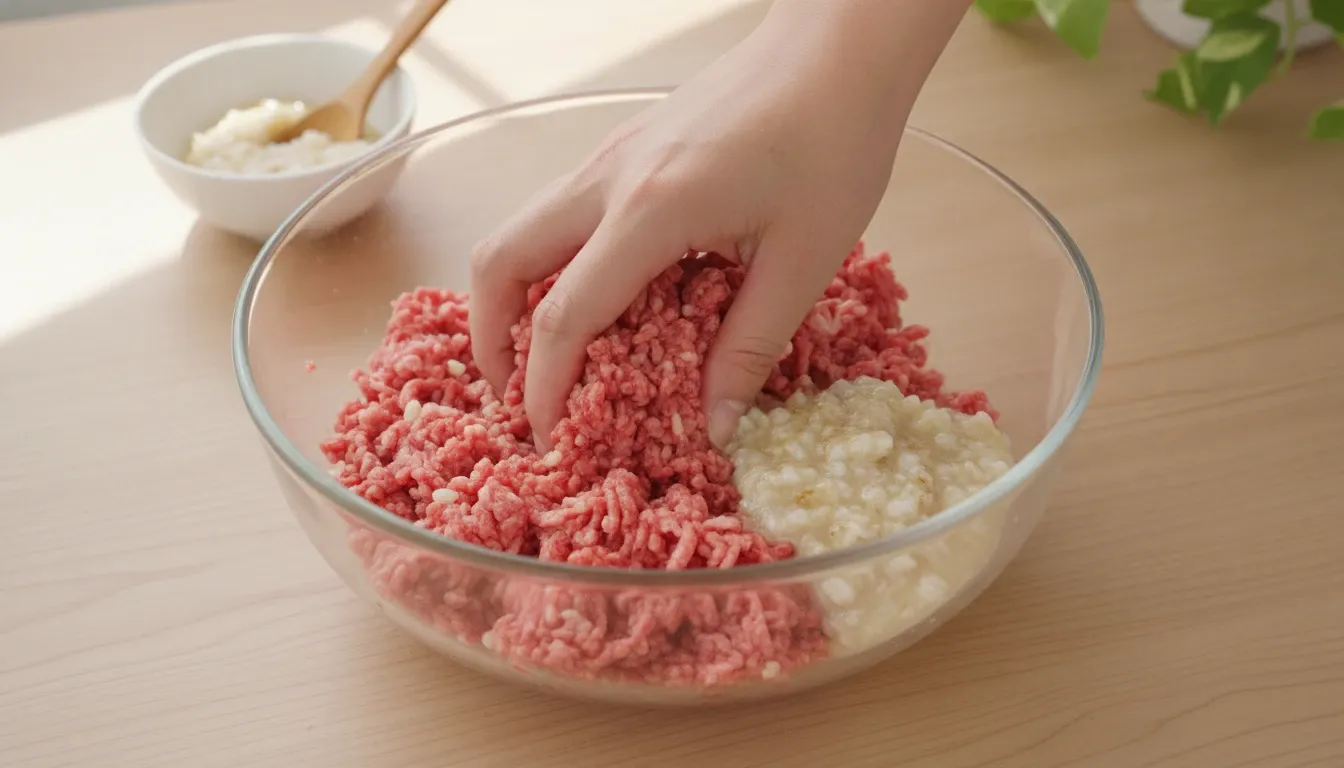
I grilled pork loin that had soaked in shio koji (塩麹, rice koji fermented with salt), and it came out moist. A thick-cut pork shoulder soaked the same way was not as tender as I expected. Even so, it tasted fuller than pork grilled with salt alone.
Those three results come from three different things in shio koji: salt, enzymes, and sugar.
This article covers what happens to food while it sits in a koji seasoning.
Three things a koji soak does
| Change in the soaked meat | What causes it | How well it worked in tests |
|---|---|---|
| Moister | The salt in shio koji | About 6% less juice lost in cooking (pork loin, overnight in the refrigerator) |
| More tender | Protease (an enzyme that cuts proteins) | Chicken tenderloin: about half the force to bite through. Pork loin in a block: no difference a machine could measure |
| More umami | Protease (in chicken, the meat’s own enzymes join in) | About 2.8 times the glutamate (pork loin, overnight in the refrigerator) |
| Sweeter | Sugar made from the koji’s rice by amylase (an enzyme that cuts starch) | Shio koji sold in Japan is about one-fifth sugar by weight |
Pork loin values: Abe and Akita (2019). Chicken tenderloin: Maehashi (2017). Sugar: average of 14 Japanese commercial products, Maehashi et al. (2015).
Salt, enzymes, and sugar differ in how strongly they work. Amazake (甘酒), a sweet koji drink, contains no salt, so it does nothing to keep meat moist.
Most of the moistness comes from salt
A salted soak loses about 6% less juice
Soak pork overnight in the refrigerator, then cook it. A soak that contains salt loses about 6% less juice than one without.
The result held for shio koji with its enzymes stopped, and even for plain salt water. What keeps the juice in is the salt, not the enzymes.
Overnight, a machine found no enzyme effect
The same study measured the hardness of the cooked meat by machine. Regular shio koji and shio koji heated to stop its enzymes showed no difference. Only shio koji with added enzyme preparation, which raised its enzyme content, made a difference.
In taste tests, meat soaked in shio koji was rated more tender and juicier than meat soaked in amazake. Meat soaked in plain salt water also beat the amazake meat on tenderness. The researchers concluded that the salt’s water-holding also shaped how tender the meat seemed.
Protease tenderizes, but it is weak
About 3 times ginger’s power, 1/8 of kiwi’s
| Ingredient | Protein-cutting power (per 1 g, in units; higher cuts faster) |
|---|---|
| Kiwi | 0.92 |
| Shio koji (homemade, 21 days after making) | 0.12 |
| Ginger | 0.04 |
Measured by how fast each breaks down casein, the protein in milk. Enguchi et al. (2016).
To match kiwi with shio koji, your only options are to leave it longer or to use more. But more shio koji also means more salt, so quantity can only make up so much.
Salt weakens the enzymes
Salt holds back koji’s protein-cutting enzymes. One report found that in 10% salt, their activity fell to about 65%.
Amazake, which has no salt, shows the difference. Made from the same koji at 60°C (140°F), amazake produced about 1.5 times the amino acids of shio koji.
On enzyme action alone, salt-free amazake gets further. But it has none of the salt that keeps meat moist. If you soak in amazake, add salt separately.
It worked on ground meat and chicken tenderloin
Enzymes work from the surface they touch. I could not find a study measuring how many millimeters into the meat they reach.
The tests that showed more tenderness used ground beef (mixed in and left 60 minutes) and chicken tenderloin (about half the bite force after one night). Pork loin in a block showed no difference.
Meat with more surface for the enzymes to touch is probably easier to affect. For tenderness, use it on ground meat, chicken tenderloin, or thin slices. I could not find a test on thin slices, though.
The umami comes from the meat
Shio koji has 1/10 the umami of miso
Glutamate, the amino acid at the heart of umami, is about 0.1% of shio koji even in the richest products. That is about 1/10 of miso. Use it at 10% of the food’s weight, and the food gets only 1/10 of that.
Even so, pork loin soaked overnight in shio koji in the refrigerator ended up with about 2.8 times the glutamate. That is more than the meat could reach even if every amino acid in the shio koji moved into it. The increase came from inside the meat.
Koji enzymes cut proteins into amino acids
Koji enzymes cut the meat’s proteins into short fragments, called peptides, and then further, into amino acids. In chicken, the meat’s own enzymes are known to cut those fragments too, making glutamate.
Meat gains umami as it ages because its own enzymes cut its proteins. A shio koji soak gives a small dose of the same change in a single night: proteins cut, umami up.
Fish and vegetables also have enzymes that turn those fragments into amino acids, to a greater or lesser degree. But no one has measured how much their amino acids rise in shio koji.
The sweetness comes from the koji’s rice
Amylase cuts starch, and meat has almost none: pork loin has 0.2 g of carbohydrate per 100 g. Amylase works on the rice in the koji instead. The sweetness is already made inside the shio koji before anything goes in.
Shio koji sold in Japan is about one-fifth sugar by weight (21.9% on average across 14 products), about 2 times the sugar in miso. With twice as much sugar as salt, it reportedly tastes less salty than miso of similar salt content.
No one knows whether this sugar also helps tenderize meat. It does stay on the surface of the soaked meat, so the meat browns faster and burns more easily.
Fruit for tenderness, salt for moistness
| Method | Moistness | Tenderness | Umami | Sweetness |
|---|---|---|---|---|
| Salting, brining | Yes | None from enzymes | No increase | None added |
| Grated fruit (kiwi, pineapple) | Yes, if you add salt | Strong | Not measured | The fruit’s sweetness |
| Shio koji with live enzymes | Yes | Weak (about 1/8 of kiwi) | Increases | Added |
| Shio koji without live enzymes | Yes | None from enzymes | No increase | Added |
Tenderizing meat with fruit enzymes is not only a Japanese practice. In the tropics, people have long wrapped tough meat in papaya leaves to soften it. Commercial meat tenderizers use papaya enzymes too.
| What you want | What to use |
|---|---|
| Meat that does not dry out when cooked | Salt (it does not need to be shio koji) |
| Clearly more tender tough meat | Fruit enzymes. With shio koji, use ground or thinly sliced meat |
| More umami | Shio koji with live enzymes, overnight in the refrigerator |
| Seasoning, moistness, and umami in one step | Shio koji with live enzymes |
How to make shio koji work
| Condition | What happens if you miss it |
|---|---|
| Use shio koji whose enzymes are still active (homemade, or in Japan, the kind sold refrigerated) | You get seasoning and moistness, but no extra tenderness or umami |
| For umami, soak overnight in the refrigerator | The figure of about 2.8 times comes from an 18-hour soak. With less time, how much it increases is unknown |
| For tenderness, use ground meat, thin slices, or chicken tenderloin | A thick block may not get tender enough for a machine to measure |
| Soak in the refrigerator | The enzymes work faster at room temperature, but the meat spoils more easily |
| Build tenderness and umami during the soak | Koji enzymes stop above 60°C (140°F), so cooking longer cannot add any |
Common failures and fixes
The first of these cannot be undone once the meat is cooked; the other two can be partly saved.
| Problem | Cause | Fix it now | Prevent it next time |
|---|---|---|---|
| The meat is tough | The protease is about 1/8 as strong as kiwi’s. In a pork loin block soaked overnight in the refrigerator, a machine measured no difference. Some products have no active enzymes at all | Once cooked, it cannot be undone. Slice it thin, across the grain, to eat | For tenderness, use shio koji with live enzymes on ground or thinly sliced meat, or use fruit enzymes |
| No umami | Shio koji itself has only about 1/10 the umami of miso. A product without live enzymes cannot draw umami out of the meat either | Pair it with seasonings that carry umami, such as kombu dashi or soy sauce | Use shio koji with live enzymes, and soak overnight in the refrigerator |
| The meat is dry | It was soaked in amazake with no added salt. Without salt, more juice runs out during cooking | Serve it with a sauce | When soaking in amazake, add salt at about 1% of the food’s weight |
Salt for moisture, enzymes for tenderness and umami
- Most of the moistness comes from the salt in shio koji. A soak with salt loses about 6% less juice in cooking
- Protease does the tenderizing, but it is about 1/8 as strong as kiwi’s. The tests where meat got more tender used ground meat and chicken tenderloin
- Shio koji does not add umami. Koji enzymes cut the meat’s proteins and draw it out
Sources
- Abe, Maki, and Osamu Akita. Effects of koji-derived enzymes and salt in shio koji on cooking meat. Journal of the Brewing Society of Japan 114(5) 258-267 (2019) (in Japanese). On free amino acids, cooking loss, hardness, and taste tests for pork loin soaked overnight in shio koji under refrigeration, and on earlier studies of ground meat and chicken
- Maehashi, Kenji. Flavoring Characteristics of a Salt-malted Rice, Shio-koji. Bulletin of the Society of Sea Water Science, Japan 71(4) 232-239 (2017) (in Japanese). On the glutamate and reducing sugar in shio koji, how salt lowers protein breakdown, and umami made by the food's own enzymes
- Enguchi, Noriko, Natsuko Yukawa, and Yoko Nakanishi. Caseinolytic Activity of Homemade Shio-Koji. Journal of Cookery Science of Japan 49(2) 166-171 (2016) (in Japanese). On how strongly shio koji, ginger, and kiwifruit break down protein
Show 4 more
- Maehashi, Kenji, et al. Effect of Temperature on Enzymatic Stability in Shio-Koji During the Maturation Process. Nippon Shokuhin Kagaku Kogaku Kaishi 62(6) 290-296 (2015) (in Japanese). On the composition and enzyme activity of commercial shio koji, and how amino acids form differently in shio koji and amazake
- Noda, Tomoaki, et al. A Comprehensive Comparative Study on Tenderization of Beef using Plant Proteases in Food. Journal of Cookery Science of Japan 58(2) 77-83 (2025) (in Japanese). On fruit and other enzymes that tenderize meat at refrigerator temperatures
- Ministry of Education, Culture, Sports, Science and Technology (MEXT). Standard Tables of Food Composition in Japan (Eighth Revised Edition). Pork, large breeds, loin, fat on, raw (in Japanese). On carbohydrate per 100 g
- Encyclopedia.com. Papain. On the practice of tenderizing meat with papaya enzymes and on commercial meat tenderizers