What this article answers
- Miso soup with the most aroma
- Heat the dashi to about 80°C (176°F), turn off the heat, dissolve the miso, and serve without reheating
- Color and depth in a long-simmered dish
- Add miso twice: early for flavor and depth, at the end for aroma
- A miso that holds up to long simmering
- Soybean or red miso. Save white miso for low heat, finishing, and curing beds
- Fish that turns soft and savory in a miso cure
- Saikyo miso (a sweet white miso), 1–3 days in the refrigerator
Miso is soybeans fermented with koji, a grain cultured with an enzyme-rich mold. Its flavor is a tangle of aroma compounds, amino acids, sugars, and organic acids.
Each of those evaporates, reacts, or breaks down at its own temperature. So the same miso turns into something different depending on how hot the pot is when it goes in, and when.
Unlike soy sauce, miso is a paste that holds its water inside. Heat moves through it more slowly, and its chemistry changes more slowly too. Knowing this is the key to cooking with miso on purpose.
Miso’s flavor at every temperature
| Temperature | Technique | Main chemical change | Flavor | Typical uses |
|---|---|---|---|---|
| Room temperature (raw) | Raw miso, sumiso (miso thinned with vinegar) | None; all volatile compounds and enzymes remain | Vivid fermented aroma; enzymes still active | Morokyu (cucumber with chunky miso), vegetables dressed with sumiso, miso dressing |
| 40–60°C (104–140°F) | Miso curing beds | Enzyme activity peaks; slow breakdown | Protein breakdown softens the food | Saikyo-zuke (fish cured in sweet white miso), other miso-cured foods |
| 60–80°C (140–176°F) | Warming, mixing in | Small loss of low-boiling compounds | Sharp edges soften; turns mellow | Hiyajiru (chilled miso soup), miso sauces |
| 80–90°C (176–194°F) | The ideal range for miso soup | Aroma compounds stay in the liquid | Fermented aroma and umami together | Miso soup, finishing other soups |
| 90–100°C (194–212°F) | Early simmering; the first of two additions (oi-miso) | Slow Maillard reaction | Color deepens; richer | Tonjiru (pork and vegetable miso soup), the base seasoning of miso stews, the first addition of oi-miso |
| Above 100°C (212°F), for a long time | Long simmering | Aroma compounds escape; melanoidins build up | Darkens toward black; aroma goes flat | Miso nikomi udon (udon simmered in miso broth), doteni (beef sinew stewed in miso) |
| 150–180°C (302–356°F) | Grilled miso (yaki-miso), dengaku | Rapid Maillard reaction | Strong roasted aroma; nutty, caramel notes | Dengaku (miso-glazed grilled tofu or vegetables) made with Hatcho miso (a dark soybean miso), yaki-onigiri (grilled rice balls), miso-grilled eggplant |
| Above 180°C (356°F) | Burning | Charring | Bitter, burnt smell | Avoid |
Most of the volatile compounds behind miso’s aroma evaporate quickly above 80°C (176°F). The Maillard reaction starts slowly around 90°C (194°F).
Browning only gets going above 140°C (284°F). Above 150°C (302°F), it is complete within tens of seconds.
So every temperature trades aroma against browning. That trade-off is the core of how to cook with miso.
Why miso soup should never boil
“Don’t boil miso soup” is not folk wisdom. Boiling costs you four things, each for a clear chemical reason.
| What boiling costs you | What happens |
|---|---|
| Aroma | HEMF and the other fermented aroma compounds escape with the steam |
| Enzymes | Whatever enzyme activity remains stops within a short time above 70°C (158°F) |
| Texture | Soy proteins clump together, and the soup turns gritty |
| Live cultures | The lactic acid bacteria and yeast in raw miso are killed off entirely (pointless unless you mean to sterilize) |
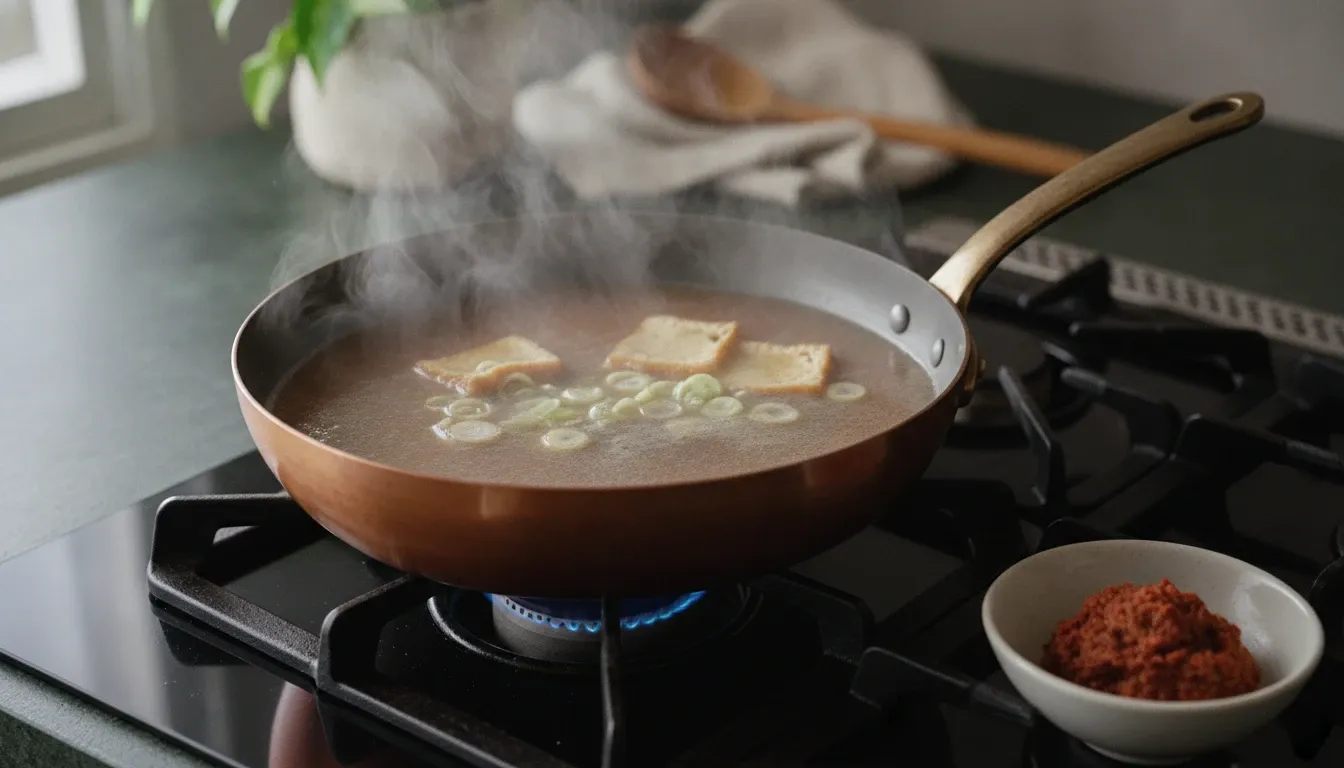
How to make it:
- Heat the dashi (Japanese stock) to about 80°C (176°F), just short of a boil
- Turn off the heat, or turn it to the lowest setting
- Add the miso, dissolving it in a little of the dashi as you go
- Serve right away, without reheating
Cooks call the moment just after the miso goes in nieba-na. That is when the aroma is fullest, and the soup should reach the table then.
Why miso goes in twice
For dishes heated a long time, such as tonjiru or miso stews, the standard move is oi-miso (“chasing miso”): adding the miso in two rounds. The logic is the same as oi-joyu, the two-stage soy sauce addition.
The early addition builds flavor
- Purpose: flavor that soaks in, and richness
- Simmered with the ingredients, its amino acids, sugars, and salt work their way into the food
- Long heating drives the Maillard reaction, giving the liquid deep color and body
- Most of the aroma is lost, but this stage is about building the backbone of the flavor
The late addition brings aroma
- Purpose: aroma
- Add it just before or just after you turn off the heat
- The volatile aroma compounds survive, so the fermented smell of miso comes through
- It is heated only briefly, so the color barely changes
The first miso carries the flavor, and the second carries the aroma. Add it all at once, and the flavor gets in but the aroma that should rise at the end is gone.
Which miso stands up to heat
Miso types differ in amino acids, sugar, and water. So they also differ widely in how well they take heat.
| Type of miso | Amino acids | Color change when heated | Maillard speed | Best use with heat |
|---|---|---|---|---|
| White miso (e.g., Saikyo miso, 西京味噌) | Low | Small | Slow | Low heat, short times: curing beds, dressed dishes, finishing |
| Light-colored miso (e.g., Shinshu miso) | Standard | Moderate | Standard | All-purpose: miso soup, stir-fries, simmered dishes |
| Red miso (aka miso, 赤味噌) | High | Large | Fast | Simmering, dengaku, dishes that need richness |
| Soybean miso (e.g., Hatcho miso, 八丁味噌) | Very high | Very large | Very fast | Long simmering, dengaku, miso nikomi udon |
White miso is aged only briefly, to keep its color pale. High heat would let the Maillard reaction brown that pale color away.
It is also sweet and high in sugar, so it scorches easily above 150°C (302°F). White miso exists for its color and sweetness. To keep them, use it at low heat and for short times.
Many jars sold as “white miso” (shiro miso) are less pale and less sweet than Saikyo miso. Saikyo miso has about 5% salt, against about 12% for standard miso. To use another white miso for a Saikyo-style cure, add a little sugar.
Soybean miso stands up to long simmering because it ages for 1–3 years. Water leaves, and the proteins and amino acids concentrate.
Its aroma has thick layers, so the flavor lasts even after a long simmer. That is why miso nikomi udon is made with Hatcho miso.
Miso as a low-temperature cure
Miso is not only for cooking with heat. Held for a long time at 40–60°C (104–140°F) or below, it becomes the most powerful curing bed there is.
| Use | Temperature | Time | Effect |
|---|---|---|---|
| Saikyo-zuke | Refrigerated | 1–3 days | Koji protease breaks down fish protein and boosts umami |
| Miso-cured pork or chicken | Refrigerated | Half a day to 2 days | Tenderizes and flavors the meat |
| Miso bed for vegetables | Refrigerated | A few hours to 1 day | Osmosis pulls out water, and the vegetables take up umami |
| Moromi bed (the chunky, unstrained mash) | Refrigerated | 1 day to several days | Amino acids soak in and sharpen the flavor |
A curing bed works in the zone where enzymes are active and no heat has killed them.
The koji protease in miso, a protein-cutting enzyme, works well at 50–60°C (122–140°F). Above 70°C (158°F), it stops within a short time.
In the refrigerator it works slowly. But because no heat stops it, it breaks down and matures the food over days. Heat can never give you this; it takes low-temperature chemistry.
Choosing temperature, miso, and timing
Every way of using miso comes down to three questions.
-
What do you want: aroma, color and richness, or enzymatic breakdown?
- Aroma → 80–90°C (176–194°F); dissolve it after turning off the heat
- Color and richness → a long time at 90–100°C (194–212°F); simmering
- Enzymatic breakdown → a long time at 40–60°C (104–140°F) or below; curing beds
-
Which miso? Choose by how well it takes heat
- High heat, long times → soybean or red miso
- Standard → light-colored miso
- Low heat, finishing, curing beds → white miso
-
When does it go in? The timing changes its job
- Early in cooking → flavor soaks in; richness
- At the end, or after the heat is off → aroma
- No heat (curing) → enzymatic breakdown; more umami
Keep those three variables in mind, temperature, type, and timing, and your miso cooking gets far more precise.
Sources
- McGee, Harold. (2004). On Food and Cooking. On how heat changes the flavor of fermented seasonings
- Maehashi, Kenji, et al. Effect of Temperature on Enzymatic Stability in Shio-Koji During the Maturation Process. Nippon Shokuhin Kagaku Kogaku Kaishi 62(6) 290-296 (2015) (in Japanese)
- Journal of the Brewing Society of Japan. Aroma compounds of miso and how they change (in Japanese)