What this article answers
- What awase miso is
- Two or more miso blended so each covers the others' weak points. Ideally you set the ratio for each dish
- A blend for everyday miso soup
- Shinshu 7 : Sendai 3, light miso with a little red for brightness
- Akadashi, the dark red miso soup
- Rice miso and soybean miso. 7:3 for a lighter soup, 5:5 as the standard
- How to design your own blend
- Start with 50–70% of a base miso, then add 10–30% of one miso for richness, sweetness, or aroma
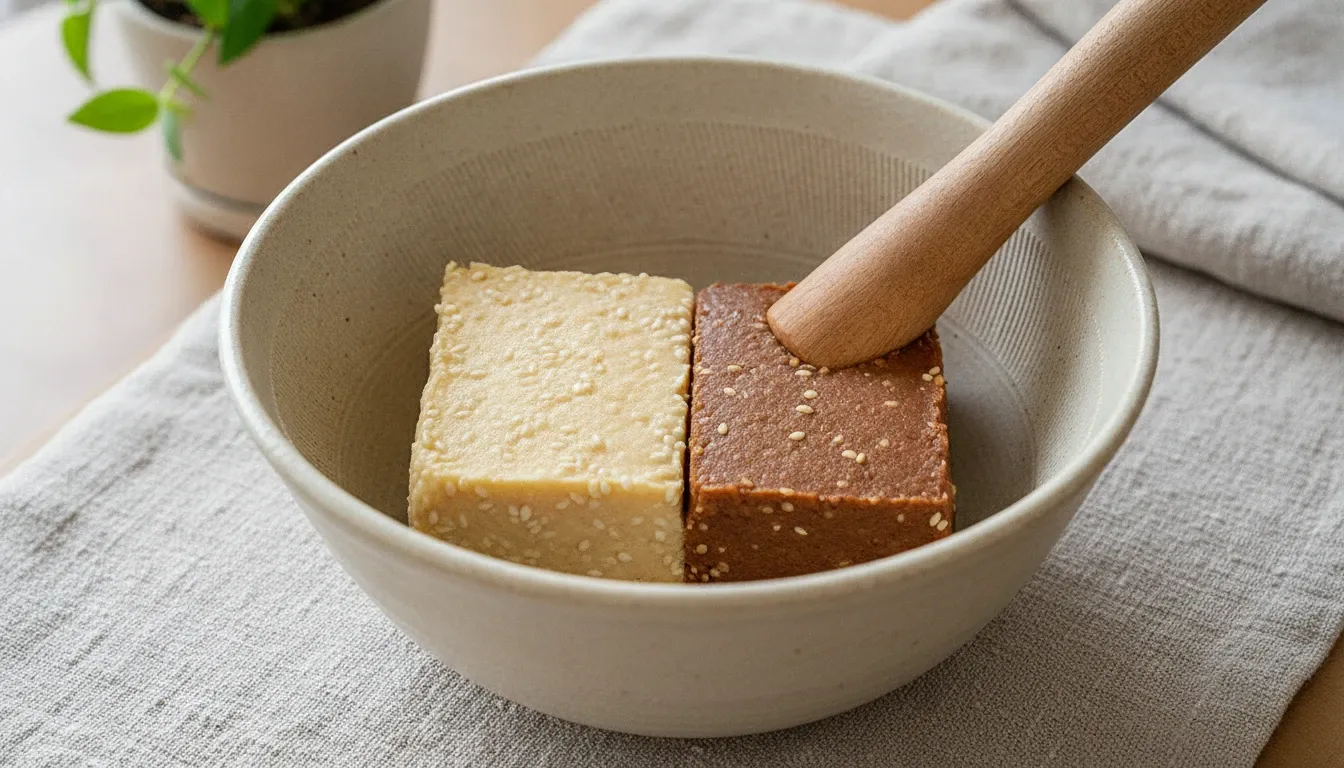
Awase miso is two or more kinds of miso blended together. A blend can strike a balance of taste, color, and aroma that no single miso can. Japanese cooks have long used it to widen what they can do with miso.
Jars labeled awase miso usually hold a blend of red and white miso. But at its root, awase is a method: you design the best ratio for each dish yourself.
Miso ferments with koji, a grain or soybeans cultured with a mold. What the koji is made from names the type: rice miso, barley miso, or soybean miso.
This article uses five Japanese miso as building blocks. Shinshu miso is a light-colored, all-purpose rice miso. Saikyo miso is a sweet, pale rice miso from Kyoto. Hatcho miso is a dark soybean miso from central Japan. Sendai miso is a salty red rice miso. Mugi miso is a barley miso.
A supermarket jar labeled “white miso” or “shiro miso” is often neither as pale nor as sweet as Saikyo miso. For blends that call for Saikyo, look for the name on the label. What each label tells you is in how to choose Japanese miso.
What blending miso is for
What “blending” means
The point of awase miso is to combine miso with different strengths and get a direction of flavor that none of them reaches alone.
| Single miso | Strengths | Weaknesses |
|---|---|---|
| Shinshu miso | Balance, all-purpose | Lacks depth of richness |
| Saikyo miso | Sweetness, refinement | Lacks saltiness and richness |
| Hatcho miso | Richness, holds up to long simmering | Heavy, astringent |
| Sendai miso | Bold red color, bright flavor | Can taste one-note |
| Mugi miso | Light sweetness | Thin on richness |
Awase miso adds up the strengths of each.
Classic blends and their ratios
1. Akadashi (rice miso and soybean miso)
The best-known blend. It is used in the miso-simmered dishes of Nagoya, in central Japan.
| Strength | Rice miso : soybean miso | Use |
|---|---|---|
| Light | 7:3 | Akadashi miso soup, everyday use |
| Standard | 5:5 | Miso nikomi udon (udon simmered in miso broth), doteni (beef tendon simmered in miso) |
| Heavy | 3:7 | Long simmers built mostly on Hatcho miso |
2. Kyushu blend (rice miso and barley miso)
A common blend in home kitchens in Kyushu and Shikoku, in southwestern Japan.
| Strength | Rice miso : barley miso | Character |
|---|---|---|
| Rice-led | 7:3 | Rice miso’s versatility with the aroma of barley |
| Half and half | 5:5 | The household standard in western Japan |
| Barley-led | 3:7 | Brings the barley miso forward |
3. Red and white (Sendai and Saikyo)
Combines the richness of red miso with the sweetness of white.
| Strength | Red : white | Use |
|---|---|---|
| Sweeter | 3:7 | Dengaku glaze, dressed vegetables |
| Standard | 5:5 | A balanced miso soup |
| Saltier | 7:3 | Simmered dishes, stir-fries |
4. Three-way blend (rice, barley, and soybean)
An advanced blend that uses all three koji bases.
| Strength | Rice : barley : soybean | Effect |
|---|---|---|
| Even | 4:3:3 | The deepest layers of flavor |
| Rice-led | 6:2:2 | For everyday use |
Why blends taste better
More kinds of amino acids
Each kind of miso has a different amino acid makeup.
| Miso | Main amino acids | Taste |
|---|---|---|
| Rice miso | Glutamic acid, alanine | Umami, fresh |
| Barley miso | Glutamic acid, lysine | Umami, richness |
| Soybean miso | Glutamic acid, leucine, phenylalanine | Umami, bitterness, complexity |
Blending makes the amino acid makeup more complex, and the flavor comes into sharper focus.
Aromas layered on aromas
Each kind of miso carries different aroma compounds.
| Miso | Main aroma compounds | Aroma |
|---|---|---|
| White miso | Ethyl acetate, HEMF | Fruity, sweet |
| Red miso | Aromas from melanoidins, pyrazines | Toasty, deep |
| Soybean miso | Pyrroles, furfural | Chocolate-like, earthy |
| Barley miso | Vanillin, ferulic acid | Toasty, sweet |
Mixed together, they build layers of aroma that no single miso can give.
Blends for each dish
Miso soup
| Dish | Blend | Why |
|---|---|---|
| Everyday miso soup | Shinshu 7 : Sendai 3 | Adds brightness |
| Akadashi | Sendai 5 : Hatcho 5 | Nagoya style |
| Rich tonjiru (pork and vegetable miso soup) | Shinshu 5 : Sendai 3 : Hatcho 2 | Three layers of richness |
| Hiyajiru (chilled miso soup) | Mugi miso alone (no blend) | Best on its own |
Simmered dishes
| Dish | Blend |
|---|---|
| Miso nikomi udon | Hatcho 7 : Sendai 3 (or ready-made akadashi miso) |
| Doteni | Hatcho 6 : Shinshu 4 |
| Saba no misoni (mackerel simmered in miso) | Sendai 6 : Hatcho 4 |
Grilled dishes and dengaku
Dengaku is tofu, eggplant, or konjac grilled with a sweet miso glaze.
| Dish | Blend |
|---|---|
| Red miso dengaku | Hatcho 5 : Sendai 5 (worked with mirin and sugar) |
| White miso dengaku | Saikyo alone |
| Yuzu miso (yuzu is a fragrant Japanese citrus) | Saikyo 7 : Shinshu 3 (with grated yuzu zest) |
Curing beds
| Dish | Blend |
|---|---|
| Saikyo-zuke (fish cured in sweet white miso) | Saikyo alone (no blend) |
| Country-style miso cure | Shinshu 5 : Mugi 5 |
How miso behaves in each of these, from raw to simmered, is covered in miso and heat.
How professionals design a blend
Three axes to design on
Keep three axes in mind when you design a blend, and you can build the best one for the dish.
| Axis | Miso high on it | Miso low on it |
|---|---|---|
| Saltiness | Shinshu, Sendai, Hatcho | Saikyo, mugi |
| Sweetness | Saikyo, mugi | Sendai, Hatcho |
| Richness and color | Hatcho, Sendai | Shinshu, Saikyo, mugi |
Decide, say, “standard saltiness, little sweetness, strong richness,” and the blend falls out as something like Sendai 5 : Hatcho 3 : Shinshu 2.
What each change does
| Change | Effect |
|---|---|
| More Shinshu | Better balance, more all-purpose |
| More Saikyo | Sweeter and more refined, less salty |
| More Hatcho | More richness and astringency, holds up better to simmering |
| More Sendai | Brighter red, more aged aroma |
| More mugi | Light sweetness, a lifted aroma |
The professional’s first move
When building a miso blend for a new dish, professionals follow these steps:
- Choose one base miso (usually Shinshu, at 50–70%)
- Choose one quality to add (richness, sweetness, aroma, or weight)
- Add 10–30% of a miso that brings that quality
- Taste and fine-tune
A three-way blend right away is hard to adjust. Build the frame with two first, then think about a third.
Choosing a ready-made awase miso
Many jars sold as awase miso do not disclose their ratio. What to check:
| Check | A good awase miso | Avoid |
|---|---|---|
| Ingredients | Soybeans, rice, barley or soybean koji, and salt only | Added flavor enhancers (such as MSG), caramel color |
| Blend on the label | States the share of each miso, such as rice miso X%, soybean miso Y% | Says only “awase miso,” with no detail |
| How it is made | Each miso naturally brewed | A mix of quick-fermented miso |
If you cook seriously, skip the ready-made blends. Keep three or four single miso and blend them yourself. You will have far more range.
The blending rules to remember
Awase miso is a technique for designing the flavor of each dish. Rather than buying a ready-made blend, keep three or four of the five miso (Shinshu, Sendai, Saikyo, Hatcho, and mugi) and change the ratio for each dish.
- Base miso: Shinshu
- For richness, add 10–30% Hatcho
- For sweetness, add 10–30% Saikyo
- For brightness, add 10–30% Sendai
- For lightness, add 10–30% mugi miso
Once you know how to blend, five kinds of miso give you endless combinations. It widens what you can cook, from everyday miso soup to serious miso dishes.
Sources
- Miso Health Promotion Committee (Japan Federation of Miso Manufacturers Cooperatives). Official miso site (in Japanese). Classification and production of rice, barley, and soybean miso
- Central Miso Research Institute (in Japanese). Research on miso brewing and quality
- Just One Cookbook. Miso: types of miso, including white, red, awase (mixed), and Saikyo miso as a white miso made only in Kyoto