What this article answers
- How sengiri differs from julienne
- Their thicknesses overlap at around 1 mm. Japanese cooking also names cuts by grain direction
- How thick Chinese si is
- Four grades from 1 to 4 mm in the Sichuan standard, each 10 cm (4 in) long
- What changes when you change the thickness
- Cooking time. Twice as thick takes about 4× as long, by calculation
- What changes with grain direction
- With the grain is crisp, across it is soft. Pungency and how flavors soak in change too
A Japanese recipe says “cut the cabbage into sengiri (千切り),” and you stop. Is that just a julienne? A Chinese recipe says “cut into si (絲).” All three seem to mean the same thing: cut into thin sticks.
Line up the sources, and thickness can’t tell the three apart. Japanese sengiri is 1 mm or less (well under 1/16 in), French julienne is 1–2 mm, and Chinese si is 1–4 mm (up to just over ⅛ in). The ranges overlap.
This article covers how the names differ, and what thickness and grain direction change in a dish. It leaves out how to move the knife and how to practice.
Fine strips start as even slabs
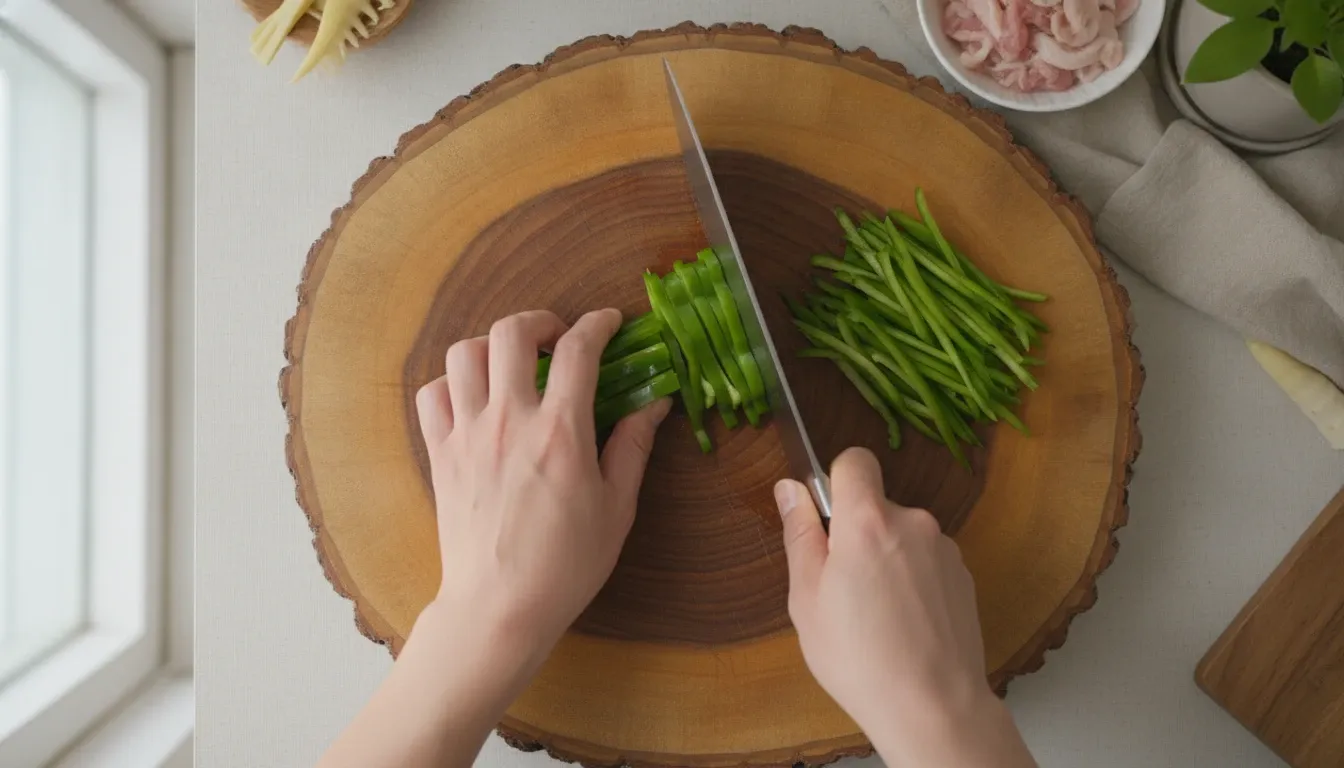
To cut fine strips, slice the ingredient into slabs of even thickness. Then stack the slabs and cut them at an even width into thin sticks.
The slab thickness sets the height of each stick’s cross-section. The cutting width sets its width.
Japanese culinary schools teach sengiri the same way. Students first slice daikon radish into slabs 1 mm thick or less, a step called hegu.
If the slabs aren’t even, the pieces come out uneven however carefully you cut them afterward.
Stick length runs from 4 to 10 cm (1½ to 4 in), depending on the dish and the source.
How strips differ from dice and slices
Cut the sticks crosswise at the same width, and you get dice: brunoise in French, ding in Chinese. Stop at the first slabs, and you have thin slices or sogi-giri (bias slices).
Thickness alone can’t tell the names apart
Here are the thicknesses for each name, from schools and cooking standards.
| Name | Thickness (mm) | Length (cm) | Source |
|---|---|---|---|
| Sengiri (Japan) | 1 or less | Not specified | Tsuji Culinary Institute |
| Senroppon (Japan) | 2–3 | Not specified | Tsuji Culinary Institute |
| Julienne (France) | 1–2 | 4–5 | Chef Fabien, Chef Link |
| Si (China; Sichuan standard) | 1–4 | 10 | Sichuan Province cooking standard for Sichuan cuisine (2011) |
| Sashimi ken (Japanese school competition) | Within 1 | Not specified | Japan’s association of culinary schools |
| Julienne (Japanese school competition) | 1 | 5 | Japan’s association of culinary schools |
| Si (Japanese school competition) | 2 | 6 | Japan’s association of culinary schools |
Sources: Tsuji Culinary Institute blog (August 2021); Chef Fabien (March 2026) and Chef Link; China News Service (October 2015) and Xiachufang; guidelines for the 42nd Cooking Skills Competition of Japan’s association of culinary schools (August 2026).
The bottom three rows are tasks from the same category of one Japanese school competition. Even there, the thickness differs from dish to dish.
Thickness varies more with the task and the dish than with the country.
Japan also names cuts by grain direction
Japanese cooking names cuts by thickness, as in sengiri and senroppon. For ken, the fine shreds served with sashimi, it also names them by the direction of the fibers.
Ken starts with katsuramuki: peeling daikon or cucumber into a long, ribbon-thin sheet. The sheet is then cut into fine strips.
Ken cut along the fibers is tate-ken (lengthwise ken). Ken cut at right angles to them is yoko-ken (crosswise ken).
Tate-ken is served in a small amount, stood up in a triangle beside the sashimi. Yoko-ken goes under the sashimi as a bed, or is piled loosely to show volume.
France and China name cuts by thickness
In French cooking, a new thickness gets a new name. A thin stick of 1–2 mm is a julienne, and a thick stick 5–6 mm square is a bâtonnet.
Schools that teach in inches set julienne thicker. Rouxbe, an online cooking school, gives julienne as ⅛ in (about 3 mm) square and 2 in (5 cm) long. Fine julienne is 1/16 in (about 1.5 mm).
Chinese cooking keeps the single name si and splits it into four grades by thickness.
Sichuan Province set a cooking standard for Sichuan cuisine in 2011. In it, tou cu si is 4 mm, er cu si 3 mm, xi si 2 mm, and yin zhen si (“silver-needle shreds”) 1 mm. All of them are 10 cm (4 in) long.
The standard is a recommendation, not a rule. For yu xiang rou si (魚香肉絲, fish-fragrant shredded pork), it gives the pork as er cu si: 3 mm square and 10 cm (4 in) long.
Twice as thick takes about 4× as long
Heat travels from the surface to the center. The time it takes grows with roughly the square of that distance.
By that calculation alone, a 2 mm stick takes about 4 times as long as a 1 mm stick. A 3 mm stick takes about 9 times as long, and a 4 mm stick about 16 times.
In real cooking, heat also needs time to cross from the water or oil into the surface. So the actual differences are smaller than the calculation.
In measurements of thick meat cooked in a water bath, doubling the thickness took 2.5–4 times as long. No measurements for fine strips by thickness turned up, but the direction holds: thicker takes longer.
Salt wilts the strips on the same curve. The time for salt to reach the center also grows with roughly the square of the distance.
Salt both for the same time, and fine sengiri should wilt to the core while thick sticks wilt only on the outside.
Grain direction changes texture, pungency, and flavor
Vegetables have long fibers running along the root or stem: the grain. Cut with the grain or across it, and the texture changes even at the same thickness.
Long fibers or short ones
Cut along the fibers, and long fibers run through each stick from end to end. You feel your teeth cut through them as you bite, and the sticks hold their shape and stand up easily.
Cut across the fibers, and each fiber is only as long as the stick is thick. The sticks come apart as soon as you bite.
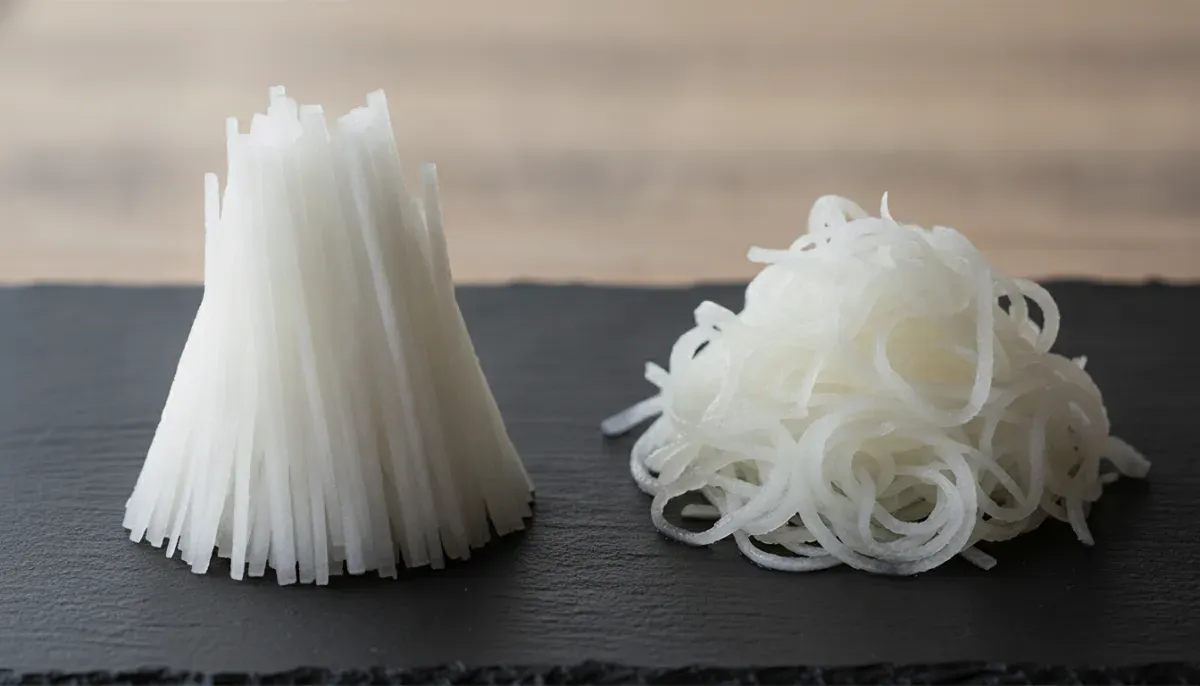
Left, tate-ken (cut along the fibers); right, yoko-ken (cut across them). Tate-ken stands beside the sashimi, and yoko-ken is laid loosely underneath.
Daikon, cabbage, carrot, and onion compared
| Vegetable | Cut along the fibers | Cut across the fibers |
|---|---|---|
| Daikon (ken for sashimi) | Stands up. Stood in a triangle beside the sashimi | Gives loose volume. Laid underneath |
| Cabbage (raw) | Crisp bite | Soft in the mouth, even cut thicker |
| Carrot (dressed salads) | Keeps some bite | Softens faster and takes on flavor |
| Onion (raw) | Less pungency and bitterness | Strong pungency and bitterness |
Sources: daikon from Tsuji Culinary Institute, “Basic terms of Japanese cuisine”; cabbage, carrot, and onion from Nagoya University of Arts and Sciences, School of Nutritional Sciences, “Does the way you cut vegetables change the taste?”
Some people find carrot cut across the fibers sweeter. The same source says the cut itself does not raise or lower the sweetness.
The Japanese school competition scores yoko-ken on whether “the fibers are not crushed and it is light and fluffy.” Cutting without crushing the fibers is part of what makes it fluffy.
Match thickness and grain to the dish
Thickness and grain combine differently for each thing you make. These are the combinations confirmed in the sources.
| What you are making | Thickness | Fiber direction |
|---|---|---|
| Ken stood up beside sashimi | Within 1 mm | Along (tate-ken) |
| Ken laid under sashimi | Within 1 mm | Across (yoko-ken) |
| Light, fluffy raw cabbage | Not specified | Across |
| Garnish for French salads and soups | 1–2 mm, 5 cm long | Not specified |
| Pork for yu xiang rou si | 3 mm, 10 cm long | Not specified |
Sources: ken from Tsuji Culinary Institute, “Basic terms of Japanese cuisine,” and Japan’s association of culinary schools (August 2026); cabbage from Nagoya University of Arts and Sciences; julienne from Chef Fabien (March 2026); yu xiang rou si from China News Service (October 2015).
Julienne simmered in broth is 1–2 mm. The pork for yu xiang rou si, stir-fried over high heat, is 3 mm.
So cooking or not doesn’t decide the thickness by itself. Each dish has its own set value.
Within one dish, cut every ingredient to the same thickness.
When thickness or grain goes wrong
Fine strips most often go wrong in three places: slab thickness, cutting direction, and a thickness that doesn’t suit the dish.
| What was off | What happens |
|---|---|
| The slabs were uneven | The thin sticks wilt first, and the thick ones keep a raw core |
| In a stir-fry, meat and vegetables were cut to different thicknesses | The thinner pieces overcook, or the thicker ones stay raw |
| Ken meant to stand up was cut across the fibers | It won’t stand and lies flat and fluffy |
| Cabbage meant to be fluffy was cut along the fibers | It has a strong bite and isn’t fluffy |
| Raw onion was cut across the fibers | Pungency and bitterness come through strongly |
Sources: cooking through is inferred from “the time to reach the center grows with the square of the thickness.” Ken is from Tsuji Culinary Institute, and cabbage and onion are the explanations from Nagoya University of Arts and Sciences, read from the side of getting it wrong.
To check that the thickness is even, lay a few sticks against a ruler. The school competition scores ken on whether “the whole is within 1 mm and even,” and si on whether it is “2 mm and even throughout.”
Sources
- Tsuji Culinary Institute blog. "Sengiri, senroppon, and tanzaku-giri." August 2021 (in Japanese). Sengiri 1 mm or less, senroppon 2–3 mm, tanzaku-giri 8 mm; slicing slabs to thickness
- Tsuji Culinary Institute. "Basic terms of Japanese cuisine: ka row" (in Japanese). Ken, tate-ken, and yoko-ken
- Zenkoku Chorishi Yosei Shisetsu Kyokai (Japan's national association of culinary schools). "Guidelines for the 42nd Culinary School Cooking Skills Competition." August 2026 (in Japanese). The yoko-ken, julienne, and si tasks
Show 6 more
- Chef Fabien. "Les différents taillages de légumes." March 2026 (in French). Julienne 5 cm × 1–2 mm
- Chef Link. "Julienne and bâtonnet" (in Japanese). Julienne 1–2 mm × 4–5 cm, bâtonnet 5–6 mm square
- China News Service. "Must yuxiang shredded pork be 10 cm long? Sichuan quality supervision bureau says it is a misunderstanding." October 2015 (in Chinese). The four grades of si in the 2011 Sichuan cuisine cooking standard
- Xiachufang. "Knife work and shaping ingredients: tou cu si, er cu si, xi si, yin zhen si" (in Chinese). Dimensions of the four grades
- Nagoya University of Arts and Sciences, School of Nutritional Sciences. "Does the way you cut vegetables change the taste?" (in Japanese). How cutting along or across the fibers changes texture and how flavors soak in
- Rouxbe. "Types of knife cuts." Julienne 1/8 × 1/8 × 2 in, fine julienne 1/16 × 1/16 × 2 in