What this article answers
- The basic crepe ratio
- Liquid (milk and egg) at three times the flour or more. 2 eggs per 100 g flour, plus melted butter
- Why rest the batter
- Rest it 30 minutes to overnight in the fridge. Flour finishes hydrating, gluten relaxes, bubbles rise out
- Crisp crepes
- Low-protein flour only, more sugar, vegetable oil, hotter pan, as thin as you can
- Chewy crepes
- Blend in 20–30% bread flour, less sugar, butter, medium heat, a slightly thicker pour
- When to flip
- When the edges color and lift and the whole surface looks dry
A crepe is a high-hydration batter poured thin, with gluten held back on purpose, and cooked supple with egg and butterfat. It doesn’t rise. The goal is a thin film that doesn’t tear.
Every step serves that one goal: the ratio (liquid at three times the flour), the mixing (no gluten), the rest (hydration and relaxing), and the cooking (spread thin). So “mix, pour, cook” hides a reason behind each step.
Poured, unleavened, and rich
Griddle batters split by hydration and by whether they rise. The crepe is the classic poured batter: high hydration, no leavening, and enriched with egg and butterfat. Set beside two other families, it shows what the crepe relies on.
| Family | Example | Hydration | Does it rise? | What makes the texture |
|---|---|---|---|---|
| Poured, unleavened, rich | Crepe (this article) | High (pours) | No | Egg and butterfat make it supple |
| Leavened | Pancakes | Medium | Yes (baking powder) | Carbon dioxide makes it thick |
| High-hydration, savory | Okonomiyaki, Korean jeon, takoyaki | Medium to high | No | Dashi plus grated yam or starch |
Okonomiyaki is a Japanese savory pancake, and takoyaki are griddled balls of batter around octopus. Both use dashi, a Japanese stock, in place of milk.
What makes a crepe a crepe is that it doesn’t rise. Add baking powder to the same ingredients, and you get pancakes. Swap the milk for dashi and add grated yam, and you get a Japanese savory batter. Think of the crepe as the batter that gave up rising and put everything into thinness and suppleness. Then every step after this makes sense.
The ratio, and the order you mix in
Making crepe batter comes down to this: set the ratio, mix in an order that avoids lumps, rest it, then cook. Start with the ratio. With flour at 100, aim for this balance.
| Ingredient | Ratio to flour | Role |
|---|---|---|
| Low-protein flour | 100% | The frame (starch plus weak gluten) |
| Milk | About 250% | Makes a thin, pourable, high-hydration batter |
| Egg | About 100% (2 whole eggs per 100 g flour) | Binds, adds suppleness and color |
| Melted butter | 10–20% | Tenderness, flavor, keeps it from sticking |
| Sugar and salt | A little | Color and a defined taste |
The key is the very high hydration: the liquid (milk plus egg) comes to three times the flour or more. That is why the batter flows out thin. The large share of egg lets a thin film hold together without tearing.
Low-protein flour here means US cake or pastry flour, at 7–9% protein. US all-purpose flour (9–12%) and UK plain flour (9.5–11%) carry more protein, so they pull the crepe toward the chewy side described below.
The mixing order matters most for avoiding lumps (pockets of dry flour).
- Mix the flour and sugar in a bowl, break in the eggs, and stir from the center. The flour takes up the egg’s water bit by bit, and you crush the lumps while the batter is still thick.
- Add the milk in three parts. Pour it in all at once, and the flour floats on the liquid and lumps remain. Thin a thick batter gradually.
- Stir in the melted butter (or browned butter) last. Add fat first, and the flour repels water and is hard to mix.
- Strain it through a sieve and let it rest. This removes leftover lumps and extra bubbles.
Why add liquid a little at a time? When flour meets a lot of water at once, only its surface turns gluey, and water can’t reach the inside, so a dry core is left. Thin a thick batter in stages, and every grain of flour gets water evenly.
Why resting stops tears
You can cook crepe batter straight after mixing. But rest it 30 minutes to overnight in the fridge, and it becomes far easier to work with, for three reasons.
| Effect | What happens | What it changes in the pan |
|---|---|---|
| 1. Hydration finishes | Starch and protein absorb all the water they can | The batter’s thickness settles, so the crepe is even |
| 2. Gluten relaxes | Gluten that linked up during mixing loosens | It doesn’t shrink, and the rubberiness goes |
| 3. Bubbles escape | Bubbles from mixing rise and burst | No holes on the surface, so it tears less |
Crisp or chewy, by formula
The griddle batter overview showed that flour and fat split crepe textures. Here it goes down to each step.
| Lever | Toward crisp | Toward chewy |
|---|---|---|
| Flour | Low-protein flour only | Low-protein flour with 20–30% bread flour blended in |
| Sugar | More | Less |
| Fat | Vegetable oil | Butter |
| Pan heat | Higher (until the edges brown) | Medium heat, briefly |
| Thickness | As thin as you can | Pour a little thicker |
Crisp means driving off water and caramelizing sugar. Chewy means keeping the stickiness of gluten and gelatinized starch. Blending in bread flour (US bread flour or UK strong flour) adds gluten and spring. Add too much, and the crepe shrinks and turns rubbery, so a longer rest goes with it.
Heat, batter amount, and when to flip
Once the ratio and rest are done, the rest is cooking.
| Item | Guide | Why |
|---|---|---|
| Pan heat | Preheat well over medium heat, until the batter sets at the edge the moment it goes in | Too cool and it sticks; too hot and it sets before it spreads |
| Oil | Brush on a thin coat and wipe off the excess | Too much oil lets the batter slide, and the thickness goes uneven |
| Amount of batter | The least that covers the whole pan thinly when you tilt it | Too much makes it thick, and it stops being a crepe |
| First side | Don’t touch it until the edges color and lift | This is the presentation side, the outside when served |
| Second side | Briefly, for tens of seconds | Cook it too long and it dries and cracks |
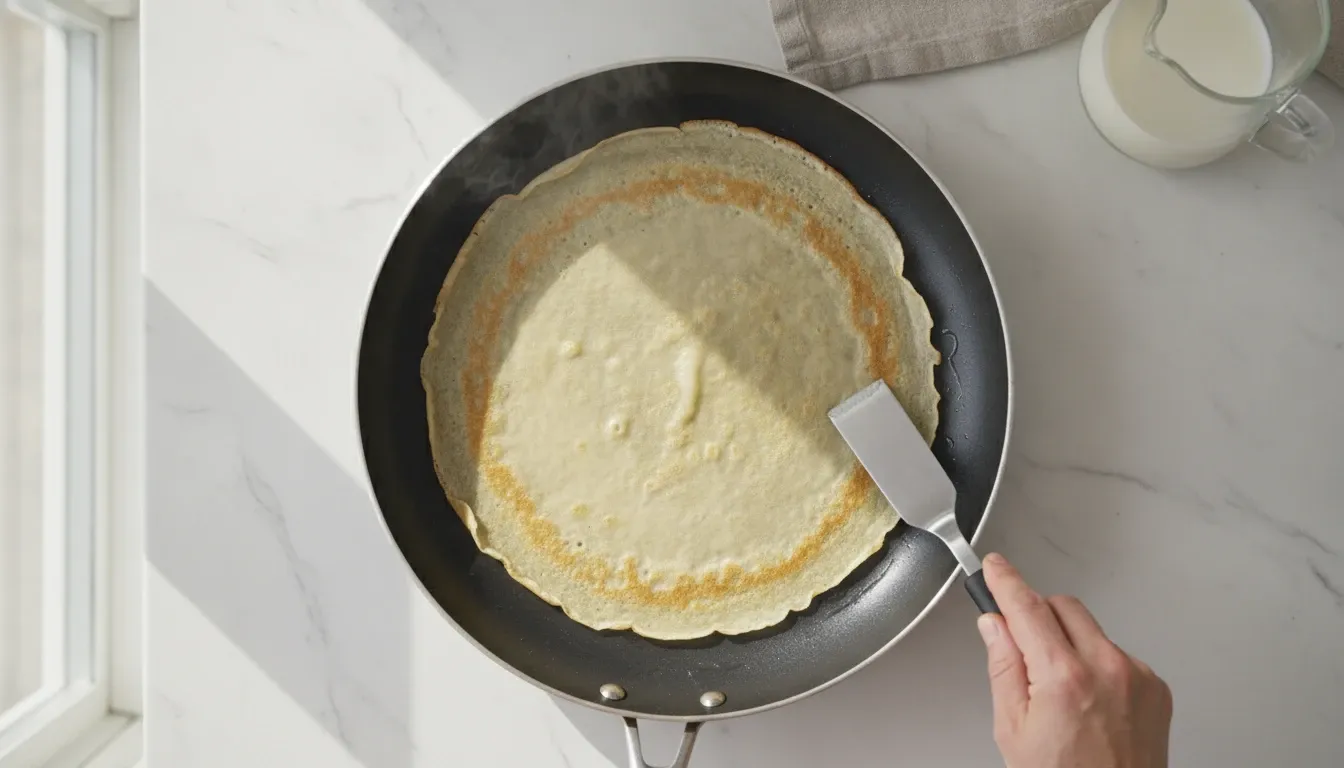
The two sides have different jobs. The first side is the presentation side, with even color. The second side only needs cooking through. Flip when the edges have colored lightly and the whole surface looks dry. Edges that dry and curl up are the signal that water has left the pan side and the film has set. Wait for it, and the crepe won’t tear when you turn it.
Buckwheat galettes hold without gluten
That covers wheat crepes. Now a batter with no gluten at all. The galette of Brittany, in northwest France, is a savory crepe made with buckwheat flour. It cooks without tearing despite having no gluten, because something else holds it together.
| Wheat crepe | Buckwheat galette | |
|---|---|---|
| Frame | Gluten + egg + gelatinized starch | Gelatinized starch + egg (no gluten) |
| Rest | 30 minutes to overnight | Overnight or longer is standard (hydration takes time) |
| Texture | Supple, moist | Crisp at the edges, toasty |
Common failures and fixes
Tearing and rubberiness look like they need opposite fixes, but resting helps both. Hydration fixes the batter that hasn’t absorbed enough water, and relaxing fixes too much gluten. One step works on both. All four of these can be recovered.
| Problem | Cause | Fix it now | Prevent it next time |
|---|---|---|---|
| It tears | The batter wasn’t rested, so it hadn’t hydrated, and the gluten network holding it together stayed weak | Rest the batter 30 minutes or more, then cook again | Rest it 30 minutes or more to hydrate it, and turn the heat down to medium |
| It’s tough and rubbery | Overmixing and high-protein flour developed too much gluten, so it springs back hard | Rest the batter to relax the gluten, then cook | Use low-protein flour, and always rest the batter after mixing |
| It cooks unevenly | The pan wasn’t preheated and had too much oil, so contact with the batter varied from spot to spot | Wipe off the excess oil, preheat well, and cook again | Preheat well, wipe off the oil, and strain the batter so its thickness is even |
| It sticks to the pan | The pan was too cool and the fat too little, so the batter’s protein bonded straight to the metal | Preheat again, add melted butter to the batter, and cook | Check the preheat, and mix melted butter into the batter |
The crepe in four lines
- A crepe is a high-hydration batter with liquid at three times the flour or more. Egg binds the thin film.
- Resting does three things, finishing hydration, relaxing gluten, and letting bubbles out, and prevents most tears and uneven cooking.
- For crisp, use more sugar, vegetable oil, and a hotter pan. For chewy, blend in bread flour, use butter, and cut back the sugar.
- A buckwheat galette is built differently: gelatinized starch and egg hold the film in place of gluten.
Sources
- McGee, Harold. (2004). On Food and Cooking. On batter hydration and the structure of thin griddle cakes
- Corriher, Shirley. (2008). BakeWise. On balancing batter formulas and the science of baking
- America's Test Kitchen. What is the difference between bread flour, all-purpose flour, pastry flour, and cake flour?