What this article answers
- What sets the texture of a griddle batter
- Hydration, whether it rises, and richness. Hydration leads
- Crepe vs pancake
- Baking powder or not. With it, thick and fluffy; without it, thin
- How to make crepes crisp
- Cook with low-protein flour and vegetable oil. Bread flour and butter make them chewy
- How a tortilla differs
- It isn't a poured batter but a low-hydration dough rolled out with a pin
Crepes, pancakes, okonomiyaki, tortillas: all of them cook on both sides on a griddle or in a skillet. Baked doughs cook surrounded by heat in an oven. Griddle doughs cook only where they touch the hot metal.
Most are batters, wet enough to pour, and their textures range from crisp to fluffy to chewy. This article sorts griddle doughs on three measures: hydration, whether they rise, and richness.
Three measures that sort griddle doughs
All griddle doughs share the same heat source, a skillet or griddle. Three measures set their textures apart.
| Measure | Range | What it changes |
|---|---|---|
| 1. Hydration | Pourable batter to rolled dough | Thinness, mouthfeel |
| 2. Whether it rises | With or without baking powder | Fluffy, or thin and flat |
| 3. Richness | The amount of egg, milk, and butter | Moistness, flavor, browning |
For oven-baked doughs, how the dough rises leads. For griddle doughs, hydration leads. The more water, the thinner the batter pours; the less, the more it becomes a dough you roll out thick.
The main griddle doughs side by side
| Dough | Hydration | Leavening | Richness | Texture |
|---|---|---|---|---|
| Crepe | High (pours) | None | Rich (egg, milk, butter) | Thin and supple, moist |
| Pancake | Medium (thick, slow-pouring) | Baking powder | Semi-rich | Fluffy and thick |
| Okonomiyaki | Medium to high | None (grated yam makes it light) | Contains dashi and egg | Chewy, cooked with its fillings |
| Flour tortilla | Low (a rolled dough) | None | Lean | Supple, can wrap a filling |
Okonomiyaki is a Japanese savory pancake of shredded cabbage in batter. The batter uses dashi, a Japanese stock, and grated yamaimo, a sticky yam.
From crepe to tortilla, the hydration falls, and the dough moves from poured to rolled.
The rolled side goes one step further. Roti canai is a Malaysian flatbread. The cook stretches an oiled dough paper-thin, folds it into a strip, coils it into a spiral, then presses it flat and cooks it. A tortilla stops at rolling thin and cooking. Roti canai brings lamination, an idea from baked doughs, to the griddle. It builds layers in a skillet, one step beyond the far end of this table.
Start from the texture you want
The table above runs from formula to result: what you put in and what you get. When you cook, you often start the other way, from the texture you want. Sorted by the target, it looks like this.
| Texture or use you want | Dough and formula | What does the work |
|---|---|---|
| Crisp and light | Thin crepes (low-protein flour + vegetable oil), buckwheat galettes | Little gluten + water driven off + high heat where it touches the pan |
| Fluffy and thick | Pancakes (with baking powder) | Rise from carbon dioxide + medium hydration |
| Chewy | Crepes (bread flour + butter), okonomiyaki (with grated yam) | The stickiness of gluten and starch |
| Supple, wraps without tearing | Tortillas, thin crepes | Kneading a low-hydration dough builds gluten / pouring thin |
Texture isn’t fixed to one dough. A crepe turns crisp with low-protein flour and oil, and chewy with bread flour and butter: opposite textures from the same batter. The formula (hydration, flour, leavening, fat) sets the texture. Think “this formula gives this texture,” not “crepes have this texture,” and you can repeat your results.
Pancakes rise, crepes don’t
Pancakes and crepes use much the same ingredients, yet come out opposite. What splits them is whether they rise (measure 2).
- Pancakes: baking powder goes in, and carbon dioxide puffs them up thick and fluffy in the pan.
- Crepes: no leavening. Poured thin and cooked, they come out flat and supple.
Where crisp and chewy crepes come from
The same thin crepe turns crisp or chewy as you change the ingredients. Flour and fat decide it.
| Texture you want | Flour | Fat | Why |
|---|---|---|---|
| Crisp | Low-protein | Vegetable oil | Gluten is weak, water leaves, and it cooks light |
| Chewy | Some bread flour | Butter | Gluten and starch make it sticky |
Crepes are mostly a rich batter of low-protein flour, egg, milk, and butter. That keeps gluten in check so the crepe cooks moist and supple. Egg and butterfat soften the batter and give the tender bite a dessert wants. The crepe batter article covers the formula, resting, and cooking in detail.
Tortillas are the one rolled dough
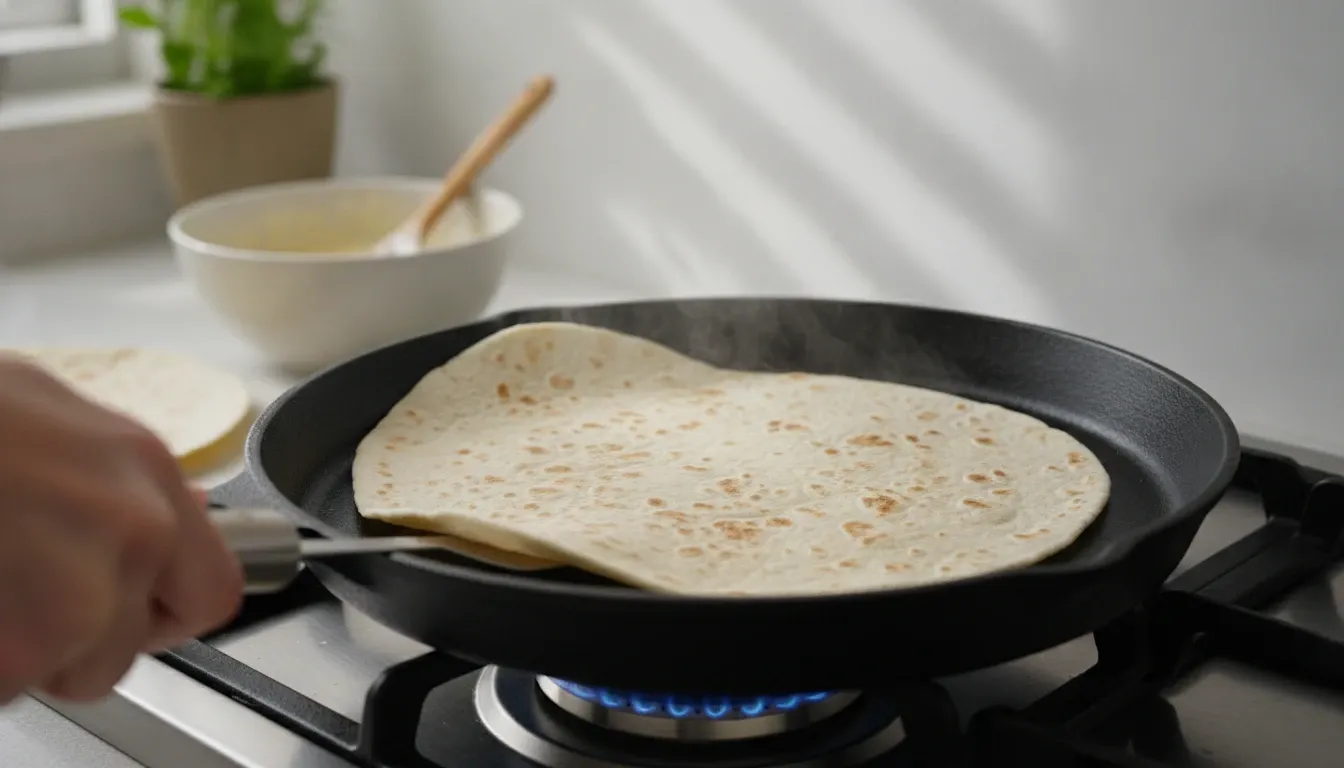
In this group, only the tortilla isn’t a poured batter. It is a low-hydration dough rolled out with a pin. A wheat tortilla is a lean mix of flour, water, fat, and salt. You knead it, roll it thin, and cook it briefly on a griddle. It doesn’t rise, it stays supple, and it resists tearing, so it suits wrapping fillings, as in burritos.
Rolling out and wrapping makes it close to wrapper doughs such as gyoza wrappers. It lands in this group only by how it cooks, on a griddle, so it sits on the border. Spring roll wrappers are also thin sheets of wheat batter cooked on a hot plate. By method, they fall between crepes and tortillas.
Other doughs in this family
Beyond these four, a few more batters and doughs cook on a griddle, in an iron, or in a skillet. Placed on the measures (hydration, how they rise, the kind of flour), they sort like this.
| Dough | Where it sits | Features |
|---|---|---|
| Waffles | Rises, cooked in an iron | Close to pancakes, but cooked in a grid-patterned iron, crisp outside |
| Galettes | A crepe with a different flour | Crepes made with buckwheat flour (covered in the crepe article) |
| Dosa (South India) | A fermented rice and lentil batter | No wheat. Rice and lentils are ground and fermented into a batter. Thin and crisp |
Waffles sit next to pancakes, as a leavened batter cooked in an iron. Dosa is a fermented batter made from something other than wheat (rice and lentils), the one in this family that leaves wheat behind.
What sets each griddle texture
- Griddle doughs cook on both sides on a griddle or in a skillet. Their texture comes down to three measures: hydration, whether they rise, and richness.
- Pancakes and crepes share similar ingredients. Baking powder, or its absence, makes one fluffy and the other thin and supple.
- Crepes turn crisp with low-protein flour and oil, and chewy with bread flour and butter. Flour and fat set the texture.
- Only the tortilla is rolled instead of poured. A low-hydration dough, it sits on the border with wrapper doughs.