What this article answers
- Conditions for a fluffy steamed cake
- Four points: leavening, mixing, timing, and steam
- A split top, or a smooth one
- Set by the heat. Strong steam splits the top
- It won't rise
- Check four causes in order: leavening, mixing, timing, steam
- A chewier, mochi-like version
- Change the flour and the amount of liquid
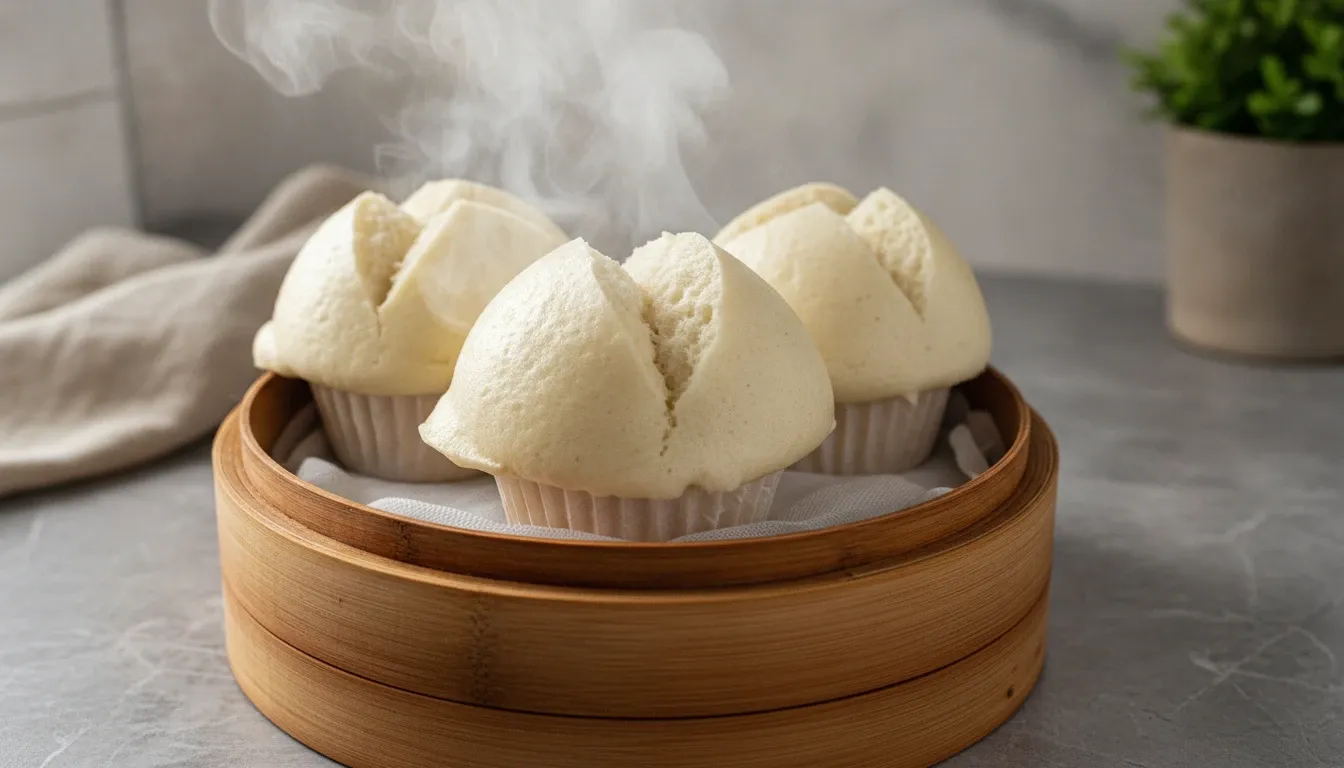
Mushipan is a Japanese steamed cake: a soft, lightly sweet cake made from a pourable batter and steamed in small cups.
It rises with no yeast and no fermentation. Gas from baking powder alone lifts it, all at once, in the steamer. With no time spent rising, you can mix and steam it in 20 minutes. The trade-off is that it gets one chance to rise, in the few minutes it heats.
Miss that chance, and the cake comes out flat, sunken, or dense. Nearly every failure traces back to one of four points: the leavening, the mixing, the timing, or the heat. The recipe and every step are worked back from one goal: get the most out of the baking powder’s gas in that single window.
Among steamed doughs, mushipan is the only one that rises on chemical leavening alone. This article covers the four points for a fluffy cake, how to trace a cake that won’t rise or sinks, how to get the split top, and how to make a chewier version.
The basic formula is a pourable batter
Here is the formula as baker’s percentages, with flour as 100.
| Ingredient | Ratio to flour | Role |
|---|---|---|
| Low-protein flour | 100 | Structure. Low protein keeps it soft and light |
| Baking powder | 4–5% (5 ml, or 1 tsp, per 100 g flour: about 4–5 g) | Does all of the rising |
| Sugar | 30–50% | Sweetness, moisture, tenderness |
| Egg | 25–50% | Richness, extra structure, a finer crumb |
| Milk (or water) | 60–80% | Adjusts the batter to a pourable thickness |
Japanese recipes use hakurikiko, Japan’s low-protein flour. In the US, use cake flour, at 7–9% protein. In the UK, plain flour (9.5–11%) is the usual choice, and its slightly higher protein makes gentle mixing all the more important.
The key point is that this is not a kneaded dough like the dough for Chinese steamed buns. It is a batter that drops thickly from a spoon. It holds almost as much liquid as flour, and you only stir it, never knead.
In that sense, mushipan is closer to pancake batter than to bread. The difference is steaming instead of cooking on a griddle (see griddle batters).
One chance to rise, no fermentation
Steamed doughs branch by what makes them rise. Mushipan is the one that uses no fermentation at all, only chemical leavening. That puts it at the opposite end from yeasted Chinese steamed buns.
A yeast dough has a hard step, judging the rise, but it gives you slack in timing. Baking powder starts releasing gas the moment it touches liquid. So with mushipan, you have no choice but to steam the batter as soon as it is mixed. That is why the rule is to pour freshly mixed batter into a steamer that is already full of steam.
| Yeast dough (Chinese steamed buns and the like) | Mushipan | |
|---|---|---|
| When it rises | During fermentation and during heating | Only once, during heating |
| How long the dough can wait | Hours, if you manage it as fermentation | The longer it waits, the more gas escapes. Steam it at once |
| Main cause of failure | Judging the fermentation | Amount and freshness of leavening, and timing |
With no fermentation as a second source of lift, each of the four points directly decides the result. The four points that follow break down what it takes to win this single chance.
The surest order of work:
- Put the steamer on the heat first
- Combine the dry ingredients
- Mix in the liquid
- Pour into the molds and steam right away
Four points for a fluffy cake
The secret of a fluffy steamed cake comes down to these four points. Miss any one, and it won’t rise, sinks, or turns dense.
| Point | What to do | What happens if you miss it |
|---|---|---|
| 1. Leavening | Measure fresh baking powder: 5 ml (1 tsp) per 100 g flour | Too little or stale, and it won’t rise |
| 2. Mixing | Once the flour is in, fold lightly and stop when no dry flour shows | Overmixed, it turns dense and heavy |
| 3. Timing | Steam as soon as it is mixed, with the steamer already boiling | The longer it waits, the more gas escapes and the less it rises |
| 4. Heat | Keep the heat high, with the steamer full of steam | On low heat, it sets before it rises, or sinks |
The batter’s thickness matters too. It should drop thickly from a spoon. Too loose, and it spreads sideways instead of rising, and sinks more easily once steamed. Too stiff, and the gas can’t expand, so the crumb turns dense.
If you add mix-ins (corn, sweet potato, cheese, and so on), toss them in a little flour first so they sink less. Too many mix-ins for the batter, and the lift from the gas can’t carry them, so the cake won’t rise.
How to get the split top
The split, flowered top that marks a classic mushipan is not luck. You can reproduce it.
| Condition | Why |
|---|---|
| Keep the heat high and the steam strong | The surface sets first, and the inside expanding breaks through it |
| Make the batter a little stiff (it drops thickly) | A loose batter spreads sideways and does not split |
| Fill the molds 70–80% full | Too little batter can’t lift high enough |
| Keep the heat especially high for the first few minutes | It lines up peak rise with the setting surface |
Why it won’t rise, or sinks
A steamed cake that won’t rise can be traced to one of four causes. Check them from the top down.
| Cause | What went wrong | How to tell | Fix |
|---|---|---|---|
| Leavening | Too little baking powder, none, or stale after opening | Heavy and dense throughout, with almost no bubbles | Check the measurement. Test old baking powder in warm water; if it barely fizzes, replace it |
| Mixing | Overmixed, so gluten developed | Firm and dense, and tears apart | Stop as soon as no dry flour shows (a few lumps are fine) |
| Timing | The batter sat after mixing | Coarse, scattered bubbles; weak lift | Steam as soon as it is mixed |
| Steam and heat | Steamer not preheated, low heat, or a lid that lets steam escape | Sets before it rises; tastes raw | Put it in once steam is rising, and keep the heat high |
Fluffy or chewy depends on the flour
The same steamed cake can be steered toward a different texture by changing the flour.
| Goal | Which way to adjust | Why |
|---|---|---|
| Fluffy and light | Low-protein flour only, a little more egg and sugar, and don’t overmix | Low gluten, and a fine crumb of small bubbles |
| Chewy (mochi-mochi) | Replace 20–30% of the flour with regular (non-glutinous) rice flour, called joshinko in Japan, and add a little more liquid | Gelatinized rice starch adds a strong, sticky chew |
The chewy version’s weak point is that it firms up as it cools, as the starch retrogrades. Steam it again or warm it in the microwave before eating, and the starch gelatinizes again and the chew comes back.
Here are failures other than the rise.
| Problem | Main cause | Fix |
|---|---|---|
| Sticky surface | Water dripping from the lid, or not steamed long enough | Wrap the lid in a cloth. Insert a bamboo skewer and check that no batter clings |
| Wrinkles as it cools | Steamed too long, or cooled too fast after steaming | Keep to the time, and let it sit off the heat a little before taking it out |
| Dense and heavy | Overmixed, or too little leavening | Trace it with the four-cause table above |
The four points to remember
- The keys to a fluffy steamed cake are the leavening, the mixing, the timing, and the heat. It is a batter that rises on baking powder alone, so it needs no kneading or fermentation, but it gets one chance: steam it as soon as it is mixed
- Trace a cake that won’t rise or sinks through four causes, in order: leavening (amount, freshness), overmixing, timing, then steam and heat
- The split top is a race between how fast the surface sets and how hard the inside rises. High heat, a slightly stiff batter, and molds filled 70–80% reproduce it
- Swap 20–30% of the flour for rice flour, and gelatinized starch makes it chewy. Low-protein flour only, with more egg, makes it fluffy
- Overmixing develops gluten, and the short rise can’t overcome it. It is the biggest enemy of a light cake
Sources
- Corriher, Shirley. (2008). BakeWise. On how chemical leaveners work and how to balance them in a recipe
- McGee, Harold. (2004). On Food and Cooking. On leavening reactions and starch gelatinization
- America's Test Kitchen. What is the difference between bread flour, all-purpose flour, pastry flour, and cake flour?