What this article answers
- What defines Chinese cooking
- Three values (balanced tastes, color-aroma-taste-shape, food as medicine), five tools: heat, oil, sauce, starch, stock
- How it differs from Japanese cooking
- It layers flavors after removing odors, and carries aroma in oil rather than in dashi
- How it differs from French cooking
- Starch goes in last, not first. No sauce poured over: a small, thick sauce coats the outside of the food
- Home stir-fries don't taste like a restaurant's
- Before turning up the heat, set the sauce, flavored oil, and stock by the wok, and cook 150–200 g at a time
Chinese food is often described as high heat, lots of oil, and lots of seasonings. But French cooks sauté over strong heat too, and Japanese cooks deep-fry tempura in oil. Japanese cooking even has ji (地), seasoning liquids mixed in advance.
So what belongs to Chinese cooking alone? Line the three cuisines up, and the difference lies less in the features than in how each one is used.
This article sets Chinese cooking beside Japanese and French cooking on the same scale. It shows where they differ, and where they point in opposite directions.
Three values and five tools
Chinese cooking holds three values. Wu wei tiao he blends the five tastes into one. Se xiang wei xing judges a dish by color, aroma, taste, and shape. Food as medicine means everyday meals nourish the body.
Five tools put these into practice in the kitchen: huo hou (heat control), oil prepared in advance, premixed sauce, starch thickening, and tang (stock). The table lays all 8 beside French and Japanese cooking.
| Feature | What is compared | Chinese cooking | French cooking | Japanese cooking |
|---|---|---|---|---|
| Blending the five tastes | What happens after odors are removed | Sweet, sour, bitter, and pungent layered on a base of salt | Butter is melted in | Added all at once in ji (premixed seasoning liquid) |
| Color, aroma, taste, shape | What cut size is matched to | Cooking through in a high-heat stir-fry | Cooking through | For sashimi, the firmness of the flesh |
| Food as medicine | How seasonal food is chosen | By the eater’s body and the season | By earliness: the first of the season | By how one ingredient tastes at each point in its season |
| Huo hou | How heat is described | Four flame levels and a scale of oil temperatures | By technique names | Whether the liquid boils or not |
| Prepared oil | What carries the aroma | Oil, flavored ahead and kept | Butter and sauce | Soy sauce and miso dissolved in dashi |
| Premixed sauce | Where the premixed flavor goes | Bowl sauce added last, to the outside of the food | Finished with a sauce | Food soaked in ji, flavor taken inside |
| Thickening | When the starch goes in | Starch slurry, last | Roux, first | Amber potato-starch sauce (bekkō-an), last |
| Stock | How the umami liquid is kept | One big pot made and kept on hand | Fond reduced as a base for sauces | Dashi made fresh for each dish |
Sources: the comparison sections of this site’s articles on each feature. For the French and Japanese side, this site’s articles on Japanese cuisine, French heat control, and the science of thickening.
High heat, oil, and premixed seasonings exist in every one of these cuisines. What differs is where in the dish each is used. For seasonal food, the criterion for choosing itself differs.
Layered flavor, matched cuts, and seasonal choice
Blending tastes means layering after odors go
French blanchir, Japanese shimofuri, and Chinese chao shui (焯水) all use hot water to remove odors before cooking. The difference comes after.
French cooks braise in fond and melt in butter. Japanese cooks put the flavor in all at once with ji.
Chinese cooks set salt as the base, at about 1% of the whole dish. They choose one main taste per dish, then layer sweet, sour, bitter, and pungent on it to rebuild one flavor.
The supporting tastes stop just short of the point where you could name them as “sweet” or “sour.”
Cut shapes are matched to high heat
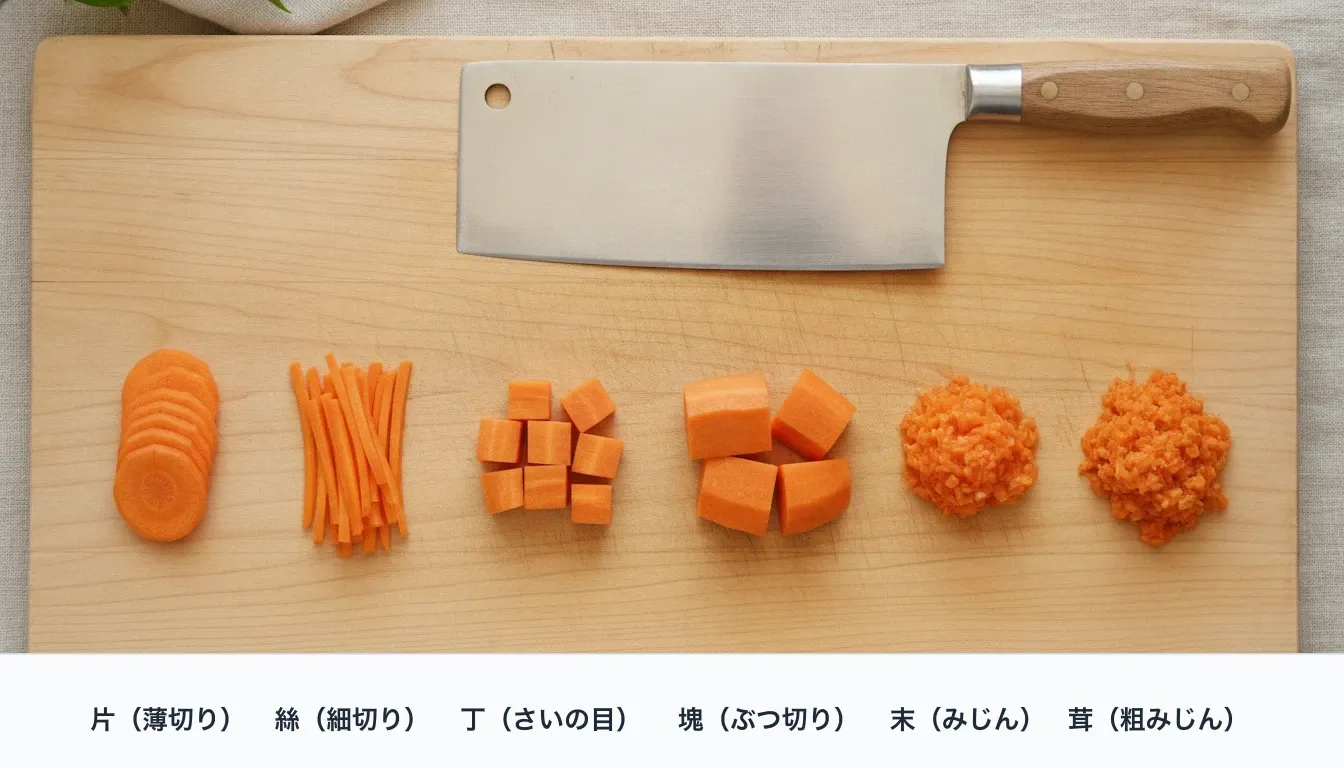
Chinese cuts have shape names, such as pian (slices), si (shreds), and ding (dice). In one dish, the main and supporting ingredients share the same shape and size.
Double the thickness, and the time to cook through rises about 4 times. If the shapes are mixed, they won’t cook through together in a short stir-fry.
Japanese sashimi isn’t cooked, so the cut surface itself is the point. In Chinese cooking, heat and seasoning finish the food after cutting, so the size is matched to cooking through.
Aroma rises twice. At the start of the stir-fry, scallion, ginger, and garlic flavor the oil. Just before plating, a flavored oil goes around the wok.
Food as medicine chooses by the eater’s body
Japanese cooks name how one ingredient’s taste changes over its season: hashiri (the first), shun (the peak), and nagori (the last). French cooks call the first vegetables of the season primeurs.
Chinese cooking sorts foods into cold, cool, neutral, warm, and hot in a traditional scheme. Cooks choose by the eater’s body and the season: more cool foods in summer, more warm foods in winter.
The phrase “food as medicine” (医食同源) was coined in Japan. In China, nourishing the body through daily meals has been called shi yang.
The tools serve a 60–90 second stir-fry
Read heat by wok and oil temperature
Chinese cooking names four levels of heat: wang huo (high), zhong huo (medium), xiao huo (low), and wei huo (very low). It counts oil temperature on a scale of steps called cheng (成).
In French cooking, technique names such as sauté and braise point to the temperature. Japanese simmered dishes divide heat by whether the liquid boils. For how five cuisines name and control heat, see Heat Control in 5 Cuisines.
For a Chinese stir-fry, heat the wok to about 250°C (482°F) before the food goes in. At that point, a drop of water forms a bead and rolls.
On a home stove, cook 150–200 g at a time. A batch of 200 g of bean sprouts takes 60–90 seconds. The smaller batch makes up for weaker heat.
Oil is flavored ahead and kept
A 60–90 second stir-fry leaves no time to draw aroma out in the wok. So Chinese cooks prepare the oil itself in advance.
Shu you first drives raw smells out of the oil. Flavored oils take on the aroma of scallion or chili and are kept. Just before plating, ming you (finishing oil) goes around the wok: 2.5–5 ml (½–1 tsp) per serving of stir-fry.
Japanese cooks protect the aroma of fermented seasonings by dissolving them in dashi, the stock of kombu and dried bonito. French cooks carry aroma in butter.
Italian cooks also flavor oil, but they do it during cooking. Chinese cooks make the aroma first, keep it, and use it as a seasoning.
Sauce and starch go in once, at the end
Chinese cooking keeps seasoning ratios under the names of flavor profiles, such as yu xiang (fish-fragrant), gong bao (kung pao), and tang cu (sweet and sour). The seasonings are premixed in a bowl.
For 200–300 g of food, about 60 g of bowl sauce goes in once, at the end of the stir-fry.
Japanese ji is premixed too. But it comes in a volume the food can soak in, like happō-dashi (a dashi-based seasoning broth), and the flavor goes inside the food. Chinese bowl sauce is a small amount of strong sauce that starch holds on the outside of the food.
Starch goes in at the opposite moment from French cooking. A French roux is flour cooked in butter, added first. Chinese gou qian (勾芡) is a slurry of potato starch and water, added last to a seasoned, boiling liquid.
The starch runs about 4% of the liquid for a thick sauce and about 1% for a soup.
One pot of stock, kept on hand
Tang carries almost no salt or fat, only umami. Mao tang (毛汤), made from chicken or pork bones, simmers about 3 hours over low heat. That is far more umami than the food can give up in a 90-second stir-fry.
Japanese dashi is made fresh for each dish. French fond is reduced as a base for sauces.
Chinese cooks make one big pot ahead. For each dish, they choose to use it as mao tang, clarify it into qing tang (clear stock), or add dried ingredients for shang tang (superior stock).
At home, you can use chicken stock powder instead: about 1.7 g per 100 ml. That adds 0.8 g of salt, so take that much salt out of the soy sauce. If your powder’s label gives a different salt content, subtract that amount instead.
Prepare first, coat at the end
Sort the 8 rows of the comparison table by cuisine. The Chinese rows line up on one point: prepare first, then coat the outside of the food at the end.
| Cuisine | After odors are removed | What flavor and aroma are dissolved in | At the end of cooking |
|---|---|---|---|
| Chinese | Aromatics and tastes are layered | Oil (aroma), bowl sauce (taste), stock (umami) | Bowl sauce and starch coat the outside of the food |
| French | Butter is melted in | Fond and butter | Finished with a sauce |
| Japanese | Only ji and fresh garnishes | Dashi and simmering liquid (water) | Cut surfaces and serving dishes shown as they are |
Sources: same as the comparison table.
Once you see this, what you fix in a home stir-fry changes. Before turning up the heat, set the bowl sauce, flavored oil, and stock beside the wok. Cut each batch to 150–200 g.
Add the bowl sauce once the food is cooked through, and the finishing oil once the sauce has thickened. With everything ready, taste, thickening, and aroma each go in once within 60–90 seconds.
Shared family meals and banquet courses
How rice, dishes, and soup fit together, and the order of a banquet, aren’t features in themselves. They are the features above, taking the shape of a table.
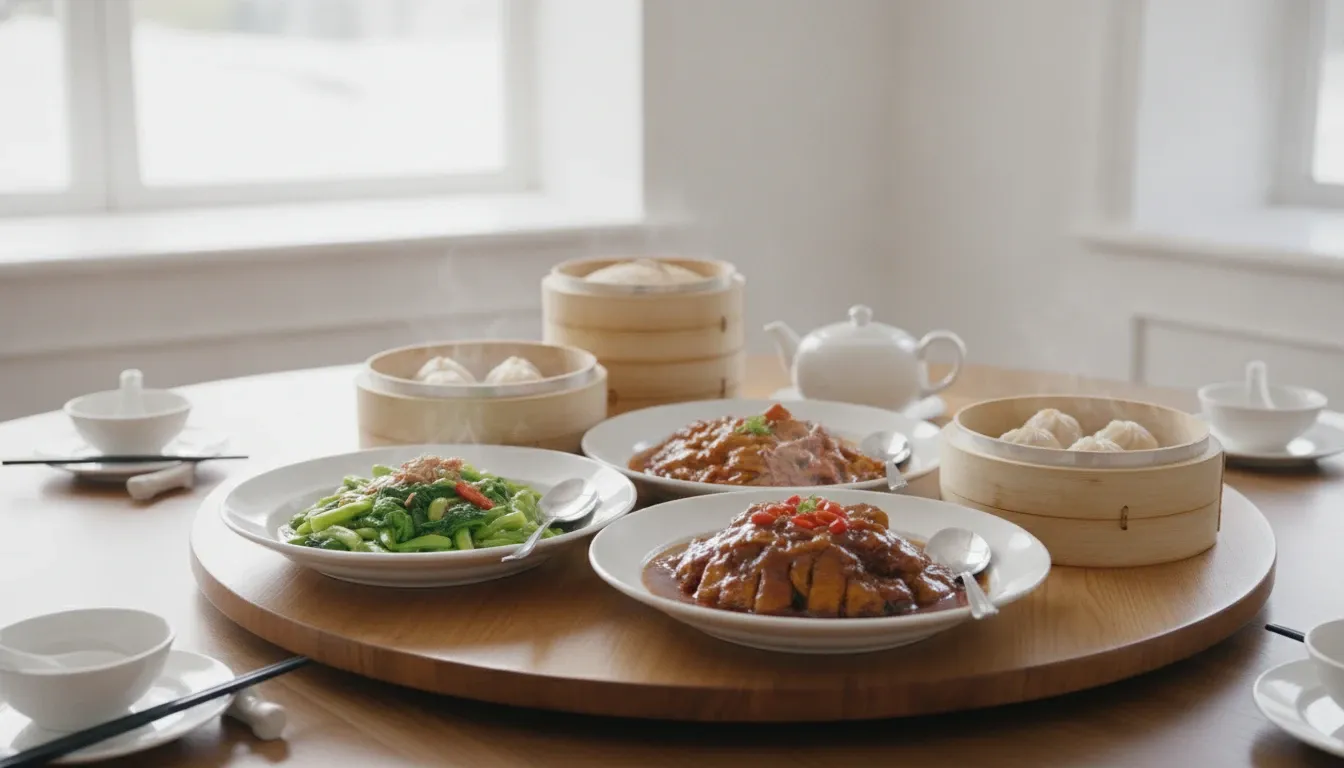
An everyday meal centers on plain, unseasoned rice. Dishes go on large plates in the middle of the table, and everyone helps themselves.
For 4 people, that means 3 dishes and 1 soup. Each dish has one flavor profile, and only 1–2 of them are stir-fries.
Japanese cooking sets out one soup and three dishes (ichijū sansai) for each person, all at once. French cooking serves a course at a time.
A banquet runs from leng cai (cold dishes) to re cai (hot dishes) and da cai (showpiece dishes). Then come soup, staples and dim sum, tian pin (sweet soups and sweets), and fruit. Where the soup comes varies by region and restaurant.
Cold dishes can be plated ahead, so they go out before all the guests arrive.
Three things to remember
- Chinese cooking holds three values, blending the five tastes, color-aroma-taste-shape, and food as medicine. It puts them into practice with heat control, prepared oil, premixed sauce, starch, and stock.
- High heat, oil, and premixed seasonings all exist in Japanese and French cooking too. The difference shows in how they are used.
- A stir-fry lasts 60–90 seconds. So aroma goes into the oil, taste and starch into the bowl, and umami into the stock ahead of time, then coat the outside of the food at the end.
When a home stir-fry falls short of a restaurant’s, set up what goes beside the wok before you turn up the heat.
Sources
- Lüshi Chunqiu, "Xiaoxing lan: Ben wei" (in Chinese). On blending sweet, sour, bitter, pungent, and salty, and their order and amounts
- National occupational skill standard "Chinese-cuisine cook (4-03-02-01)," 2018 edition (in Chinese). Combining main and supporting ingredients by texture, color, and shape
- Huangdi Neijing Suwen, chapter 22, "Zang qi fa shi lun" (in Chinese). Grains to nourish, fruits to assist, meats to benefit, vegetables to fill