What this article answers
- How a Chinese meal is put together
- Plain, unseasoned rice, shared dishes and one soup. Each dish gets one flavor profile
- How many dishes to make
- For 4, 3 dishes and 1 soup. At least 400 g of vegetables, 160–280 g of fish, meat and eggs
- Stir-fries go cold while you make the next one
- Limit stir-fries to 1–2. Make the rest as dressed, steamed or braised dishes you can cook ahead
- Every dish ends up tasting alike
- Change the flavor profile and cooking method for each dish. Never serve two soy-braised dishes
- Why a Chinese banquet starts with cold dishes
- Cold dishes can be made and set out ahead. Hot dishes then come out one at a time
You made mapo tofu, twice-cooked pork, and greens stir-fried with oyster sauce. Each one is good on its own. Side by side, though, they are all brown and all strong. And while you cook the last stir-fry, the first dish goes cold.
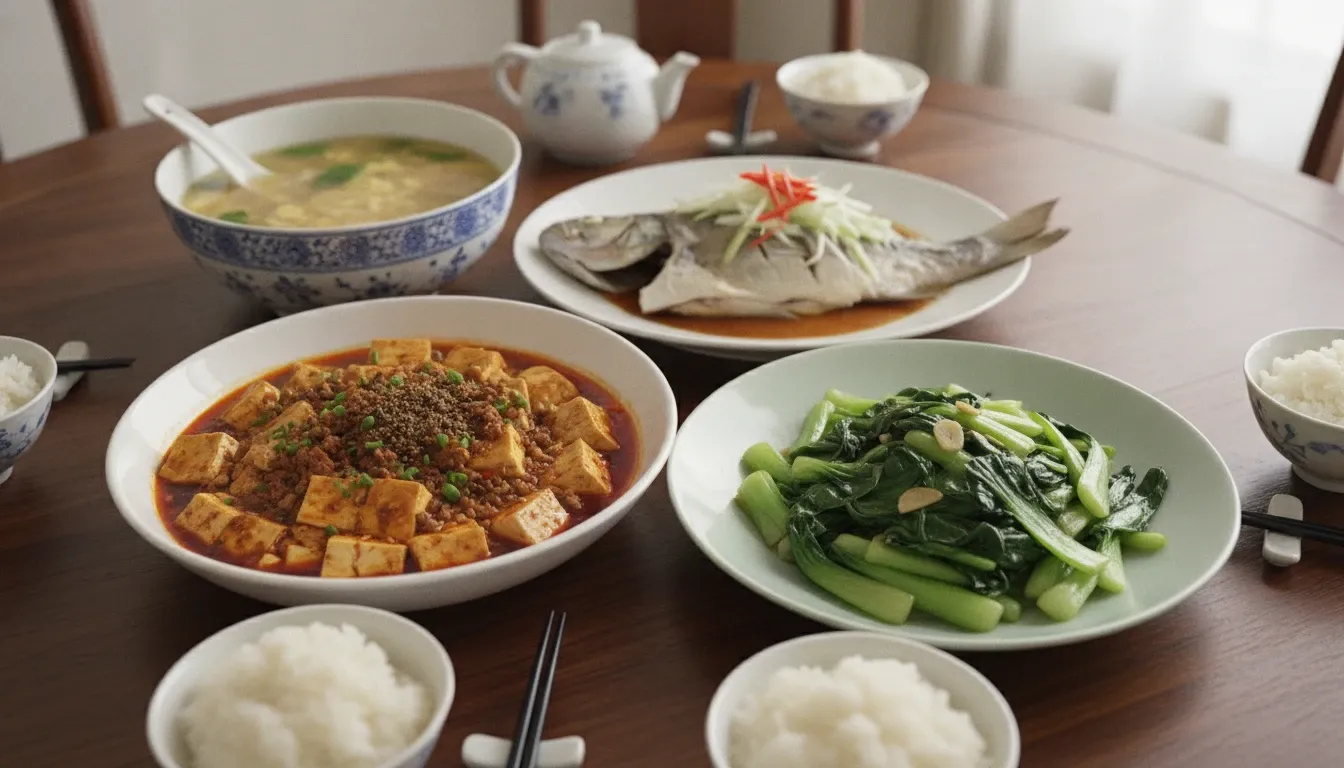
A Chinese meal is built from plain, unseasoned rice (fan), shared dishes set in the middle of the table (cai), and a soup (tang). Add dishes as the number of diners grows, and change the flavor and the heat from dish to dish. Then the flavors don’t pile up on the table, and the stir-fries reach it hot.
This article covers how Chinese cooks plan everyday meals and banquets. The temperatures and batch sizes for stir-frying are in Chinese cooking heat control.
A Chinese meal is rice, dishes and soup
An everyday Chinese meal centers on a plain, unseasoned grain. The dishes are there to help you eat it.
Plain grain at the center, dishes to eat it with
The Rites of Zhou, a text describing the institutions of the Zhou dynasty, splits the king’s meals in two. The six grains are for food (fan); the six animals are for the dishes.
Studies of Chinese food culture also treat the split between fan and cai as the foundation of a meal. A proper meal has both.
In the south, rice usually plays the part of fan; in the north, it is often noodles. Either way, it comes unseasoned. Salt and aroma belong to the dishes.
Rice and dishes per person
| Item | Its job | Per person per meal (g) |
|---|---|---|
| Rice | A plain staple that carries the flavor of the dishes | 70–100 (uncooked rice) |
| Vegetable dishes | Flavor and bulk to eat the rice with | 100 or more |
| Fish, meat and egg dishes | Flavor and umami to eat the rice with | 40–70 |
Source: the daily amounts in the Chinese Dietary Guidelines (2022), divided by 3. Weights are before cooking.
Rice is served one bowl per person. The dishes go on large plates and the soup in a large bowl, all in the middle of the table. Greens or egg in the soup cover part of the vegetables.
Shared dishes, more of them for more people
Chinese dishes are served on large plates in the middle of the table, and everyone takes from them onto a small plate.
Large plates, shared by the whole table
Scale one dish up for the whole table, and a stir-fry no longer fits in one batch. A home stove handles only 150–200 g per batch, enough for 1½ to 2 people (Chinese cooking heat control). You end up cooking it in 2 or 3 batches.
So as the table grows, add dishes rather than making one dish bigger. Restaurants also suggest ordering about one dish per person.
Use serving chopsticks (gong kuai) to take food. The Chinese dietary guidelines also recommend them when people share a table.
For 4 people, 3 dishes and a soup
As a guide, make one dish fewer than the number of people. The soup, with its greens and egg, does the work of one dish. For two people, make 2 dishes anyway, so the table has two different flavors.
| People | Dishes | Soups | Vegetables in total (g) | Fish, meat and eggs in total (g) | Uncooked rice (g) |
|---|---|---|---|---|---|
| 2 | 2 | 1 | 200 or more | 80–140 | 140–200 |
| 3 | 2 | 1 | 300 or more | 120–210 | 210–300 |
| 4 | 3 | 1 | 400 or more | 160–280 | 280–400 |
| 6 | 5 | 1 | 600 or more | 240–420 | 420–600 |
Source: amounts are the per-person figures above times the number of people. The number of dishes is this article’s guide: restaurants’ one dish per person, minus one for the soup.
For 4, spread at least 400 g of vegetables and 160–280 g of fish, meat and eggs over 3 dishes and the soup. For example: one meat-and-vegetable stir-fry, one steamed or braised tofu or fish dish, one dressed vegetable dish, and an egg and greens soup.
Change flavor and cooking method dish by dish
Everyone takes from every plate. If the plates share a flavor and a cooking method, every bite tastes the same.
One flavor profile per plate, a different one next door
A flavor profile (wei xing) is a name for a set combination of leading flavors. Examples are yu xiang (“fish-fragrant”), gong bao (kung pao), and tang cu (sweet and sour).
Sichuan cooks have a saying: “yi cai yi ge, bai cai bai wei.” Each dish has its own character; a hundred dishes, a hundred flavors.
Within a plate, keep to one leading flavor. Across the table, set out different flavor profiles. If one plate is rich with soy sauce and doubanjiang (fermented chili bean paste), make the others a qing chao or a vinegar and ginger salad. Qing chao is a stir-fry seasoned with salt alone.
Stir-fry only 1–2, and steam, braise or dress the rest
For 4, one stir-fried dish means 2 batches. Two dishes mean 4 rounds of washing and reheating the wok. A stir-fry cools as it sits, and salted greens leak water.
Make 1–2 stir-fries. Make the other dishes steamed, braised or dressed, which you can cook ahead.
| Main dish | Dishes to pair with it | Pairing to avoid |
|---|---|---|
| A stir-fry (fish-fragrant pork slivers, twice-cooked pork) | Steamed fish or braised tofu, dressed greens, a clear soup | Another stir-fry with the same flavor profile |
| A sweet-and-sour fried dish (sweet and sour spare ribs) | Greens stir-fried qing chao, steamed egg, a clear soup | A vinegar salad, another fried dish |
| A soy braise (red-braised pork, mapo tofu) | Greens stir-fried qing chao, a cucumber salad, a clear soup | Another soy-colored braise |
| Steamed fish (qing zheng yu) | A gong bao or yu xiang stir-fry, a dressed dish | Another mild steamed dish |
Source: pairings built for this article from flavor profiles, the yi cai yi ge principle, and the stir-fry batch size in Chinese cooking heat control.
Change color and texture plate by plate too
Hong shao (braising in soy sauce and sugar) and mapo tofu lean brown to red. Set the green of greens and the white of tofu or steamed fish beside them.
Two thickened dishes in a row give every plate the same mouthfeel. Keep sauces thickened with starch to 1–2 dishes. Make the others dry stir-fries or dressed dishes.
Soup and braises first, stir-fries last
Plan backward from the stir-fries, which should go from wok to table at once. Mix each stir-fry’s seasonings and starch in a bowl ahead of time. Chinese cooks call this premixed sauce wan zhi.
Source: stir-fry batch size and time from Chinese cooking heat control.
Move each batch to the plate before juice starts to pool on the wok bottom. After the first batch, cook the second without washing the wok. When it is done, combine both on one large plate and take it to the table.
For the soup you make first, use a stock from chicken or pork bones, or chicken stock powder made up as the packet directs. One Japanese brand uses about 1.7 g per 100 ml of hot water: for 4, 600 ml of liquid and about 10 g of powder. Add greens and egg.
Salt the soup to 0.6–0.8%, lighter than the dishes. Stock powders differ in saltiness, so taste it, and stop when it is clearly less salty than the dishes.
Banquets run cold, hot, soup, then staples
At a banquet, the dishes are not laid out all at once as at home. They come one at a time, in order. The basic order is shared by many regions, but where the soup falls and how many dishes there are change by region and restaurant.
| Order | What comes | How it is served |
|---|---|---|
| 1 | Cold dishes (leng cai: dressed dishes, lu wei, smoked foods) | Set out before the guests arrive |
| 2 | Hot dishes (re cai: stir-fries, fried, steamed and braised dishes) | One plate at a time |
| 3 | Centerpiece dishes (da cai: a whole fish or chicken, the heart of the meal) | Between or after the hot dishes |
| 4 | Soup | After the hot dishes (in some regions before or between them) |
| 5 | Staples and dim sum (rice, fried rice, noodles, dumplings, buns) | Near the end |
| 6 | Sweets (tian pin: sweet soups or pastries) and fruit | Last |
Sources: Wikipedia, “Customs and etiquette in Chinese dining,” and China Highlights (see References). The order and number of dishes change with region, restaurant and the formality of the occasion.
Cold dishes first, set out before guests arrive
Cold dishes are served cold: dressed dishes, or lu wei, meat simmered in a spiced broth and cooled. They can be made and plated ahead, so they are on the table before the guests are all there. They go with the first drinks.
Hot dishes, one plate at a time
China’s state banquets for visiting heads of state followed “si cai yi tang,” four dishes and a soup. That count left out the cold dishes and the sweets. The cold course could be one large platter or 7–8 small plates. The 4 hot dishes came out one at a time.
Even on a home stove, a stir-fry takes 60–90 seconds per batch (200 g of bean sprouts). The aromatic oil swirled in just before plating loses its aroma the longer the dish sits.
Serve one plate at a time, and every dish reaches the table straight from the wok.
Staples come near the end
At a banquet, the dishes are eaten with drinks, and rice, noodles or dumplings come near the end. It is often said that filling staples served first would leave no room for the dishes. We could not find a primary source that gives this reason.
Where the soup falls depends on region and restaurant
At ban zhuo, the traditional Taiwanese banquet, a cold platter comes first. Second comes hong shao geng, a thickened soup. That is the reverse of putting soup after the hot dishes.
Japan serves portions, China shares from the center
Everyday meals in Japan and China both center on a plain staple. They differ in how the dishes are served and how flavor is spread.
Ichiju sansai (“one soup, three dishes”) is the standard Japanese home meal: rice, soup, a main dish and two sides.
| Japanese cooking (ichiju sansai) | Chinese cooking (fan, cai, tang) | |
|---|---|---|
| Staple | Rice cooked without salt | Plain grain (noodles too, in the north) |
| Where rice and soup go | Rice front left, soup front right | The Book of Rites also puts rice on the left, soup on the right |
| How dishes are served | Individual portions, set out at once | Large plates in the middle, shared |
| Number of dishes | Fixed: 1 main and 2 sides | Grows with the table (3 dishes for 4) |
| How flavor is spread | Salt and umami go to the main dish; sides are light | One flavor profile per plate, a different one on each |
| Hot food | Kept to three: rice, soup and the main dish | Stir-fries cooked last; at banquets, one plate at a time |
| Staple at formal meals | First in the meal served at a tea ceremony, last in a multi-course banquet | Near the end at banquets |
On New Year’s Eve, leave some fish
At nian ye fan, the family dinner on New Year’s Eve, it is customary not to finish the fish that night. Yu (fish) sounds the same as yu (surplus). The fish stands for “nian nian you yu”: a surplus every year.
Adjusting the plan to your table
| When | What to do | Why |
|---|---|---|
| You want 2 stir-fries | Make the second a meatless qing chao of greens. Finish the soup and braise first, then stir-fry both back to back | A greens-only stir-fry has no meat to cook through, so the first dish waits less |
| The main dish is mapo tofu or twice-cooked pork | Make the others a salt-only qing chao and a vinegar salad, with a clear soup | Doubanjiang’s salt and umami would otherwise pile up |
| Cooking for just 2 | 2 dishes and 1 soup: one stir-fry, plus a dressed or steamed dish made ahead | A stir-fry for 2 fits in one batch |
| You have guests | Make 2–3 cold dishes ahead and set them out. Serve hot dishes one at a time | The table has food on it while the stir-fries cook |
| Noodle soup as the staple | Skip the soup and make one dish fewer | The noodle broth takes the soup’s place |
Common failures and fixes
Greasiness and a stir-fry gone cold can be fully fixed. An over-salted spread and a watery stir-fry can be only partly saved.
| Problem | Cause | Fix it now | Prevent it next time |
|---|---|---|---|
| Every dish is too salty | Twice-cooked pork, mapo tofu and greens in oyster sauce all used salty, umami-rich seasonings, so every plate was strongly salted | Make the soup a mild one with plenty of solids, and serve more rice | Keep salty, umami-rich flavor profiles to one dish. Make the others a salt-only qing chao or a vinegar salad |
| The meal feels greasy | Two stir-fries and a fried dish, with no vinegar dish and nothing juicy, left fat coating the mouth | Add a vinegar-dressed dish and make the soup a clear one. Acidity and liquid wash the fat away | Keep oily dishes to one. Steam, braise or dress the rest |
| The stir-fried greens are watery | The greens were cooked first and left to sit. Osmotic pressure from the salt drew water from the leaf cells, and it pooled on the plate | Pour off the liquid, toss the greens in a wok over high heat for about 10 seconds, and replate | Cook the greens last, and take them to the table as soon as they leave the wok |
| The stir-fry has gone cold and stiff | While the second stir-fry cooked, the first one cooled. The meat fat set and the sauce thinned out | Reheat it in the wok with 15 ml (1 tbsp) of hot water. If the sauce has thinned, add 2.5 ml (½ tsp) of potato starch mixed with 5 ml (1 tsp) of water. Cornstarch thickens less: use about half as much again, and simmer briefly | Limit stir-fries to 1–2. Finish the other dishes and the soup first, then cook the stir-fries last, one at a time |
Four things to remember
A Chinese meal is a way to eat plain grain with shared dishes and soup from the middle of the table.
- As a guide, make one dish fewer than the number of people. For 4: 3 dishes and 1 soup, with at least 400 g of vegetables and 160–280 g of fish, meat and eggs
- Keep each plate to one flavor profile. Change the flavor profile, cooking method and color from plate to plate
- Make 1–2 stir-fries and cook them last. Finish the soup, braises and dressed dishes first
- Banquets start with cold dishes, bring hot dishes one at a time, and serve staples near the end. The order and count vary by region and restaurant
Sources
- Rites of Zhou, Offices of Heaven, Shan Fu ("for the king's meals, the six grains for food, the six animals for dishes"). Wikisource (in Chinese)
- Book of Rites, Qu Li I ("rice to the diner's left, soup to the right"). Wikisource (in Chinese)
- K. C. Chang, ed. Food in Chinese Culture: Anthropological and Historical Perspectives. Yale University Press, 1977 (the fan-ts'ai distinction; Asia Society overview)
Show 9 more
- Shanghai Jiao Tong University School of Public Health. An expert reading of the Chinese Dietary Guidelines 2022, May 2022 (grains 200–300 g, vegetables 300 g or more, fish, poultry, eggs and lean meat 120–200 g per day) (in Chinese)
- People's Daily. Chinese Dietary Guidelines (2022) released, May 20, 2022 (the eight principles of a balanced diet; the eighth, serving chopsticks and no waste) (in Chinese)
- Wu Deguang. A witness on how state banquets changed. People's Digest, September 2012 (four dishes and a soup; cold platters and sweets not counted; the 4 dishes served one at a time) (in Chinese)
- Huang Wan-ling. The first three dishes matter most at a banquet. foodnext, May 11, 2021 (in a Taiwanese ban zhuo, a cold platter first and a thick hong shao soup second) (in Chinese)
- Xu Yingying (CCTV). New Year customs: the Chinese New Year's Eve dinner. Guangming Online, January 28, 2025 (not finishing the fish on New Year's Eve) (in Chinese)
- Wikipedia. Customs and etiquette in Chinese dining (banquet order and regional differences, one dish per person)
- China Highlights. How a Chinese Meal Is Served (cold dishes, hot dishes, soup, fruit; order one dish per person; rice in the south, noodles in the north)
- Ajinomoto. Marudori chicken stock powder, product details (1 tsp is about 2.5 g; 4 tsp in 600 ml water for 4 servings of soup) (in Japanese)
- America's Test Kitchen. Can potato starch be substituted for cornstarch to thicken sauces? (potato starch thickens more and faster; 2 tsp potato starch for 1 tbsp cornstarch)