What this article answers
- What se xiang wei xing means
- Judging a dish by color, aroma, taste, and shape. Add the serving dish and it becomes se xiang wei xing qi
- Which colors to put together
- Use the side ingredients' color to make the main one stand out. If all is white, keep the seasonings pale too
- When to raise the aroma
- Once at the start of the stir-fry with scallion, ginger, and garlic, and once just before plating with aromatic oil
- Why cut everything the same size
- Cooking time grows with roughly the square of thickness. Twice as thick takes about 4 times as long
- Which of the four counts most
- On a contest score sheet, taste and texture take 60 of 100 points. Color and shape together take 25
Chinese recipes say “cook until the color is bright,” “stir-fry until fragrant,” and “cut everything the same size.” None of these is about seasoning. Skip them and you still get a dish.
Se xiang wei xing (色香味形) is how Chinese cooking judges a dish: by color, aroma, taste, and shape. Add the serving dish and it becomes se xiang wei xing qi.
In the kitchen, it comes down to three jobs. Color: let the side ingredients make the color of the main ingredient stand out. Aroma: raise it twice, at the start of the stir-fry and just before plating. Shape: cut the main and side ingredients to the same size so they cook through together.
This article covers color, aroma, shape, and the serving dish, and where in the cooking each one is set. How to balance the tastes themselves is a separate topic.
A dish judged by eye, nose, and mouth
The four measures look at different things, and each is set at a different step. The points below come from the 2026 final of Yuecai Shifu, a Cantonese chef skills contest in Shenzhen.
| Measure | How it is judged | Points in the final (of 100) | Where you set it |
|---|---|---|---|
| Color | Eye: the colors of main and side ingredients, gloss, the sheen of the sauce | 10 | Choosing side ingredients; the oil just before plating |
| Aroma | Nose: the fragrance that rises with the steam | None | At the start of the stir-fry; just before plating |
| Taste | Mouth: one main taste, and how the others come together around it | 30 | Seasoning |
| Shape | Eye and mouth: clean cut faces (dao kou), even sizes | 15 | Cutting |
| Serving dish | Eye: how the dish and food suit each other | 2 | Plating |
Source: final-round score sheet of the 2026 Shenzhen Yuecai Shifu Chinese-cuisine cook competition (references). Of the 10 points for color, 4 go to the zhi qian (汁芡), the thickened sauce.
The rest: 30 for texture, 3 for plating and hygiene apart from the dish, and 10 for craft (technique and creativity). There is no line for aroma. Instead, the taste requirement says xian xiang shi kou (鲜香适口): fragrant and pleasing to eat.
Taste and texture, judged in the mouth, take 60 points. Color and shape, judged by eye, take 25 between them. They tell the eater how the dish turned out before the first bite. They don’t replace taste.
Color and shape are set before the heat
China’s national standard for cooks, the occupational skill standard for Chinese-cuisine cooks (中式烹调师), 2018 edition, places color and shape in cutting and combining, not in plating.
The standard names six shapes: pian (slices), si (shreds), ding (dice), tiao (sticks), kuai (chunks), and duan (lengths). Texture here means firmness and bite.
| Grade | What the standard requires | In a home kitchen |
|---|---|---|
| Grade 5 (junior) | Cut to standard into the six shapes | Make every slice, shred, dice, stick, chunk, and length the same size |
| Grade 4 (intermediate) | Combine main and side ingredients by texture, color, and shape | Choose what goes with what by bite, color, and shape |
Source: national occupational skill standard “Chinese-cuisine cook (4-03-02-01),” 2018 edition (references).
A stir-fry is done within minutes of hitting the heat. There is no time to swap a side ingredient or recut it in the wok. Decide which colors to pair and which shape to cut before you light the burner.
Side ingredients make the main one stand out
When Chinese cooks combine ingredients, they pick the side ingredients’ color to set off the main ingredient. There are two ways to do it.
Matching colors need pale seasonings
| Approach | Colors of main and side | Example | Color of seasonings |
|---|---|---|---|
| Shun se (顺色), matching | Nearly the same (usually white) | White main ingredient, white side ingredient | Pale ones such as salt and white soy sauce (a very pale soy sauce) |
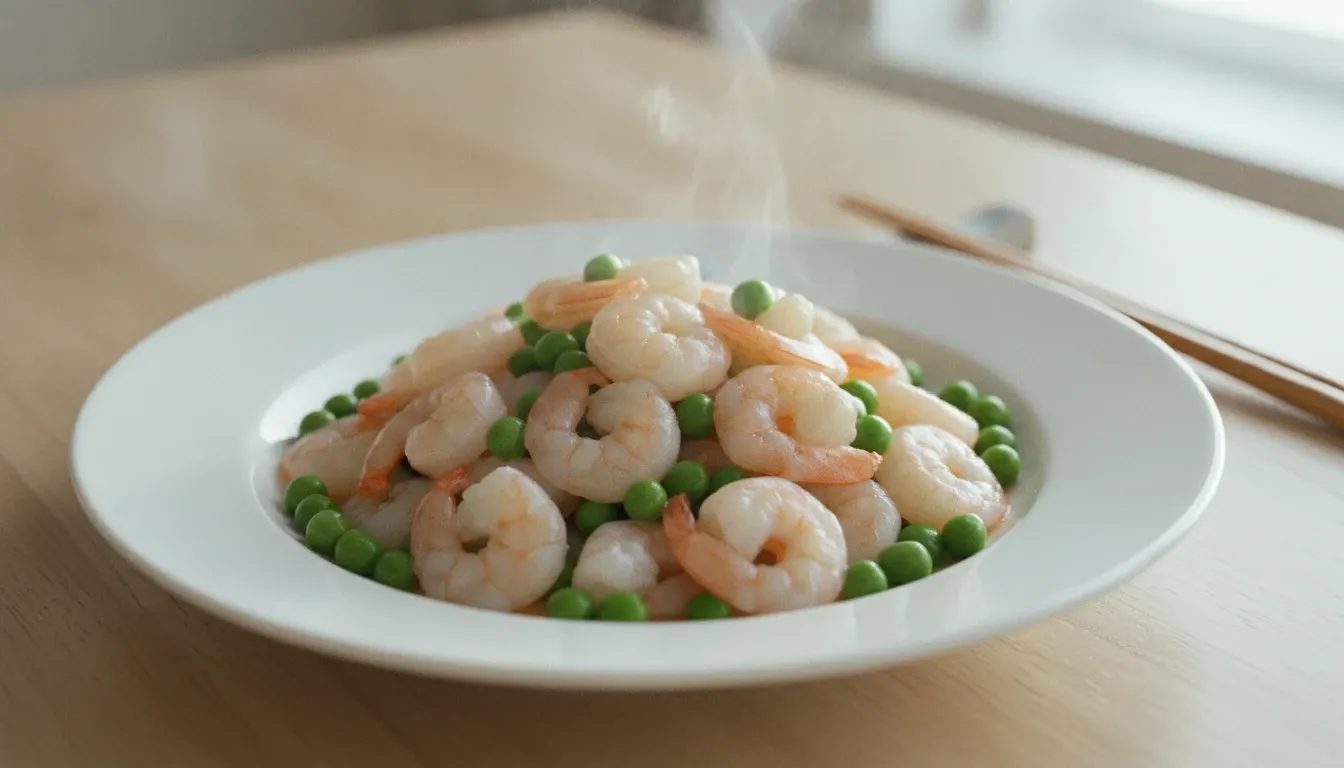
| Yi se (异色), contrasting | Clearly different | Qing dou xia ren: white peeled shrimp with green peas | No limit like that of shun se |
Source: an explanation of how Chinese cooks combine ingredients (references).
Shun se matches the main and side ingredients so the whole plate finishes in one pale color. A dish finished pale with salt suits shun se. A dish colored by soy sauce or oyster sauce suits yi se.
In shun se, the liao jiu (料酒, cooking wine) should be pale too. Regular soy sauce stains the main ingredient brown, and the point of a white dish is lost. When you match colors, choose the seasonings by color as well.
Contrasting colors need a clear difference
In yi se, make the difference between main and side ingredients clear. Pick a color close to the main one, like yellow against white, and the main ingredient is hard to pick out.
With a white main ingredient, add green vegetables or black wood ear mushrooms. White against green or black is a big contrast, so the outline of the main ingredient shows on the plate.
Add greens last, and don’t simmer them in vinegar
Choosing a color is wasted if the heat changes it. The green of leafy greens and green peppers turns yellowish brown under long heat and acid, and it doesn’t come back.
Add green ingredients last, and turn off the heat once the color brightens. In a dish with vinegar, don’t simmer for long after the vinegar goes in.
Raise the aroma twice
Aroma compounds are volatile. Heat releases them, but keep heating and they fly off out of the wok. Chinese cooking splits the aroma into two moments.
At the start, carry scallion, ginger, and garlic into the oil
Add chopped scallion, ginger, and garlic to hot oil, and once they smell fragrant, add the main ingredient. This is called bao xiang (爆香).
Most aroma compounds dissolve in oil. Move them into the oil first, and when the oil coats the food, the aroma comes along.
The cue: fine bubbles rise, the smell lifts, and the edges of the garlic are just about to color. Wait until they color, and a burnt bitterness goes into the oil.
For a flavored oil that takes on aroma slowly, cook at 100–150°C (212–302°F).
Just before plating, swirl in 2.5–5 ml of aromatic oil
Aroma lost during the stir-fry gets put back at the end. Just before you turn off the heat, swirl sesame oil or scallion oil down the side of the wok: 2.5–5 ml (½–1 tsp) per serving for a stir-fry. This is called ming you (明油).
The film of ming you adds gloss along with aroma. On the score sheet, color looks at the state of the sauce and its gloss.
Cut to one shape and size
Even shapes cook through in the same time and look even on the plate.
Cut main and side ingredients to the same shape
Diced main ingredients get diced side ingredients, slices get slices, chunks get chunks. In Chinese this is ding pei ding (dice with dice) and pian pei pian (slices with slices).
Twice as thick takes about 4 times as long
The time for heat to reach the center grows with roughly the square of thickness. Twice as thick takes about 4 times as long, three times as thick about 9 times.
| Width of the side-ingredient shreds | Time to cook through (2 mm width = 1, approximate) | With the main ingredient cut into 2 mm shreds, stir-fried over high heat |
|---|---|---|
| 2 mm | 1 (baseline) | Finishes with the main ingredient |
| 3 mm | About 2.3 | The main ingredient overcooks before the side is done |
| 4 mm | About 4 | The main ingredient is done, the side still raw inside |
The figures are estimates calculated from the square of thickness. The ratio holds for meat and vegetables alike. A Japanese culinary-school competition sets its shred task at 6 cm (2⅜ in) long and 2 mm (under ⅛ in) wide (Chinese knife skills by level).
Side ingredients that cook slowly, like carrots or bamboo shoots, keep the same shape but are cut thinner than the main ingredient, so both finish together.
What the judges score: cut faces, size, natural shape
The contest’s 15 points for shape split three ways. Clean, smooth cut faces (5 points). Even size (5 points). A natural, attractive shape (5 points). Points go to evenness, not to decorative carving.
Choose the dish to fit, don’t decorate
The national standard asks, from grade 5, the lowest, that cooks choose the serving dish to suit the food. The contest gives 2 points to whether the dish and food set each other off, and its brief says “no excessive decoration.”
Chinese meals are shared from large platters on a round table (how Chinese cooking differs). Serve the platter full, and let each person adjust their portion on their own small plate.
Don’t add to a dish with decoration. Plate food with even color and shape on a platter sized to the amount.
Taste in the mouth, or the whole plate
Among the ideas of Chinese cooking, balancing tastes and judging the dish look at different things.
| Idea | What it looks at | What you do in the kitchen | When to revisit it |
|---|---|---|---|
| Wu wei tiao he (balancing the five tastes) | Taste in the mouth | Remove odors, set salt as the base, pick one main taste and layer the others | The taste is flat, or one taste sticks out |
| Se xiang wei xing (this article) | The whole plate: eye, nose, mouth, shape | Line up the side ingredients’ color, the moments for aroma, and the cut shapes | The taste is right, but the plate looks dull, the aroma is weak, or the pieces cook unevenly |
| Food as medicine | The eater’s body | Base meals on grains, change ingredients and cooking with the season | Meals lean on meat, or the same dishes repeat whatever the season |
Japanese cuts are shown, Chinese cuts are cooked
Shape and serving dishes point in different directions in each cuisine.
| Cuisine | What the cut shape does | How the serving dish is used |
|---|---|---|
| Chinese | Main and side ingredients cut to one shape, cooked briefly over high heat | Large platters served full; portions adjusted on small plates |
| Japanese | As in sashimi, the cut face itself is what the dish shows | A different dish for each food, with empty space left inside it |
Sources: this site’s articles on cutting in Japanese cooking and on empty space in Japanese plating, in their comparisons with Chinese cooking.
Japanese cooking includes dishes that never see heat, so the cut face becomes the finished look. In Chinese cooking, heat and seasoning finish the food after cutting. So cooks size the cut to how it will cook, and match the shapes of main and side ingredients so the plate looks even too.
When to match, contrast, or cut thinner
| When | What to do | Why |
|---|---|---|
| A white main ingredient finished pale with salt (shrimp, chicken breast, white fish) | Match it with white side ingredients | The whole plate comes together in one pale color |
| A white main ingredient finished with soy sauce or oyster sauce | Pair it with green or black side ingredients | The seasoning turns it brown, so a white-on-white plate won’t look white |
| A side ingredient that cooks slower than the main one (carrot, bamboo shoot) | Cut it thinner than the main ingredient | Cooking time shrinks with roughly the square of thickness |
Common failures and fixes
Uneven cooking, weak aroma, and burnt oil can be fixed. Browned greens and a stained white dish can be only partly saved.
| Problem | Cause | Fix it now | Prevent it next time |
|---|---|---|---|
| The pieces cook unevenly | Main and side ingredients were cut to different thicknesses. Heat takes roughly the square of thickness to reach the center, so the gap widened. The thin pieces overcooked and the thick ones stayed raw | Leave only the thick pieces in the wok to cook through, then return the ones you took out at the end | Cut main and side ingredients to the same shape. Cut slow-cooking side ingredients thinner than the main one |
| The greens turned brown | Green side ingredients simmered long with vinegar or soy sauce. Heat and acid pulled the magnesium out of the chlorophyll, turning it into yellowish-brown pheophytin | The color won’t come back. Quickly stir-fry fresh greens and add them on top | Add green ingredients last and turn off the heat once the color brightens. Don’t simmer long after the vinegar goes in |
| The aroma is weak | The aroma compounds of scallion, ginger, and aromatic oil are volatile, and flew out of the wok during a long stir-fry over high heat | Turn off the heat and swirl 2.5–5 ml (½–1 tsp) of sesame or scallion oil down the side of the wok | Carry the aroma into the oil at the start, and add aromatic oil once more just before plating |
| The oil smells burnt | The garlic burned during bao xiang. Sugars and proteins charred into bitter compounds that went into the oil | Pour out the oil, wipe the wok, and carry the aroma into fresh oil | Once the aroma rises, add the main ingredient before the garlic edges color |
| A white dish turned brown | Regular soy sauce in a dish meant to stay white. Its brown pigments (melanoidins) stuck to the surface of the main ingredient | The color won’t come out. Add a green side ingredient and rework it into a contrasting dish | Season dishes meant to stay white with salt and white soy sauce (a very pale soy sauce) |
Four things to remember
Se xiang wei xing judges a dish by eye and nose, not only by taste. You act on it at three moments: before lighting the burner, at the start of the stir-fry, and just before plating.
- Color: let the side ingredients’ color make the main ingredient stand out. If all is white, keep the seasonings pale. Add green ingredients last.
- Aroma: at the start, carry scallion, ginger, and garlic into the oil. Just before plating, swirl in 2.5–5 ml (½–1 tsp) of aromatic oil.
- Shape: cut main and side ingredients to the same shape, and cut slow-cooking side ingredients thinner. Twice as thick takes about 4 times as long.
- Taste, together with texture, takes 60 of 100 points. That is the work of balancing the tastes.
Don’t add to the dish with decoration. Plate it on a platter sized to the amount.
Sources
- General Office of the Ministry of Human Resources and Social Security of the People's Republic of China. "Notice on publishing 26 national occupational skill standards, including Chinese-cuisine cook." December 2018 (in Chinese)
- National occupational skill standard "Chinese-cuisine cook (4-03-02-01)," 2018 edition (in Chinese). Grade 5: cutting standards for pian, si, ding, tiao, kuai, and duan, and choosing dishes to suit the food. Grade 4: combining main and side ingredients by texture, color, and shape. Job profile: no color blindness or loss of smell or taste (full text reproduced)
- Shenzhen Municipal Human Resources and Social Security Bureau. "2026 Shenzhen Skills Contest, Yuecai Shifu (Cantonese chef) Chinese-cuisine cook skills competition: technical document" (in Chinese). Final-round scoring: form 15, color and gloss 10, texture 30, taste 30, plating and hygiene 5, craft 10. Artificial coloring banned; points deducted for excessive decoration
Show 2 more
- "Chef's secrets: how to combine ingredients" (in Chinese). Side ingredients set off the main one; matching and contrasting colors; dice with dice, slices with slices. Apparently reproduced from a culinary-craft textbook
- Zenkoku Chorishi Yosei Shisetsu Kyokai (Japan's national association of culinary schools). "Guidelines for the 42nd Culinary School Cooking Skills Competition." August 2026 (in Japanese). Chinese cuisine division: green pepper si 6 cm long and 2 mm wide