What this article answers
- What to learn first with a Chinese cleaver
- Cut six even shapes, then add decorative scoring (hua dao), then bone whole birds and fish
- A number to measure your skill against
- Twenty 1.5 cm daikon cubes. If every one is a true cube of the same size, that scores 5 points
- How thick si (shreds) should be
- A Japanese culinary-school competition sets 6 cm long and 2 mm wide
- Where the professional yardstick comes from
- China's five grades for Chinese-cuisine cooks. New knife skills stop at grade 3
You cut with a Chinese cleaver, but you can’t tell whether you are getting better. You can cut si (shreds), but you don’t know what to practice next.
Two public yardsticks exist for Chinese knife work. One is the set of requirements China fixes for each grade of its cook qualification. The other is the scoring sheet of a Japanese culinary-school competition.
This article covers the order in which to learn Chinese knife skills, and how to measure where you are now. It doesn’t cover how to cut si or ding (dice) themselves.
For the sizes of si and where each is used, see Julienne vs. Sengiri vs. Chinese Si.
China’s five cook grades set the stages
China’s national qualification for Chinese-cuisine cooks (中式烹调师) has five grades. Each grade states what a cook must be able to do with a knife. The requirements of a lower grade carry over into every grade above it.
Hua dao (花刀), in the table, means scoring decorative cuts into the surface of an ingredient.
| Stage | Chinese grade | What you can do with the knife |
|---|---|---|
| 1 | Grade 5 (junior) | Cut ingredients evenly into the six basic shapes |
| 2 | Grade 4 (intermediate) | Score hua dao into ingredients |
| 3 | Grade 3 (senior) | Bone whole chickens and fish |
| 4 | Grade 2 (technician) | Teach knife skills to lower grades |
| 5 | Grade 1 (senior technician) | Create new dishes |
Sources: skill requirements for each grade in the national occupational skill standard “Chinese-cuisine cook,” 2018 edition.
New knife skills are required only up to stage 3. Stage 4 is about teaching, and stage 5 about creating new dishes.
Stages 1 and 2 can be measured with the tasks of the Japanese school competition. For stage 3, the qualification’s own requirement is the guide. Placing each task at a stage is this article’s own mapping of school tasks onto the grade requirements.
Stage 1 is six shapes and basic butchery
Grade 5 asks you to cut ingredients into six basic shapes. It also asks you to break chicken, duck, and fish down into parts.
Six shapes and three knife strokes
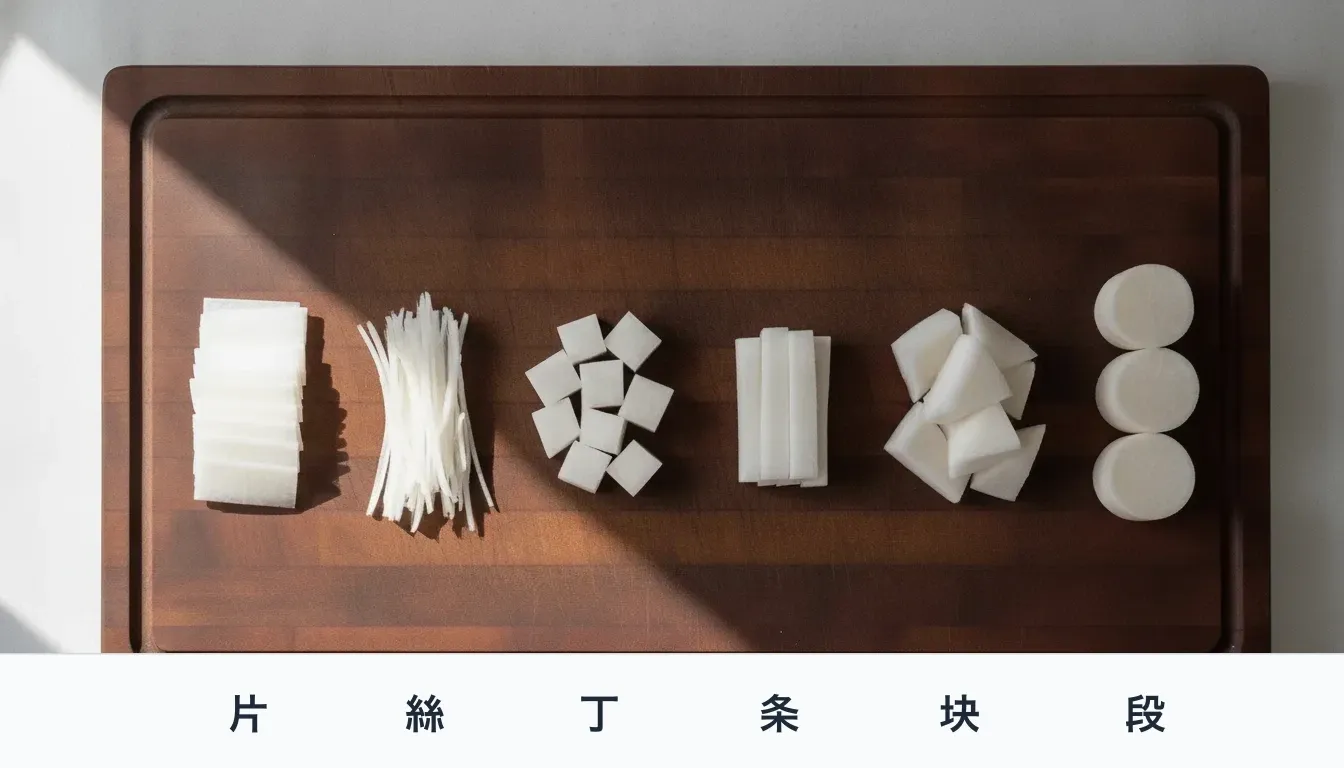
These are the six shapes, shown here on daikon (a large, mild Japanese white radish). For meat, five are required: all except si.
| Shape required at grade 5 | Pronunciation | What it looks like |
|---|---|---|
| 片 | pian | Thin slices |
| 絲 | si | Shreds |
| 丁 | ding | Dice |
| 条 | tiao | Sticks |
| 块 | kuai | Chunks |
| 段 | duan | Lengths cut crosswise |
Sources: grade 5 skill requirements in the national standard “Chinese-cuisine cook,” 2018 edition. The pronunciation and description columns were added by this article.
No public scoring standard turned up for pian, tiao, kuai, or duan.
Even shapes aren’t only for looks. When the main ingredient and the supporting ones share a shape, they cook through evenly in a short, high-heat stir-fry.
Grade 5 also asks for three knife strokes, called dao fa. The blade goes straight down, lies flat, or enters at an angle.
Three vegetable tasks that measure size
At the regional round of the Japanese school competition, the Chinese cuisine division has three vegetable tasks: ding, si, and cong hua. Cong hua is Japanese long onion (negi) chopped into 2 mm (under ⅛ in) cubes. It is a mincing task outside the six shapes.
| Scored item | Earns 5 points | Earns 1 point |
|---|---|---|
| Shape of the daikon ding | Every piece a clean cube | Shapes uneven throughout |
| Size of the daikon ding | Every piece 1.5 cm square and even | Sizes uneven throughout |
| Length of the green pepper si | 6 cm and even throughout | Uneven throughout |
| Width of the green pepper si | 2 mm and even throughout | Uneven throughout |
| Joined pieces in the si | No joined pieces at all | Joined throughout |
| Size of the negi cong hua | 2 mm cubes, even throughout | Not 2 mm, and uneven |
| Moisture in the cong hua | Almost no moisture | Far too wet |
Sources: scoring standards for the Chinese cuisine division at the regional round, guidelines for the 42nd Culinary School Cooking Skills Competition (August 2026).
The ding comes from a daikon 10 cm (4 in) tall and 8 cm (3 in) across: at least 20 cubes of 1.5 cm (⅝ in). The si uses 2 green peppers, and the cong hua a 15 cm (6 in) length of negi.
The time limit is 35 minutes. That also covers filleting a horse mackerel and making a thin omelet.
Breaking down fish and chicken
All three divisions of the school competition share one task: filleting a horse mackerel into two fillets and the frame. It is scored in three places.
| Scored item | Earns 5 points |
|---|---|
| Cleaning | Scutes (the hard scales along the tail), gills, and bloodline cleanly removed |
| Backbone and belly | Backbone unbroken, belly bones and membrane removed |
| Flesh left behind | No flesh left on the backbone, and no split fillets |
Sources: fish-filleting scoring standards shared by all three divisions, guidelines for the 42nd competition (August 2026).
You are ready for the next stage when your three vegetable tasks come out at size and no flesh is left on the mackerel’s backbone.
This site doesn’t yet have an article on the filleting steps or on breaking down a chicken.
Stage 2 adds decorative scoring
Grade 4 asks you to score hua dao into ingredients. Examples are the wheat-ear pattern (mai sui hua dao) for meat and fish and the orchid pattern (lan hua hua dao) for vegetables. Breaking pork, beef, and lamb down into parts also starts at this grade.
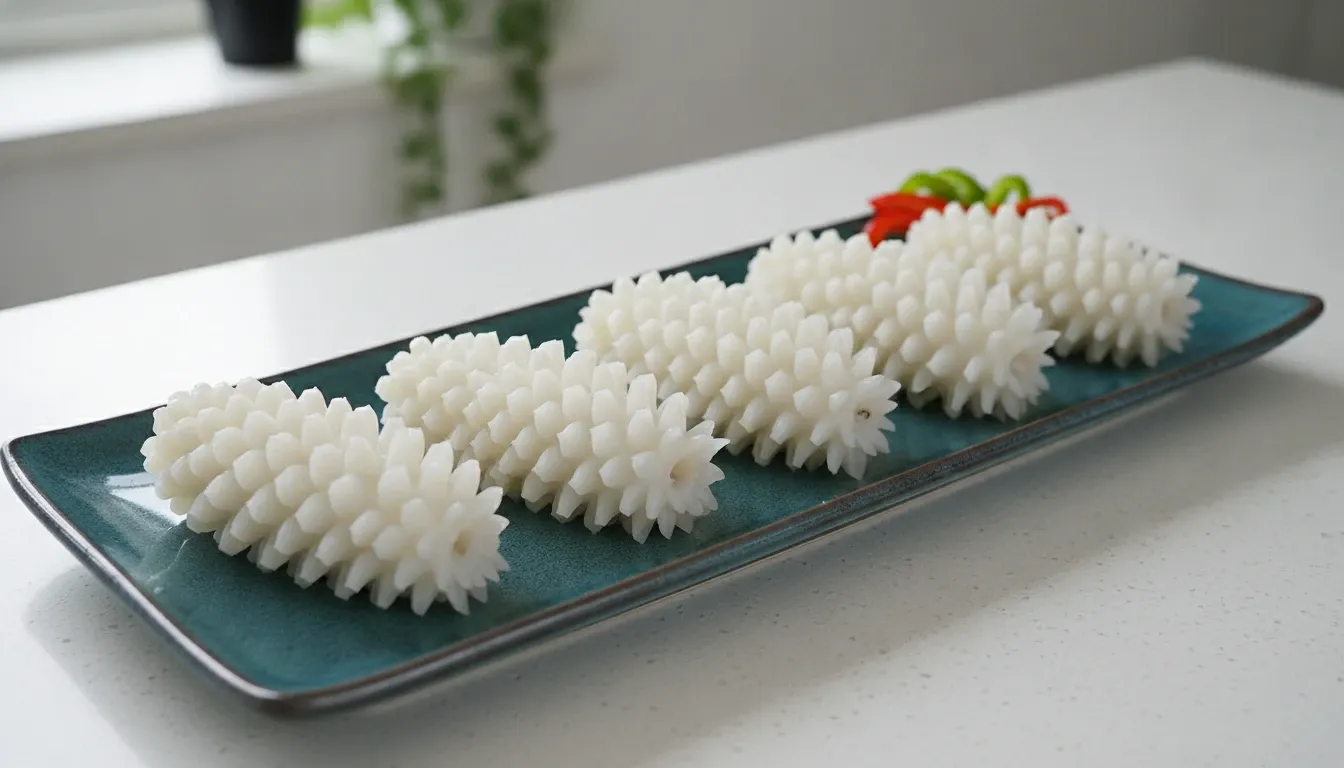
The photo shows squid scored with the wheat-ear pattern and boiled. The cuts open as it cooks, and pointed ridges stand up in one direction.
The pine-cone squid task at the national round
At the national round of the school competition, the first Chinese cuisine task is “pine-cone squid” (matsukasa-giri). You score a crosshatch into the surface of the squid, boil it, and plate it.
Whether this is the same cut as the wheat-ear pattern in the photo couldn’t be confirmed.
| Scoring on the national-round squid | Set dimension |
|---|---|
| Spacing of the crosshatch | 2 mm |
| Depth | At least 2/3 of the flesh’s thickness |
Sources: task 1 of the Chinese cuisine division at the national round, guidelines for the 42nd competition (August 2026).
The scored squid is cut into pieces 2.5–3 cm (1–1¼ in) square. The same task also asks for cucumber slices to lay under the squid: about 13 cm (5 in) long and about 2 mm (under ⅛ in) thick.
You are ready for the next stage when the squid crosshatch and the cucumber slices come out at these sizes.
To compare with decorative cuts from other cuisines, see Decorative Cutting Across Cuisines.
Stage 3 bones whole birds and makes pastes
At grade 3, knife work widens to four jobs. Rong (茸) and ni (泥) are both pastes.
| Required at grade 3 | What the job is |
|---|---|
| Zheng liao tuo gu (whole boning) | Take the bones out of a chicken, duck, or fish while it keeps its whole shape |
| Rong | Turn chicken, fish, or shrimp into a paste |
| Ni | Turn tofu or Chinese yam into a paste |
| Food carving | Carve ingredients into flowers, birds, fish, and insects |
Sources: grade 3 skill requirements in the national standard “Chinese-cuisine cook,” 2018 edition.
No public scoring standard with numbers turned up for this stage. As the qualification states, the guide is whether you can bone a bird or fish and keep its whole shape.
This site doesn’t yet have an article on the steps for whole boning or for rong.
Stages 4 and 5 teach and create
Grade 2 (technician) asks you to teach knife and prep skills to cooks at lower grades. Grade 1 (senior technician) asks you to teach grade 2 and below, design skills competitions, and create new dishes.
To sit a higher grade, you need years of work after earning the grade below.
| Grade to sit | Work experience required (main condition) | Practical exam time |
|---|---|---|
| Grade 5 (junior) | At least 1 year, or a completed apprenticeship | At least 90 minutes |
| Grade 4 (intermediate) | At least 4 years after grade 5 | At least 120 minutes |
| Grade 3 (senior) | At least 5 years after grade 4 | At least 150 minutes |
| Grade 2 (technician) | At least 4 years after grade 3 | At least 180 minutes |
| Grade 1 (senior technician) | At least 4 years after grade 2 | At least 180 minutes |
Sources: eligibility and exam times in the national standard “Chinese-cuisine cook,” 2018 edition. School graduates and some others have different conditions.
Find your stage with 7 tests
The tests run from easiest to hardest. Try them in order. The stage of the first test you can’t pass is your stage now.
If you pass them all, you are at stage 3. Stages 4 and 5 beyond it are about teaching.
| Test | Pass mark | If you miss it, you are at |
|---|---|---|
| Daikon ding | At least 20 even cubes of 1.5 cm | Stage 1 |
| Green pepper si | 6 cm long, 2 mm wide, none joined | Stage 1 |
| Negi cong hua | Even 2 mm cubes, no moisture drawn out | Stage 1 |
| Filleting a horse mackerel | No flesh left on the backbone | Stage 1 |
| Cucumber slices | About 13 cm long, about 2 mm thick | Stage 2 |
| Pine-cone squid | Crosshatch 2 mm apart, at least 2/3 deep | Stage 2 |
| Boning a whole chicken | Bones out, whole shape kept | Stage 3 |
Sources: whole-chicken boning from the grade 3 requirements of the national standard “Chinese-cuisine cook,” 2018 edition. The other tests and pass marks from the guidelines for the 42nd competition (August 2026). Matching tests to stages is this article’s own mapping.
Measure sizes with a ruler. To check the squid’s depth, cut one scored piece from the side and look at the cross-section.
How Japanese and Western tasks compare
The school competition sets vegetable tasks for Japanese, Western, and Chinese cuisine in the same slot. Japanese cuisine opens with katsuramuki: peeling daikon into a ribbon 1 mm (under 1/16 in) thick. Western cuisine opens with 6 potatoes turned into château shape.
Like the Western tasks, the three Chinese tasks ask for set shapes at set sizes. The time limit is 35 minutes, against 45 minutes for Japanese and Western cuisine.
Competition sizes differ from the usual standard
| Dimension | School competition (mm) | Standard in cut comparisons (mm) |
|---|---|---|
| Width of si | 2 | 1–4 |
| Side of ding | 15 | 8–10 |
Sources: competition from the guidelines for the 42nd competition (August 2026). Standards from Julienne vs. Sengiri vs. Chinese Si and from this site’s comparison of dice cuts.
The competition’s 2 mm si matches xi si (fine shreds), one of the four grades (1–4 mm, roughly 1/16–3/16 in) in the Sichuan cooking standard. The competition’s ding is larger than the standard.
Conditions the measurements assume
The numbers in these yardsticks were measured under the conditions below. Break them, and you lose points whatever your skill.
| Condition | What happens if you break it |
|---|---|
| Use a knife that has been properly maintained | At the national round, you lose points for knife condition |
| Don’t pound the cong hua with the knife after mincing | It breaks the competition rules |
| Slice the cucumber with a knife | Peelers aren’t allowed by the rules |
Sources: guidelines for the 42nd competition (August 2026).
Sources
- Zenkoku Chorishi Yosei Shisetsu Kyokai (Japan's national association of culinary schools). "Guidelines for the 42nd Culinary School Cooking Skills Competition (Gourmet Pic)." August 2026 (in Japanese). Tasks and scoring for the Chinese cuisine division at the regional and national rounds
- General Office of the Ministry of Human Resources and Social Security of the People's Republic of China. "Notice on publishing 26 national occupational skill standards, including Chinese-cuisine cook." December 2018 (in Chinese)
- National occupational skill standard "Chinese-cuisine cook (4-03-02-01)," 2018 edition (in Chinese). Skill requirements, eligibility, and exam times for each grade (full text reproduced)