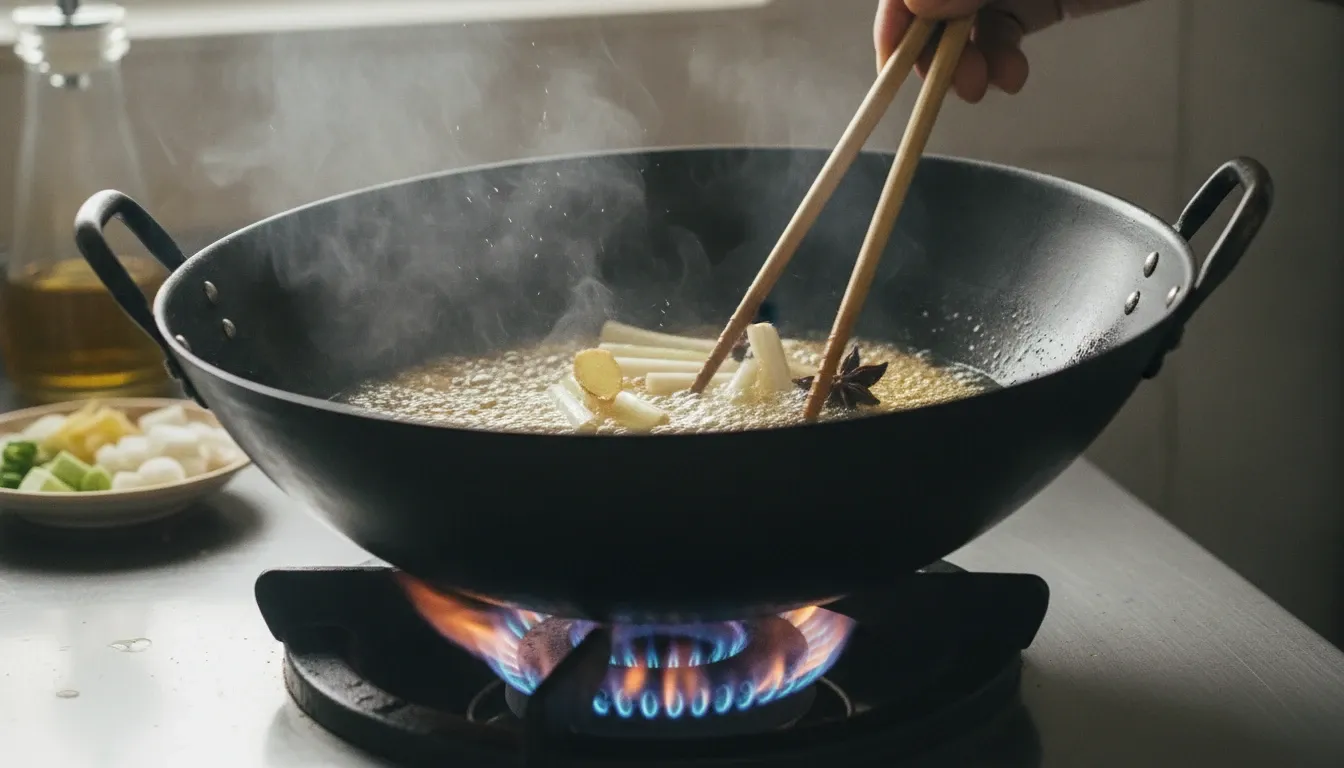
What this article answers
- The three methods and their temperatures
- Ao you at 100–150°C, qiang you at 150–180°C, po you at 180–220°C
- Scallion or garlic oil
- Ao you: start in cold oil over low heat and stop when the pieces turn golden brown
- Sichuan pepper oil
- Pour 140–150°C oil over the peppercorns and strain within 1–2 minutes. Above 160°C it turns bitter
- Why chili oil needs more than one temperature
- Color, heat and roasted aroma each come out best at a different temperature
- Storing homemade flavored oil
- Keep it in the refrigerator for up to 4 days, or freeze it
In Chinese cooking, flavored oil decides how many dishes finish. Chili oil, scallion oil, garlic oil and Sichuan pepper oil are all made the same way: the aroma of a spice or an aromatic is moved into oil.
Cooks everywhere infuse oil. What sets Chinese cooking apart is that it sorts the technique by temperature band and method, gives each one a name, and picks the one that suits the ingredient.
How Chinese cooks organize flavored oils
Infusing oil is common to every cuisine, but Chinese cooking handles it in three ways no other tradition does.
- A finished seasoning. Italian cooks flavor oil as part of cooking a dish. Chinese cooks make it ahead, store it, and use it like a condiment
- A system of names. By temperature band and method, it is sorted into ao you (熬油), qiang you and po you
- Many dedicated oils. Dozens of flavored oils exist, each for its own use
This system is a large part of why Chinese food covers such a wide range of flavors.
Three methods, three temperature bands
| Method | Temperature | How it works | Typical oils |
|---|---|---|---|
| Ao you (熬油) | 100–150°C (212–302°F) | Heat slowly over low to medium heat to draw out the aroma | Scallion oil, garlic oil |
| Qiang you (炝油) | 150–180°C (302–356°F) | Pour medium-hot oil over spices to wake up their aroma | Sichuan pepper oil, cilantro oil |
| Po you (泼油) | 180–220°C (356–428°F) | Pour very hot oil over dried spices all at once | Chili oil, including Sichuan la zi you |
All three normally start by turning the oil into shu you, oil heated hot to drive off grassy smells.
Some recipes, such as chili oil, reverse the order. The aromatics and spices flavor the oil at low heat first, and a later high-heat stage doubles as shu you.
A clip-on or instant-read thermometer makes these bands easy to hit, whatever your hob.
Ao you: slow infusion
This is the most basic method. The ingredients go into the oil, and the pan heats over low to medium heat so the aroma comes out gently.
- Put the oil and the aromatics in the pan
- Heat over low to medium heat, to 100–150°C (212–302°F)
- Turn off the heat when the pieces turn golden brown
- Let the residual heat draw out more aroma
- Strain once cool
Don’t let it burn. Once the pieces start to color, the oil is hot enough. The aroma keeps moving into the oil as it cools, so turn off the heat early.
Qiang you: waking up the aroma
Medium-hot oil is poured over the spices to draw out their aroma quickly. It sits between ao you and po you.
- Put the spices in a heatproof bowl
- Heat the oil to 150–180°C (302–356°F)
- Pour the oil over the spices
- Stir and let it cool
This suits ingredients whose aroma escapes easily, such as Sichuan pepper. Too hot, and its citrusy notes are lost.
Po you: one hot pour
Very hot oil goes over dried spices all at once. It is the most forceful of the three.
- Put the dried spices in a heatproof bowl
- Heat the oil to 180–220°C (356–428°F)
- Pour it in all at once. It should sizzle loudly
- Stir and let it cool
The heat adds roasted, toasty notes through the Maillard reaction. If the oil doesn’t sizzle, it is too cool.
The right temperature for each ingredient
Dried chilies
| Compound | Best temperature | Notes |
|---|---|---|
| Capsaicin (heat) | 150–180°C (302–356°F) | Stable in heat. Breaks down little even when hot |
| Carotenoids (red color) | 100–150°C (212–302°F) | Fade at high heat. Keep to medium heat for a bright red |
| Aroma compounds | 120–160°C (248–320°F) | Evaporate easily at high heat |
Sichuan pepper
Sichuan pepper (hua jiao) is the dried husk of a prickly ash berry. It smells of citrus and makes the lips tingle and go numb.
| Compound | Best temperature | Notes |
|---|---|---|
| Sanshools (the numbing tingle) | 130–160°C (266–320°F) | Fat-soluble, so they move into oil easily |
| Limonene and linalool (citrus aroma) | 100–140°C (212–284°F) | Evaporate easily. Lost at high heat |
Scallion, garlic and ginger
| Ingredient | Main compounds | Best temperature | Method |
|---|---|---|---|
| Scallion | Allyl sulfides (sweet aroma) | 120–140°C (248–284°F) | Ao you |
| Garlic | Allicin, which turns into ajoene (savory depth) | 100–130°C (212–266°F) | Ao you |
| Ginger | Gingerols, which turn into shogaols | 130–150°C (266–302°F) | Ao you |
How to make the classic flavored oils
Scallion oil
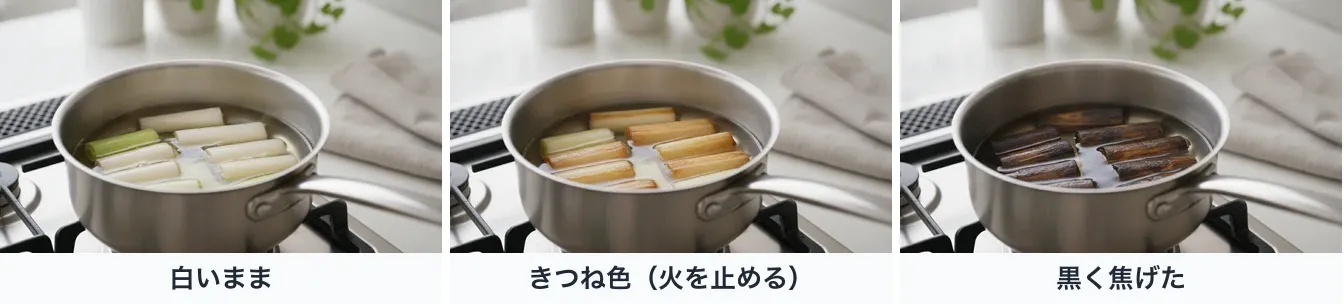
This is the most basic Chinese flavored oil. Steamed fish, dressed cold dishes and fried rice all depend on it.
Ingredients: 200 ml neutral vegetable oil, and 2 long onions cut into chunks. The long onion here is the thick Japanese negi or Chinese da cong. Leeks or the thickest scallions you can find stand in.
Method: ao you
- Put the oil and onion in the pan and heat over low heat
- Cook until the onion turns golden to deep golden brown, about 10–15 minutes
- Turn off the heat and leave it for 5 minutes
- Lift out the onion and strain the oil
Sichuan pepper oil
This is the tingling oil that mala dishes, the numbing-hot style of Sichuan, can’t do without.
Ingredients: 200 ml rapeseed oil, and 20 g whole Sichuan peppercorns
Method: qiang you
- Put the peppercorns in a heatproof bowl
- Heat the oil to 140–150°C (284–302°F)
- Pour the oil over the peppercorns and let them steep for 1–2 minutes
- Strain before the peppercorns darken
Garlic oil
A rich, savory oil for dumpling dipping sauces and stir-fries.
Ingredients: 200 ml neutral vegetable oil, and 6 cloves of garlic, thinly sliced
Method: ao you
- Put the oil and garlic slices in the pan and heat over low heat
- Cook until the garlic turns golden brown, about 8–10 minutes
- Turn off the heat and let the residual heat finish it
- Lift out the garlic and strain the oil. The garlic chips are good in other dishes
Garlic, scallions and fresh herbs in oil can carry the bacteria that cause botulism. US extension services advise keeping any homemade flavored oil, including the others here, in the refrigerator for up to 4 days, or freezing it for longer storage.
The flavored oils at a glance
| Flavored oil | Base oil | Main ingredients | Method | Main uses |
|---|---|---|---|---|
| Chili oil (la you, 辣油) | Rapeseed oil | Dried chilies, Sichuan pepper, spices | Po you plus ao you | Mapo tofu, dan dan noodles, dressed dishes |
| Scallion oil | Neutral vegetable oil | Long onion | Ao you | Steamed fish, dressed dishes, fried rice |
| Garlic oil | Neutral vegetable oil | Garlic | Ao you | Dumpling dipping sauces, stir-fries |
| Sichuan pepper oil | Rapeseed oil | Sichuan pepper | Qiang you | Mala dishes, cold dishes |
| Cilantro oil | Neutral vegetable oil | Cilantro | Low-temperature ao you | A finishing aroma |
What flavored oil does in a dish
In Chinese cooking, flavored oil does more than add flavor.
One of the four pillars of seasoning
Chinese cooks build a dish’s flavor from four elements: savoriness (umami), saltiness, sourness and aroma. Flavored oil carries the aroma. Stirred into a sauce, it adds complexity and depth to a flat taste.
The finishing oil, ming you
Chinese cooks often pour a little flavored oil over a dish as it finishes. This is ming you, the finishing oil.
- Gloss: the surface of the food shines, and the dish looks better
- Aroma: a last splash puts back the aroma lost to heat
- Warmth: a film of oil covers the surface, so the food stays hot longer
Common failures and fixes
A bitter taste cannot be fixed. The other four can be fully fixed.
| Problem | Cause | Fix it now | Prevent it next time |
|---|---|---|---|
| The aroma is weak | The oil was too cool, so the fat-soluble aroma compounds in the spices did not fully move into it | Add more spices and reheat to 100–150°C (212–302°F) to extract more | Hold 100–150°C (212–302°F), and check the ratio of spices to oil |
| The oil tastes bitter | The oil was too hot, the spices charred, and bitter breakdown products dissolved into the oil | The bitterness will not come out. Start again with fresh oil | Use a thermometer, and take the spices out as soon as they color |
| The color is pale | The red carotenoids in chilies are fat-soluble, and the oil never reached the temperature and time needed to extract them | Keep it at 100–150°C (212–302°F) for longer to draw out more color | Extract slowly at a medium 100–150°C (212–302°F) |
| The oil isn’t spicy enough | Capsaicin, the compound behind chili heat, is fat-soluble, and the oil never reached 150°C (302°F), so it did not move in | Add more chilies and extract again, holding 150°C (302°F) or above | Use enough chilies, and extract at 150°C (302°F) or above |
| The oil is cloudy | Fine particles of spice stay suspended in the oil and scatter light | Let it cool fully, then strain through a fine sieve or paper | Cool before straining, and leave no particles behind |
The three temperature bands to remember
The Chinese flavored-oil system takes a principle every cuisine shares, infusing aroma into oil, and sorts it precisely by temperature band and method.
Three methods
- Ao you, 100–150°C (212–302°F): slow and low, for scallion oil and garlic oil
- Qiang you, 150–180°C (302–356°F): medium heat to wake up aroma, for Sichuan pepper oil
- Po you, 180–220°C (356–428°F): hot and fast, for chili oil
Learn to choose among these three, and you can make any Chinese flavored oil.
Sources
- Dunlop, Fuchsia. (2003). Land of Plenty: A Treasury of Authentic Sichuan Cooking (US edition of Sichuan Cookery, 2001). On spices and oil in Sichuan cooking
- McGee, Harold. (2004). On Food and Cooking. On how aroma compounds dissolve into fats and oils
- Oregon State University Extension Service. Herbs and vegetables in oil (SP 50-701, revised January 2025). On botulism risk and storing homemade flavored oils