What this article answers
- How French cooks set the heat
- By the technique name, not high or low heat. The name points to the temperature in the pan
- What temperature poaching (frémir) means
- Liquid at 65–85°C. It trembles faintly; when bubbles start to rise, you are at the top
- What temperature a braise should be
- Liquid at 82–88°C. Even with the oven at 160°C, the liquid must not boil
- What temperature to sauté at
- Oil at 130–190°C. Add too much food at once and the oil cools, so nothing browns
- How hot egg and butter sauces can get
- Beurre blanc to 55°C, hollandaise to 65°C, crème anglaise to 84°C
A recipe says, “Poach for 20 minutes over heat that keeps the liquid at a frémir.” High or low heat you can set with the knob on the stove. But the recipe never says what temperature poaching or frémir means.
In French cooking, the temperature guide is tied to the name of the technique, not to high or low heat. Poaching keeps the liquid at 65–85°C (149–185°F). A braise keeps its liquid at 82–88°C (180–190°F). A sauté keeps the oil at 130–190°C (266–374°F). Know the technique name, and you know the temperature in the pan.
This article covers how French cooking names heat, and the temperature behind each name.
Technique names point to pan temperatures
French has phrases for high heat (feu vif), medium heat (feu moyen), and low heat (feu doux). None of them sets a temperature.
The temperature ranges belong to technique names such as pocher, braiser, and sauter.
Techniques fall into two groups by what does the cooking. Techniques that cook with water stay at or below 100°C (212°F). Techniques that cook with oil or air sit above 130°C (266°F).
Water-based techniques divide below 100°C
| Technique | Temperature in the pan (°C) | What the liquid looks like |
|---|---|---|
| Pocher (poach) | 65–85 | Trembles faintly. When bubbles start to rise, you are at the top |
| Braiser (braise), the liquid | 82–88 | Small bubbles rise slowly |
| Bouillir (boil) | 100 | Large bubbles break the surface constantly |
Sources: temperatures from the cooking-methods list used in Swiss cook training (2023) and America’s Test Kitchen; how the liquid looks from America’s Test Kitchen; not boiling from the Quebec French-language office’s terminology dictionary.
Poaching liquid never boils; it trembles faintly. That state is called frémir (“to tremble”). So “heat that keeps the liquid at a frémir” means the liquid is trembling just short of a boil.
The more delicate the food, such as fish or eggs, the closer to 65°C (149°F) you poach it. Chicken goes closer to 85°C (185°F).
Where to stop the center is separate from the liquid temperature. For fish, see fish heat control. To put safety first with chicken, poach until the center reaches 75°C for 1 minute (167°F), the standard of Japan’s health ministry.
Mijoter (to simmer gently) also cooks without boiling.
Oil and air techniques divide above 130°C
| Technique | Temperature in the pan (°C) | Temperature of what |
|---|---|---|
| Frire (deep-fry) | 130–175 | The frying oil (130–140 for a first fry) |
| Sauter (sauté) | 130–190 | The oil while cooking |
| Rôtir (roast) | 140–220 | The air in the oven |
Source: the cooking-methods list used in Swiss cook training (2023).
Water cannot go above 100°C, so to brown food, choose a technique that cooks with oil or air.
Techniques that differ from their names
Poêler can also mean cooking covered
In the Swiss cook-training standard, poêler means putting a large piece of meat or a chicken in a covered vessel and cooking it at 120–160°C (248–320°F) in its own steam.
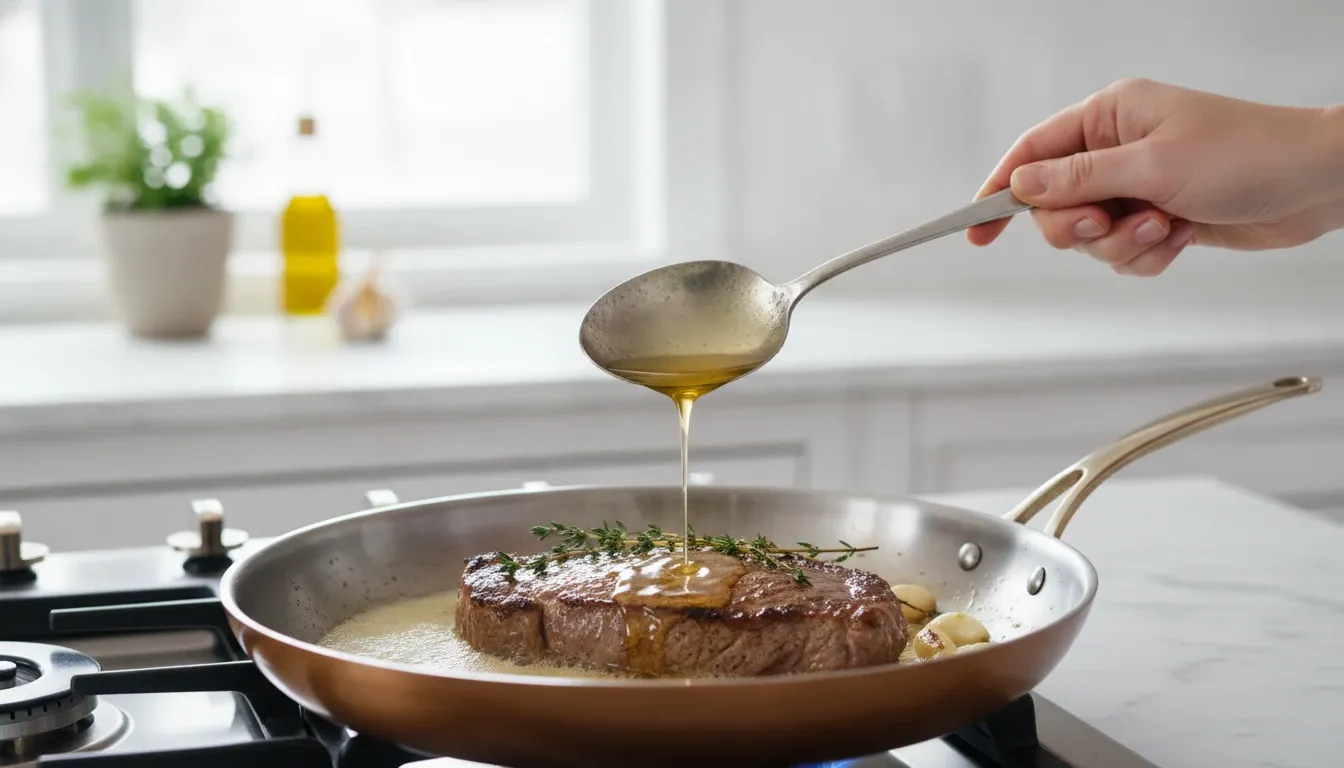
In everyday French, poêler simply means cooking food in a frying pan with fat. So many recipes use it for searing in a pan and basting with butter, which is a different technique from the covered one. To tell which one a recipe means, check whether it uses a lid.
Confit sits in the poaching range
Confit (confire) uses fat, but it is not a browning technique. The Swiss cook-training standard also classes it with poaching, by its temperature range. However much fat there is, you cook below 100°C, where nothing browns.
Sauce limits come from egg and butter
For every one of these sauces, you judge the heat not by the flame but by the temperature at which the egg or butter holding it together breaks down.
| Sauce | What it is | Temperature to hold (°C) | Above it |
|---|---|---|---|
| Beurre blanc | Cold butter melted into reduced wine and vinegar | 45–55 | The butterfat separates and floats |
| Monter au beurre | Butter stirred into a finished sauce to bind it | 45–55 | The butterfat separates and floats |
| Hollandaise | Melted butter beaten into egg yolk | 60–65 | The yolk sets and turns grainy |
| Crème anglaise | Made from egg yolk, milk, and sugar | 82–84 | The yolk sets into fine grains |
Sources: crème anglaise from Valrhona’s pastry glossary. The beurre blanc and hollandaise figures are values that cooking references agree on.
Hollandaise is made at 60–65°C (140–149°F), which does not fully cook the yolk. To put safety first, use pasteurized eggs or store-bought pasteurized liquid yolk. Japan’s standard for pasteurized liquid yolk heats the yolk at 60°C for 3.5 minutes.
When the table’s temperatures don’t apply
The table gives the temperature inside the pan. Flame size, the oven dial, and how much food you add do not tell you that temperature.
Flame size does not set the pan temperature
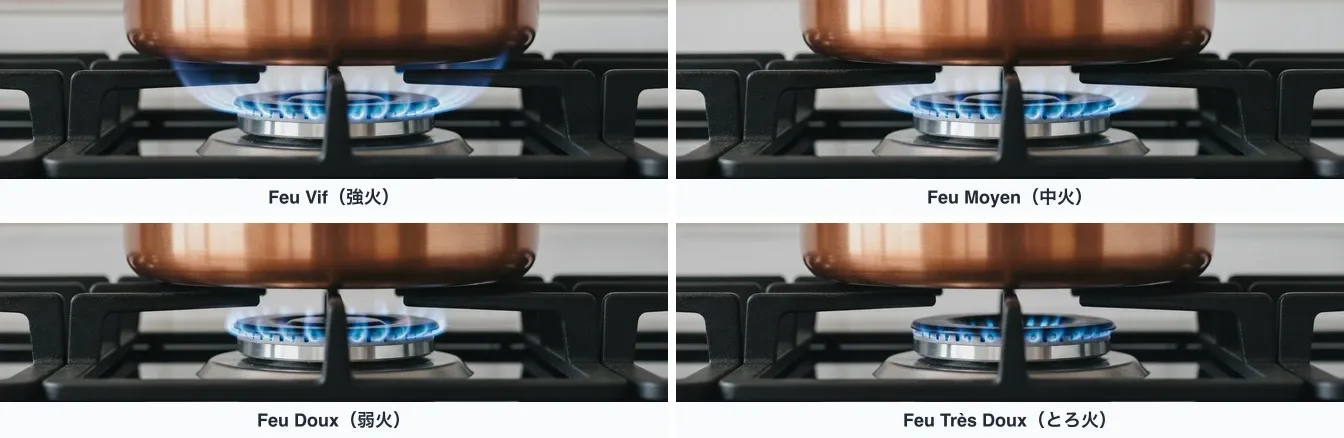
High, medium, low, and very low are names for how the flame looks. Even at the same medium heat, the temperature in the pan changes with the pan’s thickness and material, the burner’s power, and how much is in it. The same goes for the numbers on an electric or induction dial.
So treat the heat setting only as a rough guide, and adjust by the bubbles, the sound, and the state of the sauce in the pan.
Oven at 160°C, liquid still not boiling
For a braise, set the oven to 140–180°C (284–356°F). Even so, keep the liquid in the covered pot at 82–88°C. The oven number is the air temperature, not the liquid’s. If the liquid boils hard, the meat tightens and turns tough.
Adding food drops the sauté oil
The 130–190°C for a sauté is the oil temperature while cooking. Add a lot of food at once, and the oil drops below 130°C. The food then stews in its own released water and does not brown.
What to watch without a thermometer
| Technique | Temperature (°C) | Where to look | The sign |
|---|---|---|---|
| Pocher | 65–85 | The surface of the liquid | Trembles faintly. When bubbles start to rise, you are at the top |
| Braiser | 82–88 | The liquid, lid set slightly ajar | Small bubbles rise slowly |
| Bouillir | 100 | The water’s surface | Large bubbles break the surface constantly |
| Sauter | 130–190 | The oil in the pan | Food sizzles the moment it goes in |
| Anglaise | 82–84 | The back of the spatula | A line drawn with your finger does not close |
| Beurre blanc | 45–55 | The surface of the sauce | Almost no steam rises |
Sources: how the liquid looks from America’s Test Kitchen; the spatula line from Valrhona. The sound of the oil and the steam from beurre blanc are common kitchen signs.
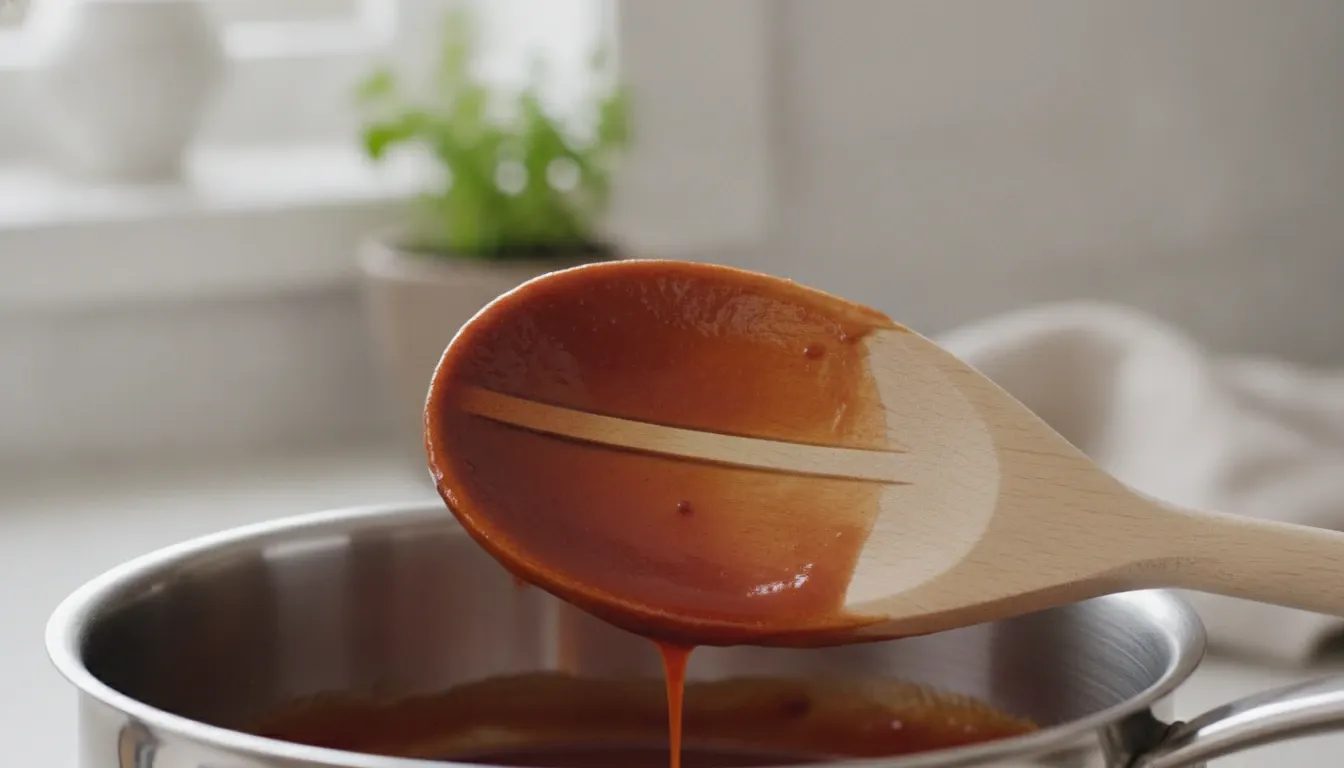
For anglaise and reduced sauces, you stop when a line drawn with your finger on the back of the spatula does not close. That state is called nappe (French for “a covering”). It is a different word from napper (to coat), used when you coat a cake with cream.
Common failures and fixes
Tough braised meat and a grainy anglaise can be partly saved. A split sauce, pale sautéed food, and burnt butter can be fully fixed.
| Problem | Cause | Fix it now | Prevent it next time |
|---|---|---|---|
| The sauce split | Beurre blanc or monter au beurre went above 45–55°C, so the butter emulsion failed and the fat separated | Take it off the heat. Put 15 ml (1 tbsp) of cold water in another pan and whisk the split sauce into it a little at a time | Turn off the heat before adding butter, add it cold and a little at a time, and stir at a temperature that gives off almost no steam |
| The anglaise is grainy | Crème anglaise went above 84°C and the yolk proteins set into fine grains | Pour it at once into a cold bowl to stop the cooking, then blend it so the grains are less noticeable | Take it off the heat when it reaches 82°C. Without a thermometer, stop when a line on the back of the spatula no longer closes |
| The braised meat is tough | The braising liquid kept boiling at 100°C, so the muscle proteins tightened and squeezed out water | Tightened meat will not soften again. Slice it thin, soak it in the liquid, and serve it with plenty of juices | Set the lid slightly ajar and check that the liquid only sends up small, slow bubbles. If it boils, turn the oven down |
| Nothing browns | Too much food went into the sauté at once, the oil fell below 130°C, and the food stewed in its own water | Take half the food out, reheat the pan, and cook again in small batches | Cook only as much as leaves the pan’s bottom visible. Check that the sizzle keeps going after the food goes in |
| The butter burned | Butter starts to smoke at 150–175°C, and its milk solids burn above 160°C. At the top of the sauté range, butter alone burns | Throw out the burnt butter, wipe the pan, and start again in fresh oil | For high-heat cooking, start in oil and add butter at the end. Clarified butter works up to about 250°C (482°F) |
How this differs from other heat guides
| Article | The question it answers |
|---|---|
| This article | What temperature each French technique name means |
| Chinese cooking heat control | How to use high heat for stir-fries and low heat for braises |
| How food changes with temperature | What happens to food at each temperature |
Read the technique name as a temperature
“Poach” or “sauté” in a recipe already tells you the temperature in the pan. Water-based techniques stay at or below 100°C and do not brown. If you need browning, choose an oil or air technique above 130°C.
The sauce limits are 55°C (131°F) for beurre blanc, 65°C (149°F) for hollandaise, and 84°C (183°F) for anglaise. Do not go by the flame or the oven dial. Watch the bubbles, the sound, and the line on the spatula, and match the pan to them.
Sources
- Hotel & Gastro formation Suisse. Liste des méthodes de cuisson (November 2023) (in French). The list of cooking methods used to assess trainee cooks in Switzerland: temperature ranges by technique, why confit is classed with poaching, and the definition of poêler
- America's Test Kitchen. Wet Cooking Methods. Water temperature and bubbles for poaching, braising liquid temperature, what a boil looks like
- Valrhona. Crème anglaise. Cook at 82–84°C, never above 84°C, and judge doneness by a line drawn on the back of a spatula
Show 7 more
- Larousse French-English dictionary. feu (à feu vif and à feu doux are expressions for high and low heat, with no set temperature)
- Michigan State University thesis. Adding sugar to custard raises the temperature at which egg proteins set
- Japan's Ministry of Health, Labour and Welfare. Q&A on heating conditions for meat. Conditions equivalent to 75°C at the center for 1 minute (in Japanese)
- Japan's Ministry of Health and Welfare. On ensuring hygiene in the manufacture of liquid egg (notice of 27 August 1993). Heating conditions for pasteurized liquid yolk (in Japanese)
- Office québécois de la langue française. Grand dictionnaire terminologique: pocher. Poaching means cooking in liquid that does not boil but trembles faintly (in French)
- US Food and Drug Administration. Assuring the safety of eggs and menu and deli items made from raw shell eggs. Substitute pasteurized eggs or egg products for raw shell eggs in hollandaise or béarnaise sauce
- Larousse French dictionary. poêler: to cook a food in a frying pan in fat (in French)