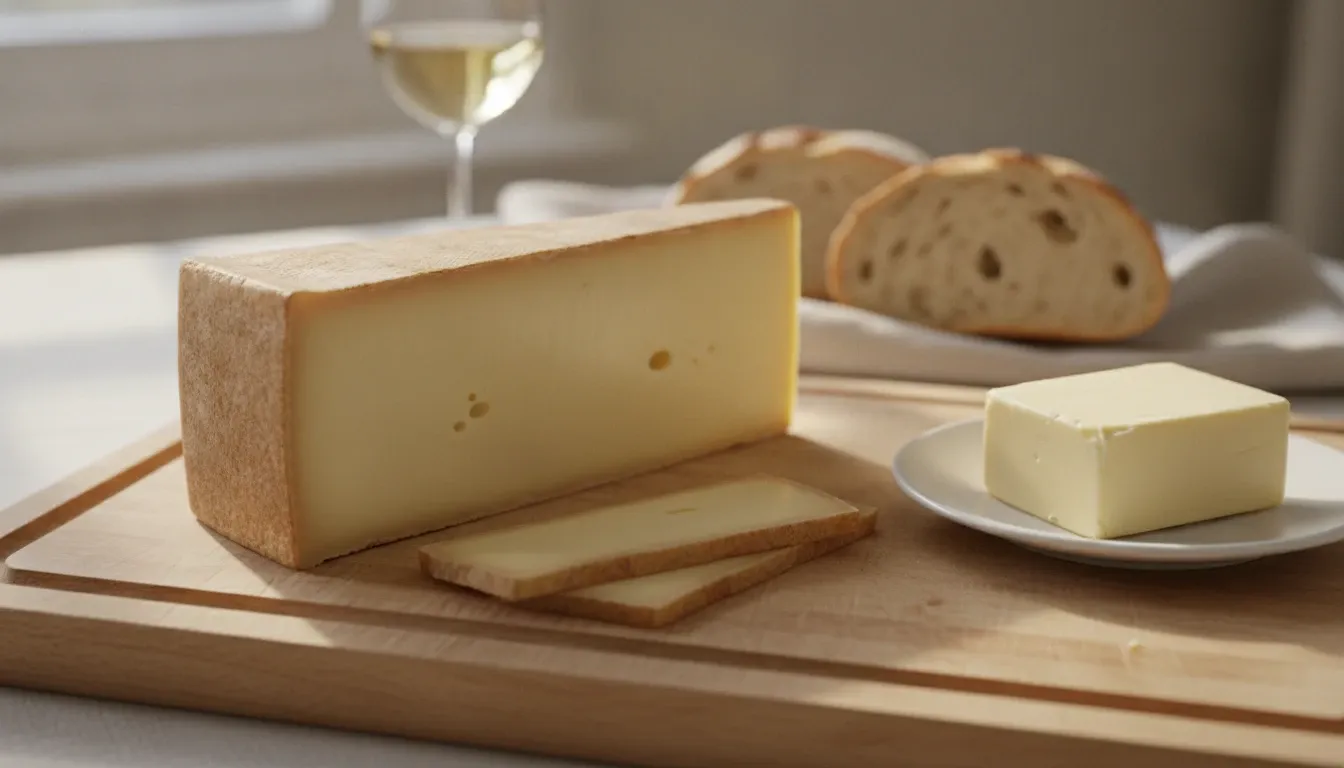
What this article answers
- What terroir means in French cooking
- Choosing an ingredient by both the land it came from and how it was made
- What an AOP name guarantees
- How it was made: feed, breed, days of aging. Not a ranking of taste
- Where to use AOP butter
- Spread on bread, or melted into a sauce at 45–55°C (113–131°F) to finish
- Where ordinary ingredients will do
- Browning, long sautéing, and strongly spiced stews
- How it differs from shun in Japanese cooking
- Shun chooses by when; a French place name chooses by where and how it was made
The ingredient list says “AOP butter” and “Comté.” Both cost more than the butter and cheese you already have. Can you swap them, and what changes if you do?
In French cooking, terroir means choosing an ingredient by both the land it grew on and how it was made. An AOP name guarantees a method: what the cows ate, how many days the animal was raised, how many days the cheese aged. It does not rank taste.
The aroma that method creates survives on the plate if you use the ingredient raw or to finish. Browning, long sautéing, and strongly spiced stews drive off or bury those aromas, and the difference from an ordinary ingredient fades.
This article covers what a place name guarantees, where a home cook should use named-origin ingredients and where to swap in ordinary ones, and how this differs from shun, the Japanese idea of peak season.
What to layer on top of an ingredient is covered in the role of sauces in French cooking.
Terroir ties flavor to land and method
Terroir comes from terre, the French word for land. It is easy to read it as soil and climate alone. In French official usage, it also covers how people make the product.
A place name covers land and know-how together
INAO, the French national institute that manages place names for food, defines terroir this way. It is shared know-how, built up over a long time by the people living within a defined area.
That know-how combines natural conditions such as soil, climate, and grass with human choices such as breed, feed, and aging. A place name points to the whole combination in one word.
Take Bresse chicken. It needs three things to carry the Bresse name: grassland on a damp, clay plain (the land), a white native breed raised there, and a finish on corn and milk (the people’s method).
French cooks start from good local produce
In 2010, UNESCO inscribed the gastronomic meal of the French as intangible cultural heritage. One of the steps it lists for putting a meal together is buying good products, local where possible, whose flavors go well together.
French cooking chooses the ingredient by its place name, then adds the sauce and garnish that suit it. If the sauce supplies what the ingredient lacks, the place name helps you choose the ingredient it goes on.
A place name guarantees method, not better taste
There are several kinds of place names, and they bind producers to different degrees. Every one of them protects a method and an origin. None of them judges which product tastes better.
AOP covers every step, IGP just one
| Kind of name | Steps done within the area | Example |
|---|---|---|
| AOP (protected designation of origin, an EU label) | Every step, from raw material to finished product | Bresse chicken, Isigny butter, Comté |
| AOC (controlled designation of origin, the French label) | Same standard as AOP, protecting the name within France | For wine, used to mean the same as AOP |
| IGP (protected geographical indication, an EU label) | At least 1 step | Guérande salt (registered in 2012) |
| Place names outside the system | No rules | Ordinary product names that carry a place name |
Sources: French Ministry of Agriculture and Food Sovereignty, Regulation (EU) No 238/2012.
France had 489 AOC/AOP products as of 2022. A place name alone tells you little. Under an IGP, only 1 step needs to happen in that place, and a name outside the system comes with no rules on method at all.
Specifications set feed, breed, and days in numbers
Each AOP has a specification, the cahier des charges, that sets the area and the method in numbers. A product that breaks it cannot be sold under the name.
| AOP product | Breed of cow or chicken | How it is raised | Step bound by time | Minimum days | What is not allowed |
|---|---|---|---|---|---|
| Bresse chicken (young bird) | Native breed with white feathers and blue legs | At least 10 m² of grassland per bird | Raising | 108 | Protein added from anything but grain |
| Isigny butter | At least 30% Normande cows | At least 7 months a year on pasture | Fermenting the cream | 0.5 | Colorings and flavorings |
| Comté | Montbéliarde or Simmental | At least 1.3 ha of grassland per cow | Aging | 120 | Pasteurized milk and fermented feed |
Sources: the specifications for each AOP (Bresse chicken, Isigny butter, Comté).
None of these specifications rules on taste itself. They rule on the conditions that produce the taste. So the question in your kitchen is whether the aroma and fat those conditions created survive in your dish.
Where the specification shows on the plate
Cultured butter keeps its aroma raw or as a finish
Isigny butter is churned from cream that has fermented at 9–15°C (48–59°F) for at least 12 hours. During fermentation, lactic acid bacteria make diacetyl and other aroma compounds. The specification describes the butter’s aroma as like fresh cream and hazelnut.
Diacetyl boils at about 88°C (190°F), so it escapes with the steam once butter is foaming in the pan. To keep the aroma, spread the butter on bread, or take the sauce off the heat and whisk the butter in at 45–55°C (113–131°F). If no oil beads float on top and the sauce is glossy, the temperature is right.
Choose Comté by serving temperature and age
Comté is made from unpasteurized cow’s milk and aged at least 120 days. The specification says the variety of grasses in the pasture adds to the cheese’s aroma compounds. It traces those aromas to the grass and the microbes in the milk, and a long aging brings them all out.
To eat it as is, serve it at 15–18°C (59–64°F). At refrigerator temperature the milk fat stays hard and the aroma stays flat. Take it out of the fridge when the meal starts. It is ready when the cut face looks moist.
Where cheese comes in a French meal, and how many to serve in what order, is in the order of a French meal.
For cooking, choose by age. The producers’ association says young Comté melts well in pasta and sandwiches. Long-aged Comté has a strong nutty, brown-butter aroma, so use it to add aroma to gratins and salads.
Roast or poach Bresse chicken whole
Bresse chicken is raised for at least 108 days and walks on grassland. For at least the last 10 days it is finished in a dark coop on grain and milk. The specification says this finish works fat into the muscle, and the aroma held in that fat spreads through the bird as it cooks.
To taste that fat and aroma, use the bird where chicken is the only flavor: roast it whole, or poach it with aromatic vegetables.
When roasting it whole, bring the center of the thigh to 70–75°C (158–167°F), until the juices near the bone run clear.
Shun chooses by when, AOP by how
The same ingredient can taste different. Japanese cooking puts that down to when it was caught or harvested. French cooking puts it down to where and how it was made.
| Cuisine | How it chooses an ingredient | Example | What the name points to |
|---|---|---|---|
| French | Where and how it was made | Bresse chicken raised 108+ days, Comté aged 120+ days | The place name and its specification |
| Japanese | When the same ingredient was caught | Katsuo (skipjack tuna) fat: 0.5 g in spring, 6.2 g in autumn (per 100 g) | Times of year: hashiri (first of the season), shun (peak), nagori (last) |
Sources: Japan’s Standard Tables of Food Composition for katsuo (spring catch, autumn catch), and the specification for each AOP.
Japanese cooking changes the dish as the same ingredient moves through its season. French cooking picks between ingredients made in different ways, by name.
Even when you choose by name, the season still shows. The Isigny butter specification describes its color as “ivory in winter, buttercup yellow in the grazing season.” The yellow comes from pigment in the grass, so butter under the same name turns yellow in the months the cows graze.
Where named ingredients are worth the price
Use named-origin ingredients where the aroma and fat their method created will reach the plate.
| When | What to do |
|---|---|
| Spreading on bread, or melting into a sauce to finish | Use AOP cultured butter |
| Brown butter, fat for sautéing, the first sauté for a stew | Use ordinary butter |
| Serving cheese on its own | Bring Comté to 15–18°C (59–64°F) before serving |
| Mixing into gratin or pasta to melt | Use young Comté |
| Cooking with long-aged Comté | Grate or shave it on just before it comes out of the oven, or on the plate |
| Roasting or poaching a whole chicken | Use Bresse chicken, or another native-breed bird raised longer |
| A strongly spiced stew | Use ordinary chicken |
Sources: the boiling point of diacetyl from PubChem, serving temperature and age for Comté from the producers’ association, and jidori from Japan’s agricultural standard for jidori (revised September 2025).
For a sense of what “raised longer” means, Japan’s standard for jidori (native-breed chicken) requires at least half native-breed blood, at least 75 days from hatching, and floor rearing without cages from 28 days old.
What decides it: for butter, whether the fermented aroma escapes at about 88°C (190°F). For Comté, the temperature at which its milk fat melts in the mouth, and the aroma of long aging. For chicken, whether another strong aroma covers the aroma held in the fat.
This is a judgment from the specifications and the properties of the aroma compounds. It does not come from cooking the same dish side by side.
Common failures and fixes
A dry breast and flat butter aroma can be partly saved. Hard, cold Comté can be fully fixed.
| Problem | Cause | Fix it now | Prevent it next time |
|---|---|---|---|
| The butter aroma is weak | While browning, the aroma from fermentation (diacetyl, boiling point about 88°C (190°F)) left with the steam, leaving only the smell of browned milk solids | Take the pan off the heat, wait 30 seconds, and melt in about 10 g more of the same butter, raw | Do browning and long sautéing with ordinary butter, and save AOP butter for the finish, off the heat |
| The Comté is hard and cold | It was cut and served straight from the fridge. The milk fat stayed solid and would not melt in the mouth, and the cold kept its aroma down | Leave the cut cheese on its plate at room temperature until the cut face looks moist and a faint sheen of fat appears | Take it out of the fridge when the meal starts and serve it at 15–18°C (59–64°F) |
| The breast meat is dry | While the thigh rose to 70–75°C (158–167°F), the breast passed 66°C (151°F). The muscle protein actin shrank and squeezed out water | Slice the breast thinly on the bias and pour warm pan juices over it | Cover the breast side with foil while roasting, and take the bird out to rest once the thigh reaches 70–75°C (158–167°F) |
Four things to check when choosing by name
Terroir names land and method together, so you can choose one ingredient over another. Check these four things.
- An AOP name guarantees a method and an origin, not a ranking of taste
- Specifications set feed, breed, and days in numbers. Bresse chicken is raised 108 days or more, Isigny butter’s cream ferments 12 hours or more, and Comté is made from unpasteurized milk and aged 120 days or more
- The difference survives raw, as a finish, and in cooking where the ingredient is the star. Browning, long sautéing, and strongly spiced stews hide it
- Shun in Japanese cooking chooses by when it was caught; a French place name chooses by where and how it was made
Save expensive ingredients for the places where their aroma reaches the plate: raw, as a finish, or cooked so the ingredient is the star.
Sources
- French Ministry of Agriculture and Food Sovereignty. AOC/AOP, IGP : tout savoir sur les signes de l'origine (definitions of AOP, AOC, and IGP; 489 French AOC/AOP products in 2022) (in French)
- INAO. Aires géographiques et délimitation des produits sous SIQO (the link to origin and the definition of terroir) (in French)
- UNESCO. Gastronomic meal of the French (inscribed in 2010 on the Representative List of the Intangible Cultural Heritage of Humanity)
Show 11 more
- AOP Volaille de Bresse, specification (approved by the order of November 6, 2019; the version approved by the EU in 2021) (in French)
- AOP Beurre d'Isigny, specification (approved by the order of September 12, 2017) (in French)
- AOP Comté, specification (approved by the order of December 18, 2025; JORF, January 7, 2026) (in French)
- Comté Cheese Association. Tips for Serving Comté (serve at 59–65°F; young vs. long-aged Comté)
- PubChem. Diacetyl (2,3-butanedione; boiling point 87.5–88°C)
- Massey University thesis (the aroma of cultured butter, and the diacetyl lactic acid bacteria make as the cream ferments)
- Regulation (EU) No 238/2012 (registration of Sel de Guérande / Fleur de sel de Guérande as an IGP)
- Japan's Ministry of Education, Culture, Sports, Science and Technology. Standard Tables of Food Composition in Japan (8th revised edition, 2023 supplement), katsuo, spring catch, raw (fat 0.5 g per 100 g) (in Japanese)
- Same, katsuo, autumn catch, raw (fat 6.2 g per 100 g) (in Japanese)
- Japan's Ministry of Agriculture, Forestry and Fisheries. Japanese Agricultural Standard for jidori chicken (revised September 2, 2025) (in Japanese)
- USDA Food Safety and Inspection Service. Safe Minimum Internal Temperature Chart (poultry: 165°F)