What this article answers
- The role of sauce in French cooking
- It adds the juices, fat, and acid that a grilled or poached main ingredient lacks
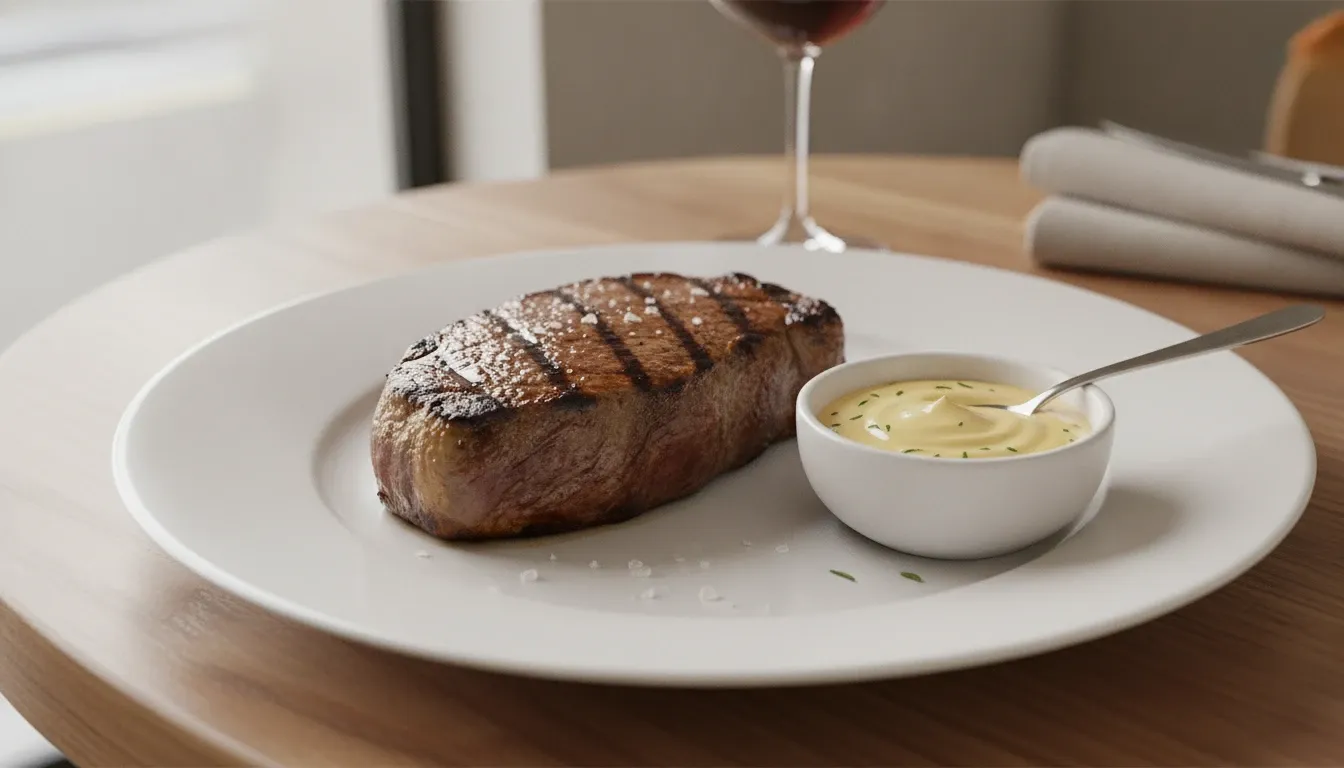
- A sauce for grilled beef
- Béarnaise, or bordelaise made from reduced red wine
- Sauces for pork, duck, and fish
- Robert for pork, orange sauce for duck, hollandaise for fish
- Which fond to use
- Game fond for game, fish fumet for fish. Brown fond for beef, pork, and duck
- How it differs from Japanese and Chinese cooking
- The sauce is made in its own pan and meets the main ingredient on the plate
A steak recipe says “serve with béarnaise.” The steak is ready to eat once it is grilled. Even so, a French recipe has you make a sauce in a second pan, apart from the steps for the meat.
A French sauce is a liquid that adds, on the plate, what a grilled or poached main ingredient lacks. On a grill, the meat’s juices drip away below the grate. Poached white fish has almost no fat. The sauce brings back those juices and that fat, plus an acid the main ingredient does not have.
You can leave the sauce off and still have a dish, but what was missing stays missing. With no time for a sauce, the smallest version is 10 g of butter and salt for grilled meat. If you seared it in a frying pan, dissolve the browned juices left in the pan instead.
This article covers why French cooking put the sauce at the finish of the plate, and which sauce to match with which main ingredient.
How to read derived sauce names such as Choron and Paloise, as a base sauce plus one change, is in why French cooking terms are so specific.
Sauce adds what grilled meat and fish lack
First, two terms. Fond is stock made by simmering meat and bones, the base of a sauce. Stock made from fish bones is called fumet. To “bind” a sauce is to hold fat and water together with egg yolk or butter so they do not separate (an emulsion).
Le Guide Culinaire, the cookbook by the chef Auguste Escoffier (1846–1935), ends each sauce recipe with what to serve it with. Here those notes are sorted by main ingredient.
| Main ingredient and method | Sauce | What the sauce adds | Texture |
|---|---|---|---|
| Grilled meat (beef and others) | Béarnaise | Butterfat, acid from tarragon vinegar | Opaque and thick, with sharp acid and herbs |
| Grilled red meat | Bordelaise | Acid and body from red wine, fat from beef marrow | Clear brown, flows freely |
| Grilled pork | Robert | Acid and bite from white wine and mustard | Brown, with bits of onion |
| Braised duck | Orange sauce | Acid from orange and lemon | Brown, with a strong citrus aroma |
| Poached fish, vegetables | Hollandaise | Butterfat, acid from lemon | Pale yellow and smooth |
| Sole | Normande | Umami from sole fumet, fat from cream and butter | White and smooth |
Source: the notes on each sauce in Le Guide Culinaire, 2nd edition. Duck is from the recipe for braised duck with orange. “What the sauce adds” and “Texture” are the writer’s reading of each recipe.
The original says what to serve each sauce with, but not why. Look at the recipes, and every pairing works the same way. The sauce carries what the main ingredient had little of to begin with, or lost in cooking.
Escoffier made sauce central, built on fond
The sauce chapter of Le Guide Culinaire opens by calling sauces the most important part of cooking. French cooking owes its standing in the world to its sauces, it goes on, and no amount of care in making them is too much.
The same paragraph says that sauces start from the juices taken from meat: fond. Brown sauces use brown fond. Velouté, a sauce of white fond thickened with roux, uses white fond.
The flavor comes from fond, not roux
Escoffier wrote that the flavor of espagnole, the mother sauce of brown fond thickened with roux, comes not from the espagnole itself but from the fond in it. Roux adds body and almost no flavor.
So to make a better sauce, look at the fond before the thickener. Veal fond simmers for anywhere from 8 hours to 2 days, depending on the source. Why the times differ is in fond.
One sauce on everything makes every plate taste alike
The same chapter looks back at the last 25 years of the 19th century, when espagnole was used so much that every dish blurred into one dull flavor. In reaction, the great kitchens went back to clear veal fond and kept espagnole for large braises and stews.
Choose the fond to match the main ingredient
Later in the general principles, Escoffier sets a rule: the meat and its sauce must agree. For a sauce made with fond, choose the fond that suits the main ingredient.
| Main ingredient | Fond to use | What the original says |
|---|---|---|
| Game (wild birds and animals) | Game fond | Do not use beef or veal fond. The flavor is weaker, but the animal’s own aroma stays |
| Fish | Fumet from the same fish | Always add fumet to a fish sauce |
| Light meats, chicken | The browned juices in the roasting pan | A sauce made from the pan juices suits them better than espagnole |
| Beef, pork, duck | Brown fond (espagnole, demi-glace) | Used in bordelaise, Robert, and orange sauce for duck |
Source: the general principles of the sauce chapter and the recipe for each sauce in Le Guide Culinaire, 2nd edition.
Game and fish take fond from the same source
Poivrade for game, a brown sauce sharp with vinegar and pepper, is simmered with game trimmings and brown game fond. The base of the sauce comes from the bones and meat of the same animal as the main ingredient.
Fish sauces, too, are made with fish fumet, so they carry no beef or veal aroma.
Light meats and chicken use the pan juices
Dissolving the browned juices stuck to the bottom of the pan with a liquid is called deglazing. For light meats and chicken, Escoffier wrote, a jus lié (pan juices thickened lightly) made from these browned juices works best.
The browned juices came from the main ingredient itself.
At home, pour off the fat from the pan you cooked the meat in. Add white wine or fond until it covers the bottom, and dissolve the browned bits. Reduce for 4–5 minutes, until a line drawn across the bottom with a wooden spoon stays open for a moment. Then stir in cold butter.
Choose what to add by what is missing
Once the fond is chosen, add what the main ingredient lacks. Here the original quantities are scaled down to home amounts.
Grilled beef: a butter sauce or reduced red wine
A grill leaves no browned juices in a pan. There is nothing to deglaze, so the sauce is made separately and served alongside.
For béarnaise, combine equal amounts of white wine and tarragon vinegar, add shallots, and reduce to a third (until the liquid barely covers the bottom of the pan).
The original binds this with 6 egg yolks and 500 g of butter. For 2 yolks at home, use 70 ml each of white wine and vinegar and 170 g of butter.
For bordelaise, reduce 300 ml of red wine to 75 ml (until the bottom of the pan shows when you tilt it). Add espagnole and 50 g of beef marrow. The original says it is “for grilled red meat.”
Both go with grilled beef. Choose béarnaise to bring acid and herbs forward, and bordelaise to layer on the body of wine.
Fatty pork and duck: acid from mustard or citrus
Robert sauce goes with grilled pork. Cook onions in butter without browning them, reduce white wine, and add demi-glace. Simmer for 10 minutes, until the sauce thinly coats the back of a spoon. Off the heat, add 15 ml (1 tbsp) of mustard and a pinch of sugar for every 500 ml of finished sauce.
Braised duck is cooked in espagnole and brown fond. Skim the fat from the braising liquid and reduce it. To the reduced sauce, add the juice of 2 oranges and half a lemon per duck, which also thins it.
In both, the acid of mustard or citrus cuts the weight of the pork or duck fat.
Mild fish: a sauce of egg yolk and butter
Poached white fish has little fat, and its flavor is mild. In the original, hollandaise is 5 egg yolks and 500 g of butter with a few drops of lemon juice. At home, the ratio is 1 yolk to 100 g of butter. The original says it is “for fish and vegetables.”
Normande, for sole, is fish velouté with sole fumet and mushroom cooking liquid, bound with egg yolks and cream, and finished by melting in butter. It layers the richness of butterfat over the umami of the fish.
The last addition is what breaks a sauce
What you added to suit the main ingredient breaks down with the temperature at the finish. For Robert and the duck’s orange sauce, the original warns: once it goes in, do not let it boil.
| Sauce | Added last | What to watch | What you see |
|---|---|---|---|
| Robert, orange sauce for duck | Mustard, citrus juice | Do not let it boil after adding | Take it off the heat when small bubbles appear at the edge |
| Béarnaise, hollandaise | Butter | 60–65°C (140–149°F) while beating in the butter. Then keep it warm over a water bath | The whisk leaves trails in the sauce |
| Pan sauce (finishing butter) | Cold butter | Melt it in at 45–55°C (113–131°F). Above 60°C (140°F) it separates | No beads of fat float on top, and it turns glossy |
Sources: “do not boil” from the notes in Le Guide Culinaire, 2nd edition. The visual cues are the writer’s. Temperatures are from this site’s article on emulsified sauce temperatures.
Boil mustard or citrus, and the aroma goes, leaving only sourness. Overheat egg yolk and butter, and the yolk sets, the fat separates, and the texture you added falls apart.
Yolk sauces at 60–65°C are not pasteurized
Béarnaise and hollandaise stop at 60–65°C (140–149°F), so the yolks never get hot enough to be fully pasteurized. For the best sauce, stop at this temperature.
To put safety first, use pasteurized eggs or store-bought pasteurized liquid yolk. Japan’s standard for pasteurized liquid yolk heats the yolk at 60°C for 3.5 minutes (140°F). Do not make it ahead, and finish it at the same meal. More is in heat control in French cooking.
A separate pan, unlike Japanese or Chinese
Each cuisine puts flavor into the food at a different point.
| Cuisine | Where flavor goes in | How it relates to the main ingredient |
|---|---|---|
| French | A sauce made in a separate pan, combined on the plate | A sauce built on a matching fond adds what the main ingredient lacks |
| Japanese | All at once during simmering, in ji, a seasoning liquid with fixed ratios | The food is cooked through the liquid, not covered with fat or sauce |
| Chinese | Seasonings tossed with the food in the wok, finished with a swirl of oil | Food and seasoning become one in the same wok |
Sources: this site’s articles on Japanese seasoning liquids (ji) and on subtraction in Japanese cooking, and ming you, the finishing oil.
French cooking keeps the steps for grilling or poaching the main ingredient apart from the steps for the sauce. Because they are separate, the same grilled beef can take béarnaise or bordelaise.
The catch is that a beef-fond sauce on fish layers the smell of beef over the smell of fish on the plate.
How French cooking differs from Japanese and Chinese on names, origins, finishing fats, and wine, measured the same way, is in French cooking compared.
Conditions that make it work
Making several fonds at home is hard, so match the fond to the main ingredient with what you have. If you make only one, make chicken fond. How much and how long it keeps are in French cooking prep.
| When | What to do | Why |
|---|---|---|
| You seared meat or fish in a frying pan | Pour off the fat, add white wine or fond to dissolve the browned juices, and stir in butter | The pan juices become a fond from the same ingredient |
| All you have is store-bought veal stock | Use it for beef, pork, and duck, not for game, fish, or chicken | The veal smell layers over the smell of the other ingredients |
| The beef is heavily marbled, or it is duck | Choose a sauce with wine or citrus acid over a butter sauce | Fat on fat makes the plate heavy |
Common failures and fixes
A split sauce and a greasy sauce can be fully fixed. A sauce that is too sour, lacks umami, or smells fishy can only be partly saved.
| Problem | Cause | Fix it now | Prevent it next time |
|---|---|---|---|
| The sauce split | Béarnaise or hollandaise went above 70°C (158°F). The yolk proteins set into grains, and the butterfat the yolk was holding separated and floated | Take it off the heat, and whisk in cold water a few drops at a time to bring it back | Keep it at 60–65°C (140–149°F) while beating in the butter, then keep it warm over a water bath |
| Too sour | The sauce boiled after mustard went into the Robert, or citrus juice into the duck sauce. The aroma went, and only sourness was left | Thin it with more of the base (fond or demi-glace) from before the acid went in, to soften the sourness | Add mustard and citrus last, off the heat, and do not boil afterward |
| Greasy | The liquid was reduced without skimming the duck or pork fat melted into it, so the fat stayed in the sauce | Pour the sauce into a bowl, skim the fat off the top, and add a little citrus juice or vinegar | Skim the fat before reducing, and match fatty ingredients with an acidic sauce |
| No umami | A fish sauce made with only water and wine got no umami from fish bones, and tasted only of butter and cream | Simmer fish heads or bones in white wine and water for 20–30 minutes, strain, and reduce the sauce again with that liquid | Make fish sauces with fumet from the same fish or another white fish |
| Smells fishy | Brown veal fond or demi-glace went on fish. The smell of beef layered over the smell of fish and brought it forward | Switch sauces. Deglaze the pan the fish was cooked in with white wine, and stir in butter | Make fish sauces from fish fumet or the pan juices left from cooking the fish |
Four points for matching a sauce
Because the sauce is made in its own pan, you can choose again for each main ingredient. Look at these four when you choose.
- The flavor of a sauce made with fond comes from the fond, not the thickener
- Match the fond to the main ingredient: game for game, fish fumet for fish, brown fond for beef, pork, and duck. At home, use the juices in the pan you cooked in
- Béarnaise or bordelaise for grilled beef, acid for fatty pork and duck, and a sauce of egg yolk and butter for mild fish
- Do not boil after adding mustard or citrus, and keep yolk-and-butter sauces warm over a water bath
Not pouring the same sauce over everything is part of matching sauces, too.
Sources
- Escoffier, A. Le Guide Culinaire, aide-mémoire de cuisine pratique (first edition 1903; quoted from the 2nd edition, Émile Colin). The general principles of the sauce chapter (Principes généraux) and the notes on each sauce (in French)
- Escoffier, A. A Guide to Modern Cookery. Heinemann, 1907 (English translation; the notes on what bordelaise, Robert, and other sauces are served with)
- Japan's Ministry of Health and Welfare. On ensuring hygiene in the manufacture of liquid egg (notice of 27 August 1993). Heating conditions for pasteurized liquid yolk (in Japanese)
Show 2 more
- US Food and Drug Administration. Assuring the safety of eggs and menu and deli items made from raw shell eggs. Substitute pasteurized eggs or egg products for raw shell eggs in hollandaise or béarnaise sauce
- Kotobank. "French cuisine" (Nipponica and Heibonsha World Encyclopedia). Sauce as the center of a dish's flavor, bringing out the ingredient's own taste (in Japanese)