What this article answers
- The order of courses in a French meal
- Aperitif, starter, main, cheese, dessert, then coffee and a digestif
- Why courses come one plate at a time
- Dishes set out together go cold. In the 19th century, plating in the kitchen took over
- At home, the last dish goes cold while you cook the next
- Serve only the main hot, make the starter and dessert ahead, and take the cheese out 1½ hours before
- How to match wine to the courses
- Light white to heavy red in course order, sweet with dessert. Match the sauce and cooking, not meat or fish
- How many bottles for 4 people
- One bottle is about 2 glasses each. Serving white and red? Open a half bottle of each
You have invited four people over. You have made a cold starter, a hot soup, a pan-seared fillet of white fish, a beef sauté, a cheese course, and a tart. You serve the soup and go back to the kitchen. While the fish cooks, the soup bowls are still on the table. By the time you start the beef, the fish has gone cold.
You opened one bottle of white and one of red, and before you noticed, both were empty.
A French meal starts with an aperitif, a drink before the meal. Then come the starter, main course, cheese, and dessert, and it ends with a digestif, a drink after the meal. Courses come one plate at a time so that hot food is eaten hot.
At home, keep the order but cut the number of courses. Serve only one dish hot, the main. Then you are not tied to the stove each time a course goes out.
This article covers the order of a French meal, how food and wine are matched, and how far to scale it down at home. It also compares the French meal with Japanese and Chinese ways of building one.
How much wine goes into the cooking, and how far to reduce it, is in cooking with wine in French cuisine. The bases to make ahead are in preparing bases in French cooking.
French courses run from aperitif to digestif
Here is the order of a French meal, with what each course holds, how warm it is served, and what to drink with it.
| Order | Course | What it holds | How warm the plate is | What to drink |
|---|---|---|---|---|
| 1 | Aperitif | A drink before the meal, with bite-sized nibbles | Cold | Sparkling wine, dry white |
| 2 | Starter (entrée) | Terrine, salad, soup | Cold or warm | Dry white |
| 3 | Main course (plat) | Fish or meat, or both, with vegetables | Hot | White or red |
| 4 | Cheese (fromage) | 3 or 5 cheeses, with a green salad and bread | Room temperature | Dry white |
| 5 | Dessert | Tart, mousse, fruit | Cold or room temperature | Sweet wine |
| 6 | Coffee and digestif | Coffee, and brandy or another after-dinner drink | Hot, room temperature | Digestif |
Sources: the order from UNESCO’s “gastronomic meal of the French”; cheese from CNIEL, the French national dairy board; drinks from Le Cordon Bleu Paris and Gault&Millau (see references).
Bread stays on the table throughout and goes with the cheese too. How to choose wine for the main and the cheese is in the wine section below.
Celebration meals have at least four courses
In 2010, the gastronomic meal of the French (le repas gastronomique des Français) was inscribed on UNESCO’s list of intangible cultural heritage.
It is the celebration meal that brings people together at milestones such as births, weddings, and anniversaries.
The inscription describes the meal as a set order. It starts with an aperitif and ends with liqueurs, and at least four courses come in between: a starter, fish or meat (or both) with vegetables, cheese, and dessert.
Pairing food with wine, and choosing good, preferably local products whose flavors go together, are part of the same inscription.
Weekday dinners shrink to two to four courses
Everyday dinners are shorter than celebration meals. A 2019 survey asked about the most recent weekday dinner. Main and dessert, two courses, made up 31%, and three to four courses made up 48%. For 59%, dinner took under 30 minutes.
French adults spent 2 hours 22 minutes a day eating in 2010. That was 13 minutes more than in 1986.
Sources: number of courses and dinner length from a 2019 survey by CRÉDOC, a French research center on living conditions; time spent eating from the 2010 time-use survey by Insee, France’s national statistics institute.
One plate at a time keeps food hot
Today’s course structure took shape in the 19th century. Until then, dishes were set out on the table together, and that had a flaw: hot dishes went cold.
Dishes once went on the table in three waves
In 1856 the chefs Dubois and Bernard published the cookbook La Cuisine classique. Its preface compares two ways of serving, French and Russian.
A formal French-style dinner set out dishes in three waves. The first ran from the potages up to, but not including, the roast (rôti). The second ran from the roast to the sweet dishes (entremets). The third was the whole dessert: ices, fruit, cheese, and the rest.
The first wave went on the table before the guests sat down. Dishes were placed in facing pairs, left and right, so their number was always even.
Dubois and Bernard name just one flaw in this style. Among the dishes set out, the hot ones eaten later had been cooked long before. So they could not stay hot enough.
They describe remedies, such as keeping dishes covered on warmers and saucing each portion as it is served. Even so, they admit that the cooling cannot be fully avoided.
Plating in the kitchen took over
Russian-style service never puts hot dishes on the table. They are carved, plated, and carried to the dining room in order, then passed among the guests. Large joints are passed on heated platters.
Dubois and Bernard wrote that Russian service pleases the eye less. But food is eaten as soon as it is cut and served, so it is at its hottest and best.
In 1856 the two styles existed side by side. By the 1864 edition, the subtitle said the book was “applied to Russian service.”
This one-plate-at-a-time service is the origin of the modern course.
Cheese used to be part of dessert
In the French style that Dubois and Bernard describe, cheese came in the third wave with fruit and sweets. In today’s meal, cheese is its own course, between the main and the dessert.
Pour wine from light to heavy
This section is about wine poured into glasses at the table. Wine as a cooking liquid is in cooking with wine in French cuisine.
| Course | Wine | Serving temperature |
|---|---|---|
| Aperitif | Sparkling wine, light dry white | 9–12°C (48–54°F) |
| Starter, seafood | Dry white | 9–12°C (48–54°F) |
| Chicken, cream sauces | Full-bodied white | 9–12°C (48–54°F) |
| Red meat braised in sauce | Light, fruity red (Gamay, Pinot Noir) | 12–14°C (54–57°F) |
| Grilled red meat | Full-bodied red | 15–17°C (59–63°F) |
| Cheese (bloomy rind, soft) | Dry white | 9–12°C (48–54°F) |
| Cheese (blue), dessert | Sweet wine | 8–12°C (46–54°F) |
Sources: pairings from Le Cordon Bleu Paris, temperatures from iDealwine, order from Gault&Millau. As a guide, serve young reds at 15°C (59°F), long-aged reds at 17°C (63°F), and sweet wines at 8°C (46°F). Keep every wine below 18°C (64°F).
Wine warms by about 2°C (4°F) once poured. Start whites and aperitif wines at the low end of the range.
White to red, dry to sweet, cold to room temperature
The usual order is sparkling wine, dry white, full-bodied white, light red, heavy red, with sweet wine saved for dessert. Young wines come before old ones, and chilled wines before those served at room temperature.
This order is a guide, not a rule. Sources also list a light red with terrine and a white with cheese. Going back to a dry white for the cheese after a red with the main is the usual exception.
If in doubt, up to the main course, choose a wine heavier than the one before.
Match the sauce and cooking, not the dish name
Even with the same red meat, grilled meat takes a full-bodied red and meat braised in sauce takes a light, fruity red. Fatty dishes want wine with clear acidity. Cream dishes want a rounder, full-bodied wine with gentle acidity.
A French main course is meat or fish, seared or roasted, and finished with a sauce. The sauce sits at the center of the plate’s flavor, so match the wine to the sauce.
Say you pour a bordelaise over grilled beef, made from 300 ml of red wine reduced to 75 ml. Then pour a full-bodied red. If the same beef is braised in red wine, switch to a light red.
Iron, not red wine, makes seafood fishy
Red wine with seafood can leave a fishy aftertaste in your mouth.
One study paired 38 reds and 26 whites with dried scallops. The fishiness tracked the iron in the wine, not its color. The more iron, the stronger the fishiness. Adding a substance that binds the iron weakened it.
Iron speeds up the oxidation of fats in the seafood, and that forms the compounds that smell fishy.
The researchers suggest that low-iron reds may suit seafood. But a label does not tell you the iron content. At home, pour a dry white or a sparkling wine with raw or seared seafood, and you will not go wrong.
One bottle for 4 is about 2 glasses each
France’s public health guideline counts one glass of wine as 10 g of pure alcohol (100 ml of wine at 12% alcohol). It advises no more than 2 glasses a day and 10 a week, and no alcohol during pregnancy.
A 750 ml bottle at 12% holds about 7.5 glasses. One bottle for 4 people comes to about 1.9 glasses each, within that guideline (our own calculation).
To serve both white and red, open a half bottle (375 ml) of each. Together they make one bottle.
At home, keep the order, serve one hot
When you serve a French meal at home, cut the number of courses to fit the occasion, but keep the remaining ones in order.
Set the number of courses by occasion
| Occasion | Courses | Served hot | Wine for 4 |
|---|---|---|---|
| Weekday dinner | Main, then cheese or dessert | The main | If drinking, one glass each (half a bottle) |
| Weekend or family meal | Starter, main, cheese, dessert | The main | 1 bottle |
| Guests for dinner | Aperitif, starter, main, cheese, dessert, coffee | The main | 2 half bottles (white and red) |
Sources: courses based on UNESCO’s four courses and CRÉDOC’s weekday dinners; wine based on France’s public guideline (2 glasses a day). This guide is our own.
To cut courses, drop the starter, or one of cheese and dessert. Never drop the main. The 31% of weekday dinners that are a main and a dessert follow this pattern.
With guests, pour white with the aperitif, starter, and cheese, and red with the main. If the cheese includes a blue, either swap it for bloomy-rind and goat cheeses, or pour a little sweet wine for that one piece.
Open sparkling or sweet wine as well, and each person drinks more than 2 glasses.
Make starter and dessert ahead, finish only the main
When one person cooks and more than one dish is hot, the problem from the opening happens. The last dish goes cold while you cook the next. Serve only the main hot, and make the rest dishes that can wait.
| Course | What to make ahead | When to make it | Just before serving |
|---|---|---|---|
| Starter | Cold terrine, salad, soup | Before guests arrive | Reheat the soup until it bubbles at the edges of the pot |
| Main (braise) | A braise such as beef in red wine | The day before. Cool it, then refrigerate | Reheat over low heat until it boils all through, and plate on warm plates |
| Main (sauté) | Not made ahead | Start cooking after the starter plates are cleared | Reduce a pan sauce in the same pan for 4–5 minutes; pour it over once it thickens |
| Dessert | Tart, mousse | The morning of the meal | Take it out of the refrigerator and slice |
Sources: why braises and fond are made ahead, and the 1–2 day refrigeration guide, follow preparing bases in French cooking. The pan-sauce time follows this site’s article on the role of sauces in French cooking.
Plate the main in the kitchen, as in Russian service, and carry it out. If you bring it to the table on a platter and serve from there, the last portions go cold.
Warm the plates by filling them with hot water. Dry them while they are still warm to the touch, and use them.
Take cheese out 1½ hours ahead
Take the cheese out of the refrigerator 1 hour 30 minutes before serving. At refrigerator temperature the milk fat stays firm and the aroma does not come through.
Comté is at its best once it has warmed back to 15–18°C (59–64°F). Serve it when the cut faces start to look moist.
Three or five cheeses, mild to strong
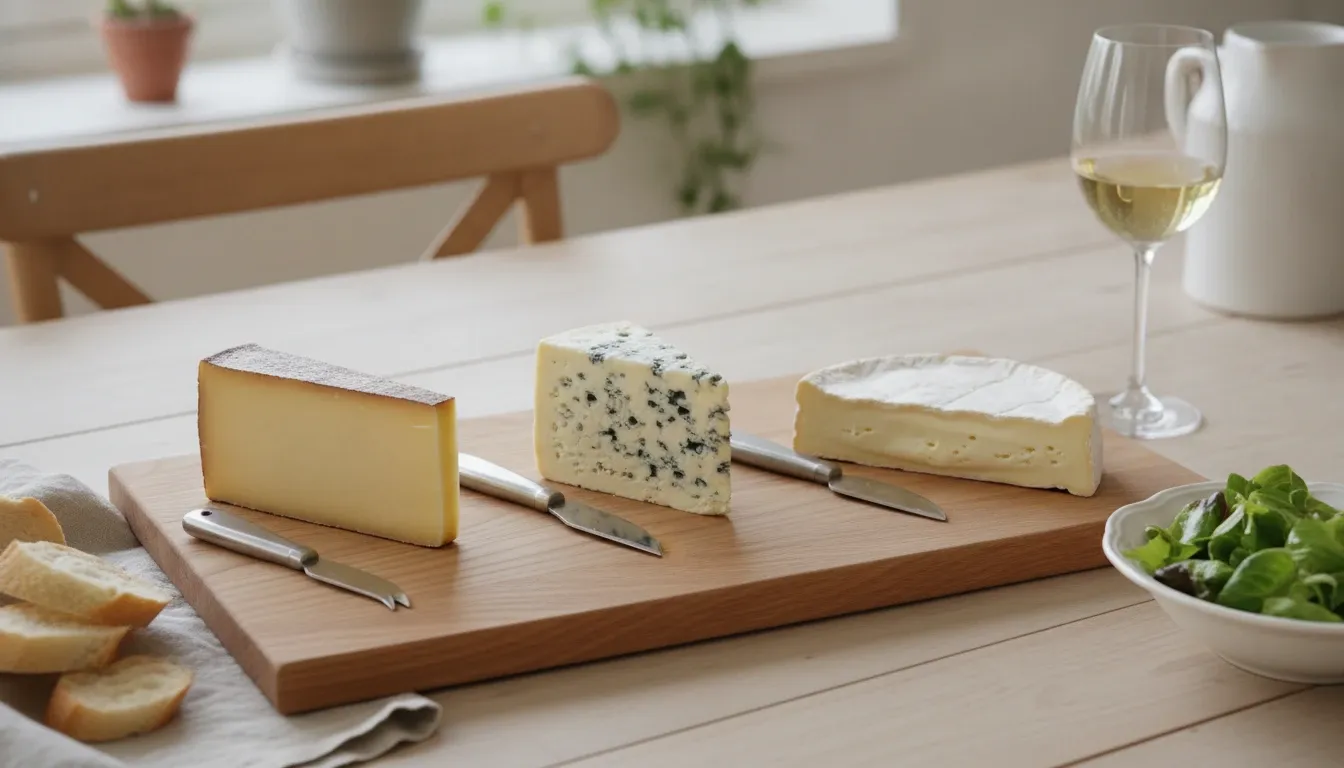
An everyday board has 3 cheeses: a cooked pressed cheese (Comté type), a blue (Roquefort type), and a bloomy rind (Brie type). Serve them with a green salad and whole-wheat bread.
For a celebration, add a goat cheese and a soft cheese with a supple rind (Pont-l’Évêque type), for 5 in all. Eat them from mild to strong, and use a separate knife for each cheese so flavors do not carry over.
Sources: the timing, number, and order follow CNIEL’s guidance (2022).
Japanese and Chinese meals keep food hot differently
Each cuisine faces the same problem, eating hot food while it is hot, and each answers it in its own way.
| Cuisine | How dishes are served | Place of the staple | How food stays hot | Place of alcohol |
|---|---|---|---|---|
| French | One plate at a time | Bread on the side | Plated in the kitchen and carried out one by one | A different wine for each course |
| Japanese | Rice, soup, and three dishes, all at once | Rice at the center | Hot items kept to three | In a multi-course banquet (kaiseki), rice ends the drinking |
| Chinese (home) | Large plates in the middle, shared | Plain rice at the center | Stir-fries cooked last | Tea is common during the meal |
| Chinese (banquet) | Hot dishes one plate at a time | Staples near the end | Hot dishes carried out straight from the wok | Cold dishes are the first snacks with drinks |
Sources: this site’s article on the Japanese meal; for China, how to plan a Chinese meal and Chinese cuisine compared.
Japanese cooks build everyday meals around ichiju sansai, “one soup, three dishes”: rice, soup, and three dishes set out at once. They limit the hot items and pair them with side dishes that taste good cold. French cooking instead stopped setting dishes out together, and kept food hot by carrying plates from the kitchen one at a time.
Serving only the main hot when you cook a French meal at home follows the same idea. Japanese cooks keep the hot items in ichiju sansai to three for the same reason.
Conditions that make it work
| When | What to do | Why |
|---|---|---|
| One person is cooking | Serve only the main hot, and make the starter and dessert cold dishes | With two or more hot dishes, the last one cools while you cook the next |
| The main is a sauté | Start cooking after the starter plates are cleared, and go straight on to the pan sauce | Cooked ahead and left, both the meat and the butter in the sauce cool |
| The starter is seafood and you only have red | Serve water and bread with that course, and start the red with the main | Iron in the wine strengthens the fishiness of seafood |
| Cheese and dessert are both too much | Serve one of them. With cheese, add a green salad | 31% of weekday dinners are just a main and a dessert |
| Some guests don’t drink | Open no more than 2 glasses per drinker, and set water for everyone | France’s guideline is no more than 2 glasses a day |
Common failures and fixes
Congealed fat and cheese with little aroma can be fully fixed. A sauce that set on cold meat and a fishy aftertaste can only be partly saved.
| Problem | Cause | Fix it now | Prevent it next time |
|---|---|---|---|
| The meat and sauce went cold and stiff | The beef sauté was cooked before the starter went out and left to sit while guests ate. The meat cooled and the butter in the pan sauce set | Move the meat to a warm plate. Reheat the sauce over low heat to 45–55°C (113–131°F), whisk in a little more butter, and plate at once | Start the sauté and pan sauce after the starter plates are cleared. Plate on warm plates as soon as it is done |
| White fat set in the sauce | The braise went on cold plates. Where the sauce touched the plate, its fat cooled and turned white and solid | Return the braise to the pot, reheat to just below a boil, skim off the fat, and replate on warm plates | During the aperitif, warm the main-course plates in hot water or the oven. Plate in the kitchen and carry them out |
| The cheese has little aroma | The cheese went out straight from the refrigerator. The milk fat was still firm, so the aroma did not come through | Leave the cut cheese on its board at room temperature until the cut faces look moist, then serve it again | Take the cheese out of the refrigerator 1½ hours before serving |
| A fishy aftertaste | Red wine was poured with pan-seared scallops and left a fishy aftertaste. Iron in the wine sped up the oxidation of the seafood’s fat | Reset your palate with bread and water for that course, and hold the wine until the next one | With raw or seared seafood, pour a dry white or a sparkling wine |
Four things to remember for a French meal
The order of a French meal grew out of plating in the kitchen and carrying out one plate at a time, so that hot food is eaten hot.
- The order is aperitif, starter, main, cheese, dessert, then coffee and a digestif. Celebration meals put at least 4 courses in between
- Pour wine in course order, from sparkling and dry white to heavy red, with sweet wine for dessert. Match the sauce and cooking, not meat or fish
- At home, keep the order but cut courses, and serve only the main hot. Make the starter and dessert ahead
- Take the cheese out 1½ hours before serving. Serve 3 or 5, from mild to strong
For the six dishes at the start, turn the soup into a cold starter and make either the fish or the beef the main. Then only one dish goes out hot, and the wine fits in two half bottles.
Sources
- UNESCO Intangible Cultural Heritage. Gastronomic meal of the French (inscribed 2010). Starts with an aperitif and ends with liqueurs, with at least four courses in between: starter, fish or meat with vegetables, cheese, dessert; pairing food and wine
- Urbain Dubois and Émile Bernard. La Cuisine classique (first edition 1856; quoted from the 1864 edition's preface, "Le service à la française et le service à la russe comparés") (in French)
- Thibaut de Saint Pol and Layla Ricroch. Le temps de l'alimentation en France. Insee Première no. 1417, October 2012 (2 hours 22 minutes a day eating, 53 minutes cooking) (in French)
Show 8 more
- CRÉDOC. Les dîners des Français : représentations & opinions, commissioned by Quitoque, December 2019 (most recent weekday dinner: main and dessert 31%, 3–4 courses 48%, under 30 minutes 59%) (in French)
- CNIEL (French national dairy board). Fromage et partage : un duo gagnant !, February 2, 2022 (take cheese out 1 hour 30 minutes ahead, mild to strong, odd numbers, 3 everyday and 5 for celebrations) (in French)
- Le Cordon Bleu Paris. Comment accorder des mets au vin ? (pairing for fatty dishes, cream dishes, grilled and sauced red meat, cheese, and sweet wines) (in French)
- Justine Knapp. L'ordre de dégustation des vins importe-t-il ? Gault&Millau, May 26, 2025 (sparkling, white, light red, heavy red, sweet with dessert) (in French)
- iDealwine. Quelle est la température de service idéale pour les vins ? March 2024 (white 9–12°C, light red 12–14°C, young red about 15°C, sweet about 8°C, about 2°C warmer in the glass) (in French)
- Tamura T. et al. Iron is an essential cause of fishy aftertaste formation in wine and seafood pairing. Journal of Agricultural and Food Chemistry 57(18):8550-8556, 2009
- Alcool Info Service (Santé publique France). Les repères de consommation (1 glass = 10 g of pure alcohol; no more than 2 glasses a day and 10 a week) (in French)
- Wikipedia. Entrée (in France, a small dish before the main course; in the United States and parts of English-speaking Canada, the main course)