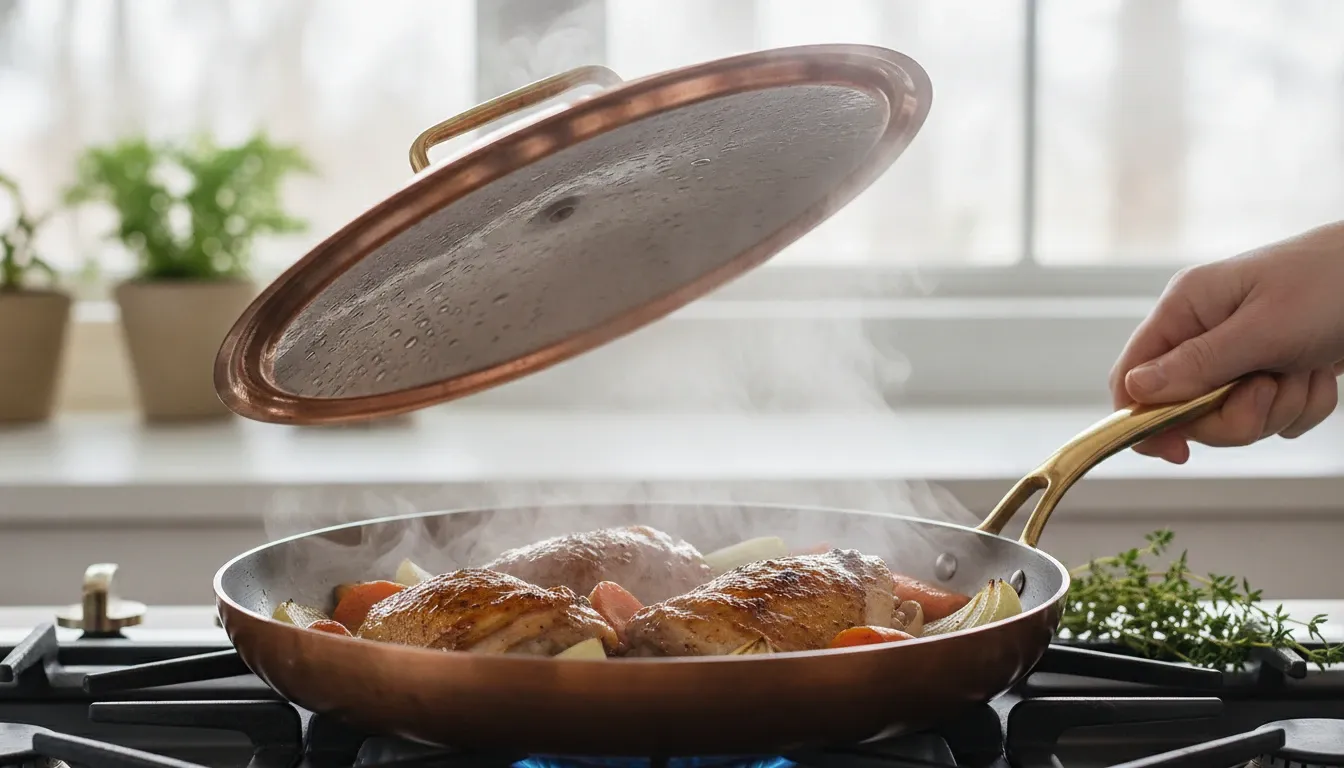
What this article answers
- What braiser à la poêle is
- Brown the food in a frying pan, add a little liquid, cover, and cook it gently
- How it differs from poêler
- A braise always adds liquid and a lid and aims for tenderness. Poêler only browns, for a crisp surface
- How much liquid to add
- About 1/3 of the food's height. Steam under the lid cooks the rest
- What heat to braise at
- Low to medium-low under the lid, so the liquid bubbles gently and never boils hard
Braiser à la poêle is the French technique of browning food in a frying pan, then covering it and cooking it in a little liquid. It gets you both the toasty flavor of browning and the tenderness of a braise. It is a practical everyday method.
This article covers what a braise is, how it differs from poêler, and how to braise in a frying pan.
Brown first, then cook covered in little liquid
Where the word comes from
Braiser is French for “to braise.” It comes from braise, glowing charcoal. Originally it meant cooking slowly over the gentle heat of embers.
The four parts of a braise
- Brown the food (saisir)
- Add a little liquid
- Cover and heat
- Cook slowly at a low temperature
Oven braise and pan braise
A classic braise is a long cook in the oven. Braiser à la poêle is the quicker version, done in a frying pan.
| Oven braise | Pan braise | |
|---|---|---|
| Equipment | Cast-iron pot and oven | Frying pan and lid |
| Time | 2–4 hours | 20–40 minutes |
| Food | Large cuts of meat | Smaller pieces of meat, vegetables |
| Liquid | 1/3–1/2 of the food’s height | About 1/3 of the food’s height (the oven version’s low end; the lid circulates steam, so less is enough) |
How braiser differs from poêler
A braise is easy to confuse with poêler, but the two are clearly different. Here poêler means its everyday sense: cooking in a frying pan with fat. The older sense, cooking covered, is explained in French cooking heat control.
What each one is
| Braiser | Poêler | |
|---|---|---|
| Liquid | Always added | None, or very little |
| Lid | Always used | Often not used |
| Aim | Cook it tender | Crisp the surface |
| Heat | Low to medium | Medium to high |
| Time | Longer | Shorter |
How each one is cooked
- Braiser: brown, add liquid, cover, braise
- Poêler: brown, baste with butter (arroser), finish
What each one gives you
- Braiser: tender and moist all through
- Poêler: crisp outside, juicy inside
Why braise in a frying pan
It is quick
An oven braise takes 2–4 hours. A pan braise is done in 20–40 minutes, which makes it workable on a weeknight.
It needs little equipment
All you need is a frying pan and a lid. You get the flavor of a real braise without an oven or a special pot.
It is hard to get wrong
With liquid in the pan and a lid on, food is less likely to burn or dry out. Even beginners usually succeed.
Steam under the lid turns sinew to gelatin
What the steam does
With the lid on, water from the food and the added liquid turn to steam and circulate inside the pan.
The steam does three things.
- Even heating: steam heats the food from above too
- Less drying: water has a hard time escaping
- Collagen breakdown: collagen slowly turns to gelatin at a low temperature
Collagen turns to gelatin
Collagen, the connective tissue in meat, slowly turns to gelatin above 55°C (131°F), and the meat softens. The hotter it is, the faster this goes. To finish in a pot within a few hours, cook it at 70°C (158°F) or above for a long time.
| Temperature | Time | What happens |
|---|---|---|
| 55–65°C (131–149°F) | 1–2 days | Gelatin forms slowly (sous vide territory) |
| 70–85°C (158–185°F) | 30 minutes or more | Gelatin forms steadily |
| 90°C (194°F) and above | A short time | The meat loses water easily |
In a pan braise, the lid holds a gentle 70–80°C (158–176°F) or so, and the collagen breaks down efficiently.
What the liquid does
| Role | What it does |
|---|---|
| Source of steam | It evaporates and makes steam |
| Heat carrier | It passes heat evenly to the food |
| Flavor | Wine or stock adds its flavor |
| Base for the sauce | It reduces into the sauce |
How to braise in a frying pan
What you need
Equipment
- A frying pan with a lid
- Tongs
- A wooden spatula
Ingredients (example: chicken thighs)
- Chicken thighs: 2
- Salt: 1% of the meat’s weight (5 g for 2 thighs, about 500 g)
- Pepper: a little (about 0.5 g)
- Olive oil: 15 ml (1 tbsp)
- White wine: 100 ml
- Stock (bouillon): 100 ml
- Thyme: 2 sprigs; rosemary: 1 sprig
Steps
1. Prepare the chicken
- Let the chicken come to room temperature (15–30 minutes)
- Pat it dry with paper towels
- Season with salt and pepper
2. Brown the surface (saisir)
- Heat the frying pan over medium-high heat
- Add the olive oil
- Put the chicken in skin side down
- Cook for 3–4 minutes without moving it
- Once the skin is browned, turn it over
- Cook the other side for 1–2 minutes
The center doesn’t need to be cooked yet. The aim here is a golden-brown surface (dorer).
3. Add the liquid
- Lower the heat to medium-low
- Pour in the white wine
- Scrape the bottom of the pan with the wooden spatula (deglaze)
- Add the stock
- Add the herbs
The liquid should come to about 1/3 of the food’s height.
4. Cover and braise
- Put the lid on
- Keep the heat at low to medium-low
- Braise for 20–30 minutes
- Check 1–2 times along the way, and add liquid if it runs low
What to look for: a gentle bubbling, never a hard boil. Judge by the pan, not the dial: the same setting runs hotter or cooler on different stoves and pans.
5. Finish
- Take off the lid and lift out the chicken
- Turn up the heat and reduce the liquid
- Season with salt and pepper
- Spoon the sauce over the chicken
Heat at each stage
| Stage | Heat | Why |
|---|---|---|
| Browning | Medium-high | Maillard reaction |
| Just after adding liquid | Medium | Bring it to a boil to cook off the alcohol’s sharpness |
| Braising | Low to medium-low | Cook slowly |
| Finishing | Medium-high | Reduce the sauce |
Classic pan-braised dishes
Braised chicken thighs
The most basic pan braise. White wine and herbs give it a fragrant finish.
Variations:
- Add tomatoes for a cacciatore style
- Add mustard for a Dijon style
- Add mushrooms for a forestière style
Braised pork
Use pork shoulder or pork belly. It goes well with apples or prunes.
Braised vegetables
Braise cabbage, napa cabbage, or fennel. They make a good side for meat.
Vegetables fall apart easily, so move them as little as possible.
Braised fish
Braise white fish in white wine and stock. It is done in a short time, 10–15 minutes.
Pairing braising with a sauté
A braise is often paired with a sauté.
The usual sequence:
- Sauté or sear (saisir): brown the surface
- Braise: add liquid and cook covered
- Finish: make the sauce
Together they give you the toasty flavor of browning and the tenderness of a braise.
Common failures and fixes
Dry meat and a burnt bottom can be only partly saved. Missing browning, a watery result, and a rattling lid can be fully fixed.
| Problem | Cause | Fix it now | Prevent it next time |
|---|---|---|---|
| The meat is dry | The liquid got too hot, and the muscle fibers contracted and pushed out the water they held | Let it cool in the liquid so the fibers take water back | Keep the heat at low to medium-low and don’t let the liquid boil |
| It didn’t brown | The browning before braising was too short, so the surface never got hot enough for the Maillard reaction | Lift it out, sear the surface on high heat, and return it to the liquid | Brown it well on high heat before braising |
| It is watery | Too much liquid, so cooking ended before it reduced and the flavor stayed thin | Lift out the meat and reduce the liquid alone to concentrate it | Keep the liquid to 1/3–1/2 of the food’s height |
| The bottom burned | Too little liquid, so it boiled dry and sugars and proteins charred on the bottom of the pan | Move the food without touching the burnt part, and carry on with fresh liquid | Check the liquid partway through and top it up if it has dropped |
| The lid lifts | The heat was too high, and steam pressure inside rose past the weight of the lid | Turn it down to low to make less steam | Turn the heat to low once the lid is on, so the liquid circulates quietly |
The points to remember
Braiser à la poêle is a practical way to braise in just a frying pan.
- What it is: brown, add liquid, cover, and cook gently
- How it differs from poêler: liquid and a lid (poêler only browns)
- Why use it: quick, simple equipment, hard to get wrong
- Heat: braise slowly at low to medium-low
- Liquid: about 1/3 of the food’s height
Practice on bone-in chicken thighs
To practice, use bone-in chicken thighs.
- Brown the skin well
- Add white wine and stock
- Cover and braise for 20–30 minutes
- Reduce the liquid into a sauce
The skin crisps and the inside stays moist and juicy. Try it on a weeknight.