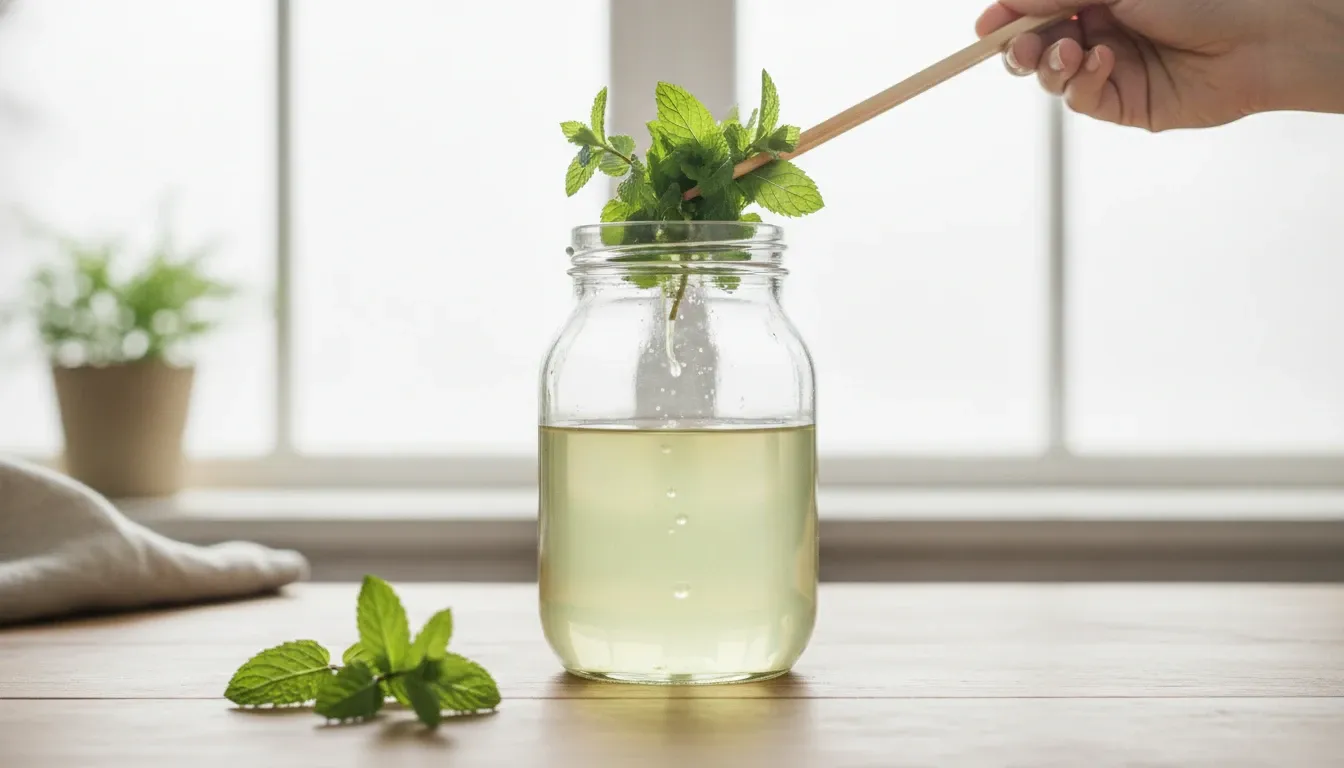
What this article answers
- How long to steep herbs in alcohol
- Mint-type herbs give enough flavor in about 3 days. Flowers and herbs are done in 1 month
- Why herbs are so much faster than fruit
- Herb aroma is fat-soluble and sits near the leaf surface. Fruit acids and sugar sit deep inside the flesh
- Why the liqueur turned bitter
- The herbs stayed in after the aroma was out. Start tasting on day 3 and remove them when the aroma peaks
- How to make it stronger
- Not by steeping longer. After 2–3 weeks, take the herbs out and add fresh ones
Steep herbs in a spirit, and you get a liqueur. It is the same “steep and wait” job as umeshu (梅酒), the Japanese liqueur made by steeping sour ume plums in spirit with sugar.
But the waiting time is in a different league.
Herbs take days, fruit takes months
| Steeping time | |
|---|---|
| Mint-type herbs | About 3 days already gives plenty of flavor and aroma |
| Flowers and herbs | Done in 1 month |
| Ume plums (fruit liqueur) | Drinkable at 3 months, and mellow after 6 months to 1 year of aging |
Both are “steep it in alcohol and wait,” yet the times differ by about two orders of magnitude. Most guides list the times and stop there. They never explain why.
There is one reason. You are extracting different things.
Why herbs are fast
| What you want | Where it is | Soluble in | Time needed | |
|---|---|---|---|---|
| Herbs | Aroma compounds | Near the leaf surface | Fat | Short |
| Fruit | Acids, sugar, pigments | Deep inside the flesh | Water | Long |
Herb aroma compounds (terpenes, aldehydes, phenols, and others) are fat-soluble. They are also stored near the surface of the leaf. They start dissolving the moment the alcohol touches them, so nothing has to pull them out from inside.
Fruit is different. Its acids and sugar sit inside the flesh. Osmotic pressure has to draw them out along with the fruit’s water.
That is why fruit liqueurs use rock sugar, which dissolves slowly and raises the osmotic pressure gently. Fruit takes longer because it needs that extra step.
The higher the proof, the more the liquid behaves like a fat-side solvent. So a high-proof spirit, such as vodka, gives herbs a faster and stronger aroma.
Herbs go downhill if left in
This is the decisive difference from fruit liqueur. Herbs have a peak.
Keep steeping after the aroma is out, and bitterness appears. This is not just a herb problem. Citrus such as lemon behaves the same way.
So the real dividing line is not “herb or fruit.” It is whether the surface carries a source of bitterness.
| What comes from the surface | Has a peak? | |
|---|---|---|
| Herbs | Once the aroma is out, bitterness follows | Yes |
| Citrus peel | The same (the peel holds bitter compounds) | Yes |
| Flesh of ume and similar fruit | Comes out of the flesh slowly | No |
So once the time is up, take the ingredients out and move the liquid to another jar. Label the jar with the date you started, and you can keep track.
To make it stronger, change the herbs
This runs against intuition. When you want a stronger liqueur, do not steep longer.
After 2–3 weeks, take out the old herbs and add fresh ones. This layers on aroma without bringing out bitterness.
The days are only a guide. In the end, you decide by tasting. The next section explains why.
Room temperature changes the speed
When the room is warm, aroma and flavor come out faster. When it is cold, they come out more slowly.
So “3 days” assumes ordinary room temperature. A warm room and a cold room will not give you the same number of days.
This follows a principle shared across extraction. Temperature decides what comes out, and time decides how much. With herb liqueur, though, you cannot control the temperature. You work with the room you have and adjust the time.
Heat would be faster, so why not use it
Alcohol evaporates when heated. Ethanol boils at 78.4°C (173°F), lower than water, so it is the first thing to leave when you warm it.
Cooks use exactly that to remove fishy odor with alcohol, as in sake-arai, the Japanese sake wash. As the alcohol evaporates, it carries odor compounds away with it.
In extraction, that is a problem. You would lose the solvent itself, so you cannot heat it.
That makes the use of heat the exact opposite of infusing aroma into oil.
| Temperature | Time | What drives extraction | |
|---|---|---|---|
| Oil | Heated | Short | Temperature |
| Alcohol | Room temperature | Long | Time |
Both target the same fat-soluble aroma compounds, yet the solvent flips the design. Oil can be heated to carry aroma over in a short time. Alcohol cannot, so it takes its time at room temperature.
While it steeps, shake the jar 1–2 times a day. This evens out the concentration so extraction stays uniform.
Fresh herbs or dried herbs
| Water | Effect on proof | Aroma | |
|---|---|---|---|
| Fresh herbs | A lot | Lowers it | Fresh, with a green note |
| Dried herbs | Almost none | No change | Settled, rounder |
Fresh herbs bring water into the jar. Just as with fruit, that lowers the proof.
So if you use fresh herbs, wipe them completely dry. The point is to bring in as little water as possible, exactly as with fruit liqueur.
Keeping everything below the surface matters in the same way. Anything that floats and touches the air spoils first. Herbs are light and float easily, so they need more care than fruit. Weigh them down with something, or choose a jar that fits the amount of liquid.
An extraction that ends in days
Both are steeped in spirit, but herb liqueur needs an order of magnitude less time than fruit liqueur. Herbs give up essential oils from near the surface of leaves or seeds, so 3 days to 1 month is enough. Fruit liqueur waits for compounds to come out from deep in the flesh, so it takes 3 months to 1 year.
Alcohol extraction also cannot be sped up with heat. Herb liqueur steeps briefly because its flavor comes out fast. Fruit liqueur waits for its flavor to come out. That is how the two divide the work.
Conditions for success
The days in this article assume the conditions below. Change a condition, and the days change too.
| Condition | What to do |
|---|---|
| Spirit | At least 20% alcohol, the minimum Japanese law sets for home infusions. The higher the proof, the faster and stronger the aroma |
| Herbs | Wipe fresh herbs completely dry before adding. Use dried herbs as they are |
| Container | A jar sterilized in boiling water and dried. Pick a size that keeps the herbs below the surface |
| Where to keep it | At room temperature, out of direct sunlight. Do not heat or chill it |
With these 4 in place, all that is left is to decide by taste when to take the herbs out.
Decide when to stop before you start
- Herb liqueur takes 3 days to 1 month, fruit liqueur 3 months to 1 year. The gap is wide because you are extracting different things.
- Herb aroma is fat-soluble and sits near the leaf surface, so it comes out fast. Fruit acids and sugar dissolve in water and sit inside the flesh, so osmosis has to draw them out.
- Herbs have a peak. Steep too long, and bitterness comes out. Citrus peel is the same, so the real line is whether the surface holds a source of bitterness.
- To make it stronger, swap the herbs instead of steeping longer. The solvent is not used up, so you can change only the ingredients. Strength comes from the number of batches, not from time.
- The days assume room temperature. Speed changes with the temperature of the room, so decide by tasting at the end.
- You cannot heat it (the alcohol would evaporate), so extraction takes time at room temperature. That is the opposite of infusing aroma into oil.
- Fresh herbs bring in water and lower the proof. Wipe them dry, and keep the floating herbs below the surface.
The same constraint, no heat, applies to fruit liqueur as well.
Common failures and fixes
Bitterness can be only partly saved, a weak aroma can be fully fixed, and spoilage cannot be saved.
| Problem | Cause | Fix it now | Prevent it next time |
|---|---|---|---|
| It tastes bitter | Once the aroma compounds were out, tannins from the leaves and stems dissolved in after them | The bitterness will not go away. Dilute it with fresh spirit, or start again | Start tasting on day 3, and take the herbs out as soon as the aroma peaks |
| The aroma is weak | The proof was too low, so the fat-soluble terpenes could not dissolve and stayed in the leaves | Steep again in a higher-proof spirit, or give it more days and watch | Choose a high-proof spirit, and shake the jar 1–2 times a day to even out the concentration |
| It has spoiled | Floating herbs rose above the surface, and microbes grew where they touched the air | Spoiled liqueur cannot be saved. Throw it out, and sterilize the jar in boiling water again | Match the jar size to the amount of liquid. Wipe fresh herbs dry and keep them below the surface |
Sources
- iichiko style. "Herb cordial liqueur: how to steep mint in spirits" (in Japanese). On mint-type herbs extracting in about 3 days, and on speed changing with room temperature
- Taberare Hokkaido. "Easy for beginners: making liqueur at home" (in Japanese). On bitterness from steeping too long, moving the liquid off the ingredients, and steeping again with fresh herbs
- Yomeishu Seizo, Genki Tsushin. "Enjoy the science of herbs and alcohol" (in Japanese). On flower and herb liqueurs being finished in 1 month