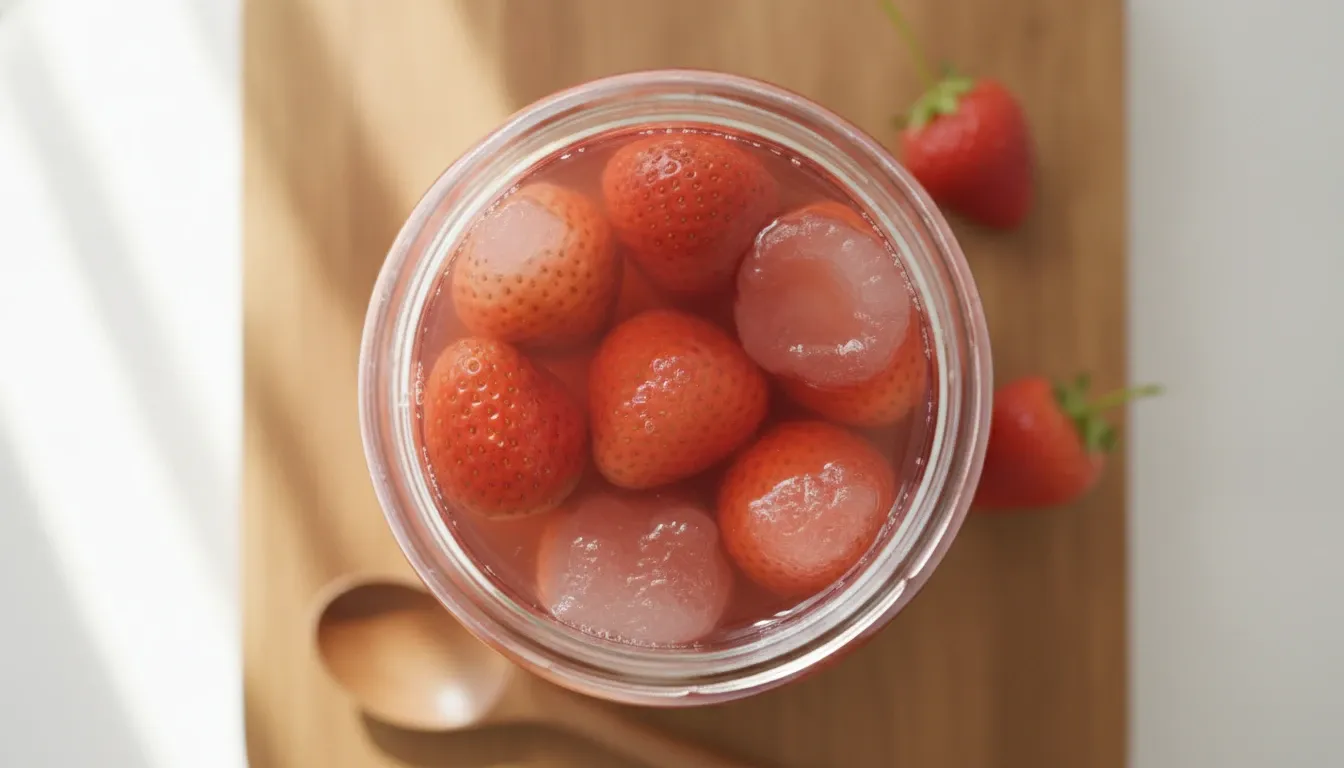
What this article answers
- How long fruit vinegar takes
- 1–2 days at room temperature, once the rock sugar has dissolved
- When to take the fruit out
- After 1 week (3 weeks for ume). Left in, the fruit spoils, and any fruit above the vinegar grows mold
- How to drink it
- Dilute it about 5 times with cold water, soda water or milk. Make it strong for that reason
- Why fruit liqueur can sit for months and this cannot
- Liquor of 20% alcohol or more preserves the fruit. Vinegar at 3–5% acetic acid is weaker, and the fruit dilutes it
- Whether vinegar can be heated
- Yes. Acetic acid boils at 118°C, above water, so the acid stays. The fruit's aroma does not
Steep fruit in vinegar and you get fruit vinegar. It is the same “steep and wait” job as making a fruit liqueur.
But the wait is different, and so is what you do afterward. Start by sorting out the name.
Herb vinegar takes aroma, fruit vinegar takes taste
Steeping things in vinegar splits into two kinds.
| Fruit vinegar | Herb vinegar | |
|---|---|---|
| What it takes out | The fruit’s sourness, sugar and color | The herb’s aroma |
| Ready to use | 1–2 days | 1 week at room temperature, or 24 hours if warmed |
| Take the solids out | After 1 week (3 weeks for ume) | After 1–2 weeks |
| How you use it | Diluted as a drink, or for sourness in dressed dishes | A little, to add aroma |
What sets fruit vinegar apart is that it takes the taste and color themselves, not just aroma. Herb vinegar picks up only aroma compounds, so the vinegar barely changes in amount or taste. Fruit vinegar takes in so much sugar and acid that it becomes a different liquid.
That is why only fruit vinegar is something you drink. Nobody dilutes herb vinegar with water for a glass. To add aroma to a dish with a few drops, use herb vinegar; the sweetness of fruit vinegar would get in the way.
Time works the other way round, too. Herb vinegar waits until the aroma is fully out, and longer steeping makes it stronger. Fruit vinegar is ready in 1–2 days, yet the fruit has to come out after a week. Only fruit vinegar has that deadline, and the reason for it is what this article is about.
”Fruit vinegar” means two different things
The same name covers two quite different products.
| What it is | Examples | |
|---|---|---|
| 1. Brewed fruit vinegar | Vinegar made by fermenting fruit | Wine vinegar, balsamic vinegar, apple cider vinegar, sherry vinegar |
| 2. Steeped fruit vinegar | Fruit steeped in vinegar to draw out its flavor, used as a seasoning or a drink | Shrubs, drinking vinegars |
The first is vinegar itself. The second uses vinegar as a solvent. One is what you buy, the other is what you make.
In English, a sweet fruit-and-vinegar syrup for diluting is also called a shrub or drinking vinegar.
This article is about the second kind. From here on, “fruit vinegar” means that.
Ready to drink in 1–2 days
The method is simple. Into a wide-mouthed jar go the fruit, then rock sugar, then vinegar: apple cider vinegar, or grain vinegar, a plain vinegar brewed from grains. Keep it somewhere cool and dark. Once a day, give the closed jar a gentle shake.
At room temperature it is ready in 1–2 days, once the rock sugar has dissolved. Rock sugar is large crystals of sugar, sold in Asian grocery stores. They dissolve slowly, so the osmotic pressure around the fruit does not change all at once.
Set it next to a fruit liqueur such as umeshu (ume, a sour Japanese stone fruit, steeped in liquor), and the times differ by two orders of magnitude.
| Ready to drink | After that | |
|---|---|---|
| Fruit vinegar | 1–2 days (once the rock sugar dissolves) | Settles down in 1 week |
| Fruit liqueur (umeshu) | 3 months | Mellows over 6 months to 1 year of aging |
Both are fruit, rock sugar and a liquid, yet the gap is that wide. There are two reasons.
They measure different things. The 1–2 days for fruit vinegar is the time until it is drinkable. The 3 months to 1 year for fruit liqueur is the time until it ages and mellows. The finish lines are different.
The fruit is different too. Umeshu uses hard, green ume left whole. Fruit vinegar uses cut apples, or small fruit such as blueberries. More surface area means the flavor comes out faster.
The ume confirms it. Even in fruit vinegar, ume alone takes 3 weeks. Hard fruit takes longer, for the same reason.
Dilute the finished vinegar about 5 times with cold water, soda water or milk. Because it is meant to be diluted, you make it strong. A fruit liqueur, drunk as it is, is built differently.
Take the fruit out after a week
Take the fruit out 1 week after steeping (3 weeks for ume). Do not leave it in.
The reason is that it spoils. Left in the jar, the fruit goes bad. And any fruit that rises above the vinegar grows mold.
That is why you shake the jar every day. It mixes the contents, but it also keeps the fruit from sitting in the air.
You do not have to throw out the fruit you take out. It makes good jam.
Two different reasons to take things out
Other steeping methods also take the solids out, but for a different reason.
| Why take it out | What happens if you leave it | |
|---|---|---|
| Herb spirits | The flavor gets worse | It turns bitter |
| Fruit vinegar | It spoils | It grows mold and rots |
| Fruit liqueur | No need to take it out | It mellows with age |
All three are steeping. Where you stop depends on whether the problem is flavor or keeping.
Vinegar can be heated, alcohol cannot
As a solvent, vinegar has a property that alcohol lacks.
| Solvent | Boiling point of its main component | Can you heat it? |
|---|---|---|
| Water | 100°C (212°F) | Yes |
| Oil | 200°C (392°F) or higher | Yes (high heat is where it works) |
| Alcohol | 78.4°C (173°F) (ethanol) | No |
| Vinegar | 118°C (244°F) (acetic acid) | Yes |
Of the four, only alcohol cannot be heated. Ethanol boils below water, so warming it drives off the solvent itself first.
Vinegar is the opposite. Acetic acid boils above water, so heating drives off the water first and the acid stays.
That is why vinegar works in cooked dishes. Rice vinegar and grain vinegar keep their sourness through heating, thanks to this gap in boiling points.
Aroma is another matter. The acetic acid stays, but the aroma compounds from the fruit are lost to heat.
If you want the acid to work, you can heat it. If you want the aroma, don’t. Fruit vinegar itself is not heated: drink it diluted, or use it to finish a dish.
What only an acid can dissolve
Besides water-soluble compounds, vinegar can take out things that dissolve only in acid.
Calcium is the classic case. In Japanese nanbanzuke, fried fish soaked in a vinegar marinade, a long soak softens the fish until you can eat the bones. It needs several hours or more; a short soak does little.
Sorted by solvent, it looks like this.
| Solvent | What it takes out |
|---|---|
| Water | Water-soluble compounds |
| Oil | Fat-soluble compounds |
| Alcohol | Both water-soluble and fat-soluble compounds |
| Vinegar | Water-soluble compounds, plus what dissolves in acid |
Vinegar extends in a different direction from alcohol, which dissolves both. It does not reach fat-soluble compounds, but it reaches things only an acid can dissolve.
Make it strong, remove fruit after a week
- “Fruit vinegar” means two things: brewed fruit vinegar (wine vinegar and the like) and steeped fruit vinegar (fruit in vinegar). This article covers the second
- It is ready in 1–2 days. Fruit liqueur takes 3 months to 1 year because the finish line and the fruit’s surface area differ. Only ume takes 3 weeks
- Take the fruit out after 1 week (3 weeks for ume), because it spoils. Fruit above the vinegar molds, so shake the jar daily
- There are two reasons to take things out. Herb spirits turn bitter; fruit vinegar spoils. Fruit liqueur can stay as it is
- Fruit liqueur keeps at room temperature because its alcohol is also a preservative. Keep fruit vinegar in the fridge and finish it within a few months
- It is made to be diluted about 5 times, so make it strong
- Acetic acid boils at 118°C (244°F), above water, so vinegar can be heated. Of the four solvents, only alcohol cannot. The aroma is still lost
- Vinegar takes out water-soluble compounds plus what dissolves in acid. Dissolving calcium is what sets it apart
Sources
- Mizkan customer center. Can I leave the fruit in fruit vinegar? On taking the fruit out after 1 week (3 weeks for ume), and mold on floating fruit (in Japanese)
- Mizkan home recipes. Apple fruit vinegar (sour drink). On the steps, readiness in 1–2 days, and diluting 5 times (in Japanese)
- Tobaya Vinegar. How to make fruit vinegar / Why use rock sugar for fruit vinegar? (in Japanese)