What this article answers
- How to make okonomiyaki fluffy
- Grated yam to hold the bubbles, a few hours' rest in the fridge, and never press it with the spatula
- How okonomiyaki, jeon and takoyaki differ
- Hydration. Liquid at 100–150% of the flour, 130–180%, and around 300%
- How jeon gets crisp and chewy at once
- Rice flour and potato starch for chew, plenty of oil to shallow-fry the bottom crisp
- Why takoyaki stays molten inside
- Liquid at about three times the flour. Turning them builds a crisp shell around a center that never fully sets
- The rule all three share
- Keep gluten down. Stop mixing as soon as the dry flour disappears
Okonomiyaki, jeon, and takoyaki are savory batters mixed with dashi instead of plain water. Grated yam or starch builds the texture, and gluten is kept out. The flavor goes into the liquid itself, and the batter cooks together with its fillings, with no leavening and no gluten to lift it.
Okonomiyaki is a Japanese savory pancake of shredded cabbage in batter. Jeon is a Korean savory pancake, and takoyaki are griddled balls of batter around octopus. Dashi is a Japanese stock, usually made from bonito flakes and kombu. The yam is nagaimo or yamaimo, a Japanese mountain yam that turns into a slippery, sticky paste when grated. It is not the orange sweet potato sold as “yam” in the US.
The three end up with opposite textures: fluffy, chewy with a crisp crust, and crisp outside with a molten center. What splits them is how much liquid goes in for the flour.
Where the savory batters sit
Griddle batters split by hydration and by whether they rise. These three swap the liquid for dashi and cook with their fillings: the high-hydration, savory family. They share the griddle with crepes and pancakes, but the flavor sits in the batter itself.
| Family | Example | Hydration | Does it rise? | What makes the texture |
|---|---|---|---|---|
| High-hydration, savory | Okonomiyaki, jeon, takoyaki (this article) | Medium to high | No | Dashi plus grated yam or starch |
| Poured, unleavened, rich | Crepe | High (pours) | No | Egg and butterfat make it supple |
| Leavened | Pancakes | Medium | Yes (baking powder) | Carbon dioxide makes it thick |
Pancakes rise on baking powder. These savory batters use none, and get their lift from the stickiness of grated yam and the steam from the fillings. The crepe carries its flavor in butterfat, and these carry it in dashi.
One thing is shared with the Western griddle batters: they don’t develop gluten. How each of the three does that splits by hydration.
Three batters mixed with dashi
All three share a frame: flour mixed with dashi, cooked on a hot griddle with the fillings. They differ in hydration (the liquid as a share of the flour’s weight) and in the supporting ingredients.
| Okonomiyaki | Jeon | Takoyaki | |
|---|---|---|---|
| Hydration (liquid to flour) | Around 100–150% | Around 130–180% | Around 300% (extremely wet) |
| Liquid | Dashi from bonito and kombu | Water plus seasoning (sometimes dashi) | Bonito dashi |
| Egg | Yes | Yes (some recipes leave it out) | Yes |
| Key extra ingredient | Grated yam | Rice flour and potato starch blended in | Soy sauce, often usukuchi (a pale Japanese soy sauce); tenkasu |
| How it cooks | Steamed under its own weight, never pressed | Shallow-fried in plenty of oil | Turned into balls in a takoyaki pan |
| Target texture | Fluffy | Chewy, with a crisp crust | Crisp outside, molten center |
Tenkasu are crunchy bits of fried tempura batter. A takoyaki pan is a cast-iron plate with rows of half-sphere wells.
Hydration sets the texture family
The more liquid in the batter, the further it moves from a soft solid toward a flowing center. Takoyaki batter is so wet that it no longer sets all the way through. It is closer to dashi sealed inside a shell.
Okonomiyaki gets fluffy from yam and resting
A fluffy okonomiyaki doesn’t come from leavening. It comes from three things: grated yam, resting, and managing the cabbage’s water.
| Element | What it does |
|---|---|
| Grated yam | The sticky paste holds bubbles and keeps them as they expand in the heat (a guide is 1.5–2 times the flour’s weight) |
| Resting the batter (hours to overnight in the fridge) | The flour finishes hydrating, the raw-flour taste goes, and the dashi flavor settles in |
| Cabbage | Gives off steam as it heats and lifts the batter from inside |
| Cooking | Never press it from above (that squeezes out the bubbles and steam) |
Resting works as it does for any dough. In a batter, the biggest effect is that hydration finishes. Cut cabbage releases water as it sits, so mix it into the batter just before cooking.
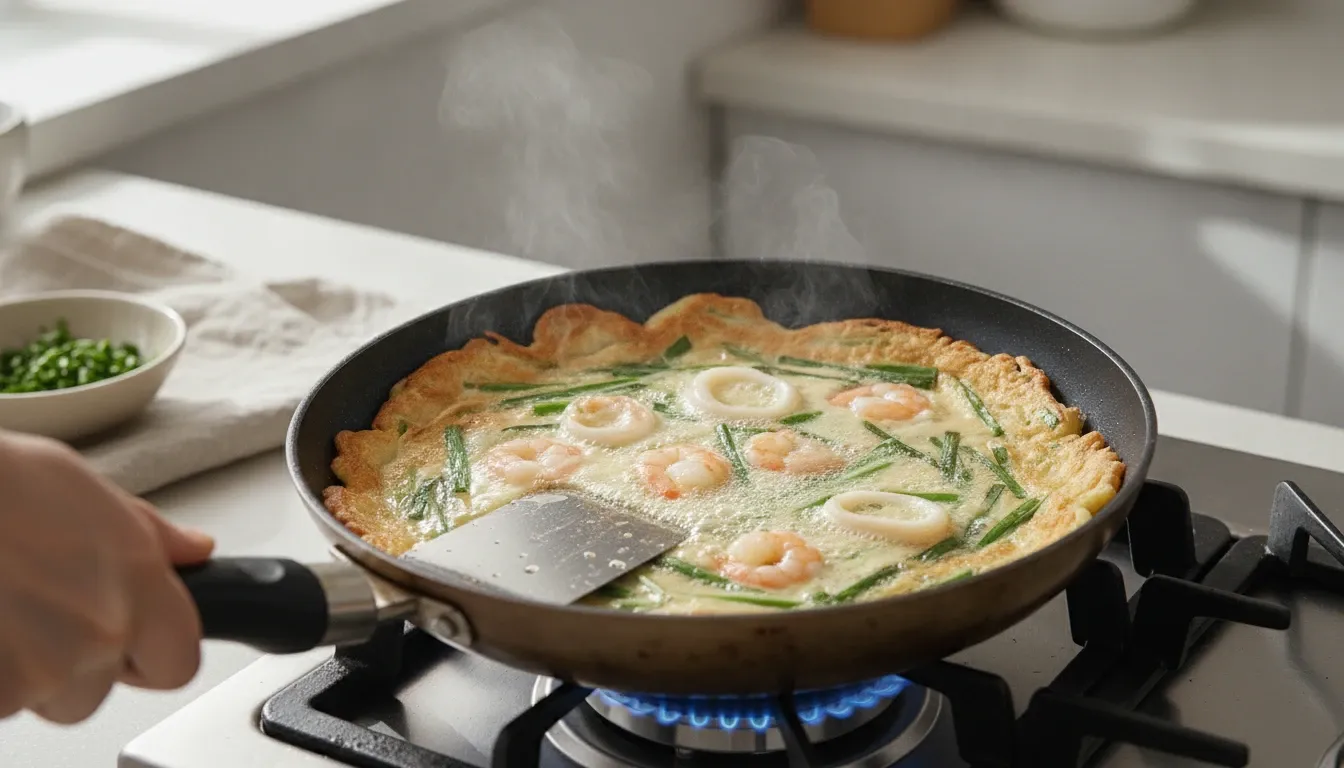
Jeon is chewy inside, crisp outside
The appeal of jeon is two textures: chewy inside, crisp at the edges and bottom. Both come from the choice of starch and the amount of oil.
| Layer | What makes it | How it works |
|---|---|---|
| Chewy inside | A blend of rice flour and potato starch | Gelatinized starch holds water and turns into a sticky gel |
| Crisp edges and bottom | Shallow-frying in plenty of oil | Water leaves the contact surface, and starch and oil form a thin fried layer |
Chewy starch turns hard as it cools
The chewy, starchy texture hardens as it cools. This is starch retrogradation: as gelatinized starch cools, it gives up water and firms again. That is why jeon is best straight from the pan.
Wet takoyaki batter makes a molten center
Takoyaki batter carries liquid at about 3 times the flour. At that ratio, the batter was never meant to set all the way through.
| Part | State | How it works |
|---|---|---|
| Shell | Set crisp | Only the surface touching the pan loses water, and the egg and starch bake |
| Center | Molten, half-liquid | Too much water to set fully; it stops as a soft, freshly gelatinized gel |
The more dashi you add, the looser the batter and the more molten the center, but the harder the balls are to turn. Wetter means softer inside and harder to handle: that trade-off is the general effect of water in any dough.
All three keep gluten down
All three share one quiet design rule: develop as little gluten as you can.
- Overmix, and gluten develops, and the result is heavy and tough (stop as soon as the dry flour disappears)
- In jeon, the rice flour and potato starch blend also simply lowers the amount of gluten
- Resting also relaxes whatever gluten did form
It is the same rule as “mix, then rest” for a crepe, and “stop while a few lumps remain” for pancakes. East or West, griddle batters are the opposite of bread: they don’t fight gluten, they avoid it.
Common failures and fixes
A collapsed okonomiyaki can’t be fixed, and a burnt surface only partly. The other three can be fully fixed.
| Problem | Cause | Fix it now | Prevent it next time |
|---|---|---|---|
| The surface is soggy | Water from the cabbage’s cells moved into the batter and raised the hydration | Cook it over high heat to drive off the water | Mix in the fillings just before cooking, and cut back the dashi a little |
| It won’t rise | Too little yam, and pressing with the spatula crushed the bubbles in the batter | Crushed bubbles don’t come back. Don’t press it next time | Use more yam, don’t press it, and mix only lightly |
| It isn’t crisp | Too little oil and too thick a batter, so the surface never got hot enough to dry and harden | Add oil and cook again over medium heat or higher, so the surface shallow-fries | Use more oil, spread it thin, and cook over medium heat or higher |
| The outside burns | The heat was too high. The outside set first and charred before the center cooked | Turn the heat down, and flip once the shell has set so the center cooks | Turn the heat down, and flip only after the shell has set |
| It’s lumpy | It wasn’t rested long enough, so the flour cooked before it fully hydrated | Let the batter rest, then cook again | Rest the batter for a few hours so it hydrates before cooking |
The three batters in five lines
- Okonomiyaki, jeon, and takoyaki are one family of savory batters mixed with dashi or water. Hydration and the extra ingredients set the texture
- Fluffy okonomiyaki comes from three things: yam holding the bubbles, resting, and never pressing it
- Jeon has two layers made by a water gradient: chewy from rice flour and potato starch, crisp from plenty of oil
- Takoyaki carries liquid at about three times the flour, and turning the balls builds the crisp shell and molten center
- All three keep gluten down, so the first rule is not to overmix
For the Western side, see crepe batter. For all griddle batters at once, see the griddle batter overview.