What this article answers
- How naengmyeon noodles are made
- Knead with boiling water, press through holes, boil, then chill in ice water
- What naengmyeon noodles are made of
- Pyongyang style is 70–80% buckwheat flour; Hamhung style is mostly potato or sweet potato starch
- Why they are too chewy to bite through
- Chilled starch forms a network. It is not wheat gluten
- Why the noodles go into ice water after boiling
- Starch retrogrades fastest at 0–5°C, and that is what makes them firm and springy
Order naengmyeon, Korean cold noodles, at a Korean restaurant and the server often cuts them with scissors. A wheat noodle gives way to your teeth. Naengmyeon stretches instead of breaking.
That spring does not come from wheat gluten. It comes from retrogradation: chilled starch rebuilding itself into a network.
This article covers what naengmyeon noodles are made of and why they are so hard to bite through. It also explains why the dough is kneaded with boiling water, pressed out through holes, and chilled in ice water.
Buckwheat-to-starch ratio defines the noodle
Naengmyeon noodles are a mix of buckwheat flour and potato or sweet potato starch. How much of each you use decides whether the noodle snaps cleanly or needs scissors. The two ends of that range are Pyongyang style and Hamhung style.
Pyongyang style and Hamhung style compared
| Style | Main flour | Typical ratio | Thickness and color | Texture | How it is eaten |
|---|---|---|---|---|---|
| Pyongyang | Buckwheat flour plus starch | 70–80% buckwheat | Thicker, darker | Snaps cleanly | In cold broth (mul naengmyeon) |
| Hamhung | Potato or sweet potato starch | Mostly starch | Thin | Hard to bite through | Tossed in a spicy sauce (bibim naengmyeon) |
Even Pyongyang-style noodles contain starch. Buckwheat flour alone is not sticky enough to hold a noodle together.
Long-running Pyongyang-style restaurants in Seoul also add starch for stickiness. Because buckwheat still makes up 70–80%, the noodles keep their aroma and break under your teeth.
Hamhung style is the reverse: starch is the star. It began as nongma guksu in the Hamhung region, made only from starch of potatoes grown in the highlands. In South Korea today, sweet potato starch is the main one, and some restaurants serve noodles of 100% sweet potato starch.
Where wheat-based and packaged noodles fit
Some cold noodles are made with wheat. Morioka reimen, a Japanese regional version, mixes wheat flour with starch. Machine-made naengmyeon sold in Korean grocery stores usually combines buckwheat flour, wheat flour, and starches.
In a noodle with wheat flour, wheat gluten joins the starch network. Part of its chew comes about differently from an all-starch noodle.
Where the chew forms, compared with other noodles
Besides naengmyeon, soba and rice noodles also do without gluten. Set beside other noodles, what sets naengmyeon apart is when and where its chew forms.
| Noodle | What gives chew and holds it together | Where the chew forms |
|---|---|---|
| Udon | Gluten tightened with salt | Kneading and treading |
| Pasta | Gluten from high-protein flour | Kneading |
| Chinese wheat noodles | Gluten tightened with kansui (an alkaline salt solution) | Kneading |
| Soba | Wheat flour binder, or gelatinized starch from hot-water kneading | Kneading |
| Rice noodles | Retrogradation of rice starch | Drying and cooling at the factory |
| Naengmyeon | Retrogradation of potato or sweet potato starch (plus buckwheat) | Cold or ice water right after boiling |
Soba asks how to hold a noodle together without gluten, and answers with a wheat flour binder or hot-water kneading. Rice noodles are dried and cooled at the factory, which retrogrades the starch into a frame. At home, you rehydrate them without breaking that frame.
Naengmyeon builds its chew right before you eat it. The pressed noodles are boiled, then chilled in ice water at once to set off retrogradation. The chew forms on the spot. That is why naengmyeon is eaten cold.
Put it in hot soup and the chew goes. Retrograded starch warmed above 60°C (140°F) partly returns to its soft, gelatinized state.
Where the scissor-worthy spring comes from
Chilled amylose forms a network
Amylose is the part of starch made of single, unbranched chains. When starch boils, it absorbs water and swells, the chains loosen, and it turns soft. This is gelatinization.
Chill it, and the loosened amylose chains gather and twist together in pairs, forming double helices. Each twisted section becomes a knot that ties one chain to another.
The more knots, the firmer and springier the starch becomes. This is starch retrogradation.
The network itself is starch
In wheat noodles, gluten forms the network and starch fills the gaps. In Hamhung-style naengmyeon, the network itself is starch.
The whole noodle is one starch network. Pull it and it stretches and springs back; press it with your teeth and it resists. That is where the scissor-worthy spring comes from.
More buckwheat snaps, more starch holds
Buckwheat flour is not pure starch. It also contains protein, and fiber from the parts near the hull.
These do not join the knots between starch chains, so the more buckwheat a noodle has, the more breaks its network has. That is probably why Pyongyang-style noodles snap cleanly. This is inferred from the makeup of buckwheat flour; we found no source that tested it on the noodles directly.
Raise the share of starch and the network breaks less, until you get a noodle like Hamhung style that you cannot bite through. Texture shifts smoothly with the ratio. So it is not a choice between Pyongyang and Hamhung; each restaurant picks a point somewhere in between.
Why the dough is kneaded hot and pressed
Naengmyeon dough uses two steps that wheat noodles do not. The kneading water is boiling, and the noodles are pressed out through holes instead of rolled and cut. Both are ways to hold together a dough with no gluten.
Knead with boiling water
Raw starch does not dissolve in water and does not turn sticky. Stir potato starch or cornstarch into water: it runs thin at first, then settles to the bottom. Particles like that will not stick to each other.
So the dough is kneaded with boiling water. In Korean this is called ikbanjuk (익반죽). Hamhung nongma guksu, too, is made by sifting potato starch and working it with boiling water.
Only the starch the boiling water touches gelatinizes into a paste, and that paste binds the remaining raw starch. It is the same principle as the hot-water kneading used for soba.
| Starch | Temperature range from start to end of gelatinization |
|---|---|
| Potato | 55–80°C (131–176°F) |
| Sweet potato | 58–83°C (136–181°F) |
Source: values from this site’s table on starch gelatinization (Hirao 2022, Tajima 2010).
Warm water does not reach these temperatures, so too little paste forms. The dough will not come together and crumbles when you press it. Use water straight off the boil.
There is enough paste once the dough holds as one mass and dents without cracking when you press it with a finger.
Press through holes instead of rolling
A dough without a gluten network tears instead of stretching when you pull it. Rice noodle dough behaves the same way. So you cannot roll it thin and cut it with a knife as you would udon or pasta.
Instead, the dough goes into a noodle press and is pushed out through small holes in the bottom. The noodles drop straight into boiling water set underneath. Some naengmyeon restaurants press the noodles in an extruder only after you order, then boil and chill them.
Pressing packs the dough tight under pressure, with no gaps, into noodles with a round cross-section. They have none of the corners of rolled-and-cut noodles, and none of the layers that rolling thin creates.
Why the noodles are chilled after boiling
When you cook naengmyeon at home, how you chill the noodles after boiling makes the biggest difference to the chew. Take it in three steps: boil, rinse, chill.
Boil briefly in plenty of water
Freshly pressed noodles are thin, so they cook very quickly. Packaged noodles vary a lot by product, from semi-dried kinds at about 40 seconds to ones that take 3–4 minutes. Go by the package.
Bring plenty of water to a boil over high heat. With too little water, the temperature drops the moment the noodles go in. The starch at the center does not fully gelatinize, and a hard core remains.
Rinse the surface starch under running water
Boiled noodles are coated in starch paste that dissolved into the cooking water. Drain them and loosen them under running water right away, rubbing until the slipperiness is gone.
Left on, the paste glues the noodles together as they cool, and it clouds the broth. Rinsing at once also stops carryover heat from gelatinizing them further and making them slack.
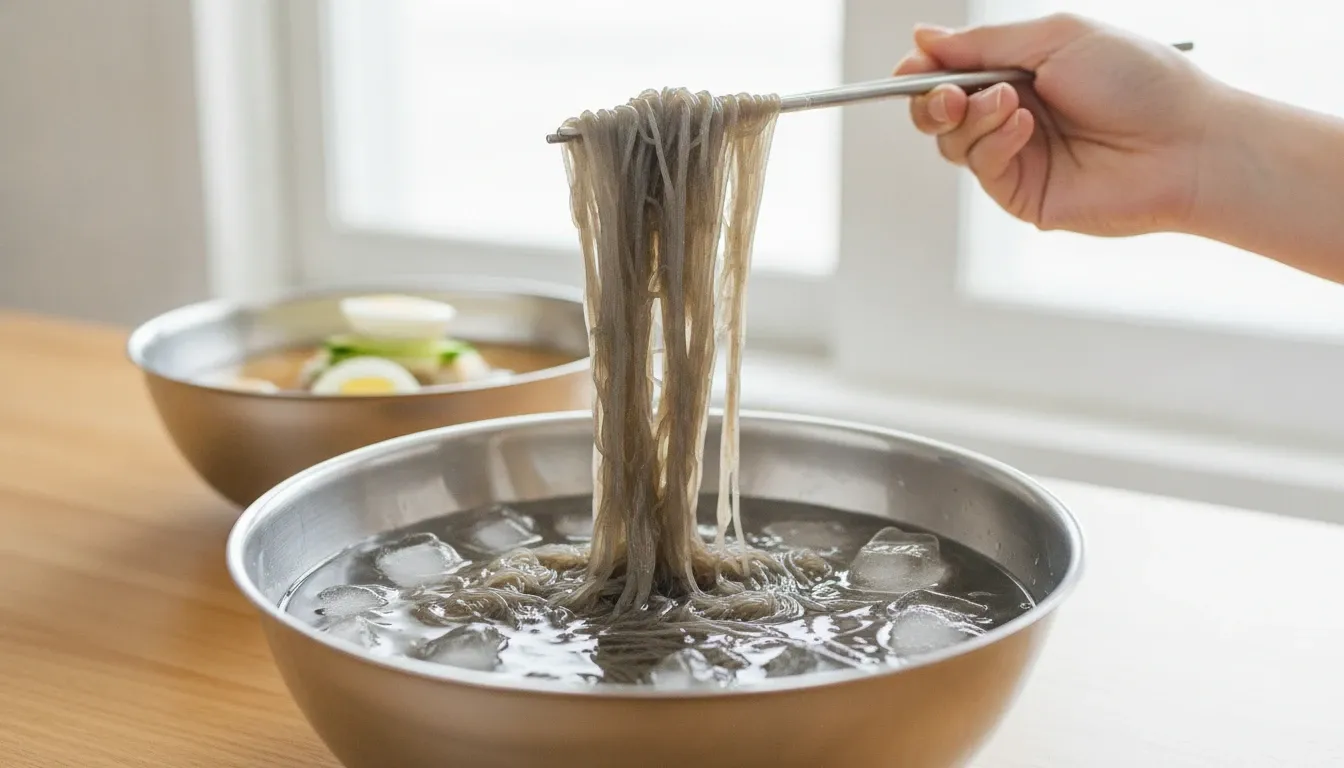
Chill in ice water to 0–5°C
Put the rinsed noodles in ice water and chill them to the core. Retrogradation goes fastest at 0–5°C (32–41°F). Ice water sits right in that range, so the amylose chains twist together and the chew sets. Tap water alone does not get down to 0–5°C, and the noodles never firm up fully.
Pick up a strand: if it feels as cold as the ice water all the way through, the noodles are set.
Drain them well once they are set. Leftover water dilutes the broth. Chill the broth too, since a warm broth takes the chew away, as explained above.
Common failures and fixes
All four of these can be recovered.
| Problem | Cause | Fix it now | Prevent it next time |
|---|---|---|---|
| The noodles are limp | They were not chilled enough, so the gelatinized amylose never realigned into a network | Move them to ice water and soak until cold to the core | After rinsing, chill in ice water at 0–5°C, and chill the broth as well |
| The noodles stick together | Starch paste from the cooking water stayed on the surface and glued them together as they cooled | Loosen and rub them under running water to remove the slippery coating | Rinse under running water as soon as they come out, until the slipperiness is gone |
| The dough crumbles | The water was not hot enough, so the starch never gelatinized into a paste to bind the flour | Work in boiling water a little at a time to make more paste | Use water straight off the boil, never warm water |
| The center is undercooked | There was too little water, so it cooled when the noodles went in and the starch at the center did not fully gelatinize | Return them to boiling water for under a minute more, then chill again | Boil plenty of water over high heat and cook in small batches |
What not to skip for a good chew
- The chew comes from starch retrogradation: chilled amylose twists together into knots
- Pyongyang style, at 70–80% buckwheat, snaps under the teeth; Hamhung style, mostly starch, does not
- Raw starch is not sticky, so knead with boiling water to turn some of it into paste
- The dough cannot be rolled, so press it through holes into boiling water
- After boiling, rinse off the paste under running water and chill in ice water at 0–5°C. Warm the noodles and they go slack
Rice noodles are the other noodle made from starch alone. For a noodle that does without gluten but leans on a binder, see soba.
Sources
- Encyclopedia of Korean Culture. Hamhung nongma guksu (in Korean). On kneading potato starch with boiling water and pressing it through a noodle press
- Seoul Shinmun (2004-07-01). Choosing naengmyeon, the taste of summer (in Korean). On the buckwheat share of Pyongyang-style noodles (70–80%) and the sweet potato starch of Hamhung style
- Kurita, Kenichi and Ichihara, Takashi. (2017). E-Starch, an enzyme-treated starch with unusual gel properties. Sugar and Starch Information, August 2017 (ALIC) (in Japanese). On amylose forming double helices as it retrogrades, which act as cross-links that make a gel firm and elastic
Show 2 more
- Hwang, Kyo-ik. (2024-01-04). A family tree of buckwheat noodles and their cousins (in Korean). On Pyongyang naengmyeon as a buckwheat noodle and Hamhung naengmyeon as a potato or sweet potato starch noodle
- Beyond Kimchee. Naengmyeon (buckwheat noodles). Machine-made naengmyeon combines buckwheat flour, wheat flour, and starches, and is sold in Korean grocery stores