What this article answers
- How to soften dried rice vermicelli
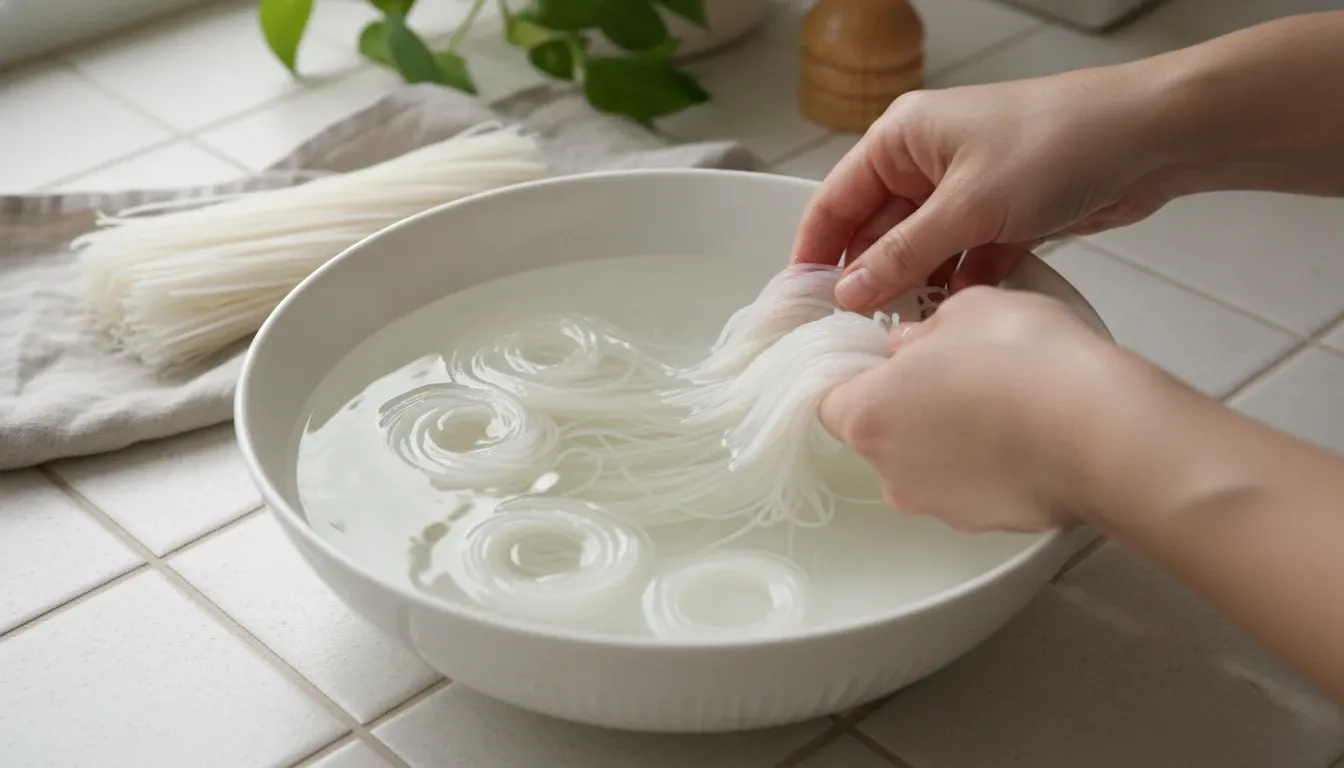
- Soak in water for about 30 minutes, or boil for a few minutes, then drain well
- How soft to make them
- Slightly firm for stir-fries and soups, fully soft for salads. Count back from the heat still to come
- How much to soften per person
- 50–70 g dried. Noodles roughly triple in weight, so 50 g becomes about 150 g
- Why rice noodles hold together without gluten
- Rice starch gelatinizes, then retrogrades as it dries and cools, and that forms the frame
- Why they break into short pieces
- Over-soaking or over-boiling turns the frame back into soft paste. When in doubt, keep them firm
Rice noodles, such as rice vermicelli and pho noodles, differ from other noodles at the root. They are made from rice starch alone, with no gluten at all.
Wheat noodles get their bite and their ability to hold together from a gluten network. Rice noodles have no such network.
They keep their shape and their bite anyway. The factory gelatinizes the starch of ordinary (non-glutinous) rice and shapes it. Drying and cooling then retrograde the starch, meaning it recrystallizes and firms into a frame.
There is not even a wheat binder. Rice noodles are pure starch.
So the step that matters most at home is how you soften them. Soften them too far, and they break.
This article covers where rice noodles sit among noodles, the main types, how to soften them, and how they keep their bite. Softening is the thread throughout.
How rice noodles are made and softened
Rice noodles are dried noodles made from non-glutinous rice. Some brands add cornstarch or potato starch. No wheat goes in.
It helps to split the process into two stages: making and cooking. Then it is clear what you are doing at home.
| Stage | Who does it | What happens |
|---|---|---|
| 1. Making (factory) | The manufacturer | Grinds the rice, adds water, gelatinizes the starch, shapes it, and dries it into dried noodles |
| 2. Cooking (home) | You | Softens the dried noodles in water or boiling water (gelatinizing them again), then stir-fries, simmers, or dresses them |
At home, you only do stage 2. Some people want to make rice noodles from rice flour, but that needs equipment for extruding or steaming, and results are hard to repeat. This article focuses on softening store-bought dried noodles.
Start from one fact. Unlike wheat noodles, rice noodles have no kneading step to build strength.
Their bite is not made in your kitchen. It is already set into the dried noodle as the state of its starch. So softening is not about building strength. It brings the noodle to an edible state without breaking the frame inside.
Where rice noodles sit among noodles
Set rice noodles beside udon (thick Japanese wheat noodles), pasta, Chinese wheat noodles, and soba (buckwheat noodles), and their oddness is plain. Those four use different means, but all of them revolve around how to handle gluten. Rice noodles stand completely outside that contest.
Naengmyeon, the Korean cold noodle, also stands outside, with potato starch as its base. It differs in where the starch firms: in ice water right after boiling, not at the factory.
| Noodle | What gives bite and holds it together | Relation to gluten | Where it stands |
|---|---|---|---|
| Udon | Gluten tightened with salt | Depends on it | Tightened with salt |
| Pasta | The strength of a high-protein flour | Depends on it | Relies on the flour |
| Chinese wheat noodles | Gluten tightened with alkali | Depends on it | Tightened with alkali |
| Soba | A wheat binder, or gelatinized starch | Does not depend on it (relies on a binder) | Does not depend on gluten |
| Rice noodles | Rice starch gelatinizing and retrograding | None at all (pure starch) | Outside the gluten contest |
| Naengmyeon | Retrograded potato starch (plus buckwheat flour) | Does not rely on it (mostly starch) | Outside the gluten contest |
Soba and rice noodles look alike because neither has gluten. But they stand a step apart.
Soba asks how to hold a noodle together without gluten. Its answer is a binder: wheat flour, or kneading with boiling water.
Rice noodles do not even need a binder. The rice starch turns itself into a frame by gelatinizing and retrograding.
Soba takes half a step outside gluten; rice noodles take a full step. Seen that way, it is clear what “pure starch noodle” means.
The frame decides how they are made and how they fail
This difference leads straight to how the noodles are made and how they fail.
A wheat network withstands pulling. So you can knead it, roll it thin, and cut it, even at home.
Rice noodles cannot take that pull. The factory either steams the gelatinized batter into sheets and cuts them, or presses it out through holes. Both shape the noodle without stretching it. That is why rice noodles are hard to make at home.
In cooking, over-softening pushes gelatinization too far and the tangles come apart. The noodle then breaks as soon as you lift it with chopsticks or tongs, a failure unique to rice noodles.
Rice vermicelli, pho, and other rice noodles
They are all called rice noodles, but they differ in ingredients, method, and origin. Here is the overall picture.
| Name | Main ingredient | Method | Origin | Shape and use |
|---|---|---|---|---|
| Rice vermicelli (米粉, sold as bee hoon, mai fun, or mei fun) | Non-glutinous rice (some add starch) | The batter is gelatinized, pressed out into thin noodles, and dried | China (Taiwan, Fujian) | Thin, round noodles. Suited to stir-fries (fried vermicelli) |
| Pho noodles (bánh phở) | Rice flour (plus starch such as tapioca) | Rice flour batter is steamed into thin sheets and cut | Vietnam | Flat, wide noodles. Suited to soups |
| Rice noodles | Rice (general term) | A general term for rice noodles, including the two above | Across Southeast Asia | Many widths and shapes |
Both are rice noodles, but vermicelli is a pressed-out round noodle and pho is a flat noodle cut from a sheet. That difference in shaping becomes a difference in texture and use.
Many recent pho and rice noodle products add tapioca starch or similar for bite and easier handling. Pure 100% rice is now the minority. What they add is starch, though, never gluten. Rice noodles stay gluten-free whatever the type.
Glass noodles look similar but are not rice. They are made from mung bean or potato starch. Both are pure starch noodles without gluten, but you tell them apart by whether they are made of rice.
Softening rice vermicelli in water or boiling water
This is the practical core. You can soften vermicelli in water or in boiling water, and you change how far you take it for the dish.
| Method | Rough steps | Best for |
|---|---|---|
| Soaking in water | Soak for about 30 minutes (warm water is faster), and drain once limp | When you want to soften slowly; stir-fries |
| Boiling | Boil for a few minutes in boiling water, then drain in a colander | When you want to be quick |
On top of that, soften the same vermicelli to a different depth for each dish.
| Dish | How far to soften | Why |
|---|---|---|
| Fried vermicelli | Slightly firm (a little core left) | It keeps cooking as you stir-fry, so over-softened noodles turn mushy |
| Vermicelli in soup | Slightly firm | It softens further in the soup |
| Salads and dressed dishes | Fully soft | No more heat comes later, so it must be ready to eat now |
To judge quantity, noodles roughly triple in weight. 50 g of dried noodles becomes about 150 g, so plan on 50–70 g of dried noodles per person.
To stop the noodles sticking, drain them well and toss them in a little oil. If you leave them sitting after softening, starch on the surface dries and glues the strands together.
Softening and handling pho and rice noodles
Flat noodles like pho have more surface than vermicelli, so they soften faster. The catch is that they fall apart easily when over-softened.
| Point | Guide and reason |
|---|---|
| Temperature | Warm to boiling water. Thick flat noodles soften more evenly in boiling water |
| Time | Varies with width and thickness, so follow the package. Erring firm is safe |
| Finishing | Make the last adjustment briefly in the soup. Do not soften all the way; let them finish in the bowl |
Flat noodles are wide, so a little too long and they suddenly go soft and break when you lift them. Do not manage them by time. Pull them out by how they feel: they bend smoothly but still have a core.
Why the bite and shape hold
The practical rules so far, that over-softened noodles break and firm is safe, all come from two changes in rice starch: gelatinization and retrogradation. This is the essence of rice noodles.
| Change | What happens | What it means for the noodle |
|---|---|---|
| Gelatinization | Water and heat swell the starch, its crystal structure breaks down, and it turns to paste | The noodle softens and becomes edible |
| Retrogradation | Gelatinized starch cools, releases water, and recrystallizes into a firm state | The noodle regains its frame, its bite, and its shape |
A rice noodle’s life is a back-and-forth between the two. The factory gelatinizes the starch once to shape it, then dries and cools it to retrograde and fix the frame. That is the dried noodle.
Soften it at home, and it gelatinizes again into an edible state. As it cools, it retrogrades again and the bite returns. That is why cold rice noodles firm up.
Amylose is the key
The key is amylose, one of the two starches in non-glutinous rice. That rice starch is about 20% amylose and 80% amylopectin. Glutinous (sticky) rice has almost 0% amylose.
Amylose is a straight-chain molecule. Its chains tangle and recrystallize easily, so it retrogrades fast.
Rice noodles keep their bite and shape because this fast-retrograding amylose builds the frame. Glutinous rice barely makes noodles at all, because it has no amylose and hardly retrogrades.
Sorting out what went wrong
Sort rice noodle failures into two causes: softened too much or too little, and sticking. Then the fix is quick.
| Symptom | Main cause | What to do |
|---|---|---|
| Breaks into short pieces | Over-softened or over-boiled, so the frame gelatinized and collapsed | Soften firm. Stop short to allow for the heat still to come |
| A hard core remains | Water too cold or time too short, so gelatinization has not reached the center | Switch to warm or boiling water, or give it longer |
| Mushy | Over-softened, or too much softening water left on | Drain well. Keep noodles for stir-fries especially firm |
| Strands stick together | Left sitting after softening, or not enough draining or oil | Drain and toss in a little oil. Soften just before you use them |
Wheat noodles have a gluten network, so they forgive more mistakes. Rice noodles rely only on retrograded starch, so they are weak against overcooking and forgive little. When in doubt, keep them firm.
The numbers to remember
- Rice noodles, such as vermicelli and pho, are pure starch noodles with no gluten. They do not even use a wheat binder
- Vermicelli is a round noodle pressed out from non-glutinous rice. Pho is a flat noodle cut from a steamed rice-flour sheet. Many now add tapioca or other starch, but never gluten
- Soften in water for about 30 minutes, or in boiling water for a few minutes. Keep them firm for stir-fries and soups, fully soft for salads, counting back from the heat still to come
- Bite and shape come from gelatinization and retrogradation going back and forth. Fast-retrograding amylose builds the frame
- With only starch as a frame, rice noodles are weak against overcooking. Erring firm is safe for both softening and boiling
Udon and Chinese wheat noodles have gluten; soba relies on a binder. Read them side by side, and rice noodles, needing no binder at all, stand clearly outside the gluten contest.
Sources
- Olive Hitomawashi. How is pho made? How is it different from rice vermicelli? On the ingredients and manufacture of rice noodles (in Japanese)
- Kenmin Foods. The basic way to boil rice vermicelli. On soaking and boiling vermicelli made from 100% non-glutinous rice (in Japanese)
- NARO Tohoku Agricultural Research Center. Low-amylose rice that stays tasty when cold. On the amylose content of non-glutinous rice and starch retrogradation (in Japanese)