What this article answers
- What food as medicine means
- Nourishing the body with everyday meals. Grain as the base, ingredients and cooking changed with the season
- How much grain to eat
- China's dietary guidelines say 200–300 g a day. Per meal, 70–100 g of uncooked rice
- What to change with the season
- Summer: cucumber and winter melon raw or briefly cooked. Winter: lamb with ginger, 2–4 hours at 80–95°C
- How much goji and jujube to add
- For chicken soup for 4 (1.5 L water): 10 g dried goji, 20 g jujube. Goji goes in for the last 10 minutes
- How it differs from medicine
- The Suwen says medicine attacks illness and food nourishes. This article doesn't cover health effects either
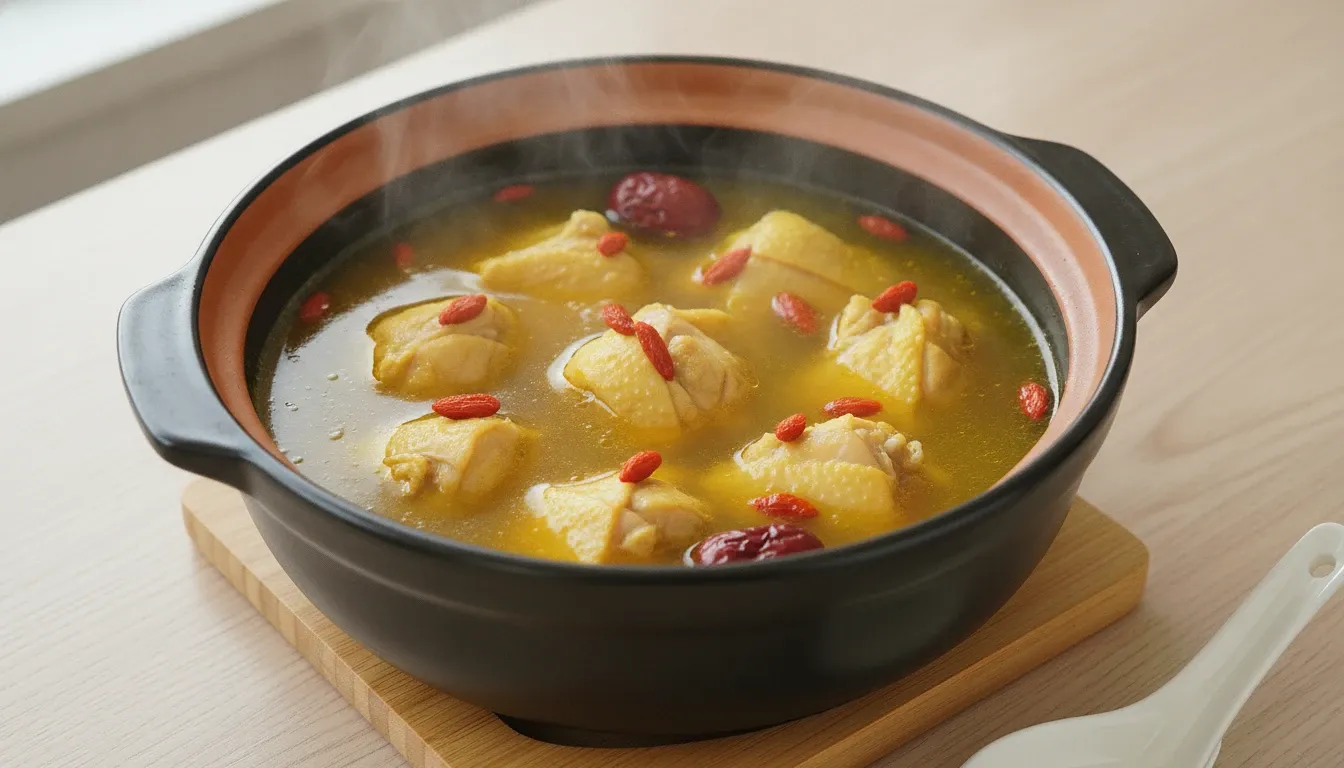
Some Chinese soup recipes list goji berries and jujubes (dried red dates) next to the chicken or pork bones. A winter lamb stew takes plenty of ginger, and summer brings dishes of cucumber and winter melon (a large, mild gourd). Flavor alone doesn’t quite explain these choices.
Food as medicine, yi shi tong yuan (医食同源), is the Chinese idea of nourishing the body with everyday meals.
Yaoshan (药膳, medicinal cuisine) is cooking built on that idea, with ingredients that also serve as herbal medicines.
This article looks at food as medicine from the eater’s side, and at what changes in how you plan meals and build the pot. It doesn’t cover the health effects of ingredients or treating illness. The Suwen, the classic of Chinese medicine this idea rests on, draws that line itself: medicine attacks illness, food nourishes the body.
Grain, season, and a light hand with herbs
Three things change in the kitchen.
| What you do | Guide | Basis |
|---|---|---|
| Make grain the base and portion everything else around it | Grain: 200–300 g a day (uncooked weight) | “The five grains nourish” in the Suwen; China’s dietary guidelines |
| Change ingredients and cooking with the season | Summer: cool foods, raw. Winter: warm foods, simmered | The traditional grouping of foods as cold, cool, neutral, warm, and hot |
| Use medicinal ingredients sparingly, as flavor ingredients | Chicken soup for 4: 10 g goji, 20 g jujube | China’s catalog of substances used as both food and medicine; daily doses in the Chinese Pharmacopoeia |
Sources: Huangdi Neijing Suwen, Zang Qi Fa Shi Lun; Dietary Guidelines for Chinese Residents (2022); Chinese Pharmacopoeia, 2020 edition (references).
All three happen before you choose a dish, while you look at who is eating and what season it is and gather the ingredients.
Grain nourishes, the rest supports, says the Suwen
The Huangdi Neijing Suwen (黄帝内经素问), a classic of Chinese medicine, has a passage on how to put meals together, in the chapter Zang Qi Fa Shi Lun.
| Phrase | Meaning | In the kitchen |
|---|---|---|
| 毒薬攻邪 | Medicine attacks illness | Curing illness is the job of medicine |
| 五穀為養 | Grains nourish | Make rice, wheat, and other grains the base of the meal |
| 五果為助 | Fruits assist | Add fruit on the side |
| 五畜為益 | Meats benefit | Keep meat, fish, and eggs to amounts that supplement the grain |
| 五菜為充 | Vegetables fill out | Use vegetables to fill out the number of dishes and the volume |
Sources: Huangdi Neijing Suwen, Zang Qi Fa Shi Lun (references). The passage continues: combine their natures and tastes when you eat.
The passage starts with medicine, then gives grains, fruits, meats, and vegetables each their role. Food sits on the side that nourishes daily with grain at the center, not on the side that attacks illness.
Portion the day starting from grain
China’s official Dietary Guidelines for Chinese Residents (2022 edition) also rest on a grain-based diet.
The 2016 edition’s heading “grains as the staple” was changed to “a wide variety, well combined.” The policy of making grain the staple stayed the same.
Grain 200–300 g a day, 50–150 g of it whole grain or beans
The amounts in the guidelines are uncooked weights.
| Food | Per day (g) | Per meal (g; daily amount divided by 3) |
|---|---|---|
| Grains | 200–300 | 70–100 |
| Of which whole grains and beans (adzuki, mung, and so on) | 50–150 | 20–50 |
| Tubers | 50–100 | 20–30 |
Sources: Dietary Guidelines for Chinese Residents (2022), guideline 1 (references). Amounts are uncooked weights.
For rice, that is about 70–100 g a meal, uncooked. Replace part of the rice with brown rice, other grains, or adzuki beans, and you reach the whole-grain-and-bean amount in the table.
Vegetables, meat, and fruit come after the grain
| Food | Per day (g) | Per meal (g; daily amount divided by 3) |
|---|---|---|
| Vegetables (half of them deeply colored) | 300 or more | 100 or more |
| Fish, poultry, eggs, and lean meat combined | 120–200 | 40–70 |
| Fruit | 200–350 | 70–120 |
Sources: Dietary Guidelines for Chinese Residents (2022), guidelines 3 and 4 (references). Amounts are uncooked weights.
Fish, meat, and eggs together come to 40–70 g a meal, about half the vegetables. A dish made of meat alone easily goes over that for one person. Mix the meat into a vegetable stir-fry, and use it to flavor the rice you eat it with.
Change ingredients with the season
Chinese tradition sorts foods into five groups by how the body feels after eating them: cold, cool, neutral, warm, and hot. This is a traditional grouping, not a nutritional effect.
| Group | Examples | Season they are most used |
|---|---|---|
| Cold, cool | Crab, mung beans, bitter melon, tofu, cucumber, winter melon | Summer |
| Neutral | Rice, pork, eggs, soybeans | The base all year |
| Warm, hot | Chicken, jujube, lamb, ginger, chili | Autumn and winter |
Sources: medicinal cuisine materials from Kagoshima University; Chinese Pharmacopoeia, 2020 edition (references).
In hot weather, use more cold and cool foods; in cold weather, more warm and hot ones. Neutral rice, pork, and eggs are the base all year.
Sources disagree on where cold ends and cool begins, or warm and hot. Some call lamb and ginger hot, others warm, and chicken is listed as warm or neutral. Rather than memorizing the groups in detail, use more watery vegetables in summer, and more lamb and strong aromatics in winter.
Change the cooking with the season
It isn’t only the ingredients that change with the season. The serving temperature differs from dish to dish too. The classic Rites of Zhou (周礼) describes the shi yi, the physician in charge of the king’s meals, and matches each dish’s serving temperature to a season.
| Dish | Season it is compared to | Serving temperature |
|---|---|---|
| Rice | Spring | Warm |
| Geng (thick soups) | Summer | Hot |
| Jiang (fermented pastes and sauces) | Autumn | Cool |
| Drinks | Winter | Cold |
Sources: Rites of Zhou, “Tian Guan: Shi Yi” (as read in Mayanagi 2016; references).
In winter, simmer lamb with ginger at 80–95°C for 2–4 hours
In winter, simmer lamb, a warm food, for a long time with ginger and scallion. Lamb shank or shoulder held at 80–95°C (176–203°F) for 2–4 hours turns tender as its collagen becomes gelatin. Turn off the heat when the meat comes away from the bone and the fibers separate when pressed.
Before simmering, cook the lamb for 2–3 minutes in boiling water with ginger and scallion, then throw the water out. This is chao shui (焯水), blanching. The fat and scum behind the smell of lamb leave with the water.
In summer, serve cucumber and winter melon raw or briefly cooked
In summer, toss cool foods raw, or finish them with brief cooking. Smash cucumber into pieces, draw out water with salt, then dress it with vinegar. Simmer winter melon in chicken or pork stock and turn off the heat once it turns translucent.
In the traditional explanation, cooking moves a food’s nature toward neutral. Daikon radish is cold raw, close to neutral when simmered, and makes a warm dish simmered with ginger. Eating a vegetable raw in summer and simmered in winter follows this idea.
Pair cold foods with warm aromatics
When you use a cold food, add warm ginger or scallion. Steamed crab eaten with ginger and vinegar is this pairing.
In the traditional grouping, ginger sits on the side that tempers cold. In the kitchen, it goes in as an aroma that covers the smell of crab and fish. The body side and the flavor side arrive at the same pairing.
Add medicinal ingredients by taste, below the dose
China keeps a catalog of substances traditionally used both as food and as Chinese herbal medicine.
The catalog had 87 entries in 2002 and 106 as of 2025. Goji berries, jujubes, Chinese yam, and ginger are on it. As herbal medicines, they are sold as gouqizi, dazao, and shanyao.
Goji and jujube: 10–20 g in a pot for 4
These amounts are for chicken soup. Simmer chicken carcasses or bone-in chicken, and add goji and jujube.
| Ingredient | Taste and traditional group | Daily dose in the pharmacopoeia | Soup for 4 (1.5 L water) | When to add |
|---|---|---|---|---|
| Goji berries | Sweet, neutral | 6–12 g | 10 g (2.5 g per person) | About 10 minutes before turning off the heat |
| Jujubes (dried) | Sweet, warm | 6–15 g | 20 g (5 g per person) | From the start |
Sources: Chinese Pharmacopoeia, 2020 edition, Part I (references). The timing is the one most common in Chinese home soup recipes.
The pharmacopoeia dose is the amount for a medicinal decoction. It isn’t a ceiling for how much can go into cooking. In cooking, use these as ingredients for sweetness and color, and keep each portion to no more than the lower end of the dose (6 g for both goji and jujube).
Goji simmered long splits its skin, falls apart, and clouds the soup. Jujubes give the sweetness of their flesh to the liquid, so add them from the start.
Check who is eating before using newly listed ingredients
Nine substances added to the catalog in 2023, including codonopsis (dangshen) and astragalus (huangqi), are not recommended for infants or pregnant or breastfeeding women. Before putting them in a family pot, check whether anyone eating falls in these groups.
If you want to use food to support someone who is unwell or has a chronic condition, talk to a doctor before adding any ingredient.
The plate’s side and the eater’s side
Among the ideas of Chinese cooking, balancing tastes and judging the dish look at the plate. Shi yang looks at the eater’s body and the season.
| Idea | What it looks at | What you do in the kitchen |
|---|---|---|
| Wu wei tiao he (five-taste harmony) | Taste in the mouth | Remove odors, set salt as the base, choose one main taste and layer the others |
| Color, aroma, taste, and shape | The whole plate: eye, nose, mouth, shape | Match the color of the supporting ingredients, the timing of aromatics, and the shape of the cuts |
| Shi yang (this article) | The eater’s body and the season | Base meals on grain, change ingredients and cooking with the season |
Ginger with crab is the same pairing in both. In wu wei tiao he it is a step to remove odor. In shi yang it is a way to pair a cold food with a warm one.
Japan picks by flavor, China by body
Every cuisine cooks with the season. What differs is how the seasonal ingredients are chosen.
| Cuisine | How seasonal ingredients are chosen | What it looks like in the kitchen |
|---|---|---|
| Chinese | The eater’s body and the season (cold, cool, warm, hot) | Summer: cool foods raw or briefly cooked. Winter: warm foods simmered long |
| Japanese | How the flavor of the same ingredient changes through its season | Dishes change for the first of the season, the peak, and the tail end |
| Korean | A dish eaten to build strength (boyangsik) | Samgyetang, chicken soup with jujube, eaten piping hot in summer |
Japanese cooks follow changes in flavor, such as the fat of bonito or the taste of spinach, to choose seasonal ingredients. Chinese cooks choose by the traditional grouping, using more cool foods in summer and more warm ones in winter.
When to adjust
| When | What to do | Why |
|---|---|---|
| Meat dishes take over and there is little grain | Cook 70–100 g of rice (uncooked) per meal, cut meat to 40–70 g, and stir-fry it with vegetables | With grain as the base, meat becomes what flavors the rice |
| The summer table turns into nothing but cold dishes | Serve rice warm and soup hot, and chill only the dressed dishes | The Rites of Zhou gives each dish its own serving temperature |
| Sharing a pot with children or someone pregnant | Stop at goji, jujube, and ginger; leave out the ingredients added in 2023 | The 9 new additions are not recommended for infants or pregnant or breastfeeding women |
Common failures and fixes
Greasy soup and watery cucumber can be fixed. A strong lamb smell and goji that fell apart can only be partly saved.
| Problem | Cause | Fix it now | Prevent it next time |
|---|---|---|---|
| The soup smells strongly of lamb | The lamb went in without blanching. Branched-chain fatty acids in lamb fat vaporized with the heat and left their smell in the liquid | Skim off the floating fat and scum, add 3–4 slices of ginger, and simmer 10 minutes | Cook the lamb 2–3 minutes in boiling water with ginger and scallion, throw the water out, then start simmering |
| The soup is greasy | Fat from the lamb melted into the liquid and floated on top, sitting heavy in the mouth | Cool the soup, lift off the fat once it sets white below 44°C (111°F), and reheat | Trim the thick fat first, and throw out the extra fat with the blanching water |
| The goji fell apart | Dried, shrunken goji soaked up liquid and swelled over long simmering. The heat-softened skin split, scattering flesh and seeds and clouding the soup | Leave the broken berries in the soup. Simmer fresh goji for just the last few minutes and put them on top | Add goji about 10 minutes before turning off the heat |
| The cucumber turned watery | The cucumber was dressed right after cutting. Salt drew water out of the cells by osmosis, and it pooled on the plate | Pour off the water and toss again with half as much dressing | Rub the cucumber with salt at 2% of its weight, leave 10 minutes, squeeze out the water, then dress it without adding more salt |
Four things to remember
Food as medicine isn’t cooking that adds health effects. It is the idea of building everyday meals from grain, and changing ingredients and cooking with the season.
- Make grain the base at 200–300 g a day (uncooked), and pair fish, meat, and eggs, 40–70 g a meal combined, with vegetables.
- In summer, serve cool foods raw or briefly cooked. In winter, simmer lamb and ginger at 80–95°C (176–203°F) for 2–4 hours.
- Pair cold foods with ginger or scallion.
- In chicken soup for 4 (1.5 L water), use no more than 10 g of dried goji and 20 g of jujube, and add the goji about 10 minutes before turning off the heat.
Sources
- Huangdi Neijing Suwen, "Zang Qi Fa Shi Lun," chapter 22 (in Chinese). "Toxic medicines attack illness; the five grains nourish, the five fruits assist, the five domestic animals benefit, the five vegetables fill out; combine their natures and tastes when eating." Wikisource, Suwen volume 7
- Makoto Mayanagi. "The origin of ishoku dogen: its logic and history in the classical texts." Kampo to Saishin Chiryo 25(3), 2016 (in Japanese). How the term was coined in 1972; the shi yi of the Rites of Zhou and the seasons matched to rice, soups, sauces, and drinks
- School of Public Health, Shanghai Jiao Tong University. "An authoritative explanation of the Dietary Guidelines for Chinese Residents (2022)." May 2022 (in Chinese). Recommended amounts under guidelines 1–8: grains 200–300 g, whole grains and beans 50–150 g, tubers 50–100 g, vegetables 300 g or more, fruit 200–350 g, fish, poultry, eggs, and lean meat 120–200 g
Show 6 more
- Chinese Center for Disease Control and Prevention, public explainer (reposted by the Ningguo Health Commission, March 2025) (in Chinese). Dietary Guidelines for Chinese Residents (2022): grains 200–300 g, of which whole grains and beans 50–150 g
- Explanation of Announcement No. 4 of 2024 by China's National Health Commission and State Administration for Market Regulation (in Chinese). Four substances including rehmannia added to the catalog of food-and-medicine substances; from 87 in 2002 to 106 as of 2025
- ChemLinked. "China Updates the Catalogue of Substances Traditionally Considered as Both Food and Chinese Medicine." November 2023. Nine substances added, including codonopsis and astragalus; not recommended for infants or pregnant or breastfeeding women
- Pharmacopoeia of the People's Republic of China, 2020 edition, Part I: "Gouqizi" (goji berry). Nature: neutral; taste: sweet; dose 6–12 g. Reproduced by ShennongAlpha, Westlake University (in Chinese)
- Pharmacopoeia of the People's Republic of China, 2020 edition, Part I: "Dazao" (jujube). Nature: warm; taste: sweet; dose 6–15 g. Reproduced by ShennongAlpha, Westlake University (in Chinese)
- Marie Amitani (Kagoshima University). "Medicinal cuisine with Kagoshima ingredients" (in Japanese). Warming foods in cold seasons, cooling foods in hot ones. Summer: cucumber, winter melon, tofu, napa cabbage. Winter: lamb, shrimp, Chinese yam, ginger, scallion