What this article answers
- What wu wei tiao he means
- Remove odors, set salt as the base, and layer the five tastes into one
- How much salt to use
- About 1% of the whole dish, 0.6–0.8% for soups. The other tastes sit on top of the salt
- Which tastes to layer
- One main taste per dish. The others play a supporting role and round off its edges
- When to stop
- If you can name a supporting taste as sweet or sour, you have added too much
- How it differs from Japanese cooking
- Japanese cooking removes and stops there. Chinese cooking removes, then layers into one
A mapo tofu recipe lists 5 or 6 seasonings that taste different from each other: doubanjiang (豆瓣酱, fermented chili bean paste), sweet bean sauce, soy sauce, wine, and sugar. A Japanese simmered dish gets by on 3: dashi (Japanese stock), soy sauce, and mirin (sweet rice wine).
Wu wei tiao he (五味调和) means bringing the five tastes together into one, so that none of them sticks out. The five are sweet, sour, bitter, spicy (the old texts say pungent), and salty.
In the kitchen, it comes down to this. Remove odors before you layer anything, build a base with salt, choose one main taste, and keep the others in support.
This article covers which tastes to layer, in what order, and where to stop. The same five tastes also appear in Chinese dietary tradition, where they guide the choice of ingredients for the eater’s body and the season. That is covered in food as medicine in Chinese cooking. How Chinese cooking judges a whole plate, color and aroma included, is in color, aroma, taste, and shape in Chinese cooking.
Five tastes layered on a base of salt
The kitchen work falls into three stages.
| Stage | What you do | Rough amount | Where to stop |
|---|---|---|---|
| Remove odors | Coat with liao jiu (料酒, Chinese cooking wine), ginger, and scallion, or dip in boiling water | Liao jiu: 15–30 ml (1–2 tbsp) per 200 g of meat | Move on once the odor is gone. No need to keep the aroma |
| Bring out the ingredient with salt | Combine the salty seasonings, then make up the rest with salt | About 1% of the whole dish, 0.6–0.8% for soups | Taste at serving temperature; stop when the ingredient’s own flavor is clear |
| Layer sweet, sour, bitter, and spicy | Choose one main taste and round off its edges with the others | One main taste per dish | Just before you can name a supporting taste as sweet or sour |
Sources: this site’s articles on liao jiu marinades and on saltiness.
The three stages follow the same order as a book written more than 2,000 years ago.
Lüshi Chunqiu frames harmony as order and amount
The Lüshi Chunqiu (吕氏春秋) was compiled in the 3rd century BC under Lü Buwei of the state of Qin. One of its chapters, Ben Wei (“The Root of Flavor”), discusses the taste of food.
| Line in Ben Wei | Meaning | In the kitchen |
|---|---|---|
| 滅腥去臊除羶 | Remove the smell of fish, the odor of game, the smell of mutton | Remove odors before seasoning |
| 調和之事、必以甘酸苦辛鹹、先後多少 | Harmony uses sweet, sour, bitter, pungent, and salty, and changes with the order and the amount | When and how much matters more than what |
| 其斉甚微 | The differences in the mix are very small | A small change in order or amount gives a different taste |
| 鼎中之変、精妙微繊、口弗能言 | The changes in the pot are subtle, beyond words | Cook by ratio, then finish by tasting |
Sources: Lüshi Chunqiu, Ben Wei (references).
Ben Wei also says that odors are removed by how strong or gentle you keep the fire. That points the same way as Chinese prep today: burning off wine over high heat, or dipping ingredients in boiling water.
Remove odors first, then set the salt
Following the order of Ben Wei, build two foundations before you think about sweet or sour.
Remove odors with wine, ginger, scallion, and blanching
For meat or fish, coat it with liao jiu (a cooking wine such as Shaoxing), 15–30 ml (1–2 tbsp) per 200 g, then lay ginger and scallion on top and let it sit. As the wine evaporates, it carries odor compounds away with it, and the aroma of ginger and scallion covers what remains.
Cook bone-in meat or offal for 2–3 minutes in boiling water with ginger, scallion, and liao jiu, then throw out the water with the scum and fat. This blanching is called chao shui (焯水).
Layering sweet or sour on top won’t drive odor compounds out of the pot. Get them out before seasoning: carried off with the evaporating wine, or thrown out with the water.
Salt at about 1%, with the other tastes on top
Chinese cooks call salt the master of a hundred tastes. Sweet, sour, and spicy only come together once salt has made the ingredient’s own flavor clear.
The saltiness people tend to find pleasant is about 1% of the whole dish, and 0.6–0.8% for soups.
Chinese cooking layers several salty seasonings: soy sauce, doubanjiang, oyster sauce. Combine those first, then make up only the shortfall with salt.
Taste at the temperature you will serve at. Saltiness feels weaker the hotter the food, so a dish that tastes right hot turns salty as it cools.
Pick one main taste, keep the rest supporting
Once the salt base is in place, layer sweet, sour, bitter, and spicy. Add them all at equal strength, and every taste goes blurry.
One dish, one character
Sichuan cooks say yi cai yi ge, bai cai bai wei (一菜一格,百菜百味): one dish, one character; a hundred dishes, a hundred flavors. In Sichuan, each set combination of seasonings is called a flavor profile, and in 2025 an industry group set 24 of them as a standard.
Each profile is described by which taste leads and which supports.
| Dish | Main taste | Supporting tastes |
|---|---|---|
| Hot and sour soup | Sour (on a base of salt) | Spicy |
| Kung pao chicken | Spicy, with salt and umami | Sweet (just enough to linger in the aftertaste) |
| Mapo tofu | Numbing and spicy, with salt and umami | Sweet and sour both kept in the background |
Sources: explanations of Sichuan flavor profiles (references). Hot and sour has salt as its base, sour leading, and heat in support. Kung pao is fragrant heat with salt and umami and a faintly sweet aftertaste. The ma la (numbing-hot) profile of mapo tofu is thick numbing heat, salty, savory, and fragrant.
Narrowing it to one main taste lets the supporting tastes work to set it off. For building a meal from dishes with different flavor profiles, see how a Chinese meal is put together.
Sweet softens sour and spicy, salt lifts sweet
A taste can seem stronger or weaker depending on what sits next to it.
- A little sweetness softens the edge of sour or bitter.
- A little salt makes sweetness clearer.
- Sweet and sour together round off the sting of spicy heat.
Supporting sweet and sour are there to round off the main taste. Don’t add so much that they taste sweet or sour on their own.
Don’t layer more onto strong-flavored foods
Suiyuan Shidan (随园食单), a Qing dynasty cookbook by Yuan Mei from 1792, says foods too strong in flavor should be used alone and not combined with others. It names eel, soft-shell turtle, crab, beef, and mutton, among others.
The same book says to pair light with light and rich with rich. Crab is eaten with nothing but ginger and vinegar. When the ingredient’s flavor is strong, don’t layer sweet, sour, and spicy on it. Layering is for mild ingredients such as tofu or chicken breast.
Timing changes the edge of a taste
The “order” in Ben Wei means the order things go in. The same amount gives a different result depending on when it is added.
| What | When to add it | How it tastes in the end |
|---|---|---|
| Liao jiu | At the start of the stir-fry, down the side of the wok | High heat drives off the alcohol and odors, leaving only aroma |
| Vinegar (to soften the sourness) | Early, and bring it to a boil | The acetic acid boils off and the edge goes |
| Vinegar (to keep the sourness sharp) | Just before you turn off the heat | Sourness and aroma stay as they are |
| Sugar | Any time | It doesn’t evaporate, so the sweetness stays even if added early. It burns easily when reduced |
| Aromatic oil (sesame or scallion oil) | 2.5–5 ml (½–1 tsp) just before plating | Puts back on the surface the aroma that heat drives off |
Sources: this site’s articles on flavor design and on ming you (finishing oil).
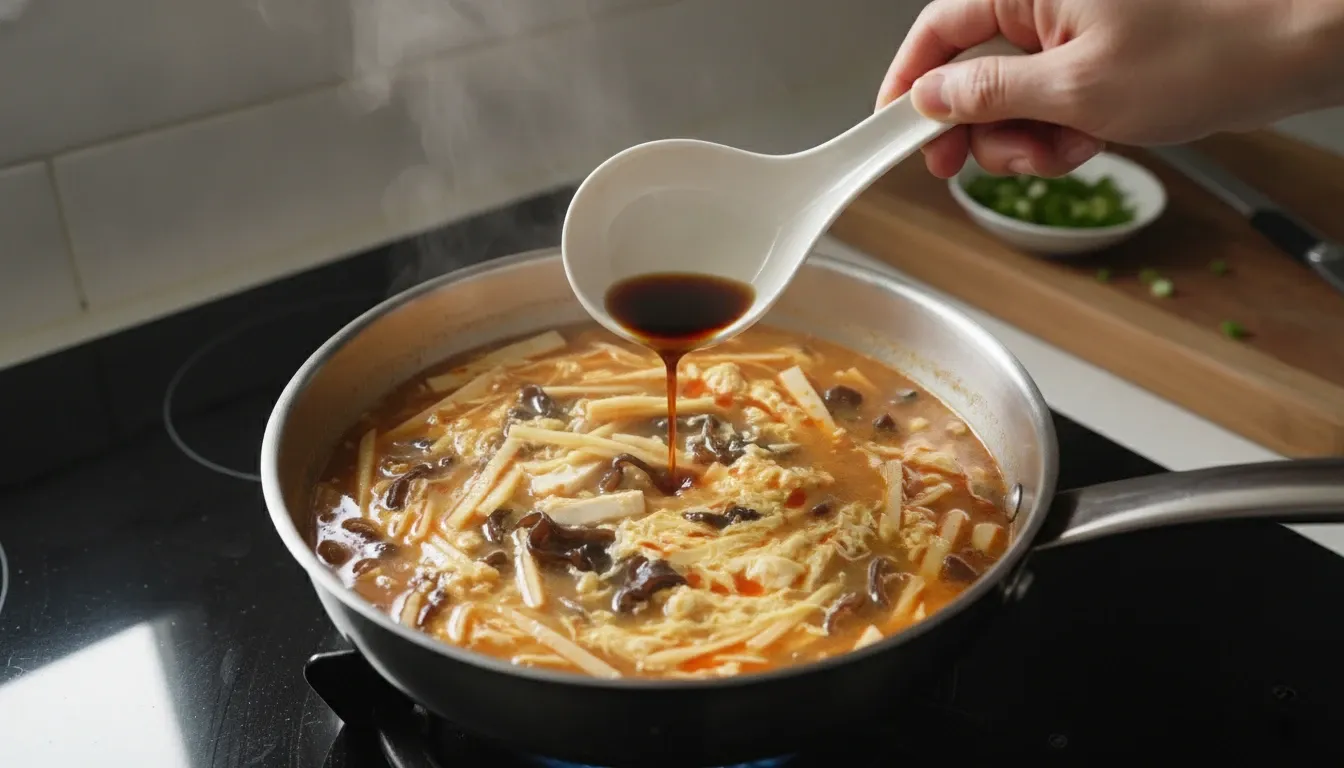
Hot and sour soup leads with sour, so the vinegar goes in just before the heat goes off. In a dish like sweet and sour pork, where sweet and sour are cooked together into a glaze, add the vinegar early and boil off its edge before it meets the sugar.
Stop just before a taste stands out
Ben Wei lists good flavor in the form “X but not too X.” Each taste is at its best when it stops just short of going too far.
| Line in Ben Wei | Meaning | Cue in the kitchen |
|---|---|---|
| 甘而不噥 | Sweet but not cloying | Before sweetness lingers so long you don’t want the next bite |
| 酸而不酷 | Sour but not harsh | Before it stings your nose |
| 辛而不烈 | Spicy but not fierce | Before the heat hides every other taste |
| 澹而不薄 | Light but not thin | If more salt makes the ingredient’s flavor clearer, it is still thin |
| 肥而不𦢈 | Rich but not greasy | No pool of oil on the plate |
Sources: Lüshi Chunqiu, Ben Wei (references).
If you can name a supporting taste, you have added too much. Taste kung pao chicken: if sweetness hits first, the sweet has overtaken the main taste.
When tasting leaves you unsure, change one taste at a time. Add two at once, and you can’t tell which seasoning changed the taste.
Japanese cooks remove; Chinese cooks remove, then layer
Japanese cooking also preps ingredients by removing odors and anything unwanted. The difference is what happens next.
| Cuisine | What prep removes | After removing |
|---|---|---|
| Chinese | Odors, blood, fat (liao jiu, ginger, scallion; chao shui) | Layer sweet, sour, bitter, and spicy on a salt base and bring them together into one taste |
| Japanese | Bitter scum, odors, excess fat and water (a quick scald, parboiling) | Season once, in a simmering liquid mixed to a set ratio, and add fresh garnishes just before eating |
Sources: this site’s articles on subtraction in Japanese cooking and on chao shui.
Japanese cooking lets the ingredient lead and builds flavor by not layering too much seasoning. Chinese cooking brings out the ingredient with salt, then layers the other tastes to remake it as one taste. Both start from removing, and head in opposite directions.
When to layer and when to stop
How much to layer depends on how strong the ingredient is and which taste leads.
| When | What to do | Why |
|---|---|---|
| The ingredient is mild, like tofu or chicken breast | Layer sweet, sour, and spicy freely | The layered tastes don’t drown out the ingredient |
| The ingredient is strong, like crab, mutton, or eel | Stop at ginger and vinegar | Layered tastes clash with the ingredient |
| You use soy sauce, doubanjiang, or oyster sauce | Combine them first, then add only the salt still missing | All of them contain salt, so salt added first makes the dish too salty |
Common failures and fixes
Too much salt, too much sourness, and a flat taste can be fixed. Too much heat and a fishy smell can only be partly saved.
| Problem | Cause | Fix it now | Prevent it next time |
|---|---|---|---|
| Too salty | Soy sauce, doubanjiang, oyster sauce, and salt were layered, and their salt added up | Add more of the main ingredients or stock to dilute it, and round it off with vinegar or sugar, which contain no salt | Combine the salty seasonings first, then add only enough salt to reach about 1% overall |
| Too sour | In a sour-led dish, the vinegar went in just before the heat went off, and the edge of the acetic acid stayed | Add sugar 2.5 ml (½ tsp) at a time to round off the sourness, or bring it back to a boil to drive off acetic acid | To soften the sourness, add vinegar early and boil it. Add it last only when you want it sharp |
| Too spicy | In a dish where heat should support, doubanjiang or chili went in at a lead amount. The sting lingers on the tongue and masks salt, sweet, and sour | Add more of the main ingredients to dilute it, and add sugar and vinegar a little at a time to round off the heat | Choose the one main taste first, and keep supporting heat to an amount you notice in the aftertaste |
| Flat, under-seasoned | Salt fell short of 1% of the whole dish. The ingredient’s flavor never came forward, and the added sweet, sour, and spicy came out scattered | Before adding sugar or vinegar, add salt a pinch at a time and taste at serving temperature | Build a base of about 1% with salty seasonings and salt, then layer sweet, sour, and spicy |
| A fishy smell | Tastes were layered without removing odors first. The fishiness mixed with the sweet and sour and stayed | Pour liao jiu down the side of the wok, burn it off over high heat, and add ginger and scallion | Before seasoning, remove odors with liao jiu, ginger, and scallion, or by blanching |
Four things to remember
Wu wei tiao he doesn’t mean using all five tastes. It means taking an ingredient with its odors removed, building a base of salt, raising one main taste, and rounding it off with the others.
- Remove odors before seasoning, with liao jiu, ginger, and scallion, or by blanching.
- Salt at about 1% of the whole dish. Combine the salty seasonings first, and make up only the shortfall with salt.
- One main taste per dish. Stop supporting tastes before you can name them.
- When tasting, change only one taste at a time.
For strong-flavored ingredients, stopping without layering is part of wu wei tiao he too.
Sources
- Lüshi Chunqiu, "Xiao Xing Lan: Ben Wei" (in Chinese). Harmony uses sweet, sour, bitter, pungent, and salty, in order and amount; remove the smells of fish, game, and mutton; sweet but not cloying, sour but not harsh, pungent but not fierce, rich but not greasy
- Yuan Mei. Suiyuan Shidan, "Things to know" (in Chinese). Foods too strong in flavor are best used alone; pair light with light, rich with rich; season to suit the ingredient
- China Securities Journal. "Group standard for 24 compound flavor profiles of Sichuan cuisine published" (October 21, 2025, Chengdu) (in Chinese). One dish, one character; a hundred dishes, a hundred flavors
Show 2 more
- Maigoo. "Flavor profiles of Sichuan cuisine" (in Chinese). Hot and sour: salt is the base, sour leads, heat supports. Hu la (scorched chili): fragrant, hot, salty, savory, slightly sweet aftertaste. Ma la: rich numbing heat, salty, savory, fragrant
- Yamaguchi Prefecture, Coordinator for International Relations report. "Sweet, bitter, salty, sour, and pungent: the harmony of the five Chinese tastes" (in Japanese). Salt as the master of a hundred tastes; sourness removes fishiness and greasiness