What this article answers
- What Saikyo miso is
- A sweet, pale rice miso from Kyoto. Salt 5–7%, koji ratio 20–25, aged only 1–4 weeks
- Where it works best
- Saikyo-zuke (fish cured 1–3 days), white miso ozoni, shira-ae, and white dengaku
- Where it does not work
- Long simmers and strong meats. The aroma fades and the sugar burns
- How to buy it
- Soybeans, rice, and salt only, made in Kyoto. A jar labeled only "white miso" is often a saltier type
Saikyo miso is the best-known white miso of Kyoto. It has a very high koji ratio, the amount of rice koji to soybeans. Koji is rice cultured with a mold that turns starch into sugar. The result is a miso low in salt, refined in its sweetness, and pale in color.
It is the base of Saikyo-zuke (fish cured in sweet miso), white miso ozoni (the New Year soup with rice cakes), dengaku, and shira-ae (a tofu dressing). Kyoto cooks have relied on white miso for more than a thousand years.
A jar labeled only “white miso” or “shiro miso” is often not Saikyo miso. Many are Shinshu-style miso: light in color but much saltier. Look for 西京 (Saikyo) or 甘口 (amakuchi, sweet) on the label.
What sets Saikyo miso apart
The basics
| Item | Details |
|---|---|
| Type | Rice miso, white and sweet |
| Color | Pale yellow to cream |
| Salt | About 5–7% (among the lowest of any miso) |
| Koji ratio | 20–25 (very high) |
| Fermentation | 1–4 weeks (short) |
| Main regions | Kyoto Prefecture and the region around Kyoto (Kinki) |
| Leading makers | Honda Miso Honten, Ishino Miso, Hondaya |
| Other names | Shiro miso (white miso), Kyo miso |
The koji ratio is the weight of rice for every 10 parts of soybeans by weight. A higher number means more koji and more sweetness.
Where it sits among miso
Saikyo miso is a special, sweet miso. Its character is far from all-purpose miso such as Shinshu or red miso. It is built with far more sugar and far less salt than other miso, so you use it in its own way.
“Saikyo white miso” and “Saikyo-style miso” are different things. The second is white miso from elsewhere, made to imitate the flavor. True Saikyo miso comes from particular makers in Kyoto Prefecture or the region around it.
Ingredients and how it is made
What goes in
Saikyo miso uses the same ingredients as Shinshu miso, soybeans, rice koji, and salt, in very different proportions.
| Ingredient | Saikyo miso | For comparison: Shinshu miso |
|---|---|---|
| Soybeans | 100% (the base amount) | 100% (the base amount) |
| Rice koji | Koji ratio 20–25 | Koji ratio 5–10 |
| Salt | About 5–7% | About 11–13% |
Koji at 2–3 times the soybeans is a design no other miso shares. It is what makes Saikyo miso sweet and pale.
How it is made
| Step | What happens | What Saikyo miso does differently |
|---|---|---|
| 1. Soybeans | The soybeans are boiled | They are skinned and the cooking water is thrown out, removing what would color the miso |
| 2. Rice koji | Koji mold is grown on rice | A large amount of koji is made |
| 3. Mixing | Soybeans, koji, and salt are mixed | A paste dominated by koji |
| 4. Fermenting and aging | A short ferment | Very short, at 1–4 weeks |
| 5. Grinding | Ground smooth | Ground fine for a refined texture |
How Saikyo miso behaves under heat is covered in miso and heat.
How it tastes and smells
The parts of the taste
| Element | Strength | Where it comes from |
|---|---|---|
| Sweetness | Very strong | Glucose and maltose from rice koji (no added sugar) |
| Umami | Strong | Amino acids from soybeans and koji |
| Saltiness | Weak | Restrained, at 5–7% |
| Sourness | Very weak | Gentle, from the short aging |
| Bitterness and astringency | Very weak | Almost none |
The aroma
With such a short aging, Saikyo miso lacks the complex aroma of long-aged miso. Instead, a bright, fruity aroma from the rice koji comes forward: ethyl acetate, isoamyl acetate, and ethanol.
Heat drives this aroma off easily, so it does not suit long cooking over high heat. The rule is low heat and short cooking, to keep the aroma and the sweetness.
How to use it in cooking
Where it fits
| Dish | Fit | How to use it |
|---|---|---|
| Saikyo-zuke | Best | Cure fish or meat for 1–3 days. Its strongest use |
| White miso ozoni | Best | Kyoto’s New Year tradition. Mix with dashi and do not let it boil |
| Shira-ae | Best | Tofu, Saikyo miso, sesame, and sugar. A refined finish |
| White dengaku | Good | Work it with mirin and sugar into a dengaku glaze |
| Vinegar-miso and mustard vinegar-miso | Good | Scallions in vinegar-miso, mustard vinegar-miso dressings |
| Dressings and sauces | Good | A refined sweetness for Western dishes and salads |
| Everyday miso soup | Weak | Too sweet alone. Blend with a rice miso such as Shinshu |
| Long simmers | Avoid | The aroma goes and the sugar burns |
Dashi is Japanese soup stock, usually from kombu and dried bonito. Mirin is a sweet rice seasoning for cooking. Dengaku is tofu, eggplant, or konjac grilled with a sweet miso glaze.
What each dish asks of it
| Dish | Role of Saikyo miso | What to add |
|---|---|---|
| Saikyo-zuke (fish) | The curing bed itself | Mirin, sake (about miso 5 : mirin 1 : sake 1) |
| White miso ozoni | The base of the soup | Kombu dashi, round rice cakes, taro |
| Dengaku glaze | Richness and sweetness | Mirin, sugar, egg yolk, sake |
| Shira-ae dressing | Richness for the dressing | Sesame paste, sugar, usukuchi (light-colored Japanese soy sauce) |
The science of Saikyo-zuke
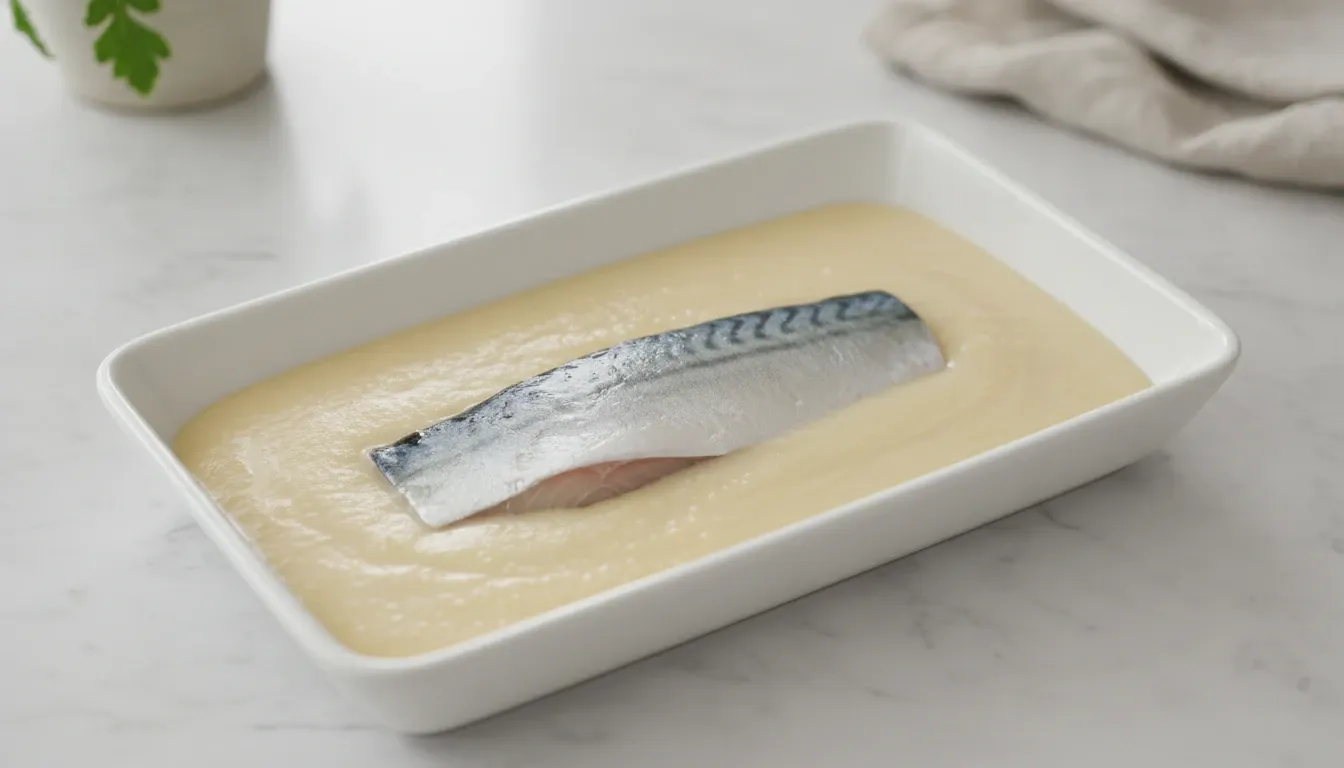
Saikyo-zuke is the most distinctive use of Saikyo miso. Here is why fish and meat cured in it turn so tender and so deep in umami.
Three changes in the curing bed
| Change | Mechanism | Result |
|---|---|---|
| Protein breakdown | Proteases from the koji keep working slowly, even at refrigerator temperature | The texture turns moist and tender |
| More umami | Protein becomes free amino acids, especially glutamic acid | Umami as if dashi had been added |
| Longer keeping | Products of the koji and the salt hold back bacteria | Keeps longer than raw fish |
The basic curing bed
| Ingredient | Amount | Role |
|---|---|---|
| Saikyo miso | 500 g | The base of the bed |
| Mirin | 45 ml | Loosens it, adds sweetness |
| Sake | 30 ml | Loosens it, adds aroma |
Steps:
- Stir the sake and mirin into the miso a little at a time, until it forms a smooth paste
- Pat the fish dry (Spanish mackerel, salmon, or black cod), salt it lightly, and leave it for 30 minutes
- Wipe off the liquid that comes out, and cover the fish with the paste
- Cure it in the refrigerator for 1–3 days
- Wipe off the miso before grilling, so it does not burn
Black cod with miso, the dish many readers know from restaurants, is often made with ordinary white miso and a lot of added sugar. The sugar offsets that miso’s salt. Saikyo miso is already sweet and low in salt, so this bed needs no sugar.
Foods that pair well
The best matches
| Category | Foods | Effect |
|---|---|---|
| White fish | Spanish mackerel, sea bream, black cod, cod, salmon | The classics for Saikyo-zuke. Brings out mild fish |
| Chicken | Thigh, breast | Tender when cured and grilled |
| Tofu | Firm, silken | Shira-ae, dengaku, miso-cured tofu |
| Vegetables | Scallions, vegetables for vinegar-miso, root vegetables | Vinegar-miso dressings, dengaku |
| Rice cakes | Round rice cakes | White miso ozoni |
| Citrus | Yuzu, sudachi | Aroma for dengaku glaze and dressings |
Yuzu and sudachi are fragrant Japanese citrus.
Poor matches
- Rich meats (beef, lamb): they overwhelm the delicacy of Saikyo miso
- Oily fish (mackerel, sardine): the sweetness floats on top of the fat and fishy smell
- Sharply acidic vegetables such as tomato: the flavors pull in different directions
How to choose a good jar
What to check on the label
| Check | A good Saikyo miso | Avoid |
|---|---|---|
| Ingredients | Soybeans, rice, and salt only | Sugar, starch syrup, flavor enhancers (such as MSG) |
| Color | Pale yellow to cream | Stark white (possibly bleached), deep yellow |
| How it is made | Fully brewed, naturally brewed | Heat-accelerated |
| Region | Kyoto Prefecture or the region around it | Labeled “Saikyo-style” or “white miso style” |
On imported jars, 西京 (Saikyo) on the label is the surest sign. A jar marked 信州 (Shinshu) is the saltier type, even when it looks pale.
How to store it
| State | Where | How long |
|---|---|---|
| Unopened | Refrigerator recommended | Until the best-before date (short: 3–6 months) |
| Opened | Refrigerator, always | Ideally within 1 month |
| Long term | Freezer | About 3 months |
Saikyo miso is low in salt (5–7%), so it keeps less well than other miso. Never store it at room temperature. Once opened, use it up quickly.
When to reach for Saikyo miso
Saikyo miso is sweet, pale, and not salty, and it has a special place among miso. It carries the delicacy of Kyoto cooking, with its own repertoire: Saikyo-zuke, white miso ozoni, dengaku, and shira-ae.
How to buy it:
- Choose a jar whose ingredients are soybeans, rice, and salt only
- Buy the real thing from Kyoto or the region around it, not “Saikyo-style”
- Keep it refrigerated once opened, and use it within 1 month
How it divides the work with other miso:
- Everyday use: Shinshu miso, a light-colored, all-purpose rice miso
- Richness and simmering: Hatcho miso
- Curing beds, sweet dishes, and refined finishes: Saikyo miso
One jar of Saikyo miso widens your cooking at once. You may not use it often, but when it counts, it makes dishes no other miso can. It is worth a spot in your refrigerator. To blend it with other miso, see awase miso.
Sources
- Kyoto Prefecture Miso Industry Cooperative. History and character of white miso (in Japanese)
- Honda Miso Honten. About Saikyo white miso (in Japanese)
- Ehime Prefecture (in Japanese). Koji ratio defined as the weight of rice or barley divided by the weight of soybeans, times 10
Show 3 more
- Chef JA Cooks. Sweet white miso: look for 西京 (Saikyo) or 甘口 (sweet) on the label; 信州 (Shinshu) marks a saltier white miso
- America's Test Kitchen. "All About Miso". Hikari Shinshu Miso White and Hikari Saikyo compared as supermarket white miso
- RecipeTin Japan. Nobu's miso-marinated black cod: Nobu uses ordinary shiro miso and adds sugar to offset its saltiness