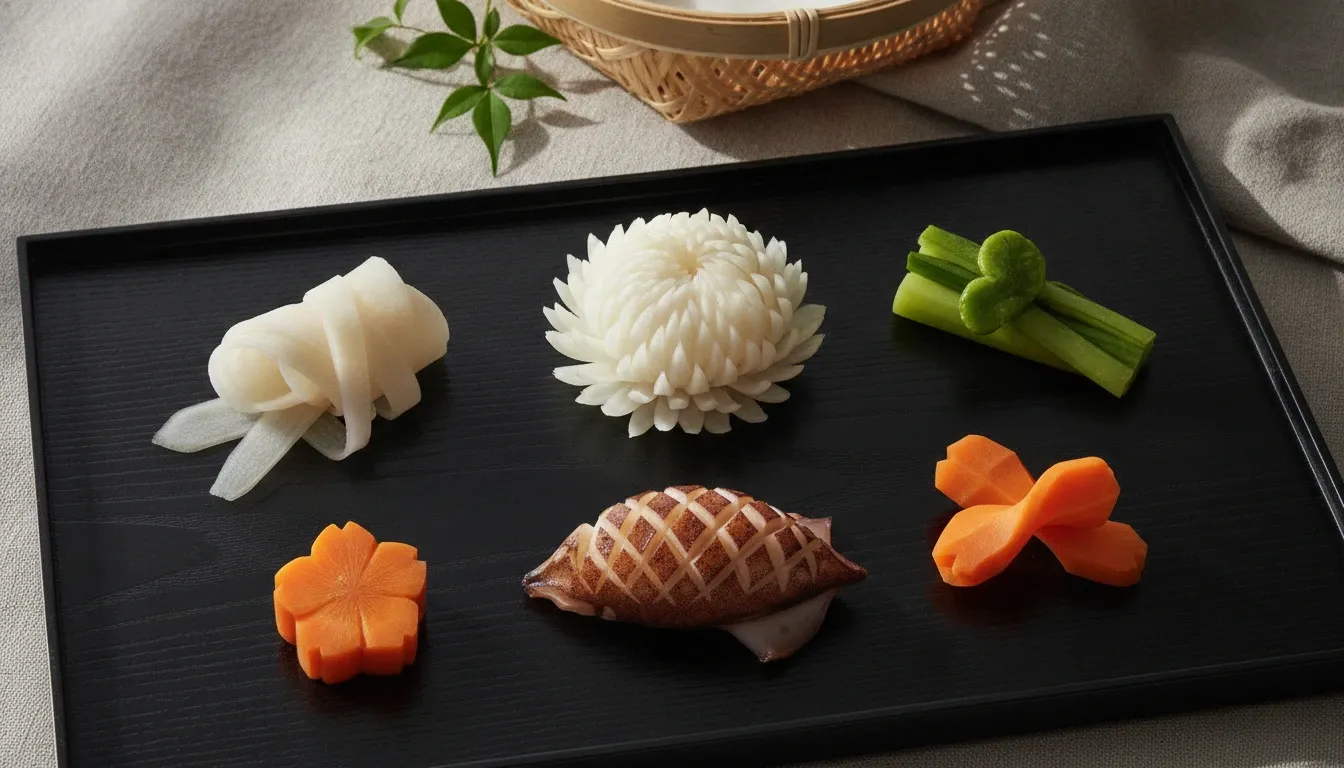
What this article answers
- What kinds of decorative cuts are there?
- 3 kinds: carve a shape to show, score cuts that open, or trim corners to make pieces even
- What changes besides the look?
- Scoring changes how heat and flavor get in. Even shapes make everything cook through together
- How deep to score squid?
- 3/5 to 4/5 of the thickness. Never cut through: the rest holds the piece together
- How do Japan, France, China, and Thailand differ?
- In their signature techniques, Japan and Thailand carve shapes, China opens, and France evens out
A carrot cut into a plum blossom, squid scored like a pine cone, a potato turned into a little barrel. All three get called decorative cuts. Yet the plum blossom keeps its shape when simmered. The squid opens like a flower the moment it hits the heat. And every barrel in the pot finishes cooking at the same time.
They share a name, but the knife is doing something different in each.
This article sorts decorative cuts by kind and shows what each kind changes in the dish. It does not cover how to make each plum blossom or chrysanthemum.
Three kinds of decorative cut
Decorative cuts split into 3 kinds by what the knife does.
You carve a shape to show. You score cuts that heat or salt will open. Or you trim off corners to make pieces even.
| Kind | What the knife does | Examples | What changes in the dish |
|---|---|---|---|
| Show a shape | Carve the outline of a flower, leaf, or bird | Twisted carrot plum blossom (nejiume), lotus-root flower, Thai fruit carving | Look and sense of season |
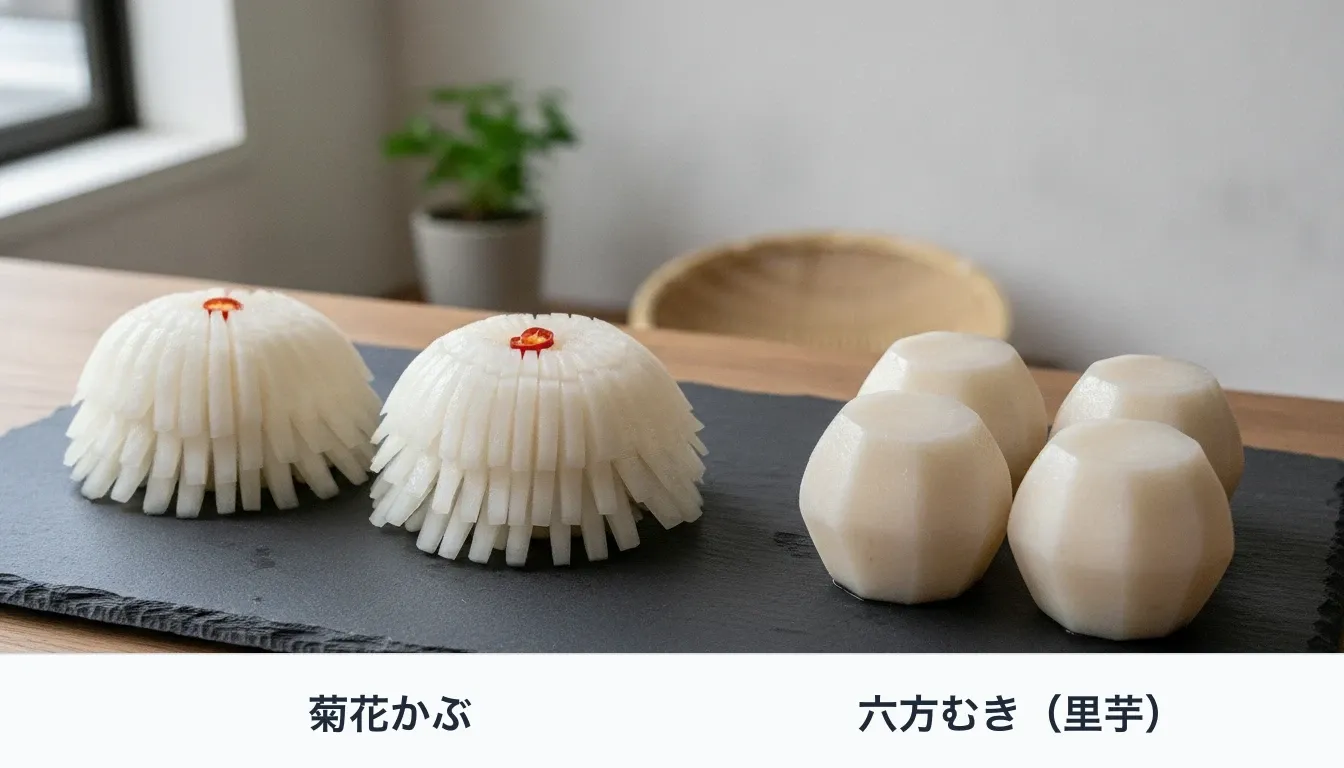
| Open | Score cuts that stop short of cutting through | Chinese hua dao scoring, kanoko squid, chrysanthemum turnip (kikka kabu) | Look, how heat gets in, how flavor gets in |
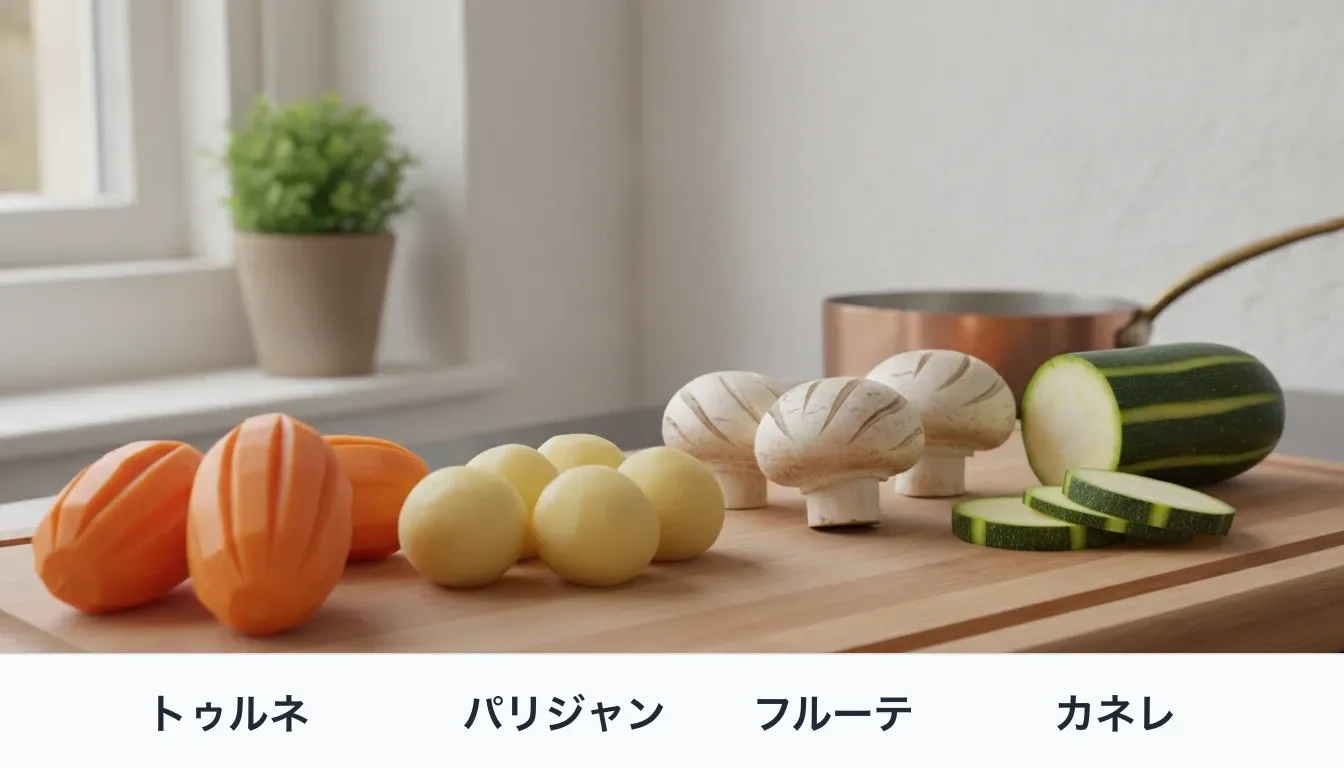
| Even out | Trim corners so pieces share one size and one number of faces | Tourné, roppo-muki, beveling | Even cooking, pieces that do not chip when plated |
Most named cuts you will find, such as pine, bamboo, leaf, or rabbit, are shapes to show. The names are countless, but this article sorts them into 3 kinds by what the knife does.
How hidden cuts and ordinary cuts differ
Kakushi-bocho (隠し包丁, hidden cuts) also score the ingredient, just like cuts that open.
The difference is which side. Hidden cuts go on the side that faces down when plated, so they only handle how heat and flavor get in. Decorative cuts go on the visible side and show the opened shape as well.
Ordinary cuts aim only to make sizes even. How thin strips differ across cuisines is in julienne vs. sengiri vs. Chinese si.
Each cuisine favors a different kind
All 4 cuisines have decorative cuts. But line up their named signature techniques, and they cluster in different kinds.
| Cuisine | Name for decorative cutting | Kind where signature techniques cluster | Signature techniques | Main ingredients |
|---|---|---|---|---|
| Japanese | Mukimono (剥き物), kazari-giri | Show a shape | Nejiume, lotus-root flower | Carrot, daikon radish, lotus root |
| Chinese | Hua dao (花刀) | Open | Wheat-ear pattern (mai sui), lychee pattern (li zhi) | Squid, pork kidney, white fish |
| French | Tourner | Even out | Tourné, château | Potato, carrot |
| Thai | Kae salak (แกะสลัก) | Show a shape | Watermelon flower, papaya bird | Watermelon, papaya, squash |
Sources: China, a Sohu hua dao training text (2019); France, US Patent 7,278,346; Thailand, Thailand Foundation (2025); lotus-root flower, Sanjo City. The “kind” column sorts each source’s techniques into this article’s 3 kinds.
Japan and Thailand carve shapes, China opens
Mukimono is the Japanese technique of peeling and carving vegetables into flowers and leaves. Nejiume is carrot carved into a plum blossom, with a twist given to each petal.
The shapes carry meanings. Lotus root, full of holes, is said to give “a clear view ahead,” so it goes into osechi, the Japanese New Year food boxes.
Thai carving uses a single small carving knife to cut flowers and birds into watermelon and papaya. Ripe fruit is carved to be eaten, and hard unripe fruit is carved to last longer on display. In 2014, Thailand’s Department of Cultural Promotion registered it as intangible cultural heritage.
Chinese hua dao assumes the cuts will open into shape under heat. While raw, it looks like nothing more than a crosshatch.
France evens out the shape
Tourné means trimming root vegetables into barrels of one size and one number of faces (5 or 7). The middle is fat and both ends taper.
Château is a larger tourné cut from potato. At a Japanese culinary-school competition, one Western-cuisine task is to turn 6 matching château potatoes, each 5–5.5 cm (about 2 in) long.
French cooking has other decorative cuts besides tourné, such as scooping balls and carving grooves.
What makes scored cuts open
Only cuts that open change shape after you cut them. Two forces open them. Squid opens because heat makes it shrink. Turnip opens because salt makes it limp.
Squid opens because heat shrinks it
The outer skin of a squid’s body has 4 layers. In the innermost layer, collagen fibers run along the length of the body. When heated, this layer shrinks hard lengthwise, so the squid curls along its body.
If the cuts stop partway through the thickness, the uncut part shrinks while still holding the flesh together. On the outside of the curl, the 2 sides of each cut are then pulled apart. The edges are thought to bend back and open.
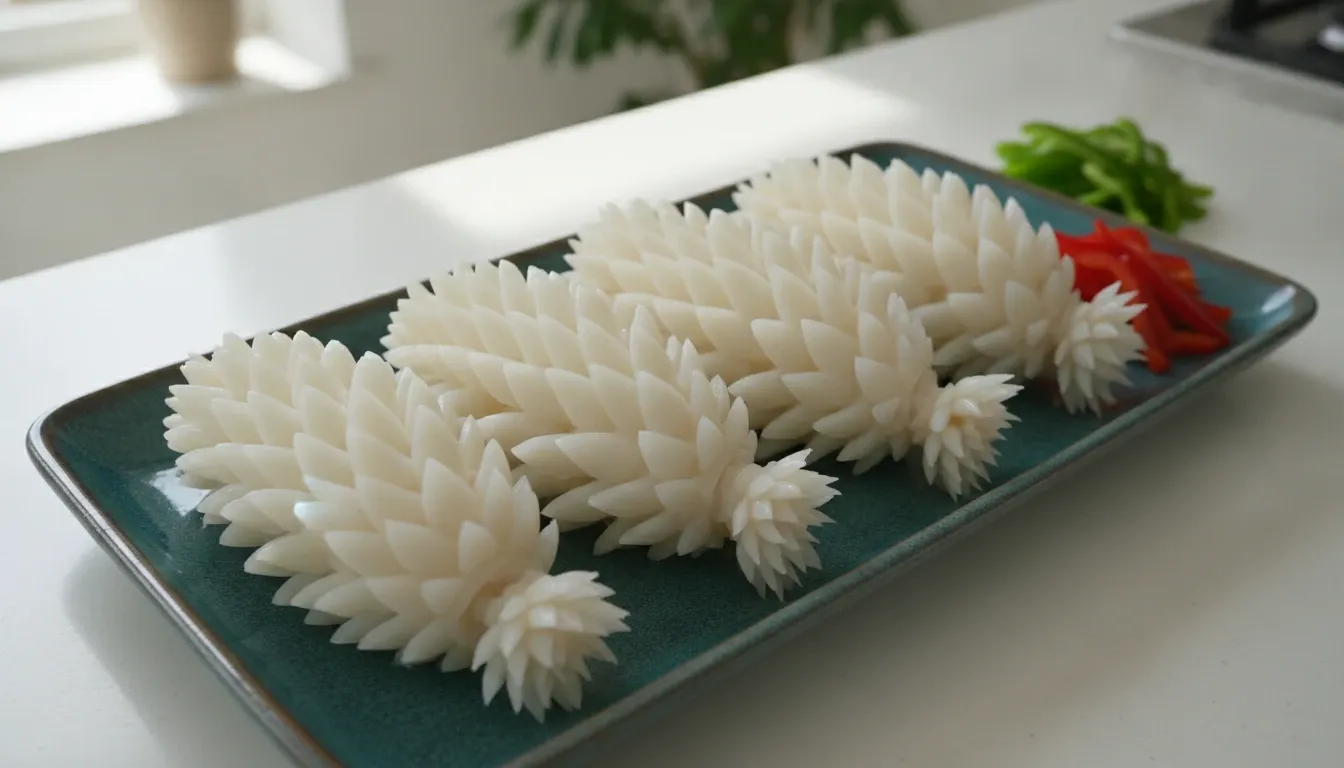
Japanese kanoko, nunome, and matsukasa squid are also scored on the body surface before grilling or simmering. The opened cuts add surface area, so more sauce or simmering liquid clings to it.
Turnip opens because salt softens it
For chrysanthemum turnip, you score a fine crosshatch into a small white turnip, then soak it in salt water.
Salt draws water out of the turnip and makes it supple. The strands between the cuts separate and open like chrysanthemum petals.
Soaking in salt water first also lets the sweet vinegar that follows reach deep into the cuts. Home recipes use 400 ml water with 10 ml (2 tsp) salt, about 3%, for 30 minutes in the fridge, then at least 1 hour in sweet vinegar.
Trimming corners evens out cooking and prevents chips
Cuts that even out do not open. Tourné and roppo-muki (peeling taro and similar roots into 6 faces) make every piece the same size and shape. Same shape, same cooking time, same result.
Beveling, called mentori in Japan, shaves a thin strip off each edge. It is often explained as a way to stop pieces from falling apart in the pot.
But chefs explain that its real purpose is to stop chopsticks from chipping the corners during plating. Falling apart can be prevented with the heat instead. Simmer at 80–90°C (176–194°F), with only a faint wisp of steam, and the pieces are said to hold together even without beveling.
Source: Japanese chef Hiromitsu Nozaki, in Waraku web (February 2026, re-edited from the October 2010 issue of Waraku).
Cut 3/5 to 4/5 deep, never through
With cuts that open, depth, blade angle, and crossing angle change the shape. For every ingredient, one condition holds: stop partway, never cut through.
Hua dao leaves 1/5 of the thickness
Chinese hua dao stops at 3/5 to 4/5 of the thickness and crosses cuts from 2 directions. The training text gives these values for each pattern.
| Pattern | First cut | Second cut | Angle where the 2 cuts cross (°) | Best ingredients |
|---|---|---|---|---|
| Wheat-ear (mai sui) | Blade tilted to about 40°, to 3/5 of the thickness | Blade upright, to 4/5 of the thickness | 70–80 | Squid, pork kidney |
| Lychee (li zhi) | Blade upright, to 4/5 of the thickness | Blade upright, to 4/5 of the thickness | 80 | Squid, pork kidney |
| Chrysanthemum | Blade upright, to 4/5 of the thickness | Blade upright, to 4/5 of the thickness | 90 | White fish, chicken gizzards, tofu |
Source: Sohu, “26 hua dao scoring techniques in Chinese cooking” (2019, reposted from a Chinese training text for cooks). Every pattern requires even spacing, depth, and blade angle throughout.
4/5 means leaving 1/5 of the thickness at the bottom. On a 5 mm (3/16 in) piece, that leaves 1 mm (under 1/16 in) at the bottom.
For fish and vegetables, set the stopping point first
Cut spacing depends on the size of the ingredient. Squirrel fish (song shu yu), a whole fish scored and fried into the shape of a squirrel, has lengthwise cuts 4–6 mm (about ¼ in) apart and diagonal cuts 2–3 mm (about ⅛ in) apart. You cut the flesh down to just above the skin, but never through the skin.
Vegetables use the same kind of stop. For chrysanthemum turnip, set the turnip between 2 disposable chopsticks. Score at 2–3 mm (about ⅛ in) intervals, stopping where the blade hits the chopsticks.
For jabara, an accordion-cut cucumber, the Japanese culinary-school competition gives full marks for evenly spaced cuts 2/3 of the way through its height.
When the depth or spacing is off
With cuts that open, how you score decides how they open. The training text lists the conditions. Break them, and this is likely what happens.
| Hua dao cuts that are | What happens when heated |
|---|---|
| Too shallow | The edges do not bend back far enough, and no shape appears |
| Cut through the skin or the joined base | The flesh is no longer held together and falls into small pieces |
| Uneven in spacing or depth | Each spot opens differently, and you get neither a wheat ear nor a lychee |
Source: an inference from breaking the conditions in Sohu, “26 hua dao scoring techniques in Chinese cooking” (2019): deep but not through, even throughout, skin left uncut.
Cooking has a signal too. Put hua dao squid into water at a hard boil, and lift it out once it has fully curled. The finished curl tells you when to stop.
Where hua dao sits among Chinese knife skills is in Chinese knife skills by level.
Sources
- Sohu. "26 hua dao scoring techniques in Chinese cooking." March 2019 (in Chinese). Angles, depths, and spacing for the wheat-ear, lychee, chrysanthemum, squirrel-fish, and coir-raincoat patterns
- Sohu. "How to make stir-fried squid." November 2022 (in Chinese). Putting scored squid into boiling water and lifting it out once it curls
- Sushi-pedia. "Kakushi bocho." The difference between hidden cuts and decorative cuts
Show 7 more
- Nihon Shokuryo Shimbun. "Seafood cookery science (4), squid part 4: the fourth layer of the mantle skin causes toughness." June 4, 2001 (in Japanese)
- Waraku web. "Is beveling necessary? Hiromitsu Nozaki on simmered dishes." February 2026, re-edited from the October 2010 issue of Waraku (in Japanese)
- Delish Kitchen. "Chrysanthemum turnip (kikka kabu)" (in Japanese). Cut spacing and times in salt water and sweet vinegar
- Sanjo City. "Decorative vegetable cuts" (in Japanese). Lotus-root flowers
- US Patent 7,278,346. "Tourne cutting method, device and kit." Definition of the tourné shape
- Thailand Foundation. "The Art of Thai Vegetable and Fruit Carving." September 2025
- Zenkoku Chorishi Yosei Shisetsu Kyokai (Japan's national association of culinary schools). "Guidelines for the 42nd Culinary School Cooking Skills Competition." August 2026 (in Japanese). The jabara and château tasks