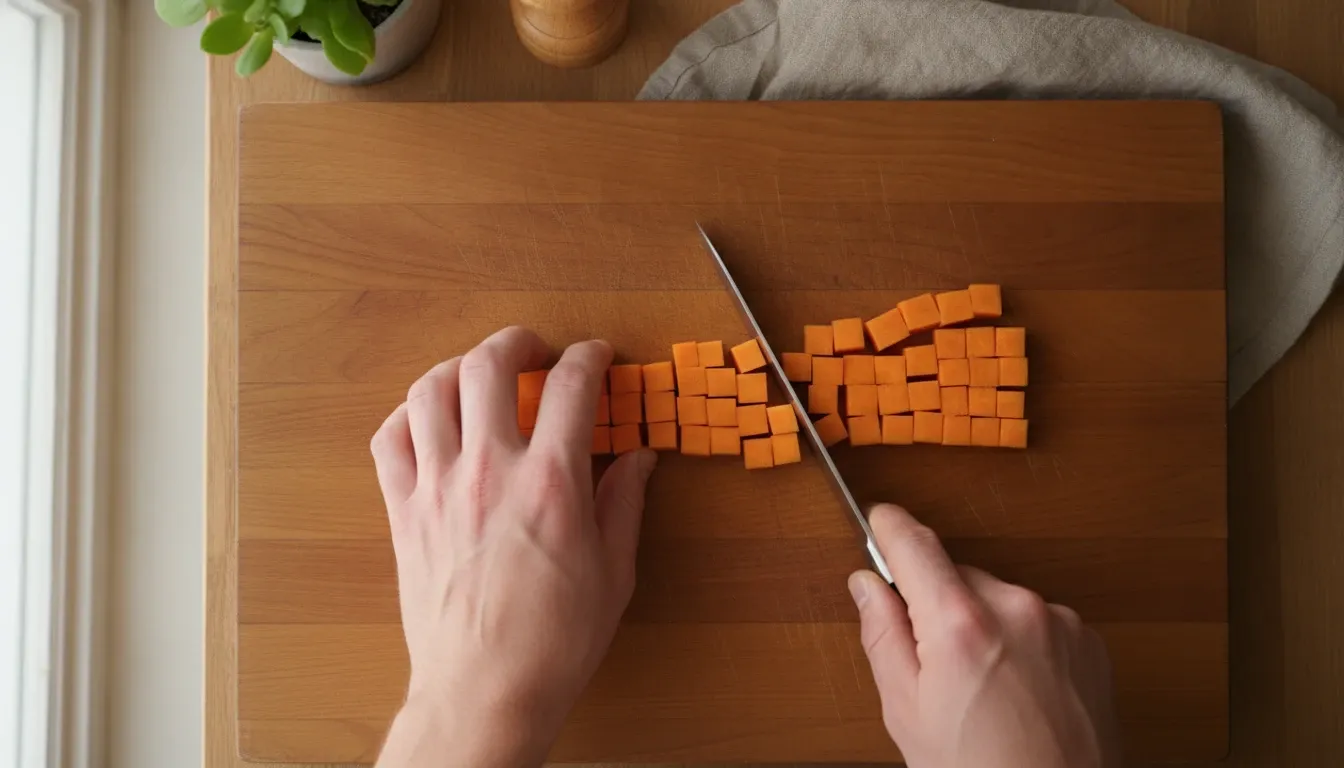
What this article answers
- How big brunoise, ding, and kakugiri are
- Brunoise 2 mm, ding 8–10 mm, kakugiri about 1 cm and changed to suit the dish
- Which dice to use for which dish
- Brunoise for sauces and consommé, ding for high-heat stir-fries, kakugiri for simmered dishes
- How to dice a round carrot evenly
- Trim it into a prism first, then slice, cut sticks, and cut cubes. Use the trimmings in stock or soup
- Whether to bevel the corners
- Japanese cooks bevel for long simmers. French and Chinese cooks generally don't
Cutting into cubes is a basic cut in every cuisine. But the size, the precision, and the use change from one cooking culture to the next.
This article compares three of them. Japanese kakugiri is the everyday cube cut of Japanese home cooking. French brunoise is the tiny, exact dice. Chinese ding (丁) is the dice cut for stir-fries, the ding in gong bao ji ding.
The three dice cuts side by side
| Japanese kakugiri | French brunoise | Chinese ding | |
|---|---|---|---|
| Aim | Even cooking, easy eating | Extreme precision, one shared standard | Speed and practicality, matched to the fire |
| Standard size | 1 cm (flexible) | 2 mm (exact) | 8–10 mm |
| Tolerance | ±2–3 mm | ±0.5 mm | ±2 mm |
| Names by size | No separate names by size | Strictly divided: brunoise, macédoine, and more | Clearly divided: ding, li, and more |
| Knife motion | Pull cut | Rocking motion | Straight-down cut |
| Priority | Easy eating, good looks | Precision, even cooking | Speed, even cooking |
| Knife | Santoku or gyuto (chef’s knife) | Chef’s knife | Chinese cleaver (wen wu dao, a mid-weight cleaver) |
| Main uses | Simmered dishes, stir-fries, soups | Sauces, garnishes | Stir-fries such as kung pao chicken |
Brunoise is 2 mm (under ⅛ in) and ding is 8–10 mm (about ⅜ in). Kakugiri is about 1 cm (⅜ in).
French cooking names dice by size
French cooking divides dice strictly by size. Escoffier set the system down, and professional kitchens around the world still use it.
| Name | Size | Use | Difficulty |
|---|---|---|---|
| Fine brunoise | 1 mm | Fine sauces, consommé | Hardest |
| Brunoise | 2 mm (3 mm in the Culinary Institute of America standard) | Sauces, garnishes | Hard |
| Matignon | 5 mm | Sauce bases | Medium |
| Macédoine | 5 mm | Salads, side dishes | Medium |
| Mirepoix | Changed to suit the use (no fixed size) | Stocks, sauce bases | Basic |
The ladder lets a cook pick the right size for each use. It shows French cooking’s habit of reason and precision.
Japanese kakugiri bends to the dish
Japanese kakugiri aims for a size that is easy to eat in one bite, and for good looks. The size isn’t fixed. The cook adjusts it to the dish.
| Size | Name | Use |
|---|---|---|
| 5 mm (¼ in) | Small kakugiri | Stir-fries, small simmered dishes |
| 1 cm (⅜ in) | Standard kakugiri | Most simmered dishes and stir-fries |
| 2 cm (¾ in) | Large kakugiri | Bigger simmered dishes, curry |
| 3 cm (1¼ in) | Block | Long-simmered dishes |
Three cuts make a 1 cm cube
- Slice the ingredient into slabs 1 cm (⅜ in) thick.
- Cut the slabs into sticks 1 cm wide.
- Cut the sticks into 1 cm lengths.
The knife is pulled toward you as it cuts. Japanese cooks use a santoku, an all-purpose knife for vegetables and meat; a chef’s knife does the same job. The rhythm is slow and sure: precision before speed.
Size changes with the dish
Japanese cooks change the size to suit each dish.
| Dish | Ingredients | Size | Why |
|---|---|---|---|
| Nikujaga (simmered meat and potatoes) | Potato, carrot | 3 cm, 1.5 cm | Each ingredient gets its own size, because they cook at different speeds |
| Chikuzen-ni (simmered chicken and root vegetables) | Carrot, burdock, konnyaku | About 2 cm | One size cooks evenly and looks neat |
| Tonjiru (pork and vegetable miso soup) | Daikon, carrot, potato | 1–1.5 cm | Bite-sized and easy to eat |
| Japanese curry | Potato, carrot, onion | 2–3 cm | Chunky pieces you can feel |
Konnyaku is a firm jelly made from konjac. Daikon is a large, mild white radish.
Four points for clean cubes
- Make the pieces as close to cubes as you can. Rectangles look careless.
- Keep all six faces flat and the corners sharp.
- Cut the same ingredient to the same size, so it cooks evenly.
- Bevel the corners lightly, shaving off the sharp edges, so the pieces don’t break up as they simmer.
French brunoise is 2 mm and exact
Brunoise is a very small, very exact dice of 2 mm. It is a signature of the standardization that Escoffier brought to French cooking.
| Brunoise | Fine brunoise | |
|---|---|---|
| Size | 2 mm | 1 mm (under 1/16 in) |
| Tolerance | ±0.5 mm | ±0.2 mm |
| Shape | A perfect cube | A perfect cube |
Brunoise starts as a julienne
A good brunoise comes from a good julienne.
- Square the ingredient into a rectangular block.
- Slice it into slabs 2 mm thick.
- Stack the slabs and cut them into a julienne 2 mm wide.
- Line the julienne up side by side.
- Cut across at 2 mm intervals.
For julienne sizes, see Julienne vs. Sengiri vs. Chinese Si.
Rocking cut and blade grip
The knife rocks on its tip, rising and falling in a steady rhythm. The grip is the blade grip: thumb and index finger pinch the blade where it meets the handle.
A professional dices a whole carrot into brunoise within 5 minutes. For an intermediate cook, 7 minutes is the target.
Why ±0.5 mm matters
If the pieces aren’t all the same size, they don’t cook evenly. One large piece stays undercooked. In a sauce, every piece should give the same texture.
| Dish | Ingredients | Point |
|---|---|---|
| Brunoise de légumes | Carrot, celery, turnip | A vegetable brunoise for garnish |
| Tomato concassé | Tomato | Peeled, seeded, then cut into brunoise |
| Garnish in sauces | Carrot, celery, shallot | Gives the sauce depth |
| Garnish in consommé | Carrot, turnip, celery | Floats neatly in a clear soup |
The garnish only floats beautifully because the consommé itself is clear.
Four points for brunoise
- Make the julienne perfect first. An uneven julienne gives an uneven brunoise.
- Line the julienne up parallel, with the ends exactly even.
- Use a chef’s knife with a blade of 20 cm (8 in) or more. A smaller knife slows you down.
- Time yourself when you practice, against the targets above.
Chinese ding is sized for high heat
Chinese ding is a fairly large dice of 8–10 mm. It is built for bao chao, stir-frying fast over very high heat, and it puts speed and practicality first.
| Ding | Xiao ding (small ding) | |
|---|---|---|
| Size | 8–10 mm | 5–6 mm (¼ in) |
| Tolerance | ±2 mm | ±1 mm |
| Shape | Close to a cube | Close to a cube |
Chinese cooking also names its dice by size.
| Name | Pinyin | Size | Use |
|---|---|---|---|
| 粒 | li | 3–5 mm (⅛–¼ in) | Fried rice |
| 小丁 | xiao ding | 5–6 mm | Fine stir-fries |
| 丁 | ding | 8–10 mm | Standard stir-fries |
| 块 | kuai | 2–3 cm (¾–1¼ in) | Braised dishes |
A straight-down cut with a rhythm
The cleaver comes straight down from above, kept perfectly vertical. You put your weight behind it and let the cleaver’s own weight do the work.
The rhythm is a steady chop, chop, chop. A professional cuts a whole carrot into ding in under 1 minute. Speed matters, but so does precision, and the rhythm keeps both.
Why ding is on the large side
- It stands up to high heat. Too small and it burns, too large and it won’t cook through.
- It balances texture: browned outside, still crisp inside.
- Bigger pieces are faster to cut.
| Dish | Ingredients | Size |
|---|---|---|
| Kung pao chicken (gong bao ji ding) | Chicken, green pepper, peanuts | All 1 cm, for even cooking |
| Mapo tofu | Tofu | 1.5 cm (⅝ in), a size that doesn’t break up |
| Black pepper beef (hei jiao niu ding) | Beef, green pepper, onion | 1 cm, stir-fried over high heat |
| Fried rice | Carrot, ham | Li (3–5 mm), the size of a grain of rice |
Four points for ding
- Chinese cooks say prep is eight-tenths of the work. Cut every ingredient into ding before you start cooking.
- In kung pao chicken, cut the chicken and pepper to the same 1 cm, matched to the peanuts.
- Use a wen dao (thin slicing cleaver) for vegetables and a wen wu dao (mid-weight cleaver) for meat.
- Cut fast, but keep the size within ±2 mm.
How size, heat, and naming compare
| Cuisine | Size | Tolerance | Volume | Ranking |
|---|---|---|---|---|
| French (brunoise) | 2 mm | ±0.5 mm | 8 mm³ | Smallest |
| Chinese (ding) | 8–10 mm | ±2 mm | 512–1000 mm³ | About the same as kakugiri, slightly smaller |
| Japanese (kakugiri) | 1 cm (flexible) | ±2–3 mm | 1000 mm³ | Largest, changed to suit the dish |
French dice are the smallest because they chase precision and go into sauces and garnishes. Chinese ding stays about the size of kakugiri because that is the largest size high heat can cook to the center in a short time. Japanese kakugiri is flexible because the size follows the dish and what is easy to eat.
Each size suits a way of cooking
| Cuisine | Main cooking methods | Why the size fits |
|---|---|---|
| Japanese | Simmering, stir-frying, deep-frying | 1 cm is one easy bite, ideal for simmered dishes |
| French | Mixed into sauces, floated in soups | 2 mm is small and blends into a sauce without getting in the way |
| Chinese | Stir-frying over high heat (bao chao) | 8–10 mm stands up to high heat: browned outside, crisp inside |
How fixed each set of names is
| Cuisine | Standardization | Names | Talking between cooks |
|---|---|---|---|
| French | Very high | Strict (brunoise, macédoine, and more) | The name tells you the size |
| Chinese | Medium | Clear (ding, li, kuai, and more) | The name tells you the rough size |
| Japanese | Low | Flexible (kakugiri, size depends on context) | You have to state the size |
The culture behind each
| Cuisine | Background | Effect on dicing |
|---|---|---|
| Japanese | An ideal of harmony, food that is easy to eat | Flexible sizes, adjusted to each dish |
| French | The court-cooking tradition and Escoffier’s system | Extreme precision; standards let professionals work together smoothly |
| Chinese | A culture of fire, speed, efficiency, and practicality | Speed first, built for short high-heat cooking |
One carrot cut three ways
The setup: one carrot, 15 cm (6 in) long and 3 cm (1¼ in) across, cut by an intermediate-level cook. The comparison looked at time, precision, texture, and the dishes each suits.
| Cut | Time | Size | Precision | Texture after stir-frying | Best for |
|---|---|---|---|---|---|
| Kakugiri (Japan) | 3 min | 1 cm | ±2 mm | Firm | Simmered dishes, stir-fries |
| Brunoise (France) | 7 min | 2 mm | ±0.5 mm | Soft, delicate | Sauces, soups |
| Ding (China) | 1 min 30 s | 9 mm | ±2 mm | Strong bite | High-heat stir-fries |
Chinese ding is by far the fastest, because bigger pieces need fewer cuts. French brunoise is the most precise, the result of thorough standardization.
Japanese kakugiri gives the best balance of speed and precision. Each cut is built for a different way of cooking, so they don’t swap well.
Which dice to use for which dish
| What you are cooking | Cut | Why |
|---|---|---|
| Simmered dishes (nikujaga, chikuzen-ni) | Japanese kakugiri (1–2 cm) | Bite-sized, and holds together in the pot |
| Garnish in a sauce | French brunoise (2 mm) | Small enough to blend in without getting in the way |
| High-heat stir-fries (bao chao) | Chinese ding (8–10 mm) | Stands up to high heat: browned outside, crisp inside |
| Garnish in a soup (consommé) | French brunoise (2 mm) | Floats neatly and cooks evenly |
| Fried rice | Chinese li (3–5 mm) | The size of a rice grain, so it blends in |
| Curry | Japanese kakugiri (2–3 cm) | Chunky pieces with substance |
A practice plan for all three
Beginners take about 1–3 months to learn the basic form of each cut. For a full ladder in one cuisine, see French Knife Skills by Level and Chinese Knife Skills by Level.
| Weeks | Practice | Pass mark |
|---|---|---|
| 1–4 | Japanese kakugiri (potato) | 1 cm, within ±3 mm, one potato within 3 minutes |
| 5–8 | Chinese ding (carrot) | 1 cm, within ±2 mm, one carrot within 2 minutes |
| 9–12 | French macédoine (5 mm) | 5 mm, within ±1 mm, one carrot within 5 minutes |
The intermediate stage takes about 3–6 months and brings precision and speed together.
| Weeks | Practice | Pass mark |
|---|---|---|
| 1–8 | Japanese kakugiri, faster | 1 cm, within ±2 mm, one potato within 2 minutes |
| 9–16 | Chinese ding, more precise | 1 cm, within ±1 mm, one carrot within 1 minute |
| 17–24 | French brunoise | 2 mm, within ±0.5 mm, one carrot within 10 minutes |
The advanced stage takes about 6 months to 1 year, and the aim is to use every cut freely.
| Goal | Pass mark |
|---|---|
| French fine brunoise | 1 mm, within ±0.2 mm, one carrot within 5 minutes |
| Chinese li | 3–5 mm, within ±1 mm, one carrot within 3 minutes |
| Creative use | Design a dish that uses all three cuts on one plate |
| Teaching | Teach each cut to a beginner until they can do it |
Three dice cuts on one plate
Here is one example: a steak with three garnishes, each diced a different way. The idea is to enjoy the differences in texture and look.
| Garnish | Cut | Cooking | Texture |
|---|---|---|---|
| Carrot | French brunoise, 2 mm | Sautéed in butter | Delicate |
| Potato | Japanese kakugiri, 1 cm | Deep-fried plain | Fluffy |
| Bell pepper | Chinese ding, 1 cm | Stir-fried over high heat | Crisp |
The sauce is a red wine sauce made with the carrot brunoise.
One plate gives three different textures. The difference in size works as a visual accent, and each cut adds its own strength.
Common questions about dice cuts
Which cut should I learn first?
Start with Japanese kakugiri. The pieces are large (1 cm), so they are easy to cut. The tolerance is moderate (±2–3 mm), so you are less likely to give up.
Any chef’s knife or santoku will do, with no special knife. And you see the result quickly in simmered dishes and curry.
Then learn Chinese ding for speed and French brunoise for precision, in that order. Each cut’s character is easier to grasp that way.
Does brunoise really have to be 2 mm?
In a professional kitchen, yes: exactly 2 mm. One large piece stays undercooked. Pieces of different sizes give a sauce mixed textures. And when a cook says “brunoise,” everyone knows it means 2 mm.
At home, an error of about ±1 mm is acceptable.
Ding and kakugiri are the same size. What differs?
The size is almost the same: 8–10 mm for ding, about 1 cm for kakugiri. What differs is the heat each is cut for. Ding is built for bao chao, short cooking over high heat.
At 8–10 mm, ding cooks to the center over high heat without burning. It comes out browned outside and crisp inside. And it is much larger than brunoise, so it is fast to cut, which matters in Chinese cooking.
Japanese simmered dishes cook slowly over low heat, so even 1 cm pieces turn tender.
How fast do professionals cut?
These are professional speeds for one carrot.
| Cut | Time |
|---|---|
| Japanese kakugiri (1 cm) | Within 2 minutes |
| Chinese ding (1 cm) | Within 1 minute |
| French brunoise (2 mm) | Within 7 minutes |
| French fine brunoise (1 mm) | Within 5 minutes |
Precision still comes before speed. Even cubes cut slowly are worth more than uneven cubes cut fast.
Should the cut change with the ingredient?
Yes. Each ingredient has a best cut, set by its firmness and how it is cooked.
| Ingredient | Cut | Why |
|---|---|---|
| Potato | Japanese kakugiri (1–2 cm) | Holds together in the pot, with a fluffy texture |
| Carrot | Any of the three | Evenly firm, so every cut is easy |
| Tofu | Chinese ding (1.5 cm) | Large enough not to break up |
| Tomato | French brunoise (2 mm) | Ideal for concassé, after peeling and seeding |
| Chicken | Chinese ding (1 cm) | Ideal for stir-fries such as kung pao chicken |
How do I dice round vegetables evenly?
A round carrot or potato won’t give even cubes as it is. Each cuisine deals with that differently.
| Cuisine | Approach | Priority | Trimmings |
|---|---|---|---|
| Japanese | Trim into a six-sided prism | Good looks, even size | Used in kinpira (stir-fried, simmered strips of root vegetable) or soups |
| French | Square into a full rectangular block | Strict standard, precision | Sorted and kept for mirepoix and stock |
| Chinese | Square only the thick part; roll-cut the thin part | Speed, practicality | Roll-cut so nothing is wasted |
Japanese cooks start by trimming. They shave the carrot lengthwise into 6 faces, making a hexagonal or square prism. Then they slice at the target size (1 cm), cut sticks 1 cm wide, and cut the sticks into 1 cm lengths.
Every piece comes out the same size, looks clean, and holds together in the pot. About 20–30% of the carrot is trimmed away. Use it in kinpira or in soup.
French cooks square the carrot into a perfect rectangular block for brunoise. They slice it 2 mm thick (a mandoline is fine), cut a 2 mm julienne, then cut it into 2 mm lengths.
The offcuts go into mirepoix (a sauce base with no fixed size), into stock, or into the staff meal. Professional kitchens sort offcuts by use and prep “brunoise carrots” already squared into blocks.
Chinese cooks square the thick part of the carrot (3 cm, 1¼ in, or more across) and dice it. The thin part (3 cm or less) is roll-cut: turned as you cut on the diagonal, called gun dao kuai (滚刀块).
Mixing dice and roll-cut pieces is fine if the sizes match. This saves time. In short high-heat cooking, size matters more than shape, and an uneven shape doesn’t matter if everything cooks evenly.
Potatoes get similar treatment.
| Cuisine | How potatoes are handled |
|---|---|
| Japanese | Small potatoes whole or halved. Large ones trimmed into a six-sided prism, then diced. “Bite-sized” is the guide, so the size is flexible |
| French | Pommes parisiennes: scooped into perfect balls about 1 cm across with a special scoop. Or squared into perfect cubes. Offcuts go into pommes purée (mashed potatoes) |
| Chinese | Rarely kept round. Usually cut into strips, as in shredded potato stir-fry (chao tu dou si). When diced, cut large without worrying about shape |
Restaurants sort carrots and potatoes into two grades first. Thick, straight ones are “standard size” and go into dice and brunoise. Thin or bent ones go into purées, soups, and stocks.
At home, make a habit of trimming first: shave the vegetable into a prism 2–3 cm (¾–1¼ in) square. Don’t throw the trimmings away. Use them in a stir-fry such as kinpira, in miso soup, or in vegetable soup, and keep a recipe ready for offcuts.
A perfect dice needs that first trimming. Offcuts always happen, so plan where they go. Match how precisely you trim to what the dish needs.
Do only Japanese cooks bevel the corners?
Each cuisine treats beveling very differently. Japanese cooking values it. French and Chinese cooking use other methods.
| Cuisine | Beveling | Why | What they do instead |
|---|---|---|---|
| Japanese | Done routinely | Stops pieces breaking up; looks better | Nothing: beveling is the standard |
| French | Generally not done | Keeps the standard shapes | Blanching (blanchir) |
| Chinese | Generally not done | Speed first; short high-heat cooking | Passing through oil (guo you) |
Japanese cooks bevel for four reasons. The corners would otherwise knock against each other in the moving liquid and crumble. The surface area grows, so flavor soaks in. Rounded corners feel gentler in the mouth. And vegetables with softened corners look refined.
Most cooks shave each corner thin with a knife. At home a vegetable peeler is quicker. There is also a special beveling tool.
Bevel vegetables for simmered dishes: nikujaga, chikuzen-ni, oden (a long-simmered one-pot dish), daikon simmered with yellowtail, and the carrot or turnip in clear soups. Shave about 1–2 mm (about 1/16 in), until the corner no longer feels sharp to the touch.
French cooks rarely bevel. Brunoise and macédoine should be perfect cubes, every one the same shape. Beveling takes time and erodes the benefit of standard cuts.
The vegetables are sautéed, roasted, or mixed into sauces, so they are less likely to break up. Turning (tourner) shaves potato or carrot into a 7-sided barrel shape. That is decorative shaping for looks and even cooking, not beveling, and it isn’t used for dice.
Instead, French cooks blanch the diced vegetables briefly first to firm the surface. Ingredients that break up easily are simply cut larger.
Chinese cooks don’t bevel either. Beveling is slow, and in Chinese cooking speed is everything. A bao chao stir-fry carries no risk of pieces breaking up. The corners are kept for their crisp bite, and the extra work does little for flavor.
Instead, Chinese cooks pass the pieces through oil (guo you) first, which seals the surface so they hold together. Roll-cut pieces have no corners to bevel. Fragile ingredients such as tofu are cut into a larger ding (1.5 cm).
The background differs too. Japanese cooking simmers many dishes slowly over low heat, its seasoning is delicate, and crumbled pieces cloud the flavor. Sharp corners are considered unattractive, and rounded shapes beautiful.
French cooking values standards, from Escoffier’s system. Vegetables often go into sauces, where breaking up does no harm, and steps that add nothing are cut to keep the kitchen efficient.
Chinese cooking is built on fire: short cooking over high heat. Huo hou (火候, the control of heat and timing) matters most, so prep is fast. Steps that barely change the flavor are dropped.
Bevel when you make Japanese simmered dishes, cook anything for 30 minutes or more over low heat, or want Japanese food to look its best. Skip it for any stir-fry (including Japanese ones), short high-heat cooking, pieces mixed into sauces, or when you are short of time.
To save time, use a peeler instead of a knife. Bevel only large pieces, not small dice. Bevel only the ingredients that break up easily, such as potato and kabocha squash.
Beveling reflects Japanese cooking’s culture of simmering and its sense of beauty. French cooking puts standards first and Chinese cooking puts speed first, so neither usually bevels. Each culture has its own way to keep pieces whole, and beveling is just one of them.
Choose the dice by its purpose
One cut, the dice, carries each cuisine’s thinking. Japanese kakugiri uses flexible sizes for easy eating and good looks. French brunoise uses extreme precision for standards and efficiency. Chinese ding uses speed and practicality, built for short high-heat cooking.
Four things are worth learning. Know why each size and tolerance exists. Pick the right cut for each dish. Understand the culture behind each cut. And combine all three to create new dishes.
Sources
- Kyodo Kumiai Keihin Hamono Senmonten-kai (Keihin cutlery retailers' cooperative). "Types of kitchen knives" (in Japanese). Japanese, Western, and Chinese knives and what each is for
- Sakai Ichimonji Mitsuhide. "Japanese knives and Western knives: what is the difference?" (in Japanese). Single and double bevels, and how the steel changes sharpness
- Tsuji Culinary Institute (in Japanese). Techniques and cooking theory of each cuisine