What this article answers
- What to learn first with a chef's knife
- The blade grip, the claw grip, and three cuts: rondelles, dés, and tranches
- How big the standard French cuts are
- Brunoise 2 mm, macédoine 5 mm, julienne 2 × 2 mm × 4–5 cm, tourné 5 cm long with 7 faces
- A test that shows your level
- Julienne one carrot within 5 minutes, every piece within ±0.5 mm, to pass the elementary level
- How long each level takes
- 1–3 months to elementary, 3–6 months to intermediate, 6 months to 2 years to advanced
French knife work is a system built for precision and efficiency. Each cut has a name, and each name has a size.
This article splits French knife skills into five levels, from beginner to master. For each level, it sets out what you must be able to do and how to check it. It covers classic cuts and modern ones.
For the same ladder in Chinese cooking, see Chinese Knife Skills by Level.
How French knife work differs
Set beside Japanese knife work, French technique starts from a different goal.
| French cooking | Japanese cooking | |
|---|---|---|
| Aim | Efficient cooking, even doneness | Beauty, control of the fibers |
| Cuts | Geometric, standardized shapes | Cuts that follow the fibers, decorative cuts |
| Knife motion | Push cut, chop | Pull cut |
| Priority | Speed, evenness, efficiency | Precision, beauty, texture |
| Standardization | Names and sizes strictly defined | Named techniques, but flexible sizes |
French cuts have strictly defined names and sizes. That lets a kitchen communicate quickly and cook evenly.
| Group | Examples |
|---|---|
| Vegetable cuts | Julienne, brunoise, macédoine |
| Meat cuts | Escalope, émincé, tranche |
| Decorative cuts | Tourné, château |
Five levels and what each means
Each level is judged on one thing: can you use the skill in real cooking?
| Level | What it means |
|---|---|
| Beginner | Uses a knife safely and can make the basic cuts |
| Elementary | Manages home cooking, and knows the standard cuts |
| Intermediate | The entry to professional work. Makes the classic cuts fast and accurately |
| Advanced | Specialist-restaurant level. Has mastered advanced and decorative cuts |
| Master | Can teach others and develop new techniques |
All five levels in one table
| Level | Skills to learn | Pass mark | Knives | Time to learn |
|---|---|---|---|---|
| Beginner | Grip, stance, basic cuts (rondelles, dés, tranches) | Cuts safely, pieces even in size | Chef’s knife, 20 cm (8 in) | 1–3 months |
| Elementary | Julienne, brunoise, macédoine, émincé, haché | Makes the standard cuts | Chef’s knife + paring knife | 3–6 months |
| Intermediate | Tourné, château, chiffonade, concassé, paillasson | Classic cuts, fast and accurate | Chef’s knife + paring knife + thin vegetable knife (such as a Japanese usuba) | 6 months to 2 years |
| Advanced | Fine brunoise, butchering meat, filleting fish, paper-thin slices | Specialist level, fast and exact | Chef’s knife + paring knife + boning knife | 2–5 years |
| Master | Own refinements, teaching, new techniques | Can teach others, applies skills creatively | Every specialist knife | 5 years or more |
Beginner level is safety and three basic cuts
The goal: use a knife safely and make the basic cuts.
Grip and stance
| Skill | How | Check |
|---|---|---|
| Grip | Blade grip: pinch the base of the blade between thumb and index finger | The knife feels like part of your hand |
| Stance | Face the board square, feet shoulder-width apart | Your elbow bends naturally |
| Board height | At waist height or a little lower | No tension in your shoulders |
| Holding the food | Claw grip: fingertips curled, nails in | Fingertips stay behind the blade |
With the blade pinched, the other three fingers hold the handle. This gives much better control than the pointer grip, with the index finger laid along the spine.
Pass mark: you can cut for 10 minutes straight without your hand tiring, and the blade grip feels natural.
Three ways to move the knife
| Motion | How | Use |
|---|---|---|
| Rocking | The tip stays down as a pivot, and the blade rises and falls | Steady and continuous |
| Slicing | Move the blade back and forth as you cut | Meat and large vegetables |
| Chopping | Bring the whole blade down in a chop | Herbs and garlic |
Rocking is the best motion for mincing.
Rest the middle knuckles of your guiding hand (the left, if you are right-handed) against the side of the blade. The knuckles set the width of each cut.
Listen, too. Good cutting makes a steady tap, tap, tap.
Pass mark: you can mince an onion with the rocking motion.
Rondelles, dés, and tranches
| Cut | What it is | Ingredients | Standard size |
|---|---|---|---|
| Rondelles | Rounds cut from a cylinder | Carrot, zucchini, cucumber | 3–5 mm (⅛–¼ in) thick, all even |
| Dés | Cubes | Potato, carrot, celery | 1 cm (⅜ in). Petits dés 5 mm, gros dés 2 cm (¾ in) |
| Tranches | Thin slices | Onion, tomato, meat | 2–3 mm thick, all even |
For rondelles, bring the knife straight down at even spacing. Slice a thin strip off one side first to make a flat face, so the vegetable doesn’t roll.
The French style is a push cut: press the knife down while moving it slightly forward. Professionals value speed, so keep a steady rhythm without losing accuracy.
Dés are cut in three steps. First slice slabs 1 cm thick, then cut sticks 1 cm wide, then cut the sticks into 1 cm lengths. Keep to that order and you get faster.
Line the sticks up parallel and cut several at once. For more on the French dice sizes, see Dice Cuts Compared.
| Dice by size | Size | Use |
|---|---|---|
| Mirepoix | No fixed size. Larger the longer it cooks | The base of aromatic vegetables |
| Matignon | 5 mm | The base for sauces |
| Brunoise | 2 mm (under ⅛ in) | Decoration, garnish |
Mirepoix is the foundation of French cooking: carrot, celery, and onion as the base of stocks and sauces. Escoffier wrote that its fineness changes with its use, so it has no fixed size.
Tranches are 2–3 mm (about ⅛ in) thick. For onion, halve it first. Leave the root on, cut in a fan along the fibers, then slice straight down.
For tomatoes, a serrated knife cuts without crushing the skin. A well-sharpened chef’s knife works too.
For meat, find the direction of the fibers and slice across them for tenderness. Half-frozen meat is easier to slice thin.
| Cut | Pass mark |
|---|---|
| Rondelles | Every piece within ±1 mm thick, straight cut faces, one carrot within 2 minutes |
| Dés | Every piece within ±2 mm, close to a cube, one potato within 3 minutes |
| Tranches | Every slice within ±0.5 mm, one onion within 3 minutes, tomatoes not crushed |
Safety in a French kitchen
| Habit | Check |
|---|---|
| Carrying a knife | Blade pointed down, held at your side. Call out “Couteau!” (knife) |
| Setting a knife down | Blade facing away, handle to the right (if right-handed) |
| Handing over a knife | Handle first. Never point the blade at the other person |
| Steadying the board | Lay a damp cloth under it |
| Washing a knife | Wipe with a sponge, blade never toward you. Dry it at once |
French kitchens run on calling out. Say “Couteau!” when you move with a knife and “Chaud!” (hot) when you carry something hot. In a tight kitchen, say “Derrière!” (behind) as you pass behind someone.
Pass mark: a month without a single cut finger, and movements that don’t make anyone nearby uneasy.
Tests to pass before moving on
Pass all five, and you are ready for the elementary level.
| Test | Pass mark |
|---|---|
| Dice one carrot into 1 cm dés | Within 3 minutes, every piece within ±2 mm, cut safely |
| Slice one onion into tranches | Within 3 minutes, every slice within ±0.5 mm |
| Cut a zucchini into rondelles | Within 2 minutes, every piece within ±1 mm |
| Blade grip | Comes naturally |
| Safety | A month of cooking without a single cut finger |
Elementary level masters the standard cuts
The goal: understand the standard French cuts and make them.
Julienne
| What it is | Matchstick-thin strips |
| Ingredients | Carrot, celery, leek, ginger |
| Standard size | 2 mm wide × 2 mm thick × 4–5 cm (1½–2 in) long |
| Steps | Cut to 4–5 cm lengths, slice lengthwise 2 mm thick, stack, and cut 2 mm wide |
Square the vegetable into a rectangular block first. Then the julienne comes out even.
Stack only 2–3 slices. More than that slips, which is dangerous, and the widths vary. Keep the knife vertical so every cut is parallel.
Fine julienne is 1 mm × 1 mm (under 1/16 in square). It is used for garnish and decoration.
A vegetable julienne (julienne de légumes) goes into soups and garnishes. A ginger julienne (julienne de gingembre) appears in Asian-inspired French dishes.
Pass mark: every strip within ±0.5 mm in width and thickness, even lengths (4–5 cm), one carrot within 5 minutes. For how julienne compares with Japanese and Chinese strips, see Julienne vs. Sengiri vs. Chinese Si.
Brunoise
| What it is | Tiny 2 mm cubes |
| Ingredients | Carrot, celery, shallot, tomato |
| Standard size | 2 mm (strictly) |
| Steps | Cut a julienne (2 mm × 2 mm × 4–5 cm), line it up, cut across at 2 mm intervals |
A good brunoise comes from a perfect julienne. If the julienne is uneven, so is the brunoise. Line every strip up parallel with the ends even: that is the key to evenness.
Use the rocking motion, pivoting on the tip in a steady rhythm. It gives both speed and precision.
Tomato concassé is tomato peeled, seeded, and cut into brunoise. It goes into sauces and garnishes.
Brunoise is used as a sauce base (brunoise mirepoix), as a garnish, and in soups.
Pass mark: every piece within ±0.5 mm, perfect cubes, one carrot within 10 minutes.
Macédoine
| What it is | 5 mm cubes |
| Ingredients | Potato, carrot, turnip, green beans |
| Standard size | 5 mm (¼ in, strictly) |
| Place in the ladder | Larger than brunoise, smaller than dés |
Macédoine de légumes is a classic French side dish. Several vegetables are cut into 5 mm cubes, boiled, and dressed with mayonnaise.
Every piece must be the same size to cook evenly. One large piece and the cooking goes uneven.
It is bigger than brunoise, so it is faster to cut. With practice, you cut it in half the time of dés.
Pass mark: every piece within ±1 mm, perfect cubes, two potatoes within 10 minutes.
Émincé
| What it is | Thin slices, especially of meat and onion |
| Ingredients | Onion, mushrooms, meat |
| Standard size | 2 mm thick, all even |
| Direction | With the fibers or across them |
For onion, halve it and slice along the fibers. The slices hold their shape when cooked.
For very thin slices, sharpen the knife well and use the slicing motion. When the onion goes into a sauce or confit, even thickness matters: uneven slices cook unevenly.
For mushrooms, stand each one upright and slice from cap to stem. Each slice comes out T-shaped. Fine restaurants slice them 1 mm or less and sometimes serve them raw.
Pass mark: every slice within ±0.5 mm, two onions within 5 minutes, 10 mushrooms within 3 minutes.
Haché
| What it is | Finely chopped |
| Ingredients | Herbs, garlic, shallot |
| Standard size | 1 mm or less |
| Motion | Rocking |
Pin the tip as a pivot and raise and lower the heel while moving the blade back and forth. Rest your other hand lightly on the spine of the knife to steady it.
To get it finer, gather the chopped food into the middle and chop again. Repeat 2–3 times.
Dry herbs well before chopping. Wet herbs bruise and lose their aroma. For garlic, chop it coarsely first, then add a pinch of salt and chop it to a paste. The aroma comes up.
Pass mark: every piece 1 mm or less, a bunch of parsley within 3 minutes, herbs not bruised and still fragrant.
Tests to pass before moving on
Pass all five, and you are ready for the intermediate level.
| Test | Pass mark |
|---|---|
| Julienne one carrot | Within 5 minutes, width and thickness within ±0.5 mm |
| Brunoise one carrot | Within 10 minutes, every piece within ±0.5 mm |
| Macédoine two potatoes | Within 10 minutes, every piece within ±1 mm |
| Émincé two onions | Within 5 minutes, every slice within ±0.5 mm |
| Haché a bunch of parsley | Within 3 minutes, every piece 1 mm or less |
Intermediate level adds classic shaped cuts
The goal: make the classic French cuts fast and accurately, including the decorative ones.
Tourné
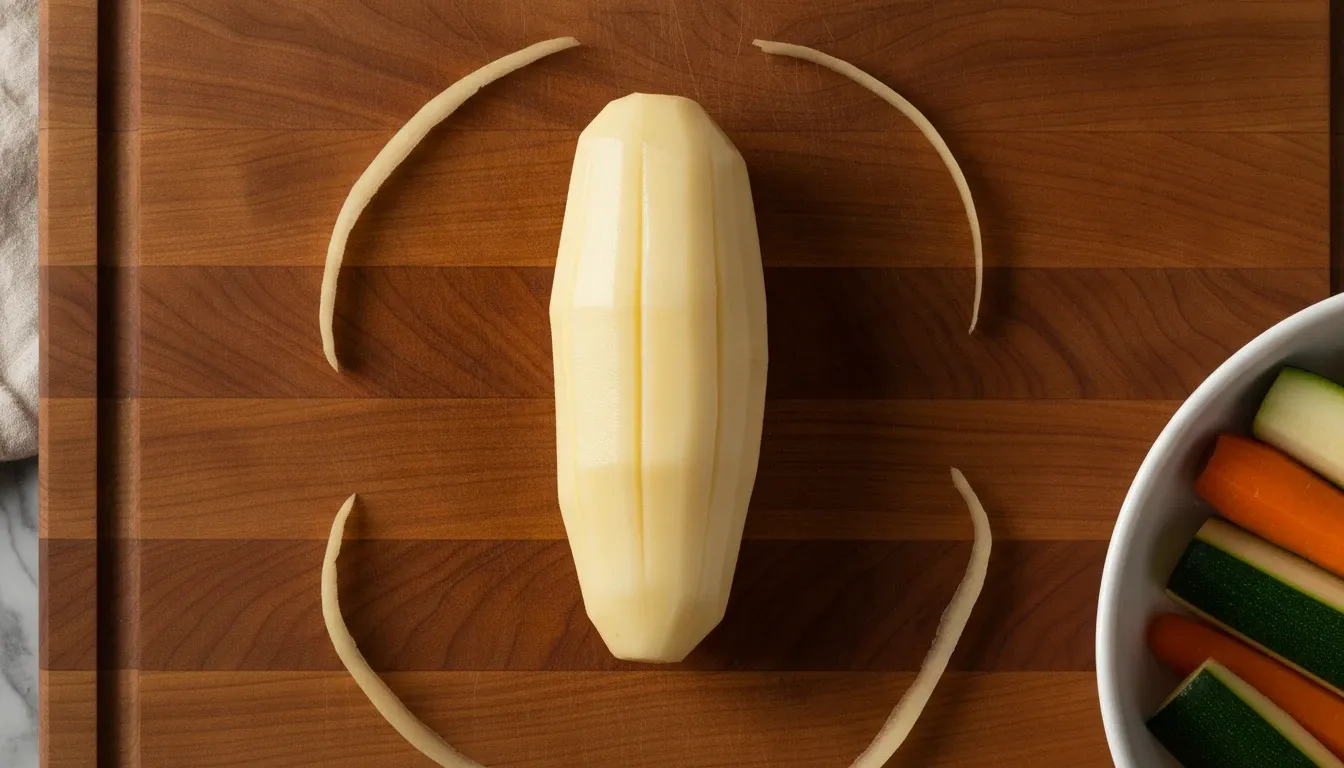
| What it is | A vegetable shaped into a 7-sided barrel |
| Ingredients | Potato, carrot, turnip, zucchini |
| Standard size | 5 cm (2 in) long, 2 cm across, 7 faces |
| Tool | A paring knife, turning the vegetable as you carve |
Cut the vegetable into 5 cm lengths. Turn it as you carve with the paring knife, into a 7-sided barrel shape. Then round off both ends.
Angle the paring knife slightly and carve toward the center of the vegetable. Turn it with the thumb of your holding hand while the other hand carves, in one continuous motion.
Seven faces is traditional. Five faces is accepted today, but seven looks better. Don’t throw away the parings; use them in stock or soup.
Tourné vegetables go into garnishes for meat and fish, into ragoûts (where the even shape looks fine), and into glazed vegetables finished with butter and sugar.
Pass mark: all 7 faces even, 5 cm ±3 mm long and 2 cm ±2 mm across, ends rounded, five potatoes within 20 minutes.
Château
| What it is | A larger turned shape with 6–7 faces |
| Ingredients | Potato |
| Standard size | 6–7 cm long, 3 cm across, 6–7 faces |
| Difference from tourné | Larger and thicker |
The technique is the same as tourné, at a larger size. Château means castle: the potato is shaped like a little castle.
Six faces is faster, seven looks better. Château potatoes are usually roasted, crisp outside and fluffy inside. They are also a garnish in fine dining.
Pass mark: all 6–7 faces even, 6–7 cm (2½–2¾ in) long and 3 cm (1¼ in) across, five potatoes within 15 minutes.
For how turning compares with decorative cuts in other cuisines, see Decorative Cutting Across Cuisines.
Chiffonade
| What it is | Leafy vegetables or herbs cut into thin ribbons |
| Ingredients | Basil, mint, lettuce, spinach |
| Standard size | 2–3 mm wide; length depends on the leaf |
| Steps | Stack a few leaves, roll them into a cigar, cut 2–3 mm wide, and loosen |
Remove tough ribs first, such as the center of a basil leaf. Roll the leaves loosely: rolled tight, they bruise and darken.
Sharpness is everything. A dull knife crushes the leaves and turns them black. Cut just before serving, when the aroma is strongest.
Basil discolors especially fast. Use it right away, or sprinkle it with lemon juice.
Chiffonade goes into garnishes, salads, and the finish of soups.
Pass mark: width within ±0.5 mm, leaves not bruised, 10 basil leaves within 2 minutes.
Concassé
| What it is | Tomato peeled, seeded, and coarsely chopped |
| Standard size | 5 mm (coarser than brunoise) |
| Steps | Score an X in the base, dip in boiling water for 10–15 seconds, cool in cold water, peel, quarter, seed, and cut into 5 mm cubes |
Leave the tomato in the boiling water too long and the flesh cooks. Move it to cold water as soon as the skin starts to curl.
Quarter the tomato and scrape out the seeds with a spoon. Seeds left in make it watery. Lay the flesh flat and cut 5 mm cubes, all the same size.
Match the size to the use: finer for sauces (3 mm, ⅛ in), coarser for garnishes (7 mm, about ¼ in). Concassé goes into tomato sauce, garnishes, and salsa.
Pass mark: skin and seeds fully removed, every piece within ±1 mm, three tomatoes within 10 minutes.
Paillasson
| What it is | Potato cut into very fine strips and cooked as a galette |
| Standard size | Strips 1 mm or less wide |
| Tool | A mandoline or a knife |
A mandoline is faster and more even than cutting by hand. With a knife, slice the potato 1 mm thick, stack the slices, and cut 1 mm wide.
Don’t rinse the strips. The starch holds the galette together. Spread them thin in a round and cook both sides in butter: crisp outside, moist inside.
Pass mark: every strip 1 mm or less wide, two potatoes within 10 minutes.
Tests to pass before moving on
Pass all five, and you are ready for the advanced level.
| Test | Pass mark |
|---|---|
| Turn five potatoes | Within 20 minutes, all 7 faces even, 5 cm long, 2 cm across |
| Fine julienne one carrot | Within 10 minutes, 1 mm × 1 mm |
| Chiffonade 20 basil leaves | Within 3 minutes, 2–3 mm wide, leaves not bruised |
| Concassé three tomatoes | Within 10 minutes, skin and seeds fully removed, 5 mm |
| Speed | Julienne one carrot within 3 minutes, brunoise one carrot within 7 minutes |
Advanced level adds fine dice, meat, and fish
The goal: specialist-restaurant skills, with advanced cuts and the handling of meat and fish.
Fine brunoise
Fine brunoise is a 1 mm (under 1/16 in) cube, cut strictly to size. It is used with carrot, celery, and truffle.
At 1 mm, the precision is close to what you would check with a magnifying glass. Start with a fine julienne of 1 mm × 1 mm and cut it across. If that julienne isn’t perfect, neither is the brunoise.
Keep the precision and still cut fast: the pass mark below is a professional’s pace. Fine brunoise goes into fine sauces, consommé garnishes, and truffle decoration.
Pass mark: every piece within ±0.2 mm, perfect cubes, one carrot within 5 minutes.
Butchering meat
| Cut | What it is | Meat | Standard size |
|---|---|---|---|
| Escalope | Thin slices cut at an angle | Veal, chicken breast, pork tenderloin | 5 mm thick, even |
| Trimming (parer) | Removing excess fat, sinew, and membrane | Beef, pork, lamb | — |
| Mignonnettes | Small round medallions | Beef tenderloin, pork tenderloin | 2 cm thick, 5 cm across |
For an escalope, lay the knife at about 30 degrees. Held upright, it gives an ordinary slice.
Cut across the fibers for a tender bite. Pull the knife toward you in one stroke: sawing back and forth tears the fibers.
After cutting, pound the slice thinner with a meat mallet. This is the standard method for escalope de veau (veal escalope). Veal top round (topside in the UK), chicken breast, and pork tenderloin are the best cuts.
For trimming, remove the silverskin from beef tenderloin: the silvery membrane on its surface. Lay the knife flat and slide it under the membrane.
Don’t remove all the fat. Leave a thin layer (2–3 mm), which adds flavor and texture. Cut tough sinew away with the tip of the knife.
A boning knife has a narrow, flexible blade, ideal for cutting along bone. Turn the meat as you go so you always trim at the best angle.
For mignonnettes, trim the tenderloin perfectly into a cylinder first. Mark it every 2 cm and cut even slices. Slices of the same thickness cook in the same time. Tie each one around the side with kitchen string so it keeps its shape.
Tournedos are similar, but thicker at 3–4 cm (1¼–1½ in), and often wrapped in bacon.
| Cut | Pass mark |
|---|---|
| Escalope | Every slice within ±1 mm thick, cut across the fibers, one chicken breast within 3 minutes |
| Trimming | Excess fat, sinew, and membrane removed, a neat shape, one whole beef tenderloin within 10 minutes |
| Mignonnettes | Every slice within ±2 mm thick, neatly round, one beef tenderloin cut into 10 slices within 5 minutes |
Fish fillets and chicken suprêmes
To fillet a fish into two fillets and the frame, use a filleting knife with a flexible blade. Sea bream, sea bass, and salmon suit it.
- Scale the fish, with a scaler or the back of the knife.
- Cut off the head.
- Open the belly and remove the guts.
- Cut in from the back, following the backbone.
- Cut in from the belly side and free the fillet.
- Turn the fish over and repeat.
The flexible blade bends along the bones, so no flesh is wasted. Keep the knife on the bone and feel it as you cut. Drift away from the bone and flesh stays behind.
After filleting, shave off the rib bones with the knife laid flat beneath them. Pull out the pin bones along the center line with fish tweezers. To skin a fillet, cut in at the tail end, then pull the skin while working the knife back and forth.
A suprême is a chicken breast taken off the bone with the skin left on.
- Cut in along the backbone.
- Free the breast from the breastbone.
- Separate it at the wing joint.
- Shape it with the skin on.
- Remove the tenderloin (the small inner fillet).
Don’t damage the skin: it carries looks and flavor. Keep the knife on the bone so no meat is wasted. The tenderloin has a sinew; remove it with the knife tip.
Trim off excess fat and cartilage for a neat shape. Use the bones and leftover meat for stock.
| Task | Pass mark |
|---|---|
| Fish fillets | No bones left in the flesh, no flesh left on the backbone, one sea bream within 10 minutes |
| Chicken suprêmes | Skin undamaged, breasts cleanly removed, two suprêmes from one chicken within 10 minutes |
Paper-thin slices
Paper-thin means 1 mm or less. Truffle, prosciutto, salmon, and zucchini are cut this way, with a well-sharpened knife, a mandoline, or a slicer.
Use a truffle slicer for truffles, or a sharp paring knife. For salmon carpaccio, half-freeze the salmon and slice it thin, ideally 1 mm or less.
A mandoline is handy for very thin vegetable slices. Always use the hand guard. For thin slices, sharpness is everything: the knife must be sharpened on a whetstone.
Pass mark: every slice 1 mm or less, thin enough to see through, one zucchini within 5 minutes.
Speed and precision at their limit
| Skill | Target |
|---|---|
| Julienne | One carrot within 3 minutes (5 minutes at elementary) |
| Brunoise | One carrot within 7 minutes (10 minutes at elementary) |
| Tourné | 10 potatoes within 30 minutes |
| Fish fillets | One sea bream within 10 minutes |
Tests to pass before moving on
Pass all five, and you are ready for the master level.
| Test | Pass mark |
|---|---|
| Fine brunoise one carrot | Within 5 minutes, every piece within ±0.2 mm |
| Escalopes from one chicken breast | Within 3 minutes, every slice within ±1 mm, across the fibers |
| Fillet one sea bream | Within 10 minutes, no bones in the flesh, no flesh on the backbone |
| Turn 10 potatoes | Within 30 minutes, all 7 faces even |
| Speed | Julienne one carrot within 3 minutes, brunoise one carrot within 7 minutes |
Master level teaches and creates
The goal: teach others, develop new techniques, and understand the thinking behind French knife work.
| Ability | What it covers | Pass mark |
|---|---|---|
| Teaching | Put your technique into words, demonstrate it, spot and correct others’ mistakes, teach to each level | You can teach a beginner the blade grip, an intermediate cook tourné, and an advanced cook butchery, and they actually learn it |
| Understanding the standards | Know Escoffier’s classic cuts and how modern French cooking applies them, and why each size is what it is | You can explain the size and purpose of every standard cut, and choose the right cut for a new dish |
| Efficiency | Mise en place, no wasted movement, tools in the best positions | Everything is ready before cooking, nothing is wasted, and you can teach others to work efficiently |
| Culinary thinking | Escoffier’s influence and how French cooking was systematized; how it differs from Japanese and Chinese cooking | You can explain Escoffier’s contribution, why French cuts were standardized, and how cuts differ across countries |
| New techniques | Improve classic techniques, devise cuts for new dishes, make existing ones more efficient | Your changes actually raise efficiency or quality, and you can explain them to others |
The standard sizes have reasons. Brunoise is 2 mm for even cooking and good looks. Tourné has 7 faces for even cooking and a shape that doesn’t roll. Julienne is matchstick-shaped to cook quickly and keep some texture.
Mise en place means “everything in its place”: all ingredients and tools ready before you cook. Keep a bowl for cut food on your left, so you cut with your right hand and drop the pieces in with your left (if right-handed).
Use separate boards for meat and vegetables to prevent cross-contamination. Keep the chef’s knife, paring knife, and boning knife within reach.
Examples of new techniques include paper-thin slices in modern French cooking (carpaccio, tartare), precise cuts in molecular gastronomy (brunoise under 1 mm), and cuts for new, exotic vegetables.
You are at the master level when you can do all five: teach, apply the standards, work efficiently, explain the culinary thinking, and develop new techniques.
Standard French cut sizes at a glance
Vegetable cuts
| Cut | Size | Shape | Use |
|---|---|---|---|
| Fine brunoise | 1 mm | Tiny cube | Fine sauces, consommé |
| Brunoise | 2 mm | Small cube | Sauces, garnishes |
| Macédoine | 5 mm | Medium cube | Salads, side dishes |
| Mirepoix | Changed to suit the use (no fixed size) | Cube | Stocks, sauce bases |
| Fine julienne | 1 mm × 1 mm × 4–5 cm | Very thin matchstick | Garnish, decoration |
| Julienne | 2 mm × 2 mm × 4–5 cm | Matchstick | Soups, salads |
| Bâtonnet | 5 mm × 5 mm × 6 cm | Thick stick | French fries |
| Tourné | 5 cm long, 7 faces | Barrel | Garnishes, glazed vegetables |
| Château | 6–7 cm long, 6–7 faces | Large barrel | Roast potatoes |
| Paysanne | 1–1.5 cm square × 1–2 mm thick (1.2 cm square × 3 mm in the Culinary Institute of America standard) | Thin square or triangle | Soups, ragoûts |
| Chiffonade | 2–3 mm wide | Ribbon | Herbs, leafy vegetables |
In French cooking, the name of a cut also gives its size. A recipe that names the cut tells you how big to make it.
Meat cuts
| Cut | Size | Shape | Use |
|---|---|---|---|
| Escalope | 5 mm thick | Thin slice | Sautéing, breaded and pan-fried |
| Émincé | 2 mm thick | Very thin slice | Stir-fries, braises |
| Mignonnettes | 2 cm thick, 5 cm across | Small round | Steaks, sautéing |
| Tournedos | 3–4 cm thick, 6 cm across | Large round | Steaks |
| Côtelette | 1.5 cm thick (on the bone) | Bone-in chop | Lamb chops, pork chops |
| Haché | Very finely chopped | Mince | Tartare, farce (stuffing) |
A practice plan between levels
Beginner to elementary (1–3 months)
| What to practice | How often | Point |
|---|---|---|
| Blade grip | Every day | Make the correct grip second nature |
| Basic cuts | 30 minutes every day | Repeat rondelles, dés, and tranches |
| Rocking motion | 3 times a week | Build rhythm by mincing |
Practice on carrots (firm, ideal for practice), potatoes (for dés), and onions (for émincé and haché).
Elementary to intermediate (3–6 months)
| What to practice | How often | Point |
|---|---|---|
| Julienne | 3 times a week | Focus on evenness |
| Brunoise | 3 times a week | Chase precision |
| Tourné | Twice a week | Get used to the paring knife |
| Speed | Every day | Practice against a timer |
Practice on carrots (julienne, brunoise), potatoes (tourné, château), and celery (julienne, brunoise).
Intermediate to advanced (6 months to 2 years)
| What to practice | How often | Point |
|---|---|---|
| Fine brunoise | Twice a week | Precision at a tiny size |
| Butchering meat | Once a week | Chicken, pork, and beef |
| Filleting fish | Once a week | Sea bream, salmon, sea bass |
| Top speed | Every day | Make every skill faster |
Practice on whole chickens (suprêmes), fish (sea bream, salmon), and beef tenderloin (trimming, mignonnettes).
Questions on knives, turning, and time
Should I learn Japanese or French knife skills first?
Either is fine, depending on your goal. If you want to cook professionally, learning French technique first builds efficient working habits.
If you cook mostly Japanese food at home, Japanese technique suits its ingredients better. Ideally, master both and use the strengths of each.
Chef’s knife or santoku?
For French cooking, buy a chef’s knife. A blade of 20–25 cm (8–10 in) is standard. For Japanese cooking, a santoku is all-purpose and easy to handle.
If you plan to learn both, start with the chef’s knife. French technique is designed around it.
I can’t get tourné right. Any tips?
Start bigger than the standard, at 7 cm (2¾ in) long and 3 cm across, and shrink it as you improve. Start with 5 faces and move up to 7.
A paring knife with a 10–12 cm (4–4¾ in) blade works best. Shorter or longer makes it harder. Search for “tourner vegetables” on YouTube and watch how professionals use their hands.
How long does it take to improve?
| Step | Practice | Time |
|---|---|---|
| Beginner to elementary | 30 minutes every day | 1–3 months |
| Elementary to intermediate | 1 hour, 5 times a week | 3–6 months |
| Intermediate to advanced | 1 hour, 5 times a week | 6 months to 2 years |
| Advanced to master | Through real work and teaching | 2–5 years |
French technique values speed too, so you may learn it in less time than Japanese technique.
Do I need culinary school to reach master level?
You can teach yourself, but it is hard. Self-study can take you to the advanced level. The master level needs experience in a professional kitchen and feedback from others. Culinary school or training in a restaurant is the recommended route.
What sets French knife work apart
French knife work has four strengths. Names and sizes are strictly defined, so cooks communicate efficiently. The system balances speed and precision. It is organized from Escoffier’s classics through to modern technique. And it works in restaurants around the world.
Keep five things in mind as you learn. Understand what each size and shape is for. Chase speed and precision together, since one alone isn’t enough. Prepare your mise en place, and the cooking goes right. Practice a little every day. And enjoy it: knife work is a craft you can study for a lifetime.
Sources
- Kyodo Kumiai Keihin Hamono Senmonten-kai (Keihin cutlery retailers' cooperative). "Types of kitchen knives" (in Japanese). Japanese, Western, and Chinese knives and what each is for
- Sakai Ichimonji Mitsuhide. "Japanese knives and Western knives: what is the difference?" (in Japanese). Single and double bevels, and how the steel changes sharpness
- Tsuji Culinary Institute (in Japanese). Techniques and cooking theory of each cuisine