What this article answers
- Why noodles differ in chew
- First, wheat or not. Then, what creates the chew
- Udon vs Chinese wheat noodles vs fresh pasta
- Udon is tightened with salt, Chinese noodles with kansui. Fresh pasta relies on the flour and egg
- What binds noodles made without wheat
- Soba uses wheat flour or hot-water kneading; rice noodles and naengmyeon use gelatinized starch
- How to make a particular noodle
- Soba and naengmyeon link from the table to full how-to articles
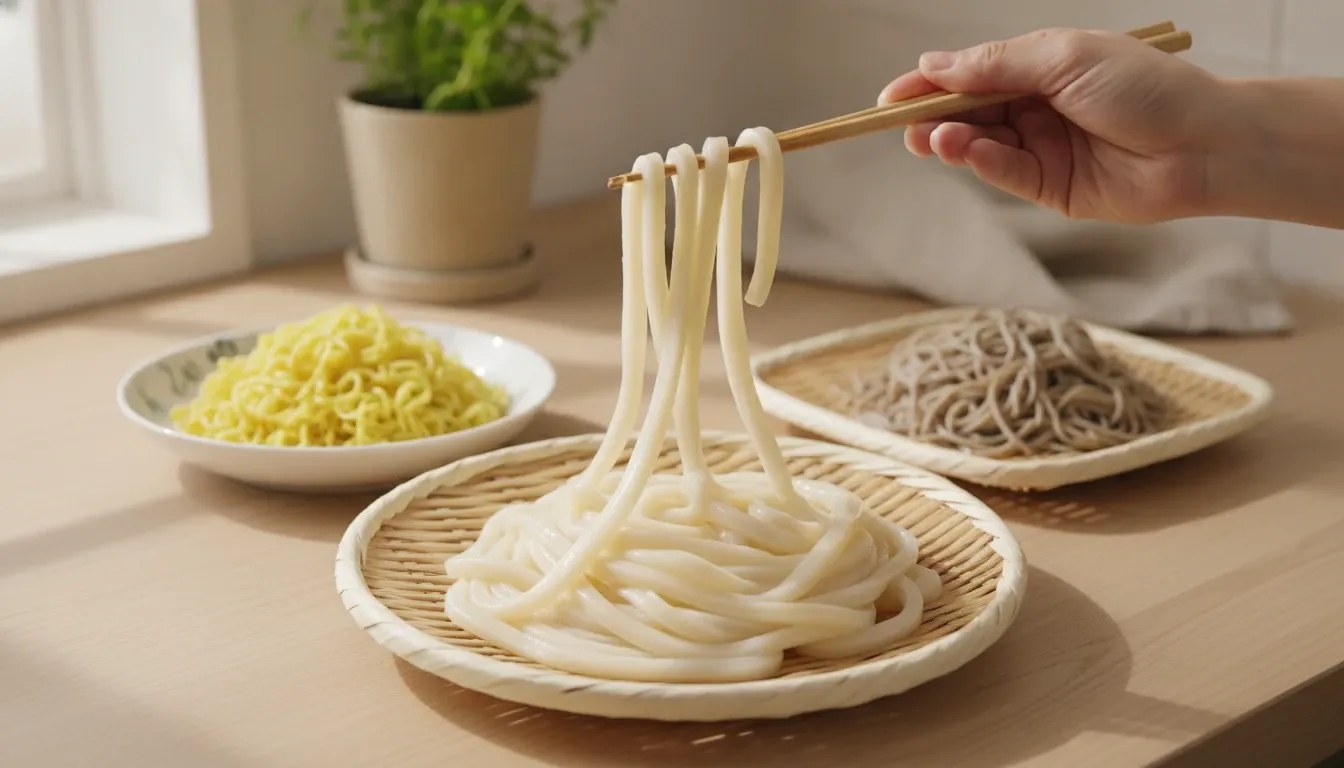
Noodle doughs, kneaded from flour and cut or pressed thin, split first into two groups: wheat, or another flour. Then they split again by what creates the chew, the springy push-back when you bite. That gives six noodles.
This article compares where the chew of six boiled noodles comes from, in those two steps. For soba and naengmyeon, the noodle’s name in the table leads to a full article with formulas and steps.
Wheat and non-wheat noodles get chew differently
Flours other than wheat can’t form gluten on their own, so something else has to bind the noodle.
Six noodles by flour and source of chew
| Noodle | Flour | What creates the chew | Texture | Key points when making it |
|---|---|---|---|---|
| Udon (thick Japanese wheat noodles) | Medium-protein flour | Gluten tightened with salt | Chewy and supple | Hydration, salt-water strength, treading the dough underfoot and resting it |
| Chinese wheat noodles | Medium-high to high-protein flour | Gluten tightened with kansui, an alkaline salt solution | Snap cleanly, yellow and fragrant | How much kansui, and whether baking soda can stand in |
| Fresh pasta | 00 flour (soft wheat), durum semolina, or bread flour | Wheat gluten, plus egg that sets as it cooks | Supple and slightly chewy | The flour-to-egg ratio, and whether it works without egg |
| Soba | Buckwheat flour (nihachi soba is 20% wheat flour) | Gluten from wheat flour, or starch gelatinized by kneading with boiling water | 100% buckwheat breaks cleanly in the mouth, with a deep aroma | Nihachi vs 100% buckwheat, and working the water in evenly |
| Rice noodles | Rice flour (non-glutinous rice) | Starch that firms as it cools | Chewy, bends without breaking | How to soak rice vermicelli and pho noodles, and how to boil them without breaking |
| Naengmyeon | Buckwheat flour plus potato or sweet potato starch | Starch firmed in ice water | The more starch, the harder to bite through | Pyongyang vs Hamhung style, and why they go into ice water |
In US terms, medium-protein flour is close to all-purpose flour, which sits mid-range in protein. High-protein flour is bread flour, the highest.
Sources
- Yamada, Masaharu. (2019). Men no Kagaku [The Science of Noodles: Texture, Aroma, and Umami Created by Flour] (Kodansha Blue Backs) (in Japanese). On noodle chew, gluten, and what kansui does
- McGee, Harold. (2004). On Food and Cooking. On gluten and starch in pasta and noodles
- America's Test Kitchen. What is the difference between bread flour, all-purpose flour, pastry flour, and cake flour? (all-purpose sits in the middle of the protein range; bread flour is the highest)