What this article answers
- Why French cooking depends on prep
- Fond takes hours, and without it no sauce or braise can start
- What to make ahead and what to make on the day
- Fond, brown roux, and glace ahead. White roux and finishing wine on the day
- How much to prep at home
- 1 kg of chicken carcasses and wings in 1.2 L of water for 3 hours gives 1 L of fond. Reduced, it makes 100 ml of glace
- How long fond keeps
- 1–2 days in the refrigerator, 2–3 months in the freezer (USDA guidance)
A chicken fricassée recipe calls for 500 ml of chicken fond, the French name for stock. You look up how to make fond, and it says to simmer chicken carcasses for 3 hours. Dinner won’t wait that long.
French cooks make the bases that take hours ahead of time. On the day, they build the dish from steps that take only minutes. What gets made ahead is what takes time and what keeps. What takes minutes, and anything kept for its aroma, gets made on the spot.
This article covers why French cooking preps its bases ahead, what is made ahead and what is made fresh, and how much to prep at home.
The temperatures and times for making fond itself are in How to Make Fond de Veau.
Make the slow bases ahead, assemble in minutes
Here are the French bases, sorted into what is made ahead and what is made on the spot.
| Base | What it is | When to make it | Why then |
|---|---|---|---|
| White fond | Bones, meat, and aromatic vegetables simmered in water. The liquid for sauces and braises | Ahead | Takes 3 hours |
| Brown fond | Fond made from roasted bones | Ahead | The bones alone take 12 hours or more |
| Glace | Fond reduced to a tenth or less, a concentrated meat glaze | Ahead | It is reduced further after the fond is made |
| Brown roux | Butter and flour cooked until brown | Ahead | It cooks for a long time |
| Duxelles | Finely chopped mushrooms cooked until dry | Ahead | Once the water is gone, it keeps |
| White roux | Butter and flour cooked without color | On the day | Takes a few minutes |
| Large-cut mirepoix | Carrot, onion, celery, and the like, cut and sautéed | On the day | Only needs cutting and sautéing |
| Finishing wine | Wine added at the end of a sauce | On the day | Its aroma boils off |
Source: Le Guide Culinaire, 2nd edition.
The line falls on two things: how long it takes, and whether it keeps. Make an hours-long base on the day, and dinner is late. Make a minutes-long one ahead, and you save almost no time on the day.
Escoffier made fond the base of the work
The line comes from Le Guide Culinaire, the cookbook by the chef Auguste Escoffier (1846–1935). First published in 1903, it opens the sauce chapter with fond.
Without fond, nothing can start
Escoffier called fond the foundation of the work, the first thing needed. Without it, he wrote, nothing worthwhile can be done. He also called it the starting point a cook returns to again and again.
The same section lists what counts as a base. Besides fond, there are fish fumet, glace, roux, the grand sauces (espagnole, velouté, béchamel, tomato), mirepoix, marinades, and farces (stuffings).
With the prep done, the kitchen keeps moving
Escoffier went on: if cooks give fond their full attention, the whole kitchen runs in good order. Every dish ordered can then be made the way it should be.
At the back of the same book is a plan for a 60-person kitchen. It sends out orders for 400–500 diners in an hour to an hour and a half.
Faster service, same fond
In the preface to the 2nd edition, Escoffier wrote that diners demanded speed, and a kitchen that failed them would lose them. Methods and service could change. What must not change, he said, was the quality of the food and the flavor of the fond at its base.
Speed comes from shortening the steps on the day. The flavor of the base is made by the day before.
Make ahead what is slow or keeps
Read the source closely, and even within one kind of base, some versions are made ahead and others on the spot.
Brown roux ahead, white and blond on the day
Roux uses the same ratio whatever its color: 500 g of butter to 600 g of flour. What differs is the cooking time. Escoffier wrote that brown roux cooks long, so it is made ahead. Blond and white roux are usually made when needed.
The source gives white roux a few minutes, until the raw flour smell is gone. In a home pan, white roux takes 7–10 minutes with the bottom of the pan at 130°C (266°F). Brown roux takes about 15 minutes at 170–180°C (338–356°F).
Fine mirepoix and duxelles are dried, then stored
Mirepoix is carrot, onion, and celery with lean pork belly, cut and sautéed and added to deepen a dish’s flavor. The source ratio is 125 g of carrot, 125 g of onion, 50 g of celery, and 100 g of raw ham. How fine to cut it depends on the use.
The large-cut mirepoix that flavors a dish is usually cut on the spot. What gets made ahead is the fine mirepoix for crayfish and lobster. It is stewed in butter until tender, packed into a container, and covered with buttered paper.
Duxelles is finely chopped mushrooms with chopped onion and shallot, cooked in butter. The source chops 250 g of mushroom peelings and stems, squeezes them, and cooks them in 30 g of butter and 30 g of oil until dry. Like mirepoix, it is stored under paper.
The source warns that water left in chopped vegetables causes mold and fermentation when they sit for long. Anything made ahead and stored is cooked dry before it goes into the container.
Add finishing wine off the heat
Demi-glace (finished espagnole) gets Madeira at the end, 50 ml per 1 L of sauce. Escoffier noted that boiling drives off wine’s aroma. He advised adding a sauce’s finishing wine off the heat.
Fond simmers for 3 to 12 hours or more to pull out flavor, but wine’s aroma fades as it simmers. So finishing wine stays out of the prep and waits for the day.
Wine for deglazing the pan has a different job. It is boiled and reduced to drive off its sharp acidity and the smell of alcohol. Only wine added for aroma at the end goes in off the heat.
At home, start with chicken fond
The first thing to prep at home is chicken fond. Chicken carcasses are cheap, and they give up their flavor faster than veal bones.
Scale the source’s white fond to a tenth
The source’s white fond is a 10 L recipe, and chicken fond uses the same recipe with chicken added. Cut it to a tenth, and you get 1 L, which fits a home pot.
| Ingredient | Source (10 L) | Home (1 L) |
|---|---|---|
| Bones and meat | 10 kg of veal shank and trimmings, carcasses of 4 chickens | 1 kg of chicken carcasses and wings |
| Water | 12 L | 1.2 L |
| Aromatic vegetables | 800 g carrot, 400 g onion, 300 g leek, 100 g celery | 80 g carrot, 40 g onion, 30 g leek, 10 g celery |
| Bouquet garni | 100 g parsley stems, thyme, 1 bay leaf | 10 g parsley stems, 1 sprig thyme, 1 bay leaf |
| Simmering time | 3 hours | 3 hours |
Source: the white fond and chicken fond in Le Guide Culinaire, 2nd edition. The home column is this site’s conversion. The source adds 60 g of salt to the 12 L of water; leave it out if you plan to reduce the fond.
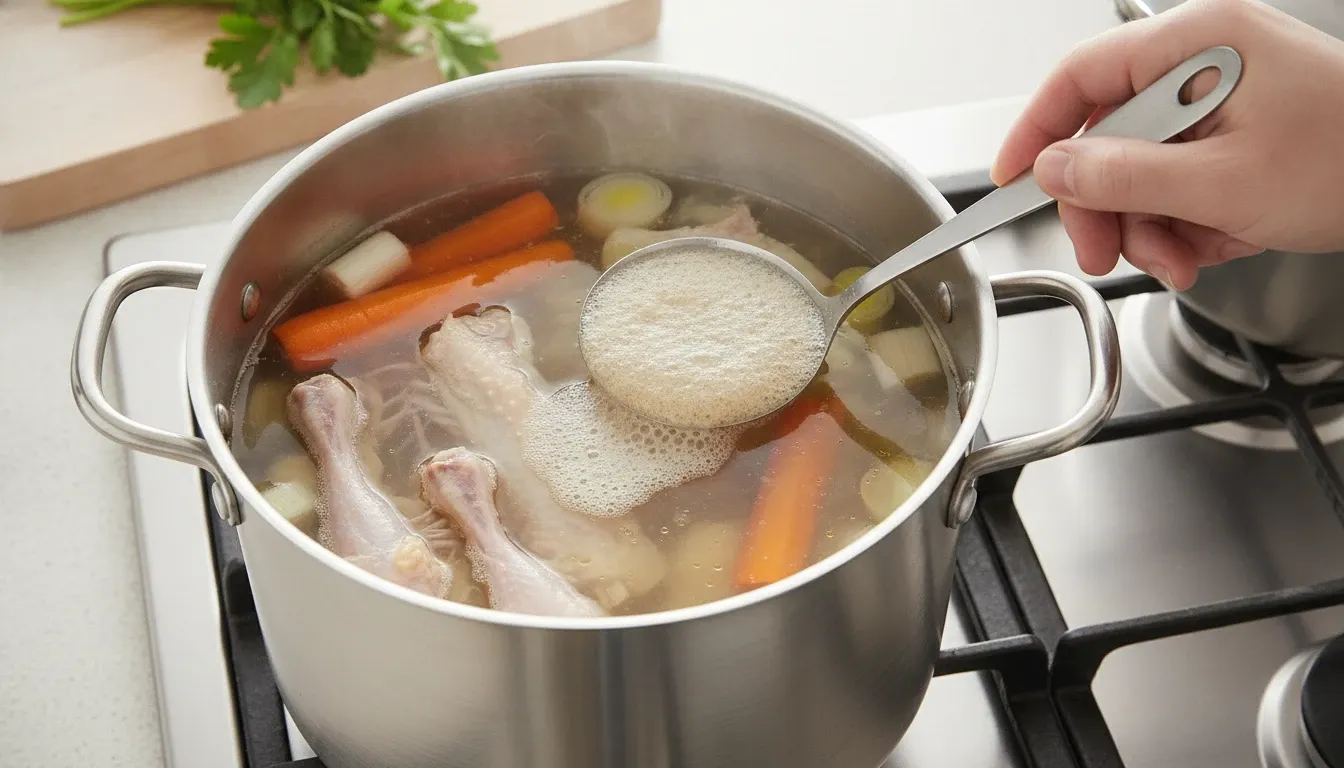
Don’t let it boil. Keep it at 85–95°C (185–203°F), with the surface just trembling (How to Make Fond de Veau). Skim off the scum with a ladle while it is still floating.
Reduced to glace, it fits an ice cube tray
To make glace, reduce the fond over high heat, and lower the heat as it thickens. Dip a spoon in and lift it out. It is done when a glossy film coats the spoon without breaking. 1 L of fond becomes 100 ml or less.
Freeze 100 ml of glace in an ice cube tray, 1 tbsp (15 ml) per cube, and you get 6–7 cubes. Each cube is about 150 ml worth of fond. Glace is rich in gelatin, so it sets rubbery when cold and pops out easily.
Refrigerate 1–2 days, freeze 2–3 months
| How it is stored | Guideline |
|---|---|
| Fond or glace, refrigerated | 1–2 days |
| Fond or glace, frozen | 2–3 months |
| Brown roux or duxelles, frozen | 2–3 months at most |
Source: the gravy and meat broth entry in the USDA “Cold Food Storage Chart”. We found no published figure for brown roux or duxelles, so this site uses the same value as fond.
Frozen food stays safe for as long as it stays frozen. The freezer times are how long the flavor holds.
Once the fond is made, divide it into small containers so it cools fast. Freeze it in portions sized to what you will take out at once.
How fast the sauce comes together with prep
What remains on the day are steps that take minutes.
| What you make on the day | Without prep | With prep |
|---|---|---|
| Pan sauce for seared meat | Deglaze the pan with white wine and reduce for 4–5 minutes | Dissolve 1 glace cube in 135 ml of water, deglaze, and reduce for 4–5 minutes |
| Sauce for chicken fricassée | Make fond for 3 hours, then white roux for 7–10 minutes | Thawed fond (500 ml) with a white roux (31 g flour, 26 g butter), 7–10 minutes |
| Thickened jus (jus lié) | Make fond for 3 hours, then reduce it | Reduce 1 L of fond to 250 ml and bind with 7.5 g of potato starch or cornstarch mixed with water |
| Stuffing for vegetables | Chop mushrooms and cook until dry | Add 50 ml of white wine to 100 g (4 tbsp) of duxelles and reduce almost dry |
Sources: the flour follows the source’s velouté ratio (625 g of roux for 5.5 L of fond). The jus lié follows the source (4 L of fond reduced to 1 L, bound with 30 g of arrowroot). The stuffing scales down the source’s duxelles.
One glace cube (15 ml) plus 135 ml of water gives back 150 ml worth of fond.
31 g of flour is about 6% of 500 ml of fond, inside the range for a pouring sauce (5–8%).
Having fond or not changes the time on the day by 3 hours.
How much butter to finish with, and when to stop, is in Butter and Cream in French Cooking.
What Japanese and Chinese cooks keep instead
Every cuisine builds on an umami-rich liquid. What differs is what gets made ahead and kept on hand.
| Cuisine | What it keeps ready | How it is made |
|---|---|---|
| French | Fond, glace, roux, duxelles, mirepoix | White fond 3 hours, brown fond 12 hours or more. Each is named and made separately |
| Japanese | Little is kept. Dashi, the basic Japanese stock, is made on the day it is used | Kombu (dried kelp) at 60°C (140°F) for 1 hour; the first, most delicate dashi strained 1–2 minutes after the boil |
| Chinese | One pot of stock | Mao tang (the basic stock) simmered gently for about 3 hours |
Sources: this site’s articles on dashi and on Chinese stock types, and Le Guide Culinaire, 2nd edition.
Kombu and katsuobushi (dried bonito flakes) give up their flavor quickly, so Japanese cooks make dashi on the day. Bones keep giving for hours, so Chinese and French cooks simmer them ahead and keep the stock. Chinese cooks then clarify mao tang into a clear stock and add dried ingredients for a richer, superior stock.
French cooking goes further and keeps the parts separate. Roux for thickening, glace for concentrated umami, and duxelles for aroma are made apart, then combined on the day.
Conditions that make it work
| When | What to do | Why |
|---|---|---|
| You have time only once, on the weekend | Make 1 L of chicken fond and reduce half to glace | Fond goes into braises, glace into sauces |
| Your freezer is small | Reduce all the fond to glace | It shrinks to a tenth of the volume or less |
| You only have store-bought stock | If it is salted, don’t reduce it. Use it as is for sauces and braises | Reducing concentrates the salt too |
| You want to make roux ahead | Make only brown roux ahead | White roux takes 7–10 minutes; making it ahead saves almost no time |
Common failures and fixes
Spoiled duxelles cannot be saved. Oversalted glace can be partly fixed. Wine aroma that has boiled off can be fully restored.
| Problem | Cause | Fix it now | Prevent it next time |
|---|---|---|---|
| The glace is too salty | Fond made with salt was reduced to glace. Only water evaporates and the salt stays, so reducing to a tenth makes it 10 times as salty | Dilute it with unsalted fond or water, and taste the sauce before adding any salt | Leave salt out of fond you plan to reduce. Salt the sauce when you finish it |
| The duxelles spoiled | It went into the container before the mushrooms’ water was gone. Microbes grew in the leftover water, and the smell changed | Throw out anything that smells off. Cooking it again won’t bring it back | Cook until no water appears when you scrape the pan floor with a wooden spoon and the mushrooms glisten with fat. Cool, then pack |
| The wine aroma is gone | The wine went in during prep and simmered with the fond for hours. Its aroma compounds boil off, so none are left by serving time | Take the finished sauce off the heat and add wine at 50 ml per 1 L to bring the aroma back | Add wine for aroma on the day, off the heat. 50 ml per 1 L of sauce is the source amount |
Four things to remember when prepping
French prep means making the hours-long bases by the day before, so the day itself takes only minutes.
- Fond is the base without which no sauce or braise can start. White fond takes 3 hours, brown fond 12 hours or more.
- Make ahead what is slow or keeps once dry: fond, glace, brown roux, and duxelles.
- Make white roux, large-cut mirepoix, and finishing wine on the day.
- At home, make 1 L of chicken fond from 1 kg of chicken carcasses and wings. Keep it 1–2 days in the refrigerator and 2–3 months in the freezer.
With 1 L of fond in the freezer, the sauce for a chicken fricassée starts with the 7–10 minutes it takes to cook a white roux.
Sources
- Escoffier, A. Le Guide Culinaire, aide-mémoire de cuisine pratique (first edition 1903; quoted from the 2nd edition, Émile Colin) (in French). Preface to the 2nd edition; the sauce chapter, "Les fonds de cuisine"; fonds, glaces, roux, velouté, jus de veau lié, and demi-glace; duxelles and mirepoix in the garnish chapter
- Larousse. "mirepoix" (in French). Dictionary definition
- Larousse. "duxelles" (in French). Dictionary definition